In This Article
Standard crutches are brilliant right up until you try to squeeze into a taxi, board a regional train or wedge them into a hatchback boot. Then they turn into two long poles with a grudge. Folding crutches for travel fix that. They shrink to a fraction of their working length, slide into a bag and stop being everyone’s problem. Choosing the right folding crutches for travel takes more thought than the word “folding” suggests, though.
Not every design is equal. Some fold in half and stay bulky. Some detach into tidy sections but take effort to rebuild. Some are carbon-fibre featherweights, while others are heavier, suspension-equipped workhorses. Pick wrong and you’ve swapped one awkwardness for another.
This guide compares seven real options available to UK buyers. The analysis rests on published specifications and the review themes that keep surfacing, not on hands-on testing, which I won’t pretend to have done. You’ll also get a plain-English look at airline mobility aid policy and packing advice covering a crutch carry case and boot storage for road trips.
The detail matters. A government-backed report on aviation accessibility gave mobility aids a theme of their own, including broken or lost equipment. How you pack, label and carry your crutches matters almost as much as which pair you buy.
One housekeeping note: prices below are ranges, they move constantly, so check the current price on the listing before you commit.
Quick Comparison: Folding Crutches for Travel at a Glance
Here’s the whole field on one screen. Where a figure couldn’t be verified from published listings, the table says so rather than guessing.
| Product | Material | Fold style | Weight (per crutch) | Max user weight | Best For |
|---|---|---|---|---|---|
| Ossenberg Carbon Fibre Folding Crutches | Carbon fibre | Three sections, about 46 cm folded | About 650 g | 140 kg | Frequent flyers who want a small packed size |
| Flexyfoot Carbon Fibre Folding Crutches | Carbon fibre | Folding (check listing for folded length) | About 620 g | 130 kg | Wet pavements and long recoveries |
| Ergobaum 7G | Anodised aluminium | Folds in half, about 67 cm | About 1.3 kg | About 159 kg | Long-distance daily walkers |
| Rebotec Travel Detachable Crutches | Aluminium | Detachable, longest piece 44 cm | Check listing | 130 kg | Tight luggage and carry-ons |
| Foldacrutch Folding Crutches | Lightweight alloy | Compact fold with carry bag | 500 g (confirm per crutch) | 120 kg | Short-term injuries and comfort |
| The Helping Hand Pair of Adjustable Folding Crutches | Aluminium | Folding (variant-dependent) | Check listing | Check listing | Budget everyday use |
| AevQuas 2PCS Folding Crutches | Aluminium | Folding | Check listing | Check listing | Budget buyers needing a wide height range |
The numbers tell a clear story. Ossenberg Carbon Fibre Folding Crutches pair the smallest verified folded length with a carry bag in the box, while Rebotec Travel Detachable Crutches counter with a 44 cm longest piece for the tightest luggage. If grip and shock absorption matter more than packability, Flexyfoot and Ergobaum 7G justify their premium positioning, although the latter’s weight is the price of its suspension. Budget buyers should note that The Helping Hand Pair of Adjustable Folding Crutches and AevQuas 2PCS Folding Crutches publish fewer verifiable specs, so check the weight limit before buying.
💬 Just one click — help others make better buying decisions too!😊
Top 7 Folding Crutches for Travel: Expert Analysis
Availability on amazon.co.uk changes by seller, size and colour. Confirm the exact variant on the listing before you buy.
1. Ossenberg Carbon Fibre Folding Crutches — folds into three sections at 46 cm
That three-section fold is the headline. Collapsed, the pair measures roughly 46 cm (18 inches) and drops into the carry bag supplied as standard. That detail decides whether your crutches ride in a suitcase or sulk in the hallway.
Each crutch weighs about 650 g, the handle height adjusts from 74 cm to 97 cm, and the stated user limit is 140 kg (22 st), which is generous for carbon fibre. Why care? Because 650 g multiplied by every swing down a long terminal adds up, and lighter crutches mean less shoulder fatigue by the time you reach the gate. Handle reflectors and 19 mm rubber ferrules are small safety extras for dusk arrivals.
Based on the spec comparison, this is the best-balanced choice for frequent travellers who want a rigid carbon pair that vanishes into a bag. The trade-off is that three sections mean more joints, and joints are where wobble and wear begin. Check each lock every time you reassemble.
I couldn’t verify a meaningful pool of independent Amazon reviews for this exact model, so I won’t characterise customer opinion. Read recent verified-buyer comments on the listing, especially about the folding joints.
Pros:
- ✅ Compact 46 cm folded length
- ✅ Carry bag included as standard
- ✅ High 140 kg user limit
Cons:
- ❌ Premium price for a pair
- ❌ More sections to rebuild than a single-hinge design
Expect the mid-£100s for a pair at specialist UK retailers at the time of research, with stock varying. That’s premium but fair for carbon plus a bag.

2. Flexyfoot Carbon Fibre Folding Crutches — shock-absorbing ferrule for slippery pavements
Grip is the story here. Flexyfoot fits each crutch with its own flexible, bellows-style ferrule. The maker says it delivers up to 50% more grip than a traditional ferrule while absorbing shock, which counts on wet British pavements in October.
Carbon fibre keeps each crutch to roughly 620 g. Retailers list 600-650 g depending on the grip variant, with a maximum user weight of 130 kg (20.5 st). You can choose comfort-grip handles, which spread weight across the palm, or soft-grip versions, and both come in red or black. Treat the 50% figure as a manufacturer claim rather than a lab result, although the design logic of a tip that stays flat to the ground is sound.
For anyone facing weeks rather than days on crutches, this is where I’d look first. Less slipping and less jolt through the wrist beats saving a few extra grams. One caution: Flexyfoot folding crutches are often sold singly, so check your basket holds two.
Testimonials on a UK supplier’s blog praise confidence on slippery surfaces. They’re supplier-featured rather than independent, so take them as indicative only.
Pros:
- ✅ Flexible ferrule absorbs shock and grips well
- ✅ Light carbon build around 620 g
- ✅ Comfort-grip option eases hand pressure
Cons:
- ❌ Frequently sold as singles, not pairs
- ❌ Folded dimensions less widely published
Around £80-£90 per crutch at specialist retailers when checked, so roughly £160-£180 a pair. That’s premium, and good value if grip is your priority.
3. Ergobaum 7G — built-in suspension, torch and horn
Think of the Ergobaum 7G as the suspension-equipped SUV of this list. It isn’t the lightest, but it’s arguably the most comfortable over distance. A shock absorber in the base takes the sting out of each step, and the crutch folds in half for transport.
The maker lists anodised aluminium poles, three points of height and position adjustment, a cushioned forearm strap, a foldable knee rest, and a built-in LED light, horn and reflectors. It’s rated to roughly 159 kg (350 lb), weighs about 1.3 kg (2.9 lb) per crutch, and folds to around 67 cm (26.5 inches) high. In practice that’s a crutch for flights and car boots, not coat pockets, and the weight is the price of the suspension.
On paper, long-distance walkers and permanent users get the most from it, because cumulative wrist impact is what suspension reduces. Reviewers on a non-UK listing of this model praise the suspension and grip comfort. They also note it is heavier than ordinary forearm crutches and folds less compactly than some lighter rivals. Because those reviews are from an overseas listing, check the UK page too.
Pros:
- ✅ Built-in shock absorption in the base
- ✅ Light, horn and reflectors for visibility
- ✅ High weight capacity of about 159 kg
Cons:
- ❌ Heavy at about 1.3 kg each
- ❌ Folds to 67 cm, bulkier than detachable rivals
It sits at the premium end on positioning, so check the current price. It’s worth it for heavy daily use and overkill for a one-off weekend away.
4. Rebotec Travel Detachable Crutches — longest piece just 44 cm
Where others fold, Rebotec dismantles. The modular German-designed aluminium crutches break down so the longest piece measures just 44 cm, small enough for a carry-on holdall rather than a long tube.
Fit is unusually granular: 8 tube height adjustments, 3 handle-to-cuff settings, a handle height of 80-100 cm, and a handle-to-cuff distance of 22-25 cm. The capacity is 130 kg, and you also get a handle reflector, a non-slip rubber foot grommet and a drawstring bag. Open-cuff and semi-closed-cuff versions exist, and one retailer lists the open-cuff model with a Flexyfoot ferrule. Confirm which version you’re buying.
The honest analysis is that detachable systems trade packed size for reassembly effort. If grip strength is limited or you’re recovering from arm or hand trouble, think about whether you’ll cope with parts and pins at an airport bench. If space is your constraint, nothing here packs smaller.
I couldn’t verify a robust UK review pool for this model, so check recent buyer comments on how easily the sections lock together.
Pros:
- ✅ Smallest packed piece length on this list
- ✅ Highly adjustable height and cuff distance
- ✅ Drawstring bag and handle reflector included
Cons:
- ❌ Reassembly takes more steps than a hinge
- ❌ Per-crutch weight not verified on listings checked
Mid-range tier, so check the current price. Good value if packing space beats speed.
5. Foldacrutch Folding Crutches — soft Velcro cuff at about 500 g
Comfort leads with Foldacrutch. A Velcro cuff strap, softer than the usual plastic, holds your forearm in place so you can free a hand for a door handle or passport without dropping a crutch.
Sold as a pair in black, blue or red, they fold compactly into a protective carry bag. The listed weight is 500 g (the retailer doesn’t specify per crutch or per pair, so confirm), with a 120 kg (19 st) user limit and extra-durable rubber ferrules for traction. That 120 kg cap is the lowest among the picks with a published limit, so heavier users should look elsewhere.
My take is that this suits short-term injuries and holiday trips, where you want light, simple and friendly to the forearm rather than loaded with extras. A soft cuff is a genuine quality-of-life feature during repeated sit-stand cycles in cafés and waiting rooms.
I found no verifiable review sample for this model, so I won’t summarise opinion. Read the latest buyer feedback for fold-lock security.
Pros:
- ✅ Light listed weight of about 500 g
- ✅ Carry bag included
- ✅ Soft Velcro cuff strap
Cons:
- ❌ 120 kg limit is the lowest here
- ❌ Limited published folded dimensions
Mid-range tier, so check the current price. Strong value for short-term travel.

6. The Helping Hand Pair of Adjustable Folding Crutches — budget everyday option
This is the budget-minded pick. It’s supplied as a matching pair of forearm crutches pitched for home, appointments and travel.
Here’s the gotcha. The same Amazon listing family includes a grey non-folding variant alongside the black folding one. A careless click gets you crutches that don’t fold at all, so confirm the folding variant before you pay. I also couldn’t verify weight, user limit or folded length from the listings I checked, so read the specification panel carefully before buying.
Budget logic says to spend the saving where it counts. A modest pair plus a decent crutch carry case often travels better than one expensive pair with nothing to protect it. For occasional use, such as a few trips during a short recovery, that’s a sensible trade. For heavy daily use, the premium models above are worth the extra.
No reliable review pool was verifiable for the folding variant specifically, so check recent comments on fold security and handle comfort.
Pros:
- ✅ Budget-friendly entry point
- ✅ Supplied as a matched pair
- ✅ Marketed for appointments and travel
Cons:
- ❌ Non-folding colourway shares the listing
- ❌ Sparse published specifications
Budget tier, and the figure shifts, so check current price. Good value if you verify the folding variant and the weight limit.
7. AevQuas 2PCS Folding Crutches — widest listed height range at 93-119 cm
AevQuas sells a pair of lightweight aluminium folding crutches with ergonomic grips and reflective strips. The standout is the listed 93-119 cm adjustment range, which suggests it could suit taller adults better than some competitors.
Be careful comparing that figure with others. Brands measure differently (overall length versus handle height), so Ossenberg‘s 74-97 cm handle height isn’t directly comparable. The reliable method is to measure from your wrist crease to the floor with your arm relaxed and shoes on, then check the listing for the setting you need.
Analytically, this is another budget-tier option where the practical advice is to buy a pair, check the weight limit before you commit, and add a crutch carry case. It suits taller buyers on a tight budget, provided the listing confirms your fit.
I couldn’t verify a meaningful review sample for this model. Scan the latest buyer comments for notes on fold lock firmness and handle comfort.
Pros:
- ✅ Wide listed height adjustment range
- ✅ Reflective strips aid visibility
- ✅ Sold as a pair
Cons:
- ❌ Fewer verifiable specifications
- ❌ Lesser-known brand, so less track record
Budget tier, so check current price. Value is good if the fit and weight limit check out.
Boot Storage, Crutch Carry Case and Carry Bag: A Practical Packing Guide
Buying the right pair is half the job. Getting them from A to B in one piece is the other half, and this is where Amazon listings tell you nothing.
Foldable Crutches With Carry Bag: What the Bag Really Does
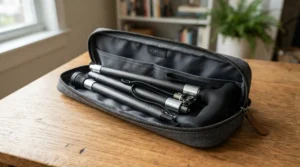
Foldable crutches with carry bag in the box, as with Ossenberg, Rebotec and Foldacrutch, give you a protective sleeve and a handle to grab. Treat the supplied bag as a snag-and-scuff cover, not armour. A drawstring bag keeps the parts together but won’t stop a hold-luggage squeeze.
Do You Need a Separate Crutch Carry Case?
If you’re checking crutches into the hold, a rigid or semi-rigid crutch carry case earns its keep. Match it to your folded length: about 46 cm for Ossenberg, a 44 cm longest piece for Rebotec, or around 67 cm folded height for Ergobaum 7G. Measure before ordering. Label the case with your name, phone number and flight number, then photograph the crutches before you hand them over.
Boot Storage: Car Boot Packing That Actually Works
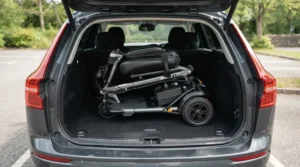
Boot storage is where folding earns its everyday value. Fold, bag, then lay the crutches flat against a side wall rather than letting them roll about under the parcel shelf. Wedge them so a hard brake doesn’t turn them into projectiles. Keep them reachable without unloading the luggage. Let wet ferrules dry before they go in the bag, because damp rubber and fabric make a smelly combination.
Before any trip, do a dry run at home. Fold, bag, unbag, unfold and lock three times so the sequence is muscle memory by the time you’re at a busy departures kerb.
✨ Don’t Miss These Top Picks!
🔍 Take your next trip to the next level with these carefully selected folding crutches. Click on any highlighted item to check current pricing and availability. These picks will help you travel with confidence and comfort!
Real-World Scenarios: Which Folding Crutches for Travel Fit Your Trip?
These are illustrative profiles to show the reasoning, not real customer stories.
The weekend city breaker. Six weeks into an ankle recovery, one carry-on, a budget of £150-£200, and a three-night flight to Lisbon. Packing space is the constraint, so Ossenberg Carbon Fibre Folding Crutches or Rebotec Travel Detachable Crutches fit best. The carry bag is already included and the folded length slots beside a washbag.
The long-recovery holidaymaker. Three weeks abroad, plenty of pavements, mixed surfaces, and walking for hours daily. Here Flexyfoot Carbon Fibre Folding Crutches or Ergobaum 7G make sense. The grip or suspension investment pays off across daily mileage, and a crutch carry case protects the premium kit in the hold.
The budget rail commuter. A student recovering from a knee injury, using regional trains daily, with limited cash. The Helping Hand Pair of Adjustable Folding Crutches or AevQuas 2PCS Folding Crutches plus a basic bag works. Spend the saving on a decent carry case and verify the weight limit first.
Notice the pattern. Budget and trip length decide the tier, and packing space decides the fold style.
Problem → Solution: Fixing the Most Common Folding Crutch Headaches
Problem: slippery pavements. Choose a flexible, shock-absorbing ferrule such as Flexyfoot‘s, or replace worn standard tips before the trip.
Problem: hands full at the worst moment. A forearm strap or closed-style cuff keeps the crutch with you. Foldacrutch includes a soft Velcro cuff, and Flexyfoot neoprene crutch cuffs are sold separately to convert open cuffs into closed ones.
Problem: a stiff or fiddly fold. Reviews of one popular US folding underarm crutch frequently mention that its bungee-cord mechanism needs real hand strength to separate and fold. If your grip is limited, favour simpler hinge or detachable designs, and test the fold before you travel.
Problem: airport nerves. Tell the airline in advance, carry your confirmation, and explain how you need the crutches handled at the boarding gate. Staff can only work with what they know.
Problem: sore palms after a day of walking. Handle shape matters more than most buyers expect. Comfort-grip handles that spread weight across the palm, or a suspension crutch like Ergobaum 7G, reduce the pressure that builds across a long day.
What Are Folding Crutches for Travel?
Folding crutches for travel are adjustable forearm or underarm crutches built to collapse, fold or detach into a compact bundle, usually supplied with a carry bag. They let you stow mobility support in a car boot, overhead locker or suitcase, instead of managing two long poles through stations and airports.
The Three Main Fold Styles
- Hinge fold: the crutch folds in half, like Ergobaum 7G. It’s quick, but the folded length is only about half the working length.
- Sectional fold: collapsible crutches that fold into three parts, like Ossenberg. They’re more compact, with more joints to check.
- Detachable: pieces come apart entirely, like Rebotec. They’re the smallest when packed and slowest to rebuild.
How to Choose Folding Crutches for Travel: 6 Steps
- Confirm your fit first. Measure wrist crease to floor and match it to the listed handle height. NHS hospital guidance notes that crutches at the wrong height can lead to back pain.
- Check the user weight limit. Limits range from 120 kg (Foldacrutch) to about 159 kg (Ergobaum 7G) among the published figures.
- Pick the fold style. Match it to how you travel: hinge for speed, sectional for balance, detachable for the smallest packed size.
- Weigh the material. Carbon (about 600-650 g) saves fatigue over long days, while aluminium saves money.
- Prioritise grip and ferrules. Wet floors cause most slips, so a quality ferrule beats any gadget.
- Check the variant, the bag and the paperwork. Make sure it’s the folding colourway, that a carry bag is included, and that the listing mentions UKCA or CE marking and a warranty.
Collapsible Crutches vs Standard Crutches: Is Folding Worth It?
Collapsible crutches cost more and add joints. Standard crutches are simpler and cheaper. Which is right depends on how often your crutches need to go somewhere other than the hallway.
| Feature | Collapsible crutches | Standard crutches |
|---|---|---|
| Packed size | 44-67 cm, depending on design | Full length, usually over 90 cm |
| Weight | Varies from about 500 g to 1.3 kg | Often lighter aluminium |
| Rigidity | More joints, so check locks | Single tube, simplest |
| Boot and cabin fit | Easy | Awkward |
| Cost | Usually higher | Usually lower |
| Best For | Frequent travellers and car or train users | Home-only use and tight budgets |
The table shows that you pay for portability in money, in extra joints, and sometimes in weight. If your crutches mostly live indoors, standard crutches win on cost and simplicity. If you’re boarding planes, hailing taxis or loading a boot weekly, collapsible crutches pay back every trip in saved hassle.
Travel Crutches for Flights and Airline Mobility Aid Policy: What UK Passengers Should Know
Travel crutches for flights are covered by passenger-assistance rules, but policies vary by airline. Use this as a general guide and confirm details with your carrier.
Your Rights and Assistance
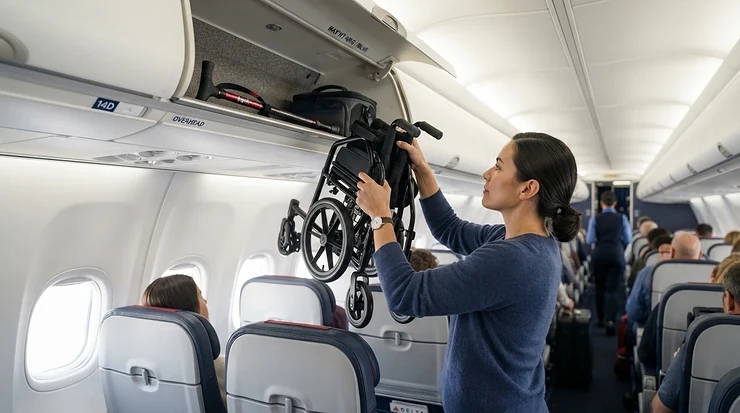
Disabled passengers and people with reduced mobility, including those with temporary injuries, are entitled to free assistance when flying from a UK airport on any airline, and when flying to a UK airport on a UK or EU airline. University of St Andrews’ air travel guidance explains that you can take up to two items of mobility equipment on board, provided they don’t breach the airline’s safety requirements.
What to Tell the Airline
Charities advise giving the airline at least 48 hours’ notice. Share the make, model, weight and folded size of your folding crutches for travel. Clearly label the equipment with your contact details and flight number, and check that your travel insurance covers it.
Security, Cabin and Hold
Crutches are generally allowed in the cabin but go through security screening. Final stowage decisions rest with the airline, so carry confirmation of what you’ve requested. If a dispute arises at the gate, show your paperwork and agree how the crutches will be handled. If you don’t receive the assistance you’re entitled to, complain to the airport or airline first, then escalate to the Civil Aviation Authority.
Airline mobility aid policy can differ on the return leg and between carriers. Check both directions before you fly.
Features That Actually Matter (And Those That Don’t)
Matters: the user weight limit, a secure fold lock, a quality ferrule, a height range that fits you, and a carry bag in the box. These affect safety, comfort and whether the crutches survive the trip.
Matters, but less than you think: weight. Saving 100 g is nice. A wobbly fold lock is not worth saving 100 g.
Nice extras: reflectors, a torch and horn (as on Ergobaum 7G), and colour choices (Foldacrutch offers three). They won’t fix a poor fit.
Mostly marketing: vague claims like “medical-grade” or “premium” without numbers. Look for stated capacity, measurements and warranty terms instead. And remember that a single-cuff or open-cuff choice affects security more than any badge.
Long-Term Cost & Maintenance: What Folding Crutches Really Cost
Cost per use makes the premium picks look less scary. A pair around £170 used daily for 12 weeks works out at roughly £2 a day, and carbon models often hold together well enough to be reused or passed on.
| Tier | Examples | What you gain | What you give up | Best For |
|---|---|---|---|---|
| Budget | The Helping Hand Pair of Adjustable Folding Crutches, AevQuas 2PCS Folding Crutches | Lowest outlay | Sparse specs, less track record | Occasional trips |
| Mid-range | Rebotec Travel Detachable Crutches, Foldacrutch Folding Crutches | Smaller packed size, bag included | Reassembly effort or a lower weight limit | Regular travellers |
| Premium | Flexyfoot, Ossenberg, Ergobaum 7G | Carbon weight, grip or suspension | Higher price | Long recoveries and frequent flyers |
The tiers show where the money goes: spec transparency and carbon weight at the top, and small packed sizes in the middle. A budget pair plus a good crutch carry case is a legitimate strategy for occasional travel. For daily use over months, spending more on grip or suspension tends to pay back in comfort.
Maintenance is cheap. NHS hospital guidance advises checking the rubber ferrules for wear and tear before each use. Add a monthly check of the fold locks and handle screws, and wipe and dry the crutches after wet trips.
Common Mistakes When Buying Folding Crutches for Travel
- Buying on folded size alone. A tiny pack is useless if the fold is fiddly or the locks feel loose.
- Ignoring the variant. The same listing may include non-folding colourways, as with The Helping Hand Pair of Adjustable Folding Crutches.
- Skipping the fit check. The wrong height causes back and shoulder strain.
- Forgetting the paperwork. Not telling the airline, or not insuring pricey kit, creates avoidable stress.
- Leaving worn ferrules. Tired rubber is an accident waiting to happen on wet floors.
- Buying one when you need two. Some brands, like Flexyfoot, sell singles.

FAQ
❓ Can you take folding crutches for travel in hand luggage on a plane?
❓ How far ahead should I tell the airline about my crutches?
❓ Are carbon fibre collapsible crutches worth the extra cost?
❓ Is there a weight limit on folding crutches for travel?
❓ Can I use folding crutches every day, or only for trips?
Conclusion
Choosing folding crutches for travel comes down to matching fold style, comfort and budget to how you actually move. For the smallest packed size with a carry bag included, Ossenberg Carbon Fibre Folding Crutches and Rebotec Travel Detachable Crutches lead. For grip and shock absorption over long walks, Flexyfoot Carbon Fibre Folding Crutches and Ergobaum 7G justify their premium positioning. Foldacrutch Folding Crutches is a comfortable mid-range choice for short-term injuries. The Helping Hand Pair of Adjustable Folding Crutches and AevQuas 2PCS Folding Crutches are the budget routes, provided you verify the folding variant and the weight limit.
Whichever you pick, three habits make every journey smoother. Check the fit, rehearse the fold at home, and tell your airline in advance. Add a sensible crutch carry case and a tidy plan for boot storage, and your crutches will stop being a travel headache.
✨ Ready to Travel Lighter!
🔍 Take your next journey to the next level with these carefully selected folding crutches. Click on any highlighted item to check current pricing and availability, and pack with confidence.
Recommended for You
- Crutches For Broken Ankle: 7 Best Picks For UK Recovery (2026)
- Underarm Crutches For Tall Adults: 7 Best Proven Picks (2026)
- Best Elbow Crutches: 7 Top-Rated UK Picks For Comfort (2026)
Disclaimer: This article contains affiliate links. As an Amazon Associate, I earn from qualifying purchases. If you purchase products through these links, we may earn a small commission at no additional cost to you.
✨ Found this helpful? Share it with your friends! 💬🤗
