In This Article
Underarm crutches for tall adults are axilla-style walking aids with a longer frame and a wider height-adjustment range. They typically fit people from about 5ft 10in to 6ft 6in (1.78–1.98 m). The padded top rests against the chest wall just below the armpit, while the handgrips carry your weight, so correct length matters far more for tall users than for anyone else.
Here’s the problem. Most crutches in a hospital cupboard are built for the middle of the bell curve. If you stand at 6ft 3in or more, you’ve probably met the “too short” pair, with hunched shoulders, locked elbows and an armpit doing a job it was never designed for. When the frame won’t reach, tall users end up leaning on the pad. That is how underarm crutches earned their reputation for sore ribs and tingling fingers.
This guide compares seven real models using their published specifications. It then goes beyond the product list. You’ll find out how to read a crutch height adjustment range, when extra tall underarm crutches become necessary, what padded underarm crutches really add, how axilla pads and covers work, and what to watch for with nerve pressure from crutches. If you want the background on crutch types first, this Wikipedia overview of crutches is a good primer.
A note on method: prices below are ranges only, and review sentiment is reported only where it could be verified. No pair here has been personally tested, and the analysis comes from specs and published information. Availability on amazon.co.uk changes, so check each listing’s size and weight limit before ordering.
Quick Comparison: Underarm Crutches for Tall Adults at a Glance
| Product | Intended user height | Max user weight | Best For |
|---|---|---|---|
| Red Dot Aluminium Axilla Crutches (Large) | 1.78–1.98 m | 127 kg (20 st) | Fine-tuning the fit after surgery |
| Days Aluminium Underarm Crutches (Large) | 1.78–1.98 m | 136 kg | Straightforward budget buying |
| Thuasne Axilla Crutches (Size L) | 1.79–1.99 m | 130 kg | Lighter, quieter daily use |
| Drive Medical Tall Adult Walking Crutches (RTL10402) | 5ft 10in–6ft 6in | about 159 kg | Sturdy all-rounder for heavier frames |
| Drive Medical Universal Aluminium Crutch (RTL10433) | 4ft 6in–6ft 6in | 136 kg | Shared households and easy storage |
| Drive Medical Bariatric Underarm Crutches (10408) | 5ft 10in–6ft 6in | about 227 kg | Tall users needing maximum load capacity |
| EZee Life Extra Tall Underarm Crutches | 5ft 11in–6ft 7in | Not verified | The very tallest users |
Looking at the table, Days and Red Dot cover the same height band, but Days offers a higher weight limit. Red Dot‘s edge is its adjustability. Thuasne is the one to consider if carrying weight matters, and its published figure is the lightest here. For anyone above 6ft 6in, EZee Life is the only model in this lineup specifically aimed at extra tall users. For heavier users, the Drive models stand out. Their capacity is much higher than the rest, though the Drive 10408 gives up some lightness because of its steel frame.
💬 Just one click — help others make better buying decisions too!😊
Top 7 Underarm Crutches for Tall Adults: Expert Analysis
1. Red Dot Aluminium Axilla Crutches — best for precise, double-adjustable fit
The clip-lock handle is what sets Red Dot Aluminium Axilla Crutches apart, because you can move the grip without hunting for pins. According to the Sunrise Medical UK specification, the Large size suits users of 1.78–1.98 m (5ft 10in–6ft 6in). Crutch length runs from 1,320 to 1,520 mm, each crutch weighs 1.25 kg, and the maximum user weight is 127 kg (20 st). In practice, independent handle and shaft adjustment is valuable for tall users with long arms or a short torso. Armpit clearance and elbow bend can be set separately rather than compromised together.
Based on the spec comparison, this suits someone who wants to fine-tune the fit after a few days of use. That matters more than people expect, because posture changes during recovery. The pads are high-density rubber and replaceable, and the crutches are latex-free, which helps if your skin is sensitive. At 1.25 kg each they aren’t featherweight, so expect your shoulders to notice on longer outings.
Customer comments on UK retailer Essential Aids, for its Red Dot axilla range, are consistently positive. Several reviewers say they preferred these to hospital-issued elbow crutches. That is retailer-site feedback rather than an aggregate of amazon.co.uk reviews, which I couldn’t verify, so read the live listing.
Pros:
- ✅ Clip-lock handle adjusts quickly and precisely
- ✅ Replacement pads and grips are available
- ✅ Latex-free pads and ferrules
Cons:
- ❌ 127 kg limit is lower than rivals
- ❌ Heavier than some alternatives at 1.25 kg each
Indicative price: around £30–£55 (check current price). Verdict: good value if adjustability is your priority.

2. Days Aluminium Underarm Crutches — best no-frills budget pick
Days Aluminium Underarm Crutches are the sensible, unfussy choice. Days Healthcare lists them in three sizes, with the Large covering user heights of 1,780–1,980 mm. They are built from high-tensile extruded aluminium with rubber tips, and the maximum user weight is 136 kg (21 st 6 lb). That is 9 kg more headroom than Red Dot, which matters if you’re a tall adult with a solid build.
On paper, the appeal is simplicity: fewer mechanisms, fewer things to loosen or rattle. The trade-off is that the published spec says little about grip adjustability, so check how the handle position is set on the listing you’re viewing. Days’ own guidance on its forearm range notes that underarm crutches are generally easier to master but may cause soreness over time. That is worth remembering whichever underarm pair you choose.
This is a sensible fit for a short-term recovery, such as a six-to-eight-week fracture or post-op period, where you want reliable kit without paying for extras. If you expect to be on crutches for months, the comfort features of other models in this guide deserve more weight.
I couldn’t verify aggregated review data for this model, so I won’t characterise customer sentiment. Check the verified-purchase reviews on the listing for sizing comments, particularly from people over 6ft 3in.
Pros:
- ✅ 136 kg capacity beats several rivals
- ✅ Lightweight high-tensile aluminium construction
- ✅ Covers the full 1.78–1.98 m height band
Cons:
- ❌ Few advanced comfort features published
- ❌ Fit details vary between listings
Indicative price: around £25–£45 (prices vary by seller). Verdict: strong value for short-term use.
3. Thuasne Axilla Crutches — lightest here, with a quiet-walking ring
Thuasne Axilla Crutches make a point of low weight and low noise. In Size L the overall length adjusts from 134 to 154 cm, and each crutch weighs 820 g. Thuasne lists a 130 kg maximum user weight and a recommended user height of 1.79–1.99 m. A built-in anti-noise ring stops the metallic clack that gives crutch users away in quiet corridors.
The weight difference is real. At 820 g against Red Dot‘s 1.25 kg, you lift 430 g less per crutch with every step. Over a long hospital-corridor day, that adds up for tired shoulders. The handle position also adapts to arm length, a helpful detail if your proportions don’t match the average.
Thuasne is also notably clear on safe use. Its guidance says the top of the crutch should sit about 5 cm below the armpit and that weight should go through the hands, not the armpits. That advice appears in nearly every clinical guideline, and it’s worth following whatever you buy.
I couldn’t verify aggregated customer reviews for this specific model, so check the live listing. As a general rule, treat any “padded pressure points” claim as an invitation to test comfort within the return window, since padding feels different on different ribcages.
Pros:
- ✅ Only 820 g per crutch in Size L
- ✅ Anti-noise ring for quieter walking
- ✅ Handle position adapts to arm length
Cons:
- ❌ 130 kg limit is mid-table only
- ❌ Fewer UK-specific user reports available
Indicative price: around £35–£65 (check current price). Verdict: worth a premium if weight or noise bothers you.
4. Drive Medical Tall Adult Walking Crutches (RTL10402) — sturdy frame with a 159 kg limit
Drive Medical Tall Adult Walking Crutches (RTL10402) are built for people who want a stout pair. The underarm height range is 53–61 in (roughly 135–155 cm), and the weight capacity is 350 lb (about 159 kg, or 25 st 7 lb). A double extruded centre tube reinforces the weight-bearing area, and push-pin adjustment moves in 1-inch steps. The grips adjust separately with wing nuts, and the tips are jumbo-sized contoured vinyl.
That wing-nut grip adjustment is slower than a clip, but it leaves less to chance mid-stride. Decide which you prefer, because the choice affects how often you’ll tweak your fit. The extra-thick latex-free pads and grips matter for comfort, and the larger tips should improve grip on smooth floors.
Based on the spec comparison, this model suits taller adults who are also heavier-set but don’t need the 227 kg limit of a bariatric frame. It’s also a sensible middle path between budget aluminium and heavy-duty steel. Always confirm the exact model code and UK compliance marking before ordering, as listings sometimes mix imports and UK-supplied stock.
I couldn’t verify aggregated review data for this model on amazon.co.uk. Retailer listings I found describe features rather than verified-customer experiences, so I’ll leave sentiment unreported.
Pros:
- ✅ About 159 kg weight capacity
- ✅ Double extruded tube strengthens load area
- ✅ Thick latex-free pads and large tips
Cons:
- ❌ Wing nuts are slower than clip-locks
- ❌ Imperial sizing needs converting
Indicative price: around £35–£65 (check current price). Verdict: excellent value for heavier tall users.
5. Drive Medical Universal Aluminium Crutch (RTL10433) — one pair for every height in the house
Drive Medical Universal Aluminium Crutch (RTL10433) is the adaptable option. A retailer specification lists a height range of 38.5–62.5 in (about 98–159 cm), suitable for users of 4ft 6in–6ft 6in. The weight capacity is 300 lb (136 kg), the crutch disassembles for storage, and the listing mentions a limited lifetime warranty. The hand grip uses Euro-style clips with push-pin adjustment.
The pitch here is flexibility. If one household has a teenager and a 6ft 4in adult, or if you want crutches that pack flat for a suitcase, this makes sense. The disassembly feature is practical for loft storage and for travel by train or car.
The caveat for tall users is that you’d be near the top of a very wide range. At full extension, check that every push-button is fully engaged and that nothing shifts under load. A universal range also isn’t the same as a purpose-built tall frame, so the lower end of the sizing is irrelevant to you while the upper end is where you’ll live.
I couldn’t verify aggregated customer review sentiment for this model. The “limited lifetime warranty” claim comes from a retailer listing, so confirm warranty terms with the UK seller before relying on them.
Pros:
- ✅ Disassembles for storage and travel
- ✅ Very wide 4ft 6in–6ft 6in range
- ✅ Euro-style clip grip adjustment
Cons:
- ❌ Tall users sit at the extreme end
- ❌ 136 kg limit trails the heavy-duty models
Indicative price: around £45–£75 (prices vary by seller). Verdict: best for households sharing one pair.
6. Drive Medical Bariatric Underarm Crutches (10408) — maximum capacity, tall frame
Drive Medical Bariatric Underarm Crutches (10408) are the heavy-duty entry. The tall adult version has a steel frame (7/8 in diameter), a crutch height range of 55–63 in (about 140–160 cm), and a weight capacity of 500 lb (about 227 kg, or 35 st 10 lb). Push-button adjustment moves in 1-inch increments. Of all seven models, this offers by far the most load headroom.
Steel is stronger than aluminium but usually heavier, so expect a pair that feels more substantial in the hand. That is a fair trade for users who need the capacity. One detail deserves care: a retailer specification I found listed the padding material as “without padding.” Confirm exactly what’s in the box, or budget for separate underarm pads, because tall users in particular shouldn’t use bare frames.
This is the right choice if you’re tall and heavier, where standard aluminium frames would be near or past their limits. It’s overkill if you’re 6ft 3in and 85 kg, since you’d carry extra weight for capacity you don’t need.
I couldn’t verify aggregated customer reviews. If you’re considering it, look specifically at verified-purchase comments that mention pad quality, since that is where the spec sheet is ambiguous.
Pros:
- ✅ Roughly 227 kg weight capacity
- ✅ Durable steel construction
- ✅ Tall adult height range up to 160 cm
Cons:
- ❌ Steel is heavier than aluminium
- ❌ Padding may not be included
Indicative price: around £60–£110 (check current price). Verdict: pay for it only if you need the capacity.
7. EZee Life Extra Tall Underarm Crutches — for people beyond 6ft 6in
EZee Life Extra Tall Underarm Crutches target the group most standard crutches ignore. The listing says they suit people between 5ft 11in and 6ft 7in, with push-button height adjustment, fully assembled delivery, and separately adjustable hand grips. They also have a double extruded centre tube, and the listing says the aluminium is lighter than wood.
One warning: the listing I found contains inconsistent numbers. It quotes an adjustment of “70 to 78 inches,” which looks like a user height band rather than crutch length, and elsewhere repeats a “4’5″–5’1″” figure that appears to be copied from a different product. Ask the seller to confirm the actual minimum and maximum crutch length. Compare that to your own armpit-to-floor measurement before buying.
The listing also gives the standard fitting rule of thumb: the top should sit roughly 1–2 inches below the armpit when you stand normally in your usual footwear. For a truly tall user, the real question is whether the maximum length exceeds your measured need, and that is where extra tall underarm crutches earn their premium.
I couldn’t verify aggregated reviews or a published maximum user weight for this model, so I’m not stating either. Confirm both with the seller, and check amazon.co.uk availability, as I could only locate the product through a Canadian retailer.
Pros:
- ✅ Aimed at users up to 6ft 7in
- ✅ Grips adjust separately for fit
- ✅ Fully assembled on delivery
Cons:
- ❌ Listing data is inconsistent
- ❌ UK availability needs confirming
Indicative price: around £40–£75 (prices vary by seller). Verdict: the specialist pick, if specs check out.
Top 7 Specifications Compared
| Product | Crutch length range | Max user weight | Price range | Best For |
|---|---|---|---|---|
| Red Dot (Large) | 132–152 cm | 127 kg | £30–£55 | Precise fitting |
| Days (Large) | User height 178–198 cm | 136 kg | £25–£45 | Budget short-term use |
| Thuasne (Size L) | 134–154 cm | 130 kg | £35–£65 | Lighter carry |
| Drive RTL10402 | about 135–155 cm | about 159 kg | £35–£65 | Sturdy all-rounder |
| Drive RTL10433 | about 98–159 cm | 136 kg | £45–£75 | Shared use, travel |
| Drive 10408 | about 140–160 cm | about 227 kg | £60–£110 | Heavy-duty needs |
| EZee Life | Unclear in listing | Not verified | £40–£75 | Tallest users |
Read the table by priority. If weight capacity decides it, the Drive models lead and Drive 10408 wins outright. If precision of fit matters most, Red Dot and Thuasne are the better-documented options. Price differences are modest compared with the cost of an ill-fitting pair, so pay for fit before you pay for extras.
✨ Don’t Miss These Tall-Friendly Finds!
🔍 Take your recovery to the next level with these carefully selected crutches. Click on any highlighted product to check current pricing and availability on amazon.co.uk. The right length now means fewer sore ribs and more confident steps later!

Practical Usage Guide: Fitting Underarm Crutches for Tall Adults in 10 Minutes
Amazon listings tell you the range. They rarely tell you how to set the crutches. Here is a practical sequence drawn from NHS and clinical guidance:
- Stand tall in your usual shoes. Arms relaxed, back straight. Change shoes later and you’ll need to re-set the height.
- Set the overall length. The top pad should sit roughly 2.5–5 cm (1–2 in) below the armpit. Hospital guidance, such as this NHS crutch walking leaflet, gives about 1–1.5 inches.
- Set the handgrip. Your elbow should bend slightly, roughly 15–30 degrees depending on the guide.
- Check both sides. Make sure every push-button clicks fully through its hole and both crutches match.
- Load through the hands. The pad should press against your ribs, with your weight going through your hands and not your armpits.
Maintenance schedule: check tips weekly for splits, wear or looseness. Test every push-button and wing nut before each outing, and wipe frames with mild soap. If a tube bends or a rivet is loose, stop using the crutches.
Mistakes in the first 30 days: forgetting to re-set height after changing footwear, letting the pad creep up into the armpit, and leaving wing nuts loose. Tall users also tend to compensate for a too-short pair by hunching, so ask a physiotherapist or GP to check your posture once.
Real-World Scenarios: Three Tall Users, Three Pairs
These are illustrative profiles, not case studies of real people, but they show how the analysis turns into a decision.
The 6ft 4in commuter. Six weeks after ankle surgery, travelling by train with a modest budget. Days is the sensible starting point: full height coverage, 136 kg capacity and low cost. If shoulder fatigue becomes a problem on longer walks, Thuasne at 820 g per crutch is the upgrade worth considering. Budget around £25–£65 depending on which route you take.
The 6ft 7in recovering athlete. Knee ligament repair, tall enough that standard “tall adult” ranges are borderline. Start with your armpit-to-floor measurement. If it comes close to the maximum of a 1.98 m crutch, EZee Life becomes the logical shortlist item, provided the seller confirms length and weight limit in writing.
The 6ft 2in, 140 kg tradesperson. Fit isn’t the issue here, load is. Drive RTL10402 (about 159 kg) works, but if there’s any chance of exceeding comfortable load, Drive 10408 (about 227 kg) leaves breathing room. The extra weight of steel is a fair price for margin.
Across all three, the pattern is simple: measure first, match capacity second, and only then think about comfort extras.
Problem and Solution Guide: Common Crutch Complaints for Tall Users
Sore armpits. This usually means you’re leaning on the pad. Lower the pad slightly, push down through the handles and squeeze the pad against your ribs. A soft pad cover can help, but it is a supplement to correct technique.
Crutches too short at maximum length. Re-measure armpit to floor in shoes. If the answer exceeds your pair’s maximum, you need extra tall underarm crutches like EZee Life, not a hunched compromise.
Numb or tingling fingers. Stop and seek advice. This is covered in the nerve section below.
Slipping on wet floors. Replace worn tips. Larger contoured tips, such as those on Drive RTL10402, give more contact area.
Rattling and noise. Tighten fixings, and consider Thuasne with its anti-noise ring if clatter is a constant annoyance.
Hand fatigue. Re-check grip height so your elbow keeps its slight bend, and consider grip covers.
How to Choose Underarm Crutches for Tall Adults
- Measure your armpit-to-floor distance in your usual shoes, then subtract about 5 cm. That figure must fall comfortably inside the crutch’s length range, not at its extreme end.
- Check the user height band, but treat it as a guide. Posture and body proportions vary, so a 6ft 4in person with long legs needs a different length from someone of equal height with a long torso.
- Match the weight limit to your weight with margin. Use the stated capacity as a ceiling, not a target.
- Choose the adjustment style you’ll actually use. Clip-locks are quicker, while wing nuts are slower but familiar.
- Inspect the padding. Confirm pads and grips are included and replaceable, particularly on heavy-duty frames.
- Look for UK-relevant compliance information. The marking section later in this guide explains what to look for.
- Plan the duration. For longer-term use, ask a clinician whether underarm crutches suit you at all.
Crutch Height Adjustment Range: Reading the Numbers Properly
A crutch height adjustment range is only useful if your measurement sits inside it with room to spare. Red Dot Large runs 1,320–1,520 mm, Thuasne Size L runs 134–154 cm, Drive RTL10402 runs roughly 135–155 cm, and Drive 10408 runs about 140–160 cm. If your calculated length is 150 cm, that is close to the top of three of those ranges.
Two numbers matter here. The first is overall length, which sets pad height. The second is grip position, which sets elbow bend. Many models adjust these independently, such as the clip-lock on Red Dot or the wing nuts on the Drive models, which lets you fix posture problems without altering clearance.
A practical rule: be wary of any crutch where your ideal length falls in the last few centimetres of the range. Telescoping tubes have the least overlap at full extension, so check engagement and avoid any wobble. Prefer a pair where you’re comfortably mid-range.
Remember that the guidance on armpit clearance varies slightly: about 2.5–5 cm in the Merck guidance, about 5 cm in Thuasne’s and in several hospital leaflets, and 1–1.5 inches in the NHS leaflet cited above. Choose a setting within that band that feels comfortable and keeps the pad off the armpit.
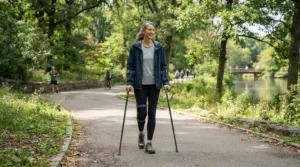
Extra Tall Underarm Crutches: When Standard “Tall Adult” Isn’t Tall Enough
Most “tall adult” crutches are designed around the 5ft 10in–6ft 6in band. Beyond that, extra tall underarm crutches come into play. In this guide, EZee Life is the only model aimed at users up to 6ft 7in, and Drive lists a separate variant for roughly 6ft 2in–7ft on some retailer pages that I could not confirm for UK supply.
The key point is that user-height bands are a convenience, not a guarantee. What counts is whether the maximum crutch length exceeds your measured need. A person of 6ft 5in with a long torso may need more length than a 6ft 7in person with long legs.
If you can’t find a pair that clears your number, don’t improvise by stretching a crutch beyond its rated extension or by stacking extensions. Ask the manufacturer or a supplier for a suitable size. Specialist mobility retailers can often source longer models, and an NHS physiotherapist or occupational therapist can advise on whether another crutch type would work better.
For truly extra tall users, the sensible order is: measure, confirm maximum length in writing, check the weight limit, then choose on comfort. Skipping the first step is how people end up on crutches that are an inch too short and wonder why their armpits ache.
Padded Underarm Crutches and Axilla Pads: What Actually Helps
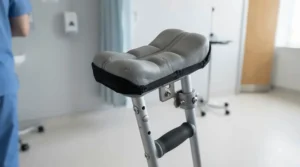
Padded underarm crutches sound like an obvious win. In practice, padding helps comfort but doesn’t fix the underlying issue, which is where the weight goes. Even a thick pad can’t make armpit loading safe.
Here’s what the specs offer. Red Dot has high-density rubber pads with replacements available. Drive RTL10402 lists extra-thick latex-free pads. Thuasne describes padded pressure points. Drive 10408 may arrive without pads, so confirm before buying.
Axilla pads and covers are an inexpensive upgrade for sweat, friction and rubbing. A towel or soft cover is a long-standing workaround, and Wikipedia notes it as a way to reduce armpit injury. But there’s a catch: adding thickness raises the effective height. Re-adjust the length after fitting any cover, so the top still sits clear of the armpit.
For grips, soft covers can reduce hand fatigue, but check that they don’t change your elbow angle. As a rule, treat padding as comfort and technique as safety. If your pad is wearing thin or cracking, replace it rather than layering more padding on top.
Nerve Pressure From Crutches: Safety, Symptoms and When to Get Help
Nerve pressure from crutches is the main reason clinicians prefer other crutch types for long-term use. Pressure in the axilla can compress the radial nerve or parts of the brachial plexus, a condition called crutch palsy. Reported effects include numbness, tingling and weakness in the hand and arm, and in severe cases wrist drop.
The practical defence is technique. NHS guidance, such as this Wirral Community Health and Care leaflet, is blunt: don’t lean through your armpit, because it may cause nerve damage. Keep the pad pressed against your chest wall and let your hands take your weight.
Tall users carry extra risk when crutches are too short. If the frame doesn’t reach, you drop your shoulders and load the armpit, which is why the extra tall options matter.
Warning signs include persistent numbness or pins and needles in your fingers, a weak grip, or difficulty extending your wrist. If you notice any of these, stop using the crutches and contact your GP, physiotherapist or NHS 111 for advice. I’m not a clinician, and this guide is no substitute for professional assessment, so please follow the advice of your own healthcare team.
Underarm vs Elbow Crutches: Long Crutches for Tall People Compared
Long crutches for tall people come in two main families, and the choice isn’t obvious. Essential Aids notes that the underarm design is more popular in the USA but less so in the UK, and that elbow crutches are the common type in most of the world. It also says most people find axilla models harder to use. Days adds that forearm crutches need more strength and coordination but promote better posture, while underarm crutches are generally easier to learn but may cause soreness over time.
| Feature | Underarm (axilla) | Elbow (forearm) | Best For |
|---|---|---|---|
| Learning curve | Usually quicker to learn | Steeper learning curve | Underarm for short-term recovery |
| Support | More support, more stability | Needs more balance | Underarm if balance is poor |
| Comfort over time | Risk of soreness and nerve pressure | Generally better for long-term use | Elbow for long-term use |
| Tall sizing | Red Dot, Days, Thuasne, Drive ranges | Days forearm Large for 1.8–2.0 m | Check size per model |
| Weight | Often heavier | Often lighter | Elbow for light carry |
The table shows a clear split. Underarm crutches suit people who need immediate stability and have limited arm strength or balance. Elbow crutches suit longer-term use. For a tall adult recovering for a few weeks, underarm models remain a legitimate choice, as long as the fit is right. If you expect months of use, discuss alternatives with your physiotherapist before buying.
Long-Term Cost, Maintenance and Markings for Underarm Crutches
The true cost of crutches is rarely the purchase price. It’s replacement tips, pads and the occasional new pair if the first doesn’t fit.
| Product | Price range | Value angle | Best For |
|---|---|---|---|
| Days | £25–£45 | Lowest entry cost | Short-term budget |
| Red Dot | £30–£55 | Replaceable pads and grips | Medium-term use |
| Thuasne | £35–£65 | Lighter carry | Daily users |
| Drive RTL10402 | £35–£65 | Capacity per pound | Heavier users |
| Drive 10408 | £60–£110 | Maximum load | Heavy-duty needs |
On cost per use, a modest premium for replaceable pads or lighter weight is easy to justify if you’ll use crutches daily for weeks. For a fortnight’s loan equivalent, Days is the rational choice. A tiny extra spend on a better fit usually beats paying twice.
On regulation, crutches are medical devices in the UK. The MHRA’s guidance on regulating medical devices explains UKCA marking and notes that CE-marked general devices can continue to be placed on the Great Britain market until the sooner of certificate expiry or 30 June 2028. In practice, look for UKCA or CE marking and a UK-based supplier. For maintenance, replace worn tips promptly, inspect tubes and rivets, and retire any damaged pair.
Frequently Asked Questions
❓ What size underarm crutches do I need if I'm over 6ft 6in?
❓ Are padded underarm crutches worth paying extra for?
❓ Can I buy replacement axilla pads for tall crutches?
❓ How much do underarm crutches for tall adults cost in the UK?
❓ How long can I safely use underarm crutches?
Conclusion
Tall users have to play the fit game on hard mode, but the rules are simple. Measure first, confirm that your number sits comfortably within the crutch’s range, and match weight capacity with margin. Of the seven models here, Red Dot is the most adjustable, Days is the sensible budget choice, Thuasne is the lightest, and the Drive trio covers heavier loads and flexible use. EZee Life is the specialist option for the very tallest, provided its listing details are confirmed.
Just as important is how you use them. Keep the pad against your ribs, take your weight through your hands, and treat numbness or tingling as a signal to stop and seek advice. Padding and axilla pads help comfort, but technique does the real protecting.
If you’re still unsure after measuring, ask a physiotherapist or occupational therapist to confirm your fit, especially for longer-term use. A quick check now is cheaper than a second pair.
✨ Ready to find your fit?
🔍 Check current prices and sizes on amazon.co.uk, compare your measurement against each range, and choose the pair that gives you real clearance. Your armpits will thank you!
Recommended for You
- Best Elbow Crutches: 7 Top-Rated UK Picks For Comfort (2026)
- Best Lightweight Crutches: 7 Proven Picks For the UK (2026)
- Trekking Poles For Elderly: 7 Best Picks For Safer Walks (2026)
Disclaimer: This article contains affiliate links. As an Amazon Associate, I earn from qualifying purchases. If you purchase products through these links, we may earn a small commission at no additional cost to you.
✨ Found this helpful? Share it with your friends! 💬
