
In This Article
A wheelchair for rugged pavements and uneven kerbs is a manual chair built to cope with cracked tarmac, tree-root heave, cobbles, gravel and high kerbs. Typically that means large rear wheels on pneumatic tyres, bigger front casters, a stable frame and anti tip bars. It sits between a standard transit chair and a full off-road machine.
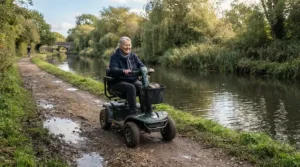
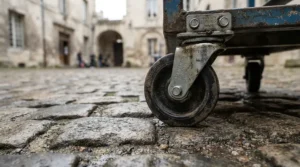
Anyone who has pushed a loved one down a British high street knows the drill. Patched tarmac. Tree roots heaving the paving up like something from a horror film. A dropped kerb that isn’t quite dropped. And a tiny front wheel wedging itself into a crack with the stubbornness of a toddler at bedtime. Standard hospital-style chairs were designed for corridors, not Victorian flagstones.
This isn’t just anecdote. The Department for Transport’s Inclusive Mobility guidance recommends dropped kerbs that sit flush with the road, within a 6mm tolerance, with crossing points roughly every 100 metres where possible. Walk almost any town centre and you’ll see how often reality falls short. Until councils catch up, the chair itself has to do the heavy lifting.
So what are you actually shopping for? This guide compares seven real chairs, from budget picks to premium trail machines. It then unpicks the details that decide whether a kerb is a speed bump or a wall: wheel size, tyres, caster size and anti tip bars. One honest note: I haven’t sat in or pushed any of these chairs. Everything here comes from published specifications, retailer data and the themes reviewers keep returning to. Prices are ranges because they move. This isn’t medical advice either, so let an occupational therapist or wheelchair service have the final say on fit and safety.
Quick Comparison: 7 Wheelchairs for Rugged Pavements at a Glance
Here’s the short version before the deep dive. Weights and specs are as listed by UK retailers at the time of research and can vary by seat width, so check the final listing.
| Chair | Rear wheels | Weight (listed) | Price range | Best For |
|---|---|---|---|---|
| MobiQuip All Terrain | 24″ pneumatic, quick-release | 12.5kg (some variants 15kg) | Around £350-£450 | Everyday self-propelling on bad pavements |
| CareCo Outlander | 24″ pneumatic, treaded | Not stated in listing | Under £400 | A first all-terrain chair on a tight budget |
| Excel G-Explorer | 24″ pneumatic | 15kg | £350-£450 range | Choosing between three seat widths |
| Roma 1472X HD | 24″ pneumatic spoke | Check listing | Around £400 | Heavy-duty robustness on rough pavements |
| Karma Ergo 125 | 24″ quick-release, solid | Roughly 13-15kg | Check current price | Low maintenance on moderately rough routes |
| Trekinetic K2 | Off-road-spec wheels | 17kg (heaviest part about 9kg) | £5,000-£6,500 range | Trails, beaches and city kerbs |
| Mountain Trike | Mountain-bike wheels, three-wheel layout | Check listing | £4,500-£5,700 range | Hills, mud and hands-clean lever drive |
Look at the pattern. Four chairs cluster around the £400 mark and share the same basic recipe of 24 inch rear wheels and pneumatic or heavy-duty setups. The two premium chairs cost roughly a dozen times as much. What that buys isn’t just rougher terrain capability but suspension, steering and braking systems that cheaper frames simply don’t have. If your world is cracked pavements and kerbs rather than woodland, the budget cluster is where the value lives. The Karma Ergo 125 is the outlier worth reading about because of its solid tyres.
💬 Just one click — help others make better buying decisions too!😊
Top 7 Wheelchairs for Rugged Pavements and Uneven Kerbs: Expert Analysis
A note on availability: some of these appear as regular amazon.co.uk listings, while others, especially the premium chairs, are mainly sold by specialist dealers after an assessment. Check whether a listing exists, and who the seller is, before ordering.
1. MobiQuip All Terrain — lightest pneumatic-tyre pick at 12.5kg
At 12.5kg on the listing I reviewed, this is among the lighter chairs in its class to carry big pneumatic tyres, and that matters every time it goes into a car boot. Other listings quote 15kg for different variants, so check your exact seat size.
The spec sheet pairs 24 inch mountain-bike-style tyres, quick-release wheels and a folding frame with larger front casters. That last detail is the underrated half of the equation. Big rear wheels roll over cracks, but front casters decide whether you get stuck in them. It’s rated for users up to 18 stone, so it isn’t a lightweight-users-only chair. Based on the spec comparison, this suits someone wanting one chair for pavements, parks and the odd gravel path.
The caveat reviewers raise is that it’s best for people who don’t self-propel all day, every day. Knobbly rubber has more rolling resistance than slick tyres. Reviewers on a specialist retailer’s page consistently praise comfort over bumps and robustness. One family described a relative who stopped flinching at potholes, and another noted it copes with old cobbled streets. I couldn’t verify Amazon-specific review counts, so treat this as retailer-page sentiment.
Pros:
- ✅ Light for a chair on pneumatic tyres
- ✅ Larger front casters for rough ground
- ✅ Quick-release wheels ease boot loading
Cons:
- ❌ Knobbly tyres add rolling resistance
- ❌ Weight varies between listed variants
Price range: around £350-£450; check current price. Value verdict: the strongest all-round value here for comfort on bad pavements.
2. CareCo Outlander — budget bike-style tyres for under £400
Plenty of budget chairs print “all terrain” on the box. The CareCo Outlander at least puts the right hardware behind the claim.
The retailer lists 24 inch pneumatic treaded tyres borrowed from mountain-bike design. In practice, that means more grip and far better shock absorption than the hard little wheels on a transit chair. Comfortable hand rims suit self-propelling. One honest detail from the listing: the tyres may need inflating with a standard bicycle pump on first assembly, and topping up occasionally afterwards. It’s a useful reminder that pneumatic tyres are an ongoing relationship, not a one-off purchase.
What the spec sheet won’t tell you is how it handles lifting. The portion of the listing I reviewed doesn’t give a clear frame weight or maximum user weight, and both matter. Weight decides how painful boot-loading is, and capacity decides whether it’s safe for you. Ask before buying. I’d treat this as the “try it” chair for someone whose current transit chair makes every outing miserable.
I couldn’t find enough independent customer reviews to summarise honestly, and the retailer’s copy is promotional, so I’m not claiming a verdict from other buyers.
Pros:
- ✅ Mountain-bike-style treaded pneumatic tyres
- ✅ Hand rims suit self-propelling
- ✅ Very low entry price for the category
Cons:
- ❌ Weight and capacity not clearly stated
- ❌ Needs regular pumping and tyre checks
Price range: under £400 (the retailer quotes VAT-exempt pricing). Value verdict: a sensible gateway chair if you check the missing specs first.
3. Excel G-Explorer — three seat widths for a better fit
Seat width is the most under-rated spec in this category, and the Excel G-Explorer offers three: 40, 45 or 50cm. Too wide and self-propelling becomes awkward, because your arms reach outwards to the hand rims. Too narrow and you risk pressure points.
It weighs 15kg and is rated for 113kg (17.5 stone), with 24 inch pneumatic mountain-bike tyres. The same name appears under MobiQuip branding at some retailers, with quick-release axles, swing-away armrests and leg rests, a hand brake and a 120kg rating. The specs differ between listings, so confirm exactly which version you’re buying and get the rating in writing.
Compared with the 12.5kg MobiQuip All Terrain, you’re carrying an extra 2.5kg. You’ll notice that at the boot lip, though removable wheels soften the blow. Based on the spec comparison, this is the one for people who’ve struggled with a standard-width chair and want proper tyres without a premium price.
I couldn’t verify independent review volumes for this chair, only retailer descriptions, so I’m not summarising buyer sentiment.
Pros:
- ✅ Three seat widths for a better fit
- ✅ 24 inch pneumatic tyres for cushioning
- ✅ Quick-release axles on some listings
Cons:
- ❌ Heavier than the lightest rivals
- ❌ Specs differ between retailer listings
Price range: £350-£450 range at UK retailers; check current price. Value verdict: worth it if fit matters most.
4. Roma 1472X HD — heavy-duty frame on 24 inch pneumatic rear wheels
The Roma 1472X HD is described as a robust, reliable heavy-duty chair. It’s less about trail glamour and more about a frame that won’t flinch.
The listing gives 60cm (24 inch) spoke pneumatic rear wheels and 20cm (8 inch) front solid-tyre swivel casters. An 8 inch caster is larger than many fitted to standard self-propelled chairs, and bigger casters roll over ridges instead of dropping into them. The trade-off is that solid front tyres give no cushioning, so vibration travels up through the footplates. Heavy-duty also usually means a heavier frame, so check the weight before planning any boot-lifting. A very similar wheel setup appears on the Drive Bariatric Sentra EC, which suggests this is a recognised formula for sturdier users.
Who is it for? Larger-framed users, or attendants who value robustness over portability and mostly face rough-but-not-wild pavements. It isn’t a trail chair, and it doesn’t pretend to be.
I couldn’t locate enough independent reviews to summarise, so I’m not putting words in buyers’ mouths.
Pros:
- ✅ Heavy-duty build for rougher routes
- ✅ Large 8 inch front casters
- ✅ Pneumatic rear tyres add comfort
Cons:
- ❌ Solid front tyres transmit vibration
- ❌ Likely heavier to lift and store
Price range: around £400 with VAT relief, per one retailer listing; check current price. Value verdict: good value for sturdiness, less so for portability.
5. Karma Ergo 125 — crash-tested lightweight with puncture-proof tyres
The Karma Ergo 125 is the sensible outsider here. It’s listed at about 13.1kg product weight (14.6-15.0kg by seat width in one spec table), rated to 115kg (18 stone), with a double cross-bar frame and crash testing.
Its 24 inch rear wheels are quick-release, but the tyres are solid, and the front casters are a mid-sized 7 inch solid. In practice, solid tyres mean no punctures and no pumping, which is a genuine saving in hassle. The price is that every pavement joint reaches your spine, with no air cushioning. Crash testing matters if the chair doubles as a vehicle seat on journeys, though it says nothing about comfort on cobbles.
My honest read: this is the pick when puncture anxiety outweighs ride comfort, or when your routes are rough-ish rather than ruinous. If your pavements resemble a ploughed field, the pneumatic options will serve you better. Ask the retailer whether pneumatic wheels can be fitted before you assume anything.
I couldn’t verify aggregated reviews for this exact model, so no buyer sentiment is claimed.
Pros:
- ✅ Crash-tested frame design
- ✅ Puncture-proof solid tyres
- ✅ Quick-release 24 inch rear wheels
Cons:
- ❌ Less shock absorption than pneumatic tyres
- ❌ Mid-size 7 inch casters only
Price range: check current price; this lightweight class commonly sits in the £300-£500 range. Value verdict: great for low maintenance, weaker on very rough ground.

6. Trekinetic K2 — 17kg trail chair that shrugs off city kerbs
Weight is the headline: roughly 17kg overall, with the heaviest piece about 9kg once it’s broken down. That’s a genuinely boot-friendly figure for a chair built for forest trails, muddy fields, beaches and snow, according to its UK distributor.
It’s rated for 18 stone (115kg). Here’s the reality check: ordinary pavement kerbs are the easy part. What the money buys is the ability to leave the pavement altogether. Retailer pages list it at roughly £5,450 with VAT relief, or around £6,540 without. My analysis: unless your lifestyle genuinely includes trails, that premium is hard to justify for pavements alone. For active users who refuse to be limited to tarmac, it’s the benchmark in this round-up.
Seller pages carry user testimonials, including one from someone who wanted a manual chair that didn’t limit them to smooth pavements. Those are curated by sellers, so I couldn’t verify an independent aggregate. Treat them as encouraging, not conclusive.
Pros:
- ✅ Heaviest component only about 9kg
- ✅ Built for mud, sand and snow
- ✅ 18 stone user weight rating
Cons:
- ❌ Premium price tag
- ❌ Overkill for pavement-only routes
Price range: £5,000-£6,500 range depending on VAT relief; check current price. Value verdict: superb if you’ll use the trail ability, hard to justify otherwise.
7. Mountain Trike — lever drive and air suspension for hills
The Mountain Trike swaps push rims for two levers that propel, steer and brake the chair, borrowing mountain-bike technology. Retailer specs list a three-wheel layout, an aluminium frame, Rock Shox Monarch R air shocks and hydraulic disc brakes.
On paper, lever drive gives a mechanical advantage on hills and rough surfaces. It also keeps your hands clean, which matters more than you’d think after a wet week. Retailers say the air suspension smooths rough ground and kerb descents, and it allows one-arm steering and driving if needed. It folds into a cube for transport, and a push-handle version exists for attendants. The firm limits are a maximum user weight of 100kg and height of 6ft 4.
Specialist disability press has covered the design admiringly, and one feature suggested that a reinvented wheelchair might look like this. I couldn’t verify independent aggregated customer reviews, so that remains editorial praise, not buyer consensus. The learning curve for lever steering is also real; try before you buy if you can.
Pros:
- ✅ Lever drive gives mechanical advantage
- ✅ Air suspension and hydraulic disc brakes
- ✅ Folds into a cube for transport
Cons:
- ❌ 100kg and 6ft 4 user limits
- ❌ Premium price and a learning curve
Price range: £4,500-£5,700 range depending on retailer and VAT; check current price. Value verdict: outstanding for hills and mud, steep for pavements alone.
Spec Snapshot: Tyres and Weight Limits
| Chair | Tyre type | Max user weight | Best For |
|---|---|---|---|
| MobiQuip All Terrain | Pneumatic | Up to 18 stone | Comfort on bad pavements |
| CareCo Outlander | Pneumatic, treaded | Check listing | Budget gateway |
| Excel G-Explorer | Pneumatic | 113kg (17.5 stone) | Better seat fit |
| Roma 1472X HD | Pneumatic rear, solid 8″ front | Check listing | Rugged robustness |
| Karma Ergo 125 | Solid | 115kg (18 stone) | Low maintenance |
| Trekinetic K2 | Off-road wheels | 115kg (18 stone) | Trails and kerbs |
| Mountain Trike | Mountain-bike wheels | 100kg | Hills and clean hands |
Most weight limits cluster around 18 stone. Anyone near or above that should confirm the rating in writing and consider the heavy-duty class, such as the Roma 1472X HD. The Mountain Trike‘s 100kg cap is the lowest here, which is worth knowing because it’s also among the priciest. And only one chair on this list, the Karma Ergo 125, uses solid tyres throughout.
How to Choose a Wheelchair for Rugged Pavements and Uneven Kerbs
Think of this as a seven-step filter. Run your life through it before you run your card through a checkout.
- Map your real route. Note kerb heights, crack depth, gradients and surface changes on the journeys you actually make. A route of tarmac and the odd step needs different kit than one with woodland tracks.
- Match propulsion to your body. Push rims suit most self-propellers, lever drive helps with hills, and an attendant chair suits those who can’t self-propel. Be realistic about stamina over a full outing.
- Choose your tyre type. Pneumatic tyres cushion; solid tyres never puncture. Rough pavements usually favour air.
- Check front caster size and rear wheel size. Bigger casters roll over gaps. 24 inch rear wheels are the usual standard for rugged use.
- Decide on anti tip bars. Treat them as standard unless a trained professional says otherwise.
- Weigh transport. Check the heaviest single component and whether wheels release without tools.
- Set the budget and funding route. NHS wheelchair assessments need a referral and are based on need, not income. Scope’s wheelchair guide also explains personal wheelchair budgets and private options, including that you don’t have to accept the chair you’re offered.
A practical way to use the list: score each candidate from one to five on every step, then look at which score you can’t live with. That is usually the deal-breaker, not the headline price.
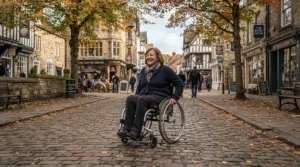
All Terrain Manual Wheelchair for Pavements: What the Label Actually Means
“All terrain” isn’t a regulated term. One brand’s definition involves snowdrifts; another’s means a slightly knobblier tyre. Disabled World defines an all-terrain wheelchair as one engineered for rough, uneven ground such as mud, grass, gravel, sand, woodland tracks and hill trails. It adds that many can use pavements, but their size, tyres and turning needs often make them less suited to tight indoor spaces than an everyday chair.
So think in two tiers. At the pavement-grade end, an all terrain manual wheelchair for pavements like the CareCo Outlander or Excel G-Explorer uses large pneumatic tyres to soften cracked pavements, parks and gravel. At the trail grade, chairs such as the Trekinetic K2 and Mountain Trike add suspension, braking and geometry meant for woodland and beaches.
Here’s what that means in practice. If you only meet rough ground on the way to the shops, paying trail-grade money buys capability you’ll rarely use. If your weekend includes a muddy woodland path, a pavement-grade chair may leave you stuck at the car park. Match the label to your actual route and the price drops by thousands.
Wheelchair With Large Rear Wheels for Kerbs: Why Size and Technique Matter
A standard UK kerb upstand is around 120mm, according to RNIB guidance. Meanwhile, in a laboratory experiment by Transport Scotland, 50-60mm kerbs were not traversable by wheelchair users without a third wheel attached or additional assistance. In plain English, even a strong user in an ordinary chair can’t simply muscle a kerb. The practical answer is dropped kerbs first, technique second.
A wheelchair with large rear wheels for kerbs helps because bigger wheels meet obstacles at a gentler angle and roll over them with less jolt. Twenty-four inch rear wheels are the usual choice here. Chairs like the MobiQuip All Terrain, Excel G-Explorer and Karma Ergo 125 all use them. By comparison, the self-propel version of Karma’s Ergo Lite 2 uses smaller 20 inch quick-release wheels, which favour portability over rough-ground rolling.
Rear wheel size is only half the story, though. Kerb climbing is about lifting the front casters over the edge, then rolling the rear wheels up after them. That’s a technique, usually involving tipping levers and an attendant, not a spec sheet feature. Ask your wheelchair service therapist to demonstrate before you attempt it.
Anti Tip Bars: Safety Net or Kerb-Snagging Nuisance?
Anti tip bars are small rear-mounted wheels or bars that stop the chair tipping backwards. On steep slopes, kerb ramps or when someone leans back to pick something up, they can stop a nasty fall.
The trade-off is obvious on uneven ground. Anti tip bars sit low behind the rear wheels, so they can snag on kerbs, ramp lips and humps. Some are removable or flip-up types, and some chairs ship with them while others list them as extras. The Karma Ergo Lite Deluxe, for example, offers them at additional cost, while the Karma Ergo 3 comes with anti tip wheels as standard. Check what’s included in the price before you compare.
My view, based on the physics rather than any hands-on testing: leave anti tip bars fitted by default, especially for attendants and anyone new to rough routes. Remove or flip them only after a trained professional has assessed you and shown you the technique. A snagged bar is irritating; a backwards fall is not. If your regular route has a nasty kerb ramp, raise the issue with your therapist before experimenting, not after.
Pneumatic Tyres: Comfort, Punctures and Pressure
Pneumatic tyres do one thing solid tyres can’t: they absorb vibration. On cracked UK pavements, that’s the difference between an outing that leaves you rattled and one that doesn’t. Specialist guidance for outdoor chairs makes the same point, noting that pneumatic tyres absorb vibration from rough ground in a way solid tyres cannot.
The cost is maintenance. Pneumatic tyres need pumping, and the CareCo Outlander listing says plainly that they may need inflating on assembly with a standard bicycle pump and occasionally afterwards. Punctures are possible too, though reviewers of the MobiQuip All Terrain noted that its thick, mountain-bike-style outer tyres seem to offer some protection.
Under-inflated pneumatic tyres feel heavy to push, and over-inflated ones feel jarring. Use the pressure range printed on the tyre sidewall or in the manual, not guesswork. If you’d rather never pump a tyre, the Karma Ergo 125 shows the solid alternative, with the comfort cost described above. Pneumatic tyres are worth it for anyone regularly crossing bad surfaces. If you’re only crossing the car park once a week, solid may be plenty.
Caster Size: The Small Wheel Doing the Big Job
If the rear wheels are the engine, the front casters are the steering and the early warning system. A small caster drops into a crack and stops dead, pitching the rider forward. A bigger one rolls over.
Caster size also changes the rest of the chair. Karma’s own quick-reference guide shows that moving from a 6 inch to an 8 inch caster on a 24 inch rear wheel changes seat-to-floor height by about an inch on the Agile (19 to 20 inches). Rated weight can shift too: Etac’s Elite manual lists 100kg with a 5 inch caster and 125kg with a 6 inch one. That’s a useful reminder that caster size is a structural decision, not just a ride-quality one.
Across the chairs here, the Roma 1472X HD stands out with 8 inch front casters, while the Karma Ergo 125 uses 7 inch solid ones. Most manual chairs let you swap casters without replacing the whole chair, so ask a supplier about options before you resign yourself to a poor setup. Pair larger casters with correct fitting for your height and posture, because changing the geometry changes how the chair feels.
✨ Ready to Take on Britain’s Bumpy Pavements?
🔍 Narrow down your shortlist, then click any highlighted product name to check current pricing and availability. The right tyres, casters and wheel size can turn a dreaded outing into a genuinely enjoyable one!
Practical Guide: Setting Up Your Chair and Tackling Kerbs Safely
Day-one setup
- Inflate pneumatic tyres to the pressure range marked on the tyre, using a standard bicycle pump.
- Fit the quick-release wheels and tug each one firmly to confirm it has locked.
- Test the brakes on a gentle slope near home before you trust them elsewhere.
- Check that anti tip bars are fitted and correctly positioned.
Weekly and monthly routine
- Weekly: check tyre pressure, look for embedded thorns or glass, and clear hair and grit from caster forks.
- Monthly: check bolts, spoke tension and wheel alignment, and wipe down the frame.
Common first-30-day mistakes
- Running tyres soft, which makes the chair feel sluggish.
- Forgetting that anti tip bars can catch on kerb ramps.
- Taking an unscouted route on the first outing.
- Skipping the quick-release check after reassembly.
Kerb basics
Use dropped kerbs wherever possible. If you must tackle a raised kerb with an attendant, the general principle is to approach square-on, tilt the chair using the tipping levers, lift the casters over, then roll the rear wheels after them. Learn the technique from a trained professional, because it varies by chair and user.
Real-World Scenarios: Which Chair for Which Life?
These are hypothetical profiles, not real user stories. They show how the analysis above plays out.
Scenario A: the cobbled market town. A retired couple in an older town. One partner pushes the other three or four times a week, and the budget is around £400. The MobiQuip All Terrain fits well, thanks to its pneumatic tyres, larger front casters and lighter weight for repeated boot-loading. If the budget is tighter, the CareCo Outlander is the alternative, provided the missing weight and capacity details check out.
Scenario B: the larger-framed user. Someone near the top of the standard weight range, needing a robust frame for rough pavements but not trails. The Roma 1472X HD is the logical place to start. Confirm the rated weight in writing, and weigh up its likely heavier frame.
Scenario C: the weekend trail fan. An active self-propeller with a £5,000 budget who wants woodland tracks at the weekend and kerbs during the week. The Trekinetic K2 is the benchmark choice. If they’re under 100kg and 6ft 4, and prefer lever drive, the Mountain Trike is the alternative.
Scenario D: the zero-maintenance priority. Someone who never wants to pump a tyre and travels mostly on moderately rough routes. The Karma Ergo 125 fits, accepting a firmer ride in exchange for fewer chores.
All Terrain Wheelchairs vs Traditional Alternatives
Tables show the differences, but written comparison shows the reasons. Here’s how the main options stack up.
| Option | Strength on rough pavements | Weakness | Best For |
|---|---|---|---|
| All-terrain self-propelled (e.g. MobiQuip All Terrain) | Pneumatic cushioning, bigger casters | Bulkier, needs pumping | Everyday outdoor use |
| Standard transit chair | Light and compact | Small wheels trap in cracks and jar | Short trips from car to door |
| Self-propel with solid tyres (e.g. Karma Ergo 125) | Puncture-free, easy upkeep | Transmits vibration | Moderately rough routes |
| Premium trail chair (e.g. Trekinetic K2, Mountain Trike) | Suspension, leverage, trail ability | Cost | Trails plus city kerbs |
| Manual chair with power attachment | Reduces effort | Extra cost and weight | Riders with limited stamina |
A transit chair is brilliant at being small and awkward on everything else. The gap between it and an all-terrain chair is largest on cracked pavements, and the gap between solid and pneumatic tyres is largest on the same surfaces. Scope notes that power attachments can turn a manual chair electric, which can suit people who love the manual chair’s form but tire on long routes. If you’re weighing a premium trail chair against a pavement-grade pneumatic one, the real question is how often you’ll leave the pavement. Be honest with yourself about the answer.
Long-Term Cost and Maintenance
The sticker price is only the opening bid. Pneumatic tyres bring inner tubes, puncture repair and eventual replacement. Casters wear, bearings need cleaning and bolts loosen. Solid tyres like those on the Karma Ergo 125 trade that ongoing cost for a harsher ride.
Funding matters too. There’s no general VAT relief for disabled people, but some products can be zero-rated for eligible buyers. Both the product and the disability have to qualify, so read HMRC’s VAT relief guidance for disabled people before assuming anything. Several listings quote prices “with VAT relief”, so compare like for like.
| Tier | Price range | Example chairs | What you get | Best For |
|---|---|---|---|---|
| Budget all-terrain | Around £300-£450 | CareCo Outlander, Excel G-Explorer, MobiQuip All Terrain, Roma 1472X HD | Pneumatic or heavy-duty rough-pavement ability | Most pavement users |
| Lightweight, low maintenance | Check current price (often £300-£500) | Karma Ergo 125 | Solid tyres, crash testing | Low-fuss routes |
| Premium trail | £4,500-£6,500 | Mountain Trike, Trekinetic K2 | Suspension, lever drive, trail capability | Active, varied terrain |
Spread over five years of regular use, a chair around £400 works out at roughly £80 a year before maintenance, while a £5,000 chair is about £1,000 a year. The premium can be fair if you’ll use the trail capability weekly, and poor value if you won’t. The budget tier gives the best value for rough pavements alone.

FAQ: Wheelchairs for Rugged Pavements
❓ How much does an all terrain manual wheelchair cost in the UK?
❓ Can I get an all terrain wheelchair through the NHS?
❓ Will an all terrain wheelchair fit in a car boot?
❓ Are all terrain wheelchairs usable indoors?
❓ What weight limit should I look for?
Conclusion: Choosing the Right Wheelchair for Rugged Pavements and Uneven Kerbs
The best wheelchair for rugged pavements and uneven kerbs isn’t the most expensive one. It’s the one whose wheels, tyres and casters match your actual route. For most people on bad British pavements, that means a budget-tier all terrain manual wheelchair for pavements with 24 inch pneumatic tyres. The MobiQuip All Terrain leads for balance, the CareCo Outlander for entry price, the Excel G-Explorer for fit options and the Roma 1472X HD for sturdiness. The Karma Ergo 125 wins for low maintenance, while the Trekinetic K2 and Mountain Trike are for those who want trails as well as kerbs.
Remember the details that decide the experience: front caster size, rear wheel size, pneumatic versus solid tyres, and keeping anti tip bars fitted unless a professional says otherwise. A wheelchair with large rear wheels for kerbs helps, but technique and dropped kerbs matter just as much. Above all, get a professional opinion on fit and safety, and confirm the missing specs I’ve flagged before you buy.
✨ Your Kerbs Won’t Fix Themselves, But Your Chair Can Cope!
🔍 Compare your shortlist, click any highlighted product to check current pricing and availability, and choose the chair that turns rough pavements into just another route!
Recommended for You
- Wheelchair For People With One Working Arm: 7 Best Picks (2026)
- Walking Stick Wrist Strap Replacement: 7 Essential Picks (2026)
- Crutch Tips Replacement: 7 Best Picks For UK Users (2026)
Disclaimer: This article contains affiliate links. As an Amazon Associate, I earn from qualifying purchases. If you purchase products through these links, we may earn a small commission at no additional cost to you.
✨ Found this helpful? Share it with your friends! 💬🤗
