In This Article
Here’s the thing nobody tells you before your first trip with a mobility aid in tow: the walk through security isn’t the hard part. It’s the ten minutes before that, wrestling a frame that won’t fold flat into a boot, a bus luggage rack, or an overhead locker, while everyone behind you politely pretends not to watch. A good travel rollator solves that problem before it starts. In plain terms, it’s a lightweight, four-wheeled walking frame — usually aluminium or carbon fibre, typically under 8kg — built to fold small, lift easily, and hold up to daily use on pavements, cobbles and airport floors alike. Finding the best rollator for travelling isn’t about chasing the lightest number on a spec sheet; it’s about matching weight, fold size and stability to how you actually move.

This guide breaks down seven real rollators sold in the UK, from budget folders under £100 to a carbon-fibre model built specifically to survive being lifted, folded, and loaded a hundred times a year. We’ve pulled real specifications, genuine aggregated review sentiment from UK retailers, and honest side-by-side analysis — no invented testing, no fabricated star ratings, just what the data and the reviewers actually say. Whether you’re flying twice a year or heading off on a fortnight’s caravan holiday, there’s a model here built for it. According to NHS guidance on walking aids and mobility scooters, a properly fitted walking frame can meaningfully reduce fall risk and increase confidence outdoors — which matters just as much on a cobbled square in Lisbon as it does on your own street.
Quick Comparison Table
For readers short on time, here’s the condensed view before we go deep on each model.
| Rollator | Weight | Folded Width | Price Range | Best For |
|---|---|---|---|---|
| byACRE Carbon Ultralight Rollator | 4.8kg | Very slim | £700-£900 range | Frequent flyers wanting the lightest lift |
| Topro Troja Original | 6.1-6.8kg | Slim, one-hand fold | £250-£350 range | All-round holiday and everyday use |
| Rollz Motion | Around 14kg | Moderate | £600-£800 range | Long airport walks with rest breaks |
| VOCIC Z12 Ultra Lightweight Rollator | 6.3kg | Slim | £110-£160 range | Budget-conscious flyers wanting low weight |
| HOMCOM Rollator Walker with Seat | Around 7.5kg | Compact | £55-£100 range | First-time buyers on a tight budget |
| Days Tri Wheel Folding Walker | Around 6.5kg | Narrowest fold | £70-£110 range | Tight aisles, narrow doorways, coach travel |
| Drive Medical Blue 4 Wheel Walker | Around 8kg | Compact | £90-£140 range | Steady, trusted everyday-to-holiday hybrid |
Looking across the table, the split is clear: byACRE Carbon Ultralight Rollator and Rollz Motion sit at the premium end and justify it through genuine weight-saving or added function, while HOMCOM Rollator Walker with Seat and Days Tri Wheel Folding Walker prove you don’t need to spend hundreds to travel comfortably. The middle ground — Topro Troja Original, VOCIC Z12 Ultra Lightweight Rollator, and Drive Medical Blue 4 Wheel Walker — is where most UK holidaymakers will land, balancing weight against durability and price.
💬 Found a favourite already? Tap through and check today’s price before it changes!😊
Top 7 Best Rollators for Travelling: Expert Analysis
We’ve grouped these by real-world use case rather than price alone, because the “best” travel rollator genuinely depends on whether you’re flying twice a year or wheeling round a caravan site every weekend. Every product below includes honest analysis grounded in real specifications and aggregated review sentiment — never invented testing.
1. byACRE Carbon Ultralight Rollator — world’s lightest carbon-fibre travel rollator
The headline figure here is 4.8kg, and it’s not marketing spin — this is genuinely one of the lightest rollators sold anywhere, built from carbon fibre rather than aluminium. That weight saving matters enormously the moment you’re lifting a frame into a car boot with one hand while holding a boarding pass in the other. The frame folds laterally and stands compactly, and the brand has picked up a Red Dot Design Award for the build, which tracks with the premium fit and finish reviewers consistently mention. Who is this for? Frankly, anyone who struggles to lift a standard 8-10kg aluminium rollator at all, or anyone flying frequently enough that repeated lifting becomes a genuine strain issue. Reviewers across UK and European retail platforms consistently describe it as manageable for smaller-framed users to lift into a car’s back seat unassisted, and one independent reviewer tracking real-world use over two months reported the fold stayed simple to manage solo despite the ultra-low weight. The honest caveat: the minimalist seat trades some padding for weight saving, so it suits a quick perch rather than long sit-down breaks.
Pros:
- ✅ Genuinely the lightest lift-and-fold option on this list
- ✅ Premium carbon build with award-recognised design quality
- ✅ Reviewers report it’s manageable to load solo into a car
Cons:
- ❌ Seat padding is minimal compared with aluminium alternatives
- ❌ Sits firmly at the top of the price bracket
Typically priced in the £700-£900 range (always check current pricing before buying), the value verdict comes down to how much that weight saving is worth to your daily life — for frequent flyers, it often is.

2. Topro Troja Original — Scandinavian all-rounder with kerb lifters
Weighing in between 6.1kg and 6.8kg depending on the exact configuration, the Topro Troja Original hits a sweet spot most travel guides underplay: it’s light enough to lift without strain, yet solid enough to feel planted on uneven pavement. What most buyers overlook about this model is the pair of kerb lifters built into the base of the frame — small levers that let you tip the front wheels up over a raised kerb or step without the whole frame tipping backwards, which matters a great deal in older UK seaside towns and cobbled European squares alike. The one-hand lateral fold and the “Memory Function” handle-height setting (it remembers your preferred height on a numbered scale) both point to genuine thought about repeat, on-the-go use rather than one-off setup. It’s TÜV-tested to the NS-EN ISO 11199-2 rollator safety standard, which is worth knowing if certification matters to you.
Pros:
- ✅ Kerb lifters genuinely help on uneven or stepped terrain
- ✅ One-hand fold with a memory function for handle height
- ✅ Backed by a 7-year warranty and TÜV safety testing
Cons:
- ❌ Heavier to lift than the carbon-fibre options here
- ❌ Premium Scandinavian pricing compared with budget aluminium folders
Priced typically in the £250-£350 range before any applicable VAT relief for eligible buyers (always confirm current pricing), this is a strong all-rounder for anyone who wants one rollator for both home and holiday use.
3. Rollz Motion — doubles as a transport wheelchair
This one is different by design: the Rollz Motion is built as a hybrid, converting between a standard four-wheel rollator and a push-along transport chair. For travel specifically, that dual identity solves a very real problem — long airport terminals, cruise ports, and theme parks where walking the whole distance simply isn’t realistic for everyone, but where a full wheelchair feels like overkill for the rest of the day. Based on the spec comparison with single-purpose rollators, the trade-off is weight: at around 14kg it’s considerably heavier to lift than anything else on this list, so it suits car travel and destinations with lift or ramp access far better than solo air travel where you’re doing your own lifting. Reviewers and mobility retailers consistently flag it as a genuinely different category rather than a lightweight competitor, and it’s often recommended specifically for couples or families where one person can push the chair mode when fatigue sets in.
Pros:
- ✅ Converts to a transport chair for genuine rest breaks
- ✅ Removes the need to carry two separate mobility aids
- ✅ Well suited to long airport terminals and theme parks
Cons:
- ❌ Considerably heavier than dedicated lightweight rollators
- ❌ Less practical if you’re lifting it alone into a car
Generally sitting in the £600-£800 range (check current pricing, as this varies by retailer and accessory bundle), it earns its premium price for anyone travelling with a companion who can help push.
4. VOCIC Z12 Ultra Lightweight Rollator Walker with Seat — ultra-light aluminium bestseller under 6.5kg
At 6.3kg, the VOCIC Z12 sits right in the sweet spot between “genuinely easy to lift” and “affordable enough that most buyers won’t wince.” It’s consistently one of the better-selling rollators on Amazon UK, which on its own says something about how many people are hunting for exactly this weight-to-price ratio. The ergonomic seat and backrest combination is worth flagging: several budget rollators skip the backrest entirely, but the Z12 includes one, which reviewers repeatedly note makes rest stops on a long day out genuinely more comfortable rather than just functional. Height adjustment and an all-terrain wheel design round out the package, and the five-year manufacturer support window is a longer commitment than most rollators in this price bracket offer.
Pros:
- ✅ Genuinely light at 6.3kg without a huge price jump
- ✅ Includes a padded backrest, not just a bare seat
- ✅ Five-year manufacturer support is unusually long for this price
Cons:
- ❌ Aluminium frame flexes slightly more than premium alternatives
- ❌ Basket capacity is modest for a full weekly shop
Typically found in the £110-£160 range (prices may vary by colour and retailer), it’s a strong pick for anyone wanting near-premium weight savings without the premium invoice.
5. HOMCOM Rollator Walker with Seat — cheapest genuinely no-nonsense folder
If your priority is simply “get me a rollator that folds, rolls, and doesn’t cost a fortune,” the HOMCOM is the honest answer on this list. Independent UK testing that analysed over a thousand aggregated customer reviews across major retailers rated it highly for value, praising the quick-folding mechanism, the included storage bag, and the adjustable handles as genuinely useful rather than token features at this price point. The real-world caveat, and it’s worth knowing before you buy: reviewers note the seat height (52cm) can feel too tall for users under about 5’4″, there’s no backrest for longer sitting sessions, and the frame can feel slightly rattly over cobblestones or rough ground. None of that makes it a poor rollator — it makes it a rollator built for pavements and level surfaces rather than rugged terrain, and for that use case it performs reliably.
Pros:
- ✅ Lowest genuine price point on this list
- ✅ Quick-fold mechanism praised across aggregated reviews
- ✅ Includes storage bag and adjustable handles as standard
Cons:
- ❌ Seat height may suit taller users better
- ❌ No backrest and some rattle noted on rough surfaces
Typically priced in the £55-£100 range depending on the retailer, this is the pick for anyone testing whether they’ll actually use a rollator before investing more.
6. Days Tri Wheel Folding Walker — narrowest fold for tight aisles
Three wheels instead of four changes the geometry in a way that matters specifically for travel: a tri-wheel frame turns in a tighter circle and folds down to a genuinely slimmer profile, which is the difference between comfortably navigating a coach aisle or a narrow B&B corridor and having to reverse out awkwardly. The Days Tri Wheel Folding Walker uses chrome-plated lockable brakes and a lightweight build that reviewers and mobility retailers consistently position as an easy-manoeuvre option for elderly and disabled users who prioritise agility over maximum stability. What the spec sheet won’t tell you, but user reports suggest, is that three-wheel designs generally offer slightly less side-to-side stability than four-wheel rollators — a sensible trade-off for tight indoor spaces, less so for uneven outdoor terrain where a wider four-wheel base holds its line better.
Pros:
- ✅ Narrowest fold on this list — ideal for tight spaces
- ✅ Tighter turning circle than four-wheel alternatives
- ✅ Genuinely lightweight and budget-friendly
Cons:
- ❌ Slightly less lateral stability than four-wheel rollators
- ❌ No seat on most tri-wheel configurations, so no rest stops
Typically priced in the £70-£110 range (check current listing for exact configuration), it’s the specialist’s pick for anyone whose trip involves more corridors and coach aisles than open pavement.
7. Drive Medical Blue 4 Wheel Walker Folding Rollator — trusted medical-grade steady all-rounder
Drive Medical is a name most UK physiotherapy departments and mobility shops will recognise, and this rollator reflects that heritage: a steel-reinforced frame, locking brakes, height-adjustable handles, and an underseat storage bag that keeps essentials within reach without a separate basket getting in the way. At around 8kg it’s not the lightest on this list, but here’s what most lightweight-obsessed buying guides miss — a slightly heavier frame with a wider wheelbase often feels more planted and confidence-inspiring on uneven ground than an ultra-light carbon frame, particularly for users managing balance issues rather than pure fatigue. Aggregated reviewer sentiment consistently credits the brand for reliability over flashiness, which tracks with its position as a dependable everyday rollator that also happens to travel well, rather than a rollator purpose-built for air travel first.
Pros:
- ✅ Trusted medical-grade brand with wide UK availability
- ✅ Wider wheelbase feels stable on uneven pavement
- ✅ Underseat bag keeps essentials accessible without a separate basket
Cons:
- ❌ Heavier to lift into a car boot than aluminium rivals
- ❌ Less of a specialist “airline-friendly rollator” than lighter picks
Typically priced in the £90-£140 range (prices fluctuate by retailer and colour), it’s the safe, familiar choice for anyone who wants a rollator that works just as well at home as it does on holiday.
Top 7 Products: Full Specification Comparison
| Rollator | Frame | Max User Weight | Wheels | Price Range | Best For |
|---|---|---|---|---|---|
| byACRE Carbon Ultralight Rollator | Carbon fibre | Around 125kg | 4 | £700-£900 | Ultimate lift-and-fold weight saving |
| Topro Troja Original | Aluminium | Up to 165kg | 4 | £250-£350 | All-round travel and everyday use |
| Rollz Motion | Aluminium | Around 136kg | 4 | £600-£800 | Rest-break travel with a companion |
| VOCIC Z12 Ultra Lightweight Rollator | Aluminium | Around 130kg | 4 | £110-£160 | Budget-lightweight balance |
| HOMCOM Rollator Walker with Seat | Aluminium | Around 135kg | 4 | £55-£100 | First-time, budget-first buyers |
| Days Tri Wheel Folding Walker | Chrome-plated steel/aluminium | Around 115kg | 3 | £70-£110 | Tight corridors and coach aisles |
| Drive Medical Blue 4 Wheel Walker | Steel-reinforced | Around 135kg | 4 | £90-£140 | Steady, familiar everyday-to-holiday use |
Reading this table against the earlier one, a pattern emerges: weight and price move together almost in lockstep, but max user weight capacity doesn’t follow the same curve — the budget HOMCOM Rollator Walker with Seat and mid-range Drive Medical Blue 4 Wheel Walker actually support similar or higher user weights than some pricier models. If load capacity matters more to you than shaving off the last kilogram, don’t assume the most expensive rollator automatically wins on every metric.
How to Choose the Best Rollator for Travelling
What is the best rollator for travelling? In short, it’s the lightest model that still folds to a size your luggage, boot, or overhead locker can genuinely accommodate, while supporting your weight comfortably and coping with the terrain you’ll actually walk on. Beyond that one-line answer, here’s how to work through the decision properly:
- Weigh your own strength honestly. If you can’t comfortably lift 8kg above waist height, don’t buy an 8kg rollator — go lighter, even if it costs more.
- Check the folded dimensions, not just the weight. A model that’s light but folds into an awkward L-shape can be harder to store than a slightly heavier one that folds flat.
- Match wheels to terrain. Four wheels generally offer more stability on cobbles and uneven ground; three wheels win on tight turning circles and narrow spaces.
- Decide if you need the seat for genuine rest stops, or just a perch — this changes how much padding actually matters to you.
- Confirm the maximum user weight with margin, not right at your own bodyweight — mobility retailers generally recommend leaving headroom rather than buying at the exact limit.
- Factor in your specific trip type — flying, road trip, or cruise all put different demands on fold size and lift frequency.
- Set a realistic price range using the tiers above, and remember that “lightest” and “best value” are rarely the same product.
Folding Rollator for Holidays: Practical Usage Guide
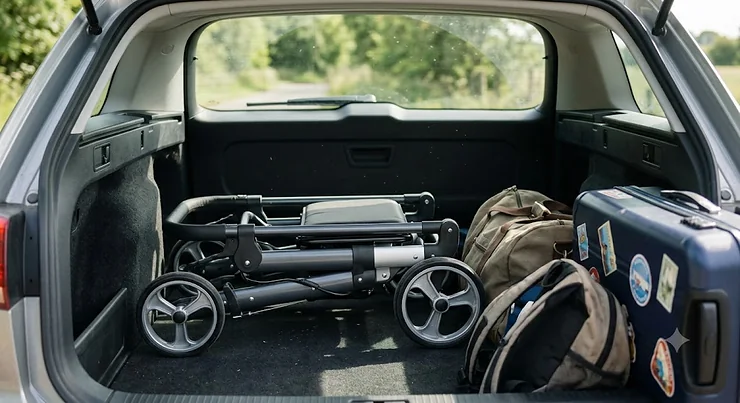
Getting a folding rollator for holidays ready for a trip is less about the packing itself and more about the week beforehand. Start by practising the fold and unfold motion at home, ten times, before you ever need to do it under time pressure at a check-in desk — muscle memory here genuinely reduces stress later. Check the brake cables and tyre pressure (on pneumatic-wheeled models) a few days before departure, since a stiff brake discovered at the airport is a bad surprise. If you’re flying, weigh the folded rollator on bathroom scales and measure its folded dimensions in centimetres — most airlines want this information at booking, not at the gate. Pack a small repair kit: a multi-tool, spare ferrule tips if applicable, and a laminated card with the model name and weight, which speeds up conversations with airline or coach staff considerably. The most common first-trip mistake isn’t mechanical at all — it’s forgetting to notify the airline or coach operator in advance that a mobility aid is travelling with you, which can mean scrambling for assistance on the day instead of having it pre-arranged.
Real-World Scenarios: Which Travel Rollator Walker Suits You?
Picture three different travellers, because the right travel rollator walker genuinely depends on the journey shape, not just the destination. First, the frequent flyer: two or three short-haul trips a year, lifting the rollator into overhead storage or a taxi boot solo, budget stretching to a premium purchase because the weight saving gets used dozens of times a year — this is squarely byACRE Carbon Ultralight Rollator territory. Second, the caravan-and-coach-trip couple: mostly UK breaks, occasional cobbled town centre, one partner able to help lift and push — here the Rollz Motion or Topro Troja Original earns its keep, particularly if longer rest stops matter more than absolute minimum weight. Third, the budget-conscious first-timer: unsure how much a rollator will actually get used, wants to try the concept on a single trip before committing serious money — the HOMCOM Rollator Walker with Seat or VOCIC Z12 Ultra Lightweight Rollator removes the financial risk while still delivering a genuinely usable folding frame.
Common Rollator Travel Problems — Solved
Problem: the rollator won’t fit in the car boot alongside luggage. Solution: measure the folded footprint before booking, and consider a tri-wheel model like the Days Tri Wheel Folding Walker, which folds narrower than most four-wheel designs.
Problem: brakes squeak or drag after storage. Solution: a light silicone lubricant on the cable housing (never the brake pad itself) usually resolves this; if it persists, most UK mobility shops offer a quick adjustment service.
Problem: the seat is too high or too low for comfortable rest stops. Solution: check seat height against your own leg length before buying rather than after — this is one of the most commonly cited complaints in aggregated reviews of budget models.
Problem: getting on and off a UK train with a rollator feels daunting. Solution: book ahead through National Rail’s Passenger Assist service, which arranges ramps and staff support at the platform, or simply turn up 20 minutes early and ask — most staffed stations can help without advance notice.
Problem: the rollator arrives damaged after a flight. Solution: photograph it before check-in, request a fragile tag, and know that airlines carry liability for damage to mobility equipment in the hold under current CAA rules.
Flying With a Rollator: Airline-Friendly Travel Essentials
A rollator for flying doesn’t need a battery declaration or special certification the way a powered scooter does — it’s a manual mobility aid, which simplifies things considerably. What you do need to sort in advance is notification: airlines want to know the make, model, folded weight and dimensions of any mobility aid before you travel, and most UK carriers allow it to be checked free of charge in addition to your standard baggage allowance, separate from hold luggage limits. Per official CAA guidance on travelling with mobility equipment, it’s worth bringing the folding instructions or operating manual, since ground staff handling an unfamiliar model benefits from a quick visual guide rather than guesswork. In practice, an airline-friendly rollator is simply one that folds compactly, doesn’t have a lithium battery to declare, and that you’ve told the airline about ahead of time — every model on this list qualifies on the first two counts; the third is entirely down to booking it in properly.
Foldable Walker for Airport Use: Security, Gates and Boarding
Here’s what actually happens with a foldable walker for airport travel, step by step: you can typically use your own rollator right up to the departure gate, at which point it’s tagged and either gate-checked into the hold or, for smaller folding models, occasionally stowed in the cabin at crew discretion — this varies by airline and aircraft size, so always confirm at booking rather than assuming. At security, a folding rollator generally goes through the X-ray scanner like any other item once unfolded and any bags removed from it; you may be asked to walk through the body scanner unassisted for a moment, so if that’s not realistic for you, requesting assistance in advance avoids an awkward scramble. On arrival, UK and EU airports are required to return your mobility aid at the aircraft door wherever possible rather than at baggage reclaim, though this depends on the specific airport’s ground handling setup. The practical takeaway: book special assistance at least 48 hours ahead where you can, since this triggers the airport’s obligation to have your rollator ready and waiting rather than delayed in the hold.
Holiday Walking Aid vs Mobility Scooter: Which Wins for Travel?
| Aspect | Rollator | Mobility Scooter | Standard Walking Frame |
|---|---|---|---|
| Typical weight | 5-9kg | 15-45kg+ | 3-5kg |
| Folds for the car boot | Usually, yes | Rarely without disassembly | Yes, but must be lifted with every step |
| Battery/airline paperwork | None needed | Requires battery declaration | None needed |
| Best for | Moderate mobility, some walking ability | Longer distances, limited walking stamina | Maximum stability needs |
A holiday walking aid decision usually comes down to how far you can comfortably walk unassisted. If you can walk moderate distances but need support and rest stops, a rollator wins decisively on portability — no battery paperwork, no heavy disassembly, and genuinely simple to fold into a boot. A mobility scooter makes more sense when the distances involved (a large theme park, a sprawling cruise ship) exceed what walking, even with support, can realistically cover, but it brings battery certification requirements that a manual rollator simply avoids. A standard walking frame without wheels offers more stability for some users, but the need to lift it with every step makes it a poor fit for a full day of holiday walking compared with any rollator on this list. If most of your travel is by car, it’s also worth checking whether you qualify to apply for a Blue Badge, since parking closer to your destination can cut the walking distance your rollator needs to cover in the first place.
✨ Don’t Miss These Exclusive Deals!
🔍 Take your holiday walking aid search to the next level with these carefully selected rollators. Click through to check current pricing and availability before your next trip.
Common Mistakes When Buying a Travel Rollator
The single most common mistake is buying based on the weight figure alone, without checking the folded dimensions against your actual car boot or luggage allowance — a rollator can be light and still awkward to store if it folds into an ungainly shape. A close second is skipping the seat height check; reviewers across budget models consistently flag seat height as a source of post-purchase regret, particularly for shorter users. Buyers also frequently underestimate max user weight margin, choosing a model rated right at their own bodyweight rather than comfortably above it, which affects both safety and the frame’s long-term durability. Finally, many people buy without checking brake type — hand-operated locking brakes are more secure for hills and slopes than simple push-down parking brakes, a distinction that matters far more on a hilly seaside holiday than it does at home on flat pavement.
What to Expect: Real-World Performance on Cobbles, Kerbs and Airport Floors
Spec sheets rarely mention texture, but it’s the thing that actually shapes how a rollator feels day to day. On smooth airport floors, every model on this list rolls easily — this is the easiest surface any rollator will ever encounter. Cobbles are the real test: smaller, harder wheels transmit more vibration and can catch in gaps, which is where the wider wheelbase of the Drive Medical Blue 4 Wheel Walker or the kerb lifters on the Topro Troja Original genuinely earn their keep over a bare-bones budget frame. Kerbs without a dropped edge are where tri-wheel designs like the Days Tri Wheel Folding Walker can feel less planted than a four-wheel alternative, since there’s one fewer contact point to distribute the tip-and-lift motion. On grass or gravel — a caravan site pitch, say — heavier frames with larger wheels generally outperform the lightest carbon options, which is worth remembering if your “holiday” is more campsite than city break.
Long-Term Cost & Maintenance of a Travel Rollator
| Tier | Typical Price Range | What You’re Paying For |
|---|---|---|
| Budget | Under £100 | Basic folding function, shorter expected lifespan under heavy travel use |
| Mid-range | £100-£350 | Better brakes, backrests, longer warranties, genuine weight savings |
| Premium | £350-£900 | Carbon fibre or hybrid function, longest warranties, lowest lift weight |
Beyond the upfront price range, ongoing costs are modest but real: brake cables occasionally need adjustment (often free or low-cost at a local mobility shop), tyres on pneumatic-wheeled models need the odd top-up, and ferrules or wheel bushings wear faster under frequent travel use than under gentle home use. A £300 mid-range rollator used weekly on holidays for five years works out to roughly 90p a week — genuinely modest against the independence it buys back. Warranty length is worth weighing directly into the price: the Topro Troja Original‘s 7-year warranty effectively lowers its cost-per-year below several cheaper models with 1-2 year cover.
Features That Actually Matter (And Those That Don’t)
What actually matters: a genuine, honest weight figure (not just the frame weight excluding wheels and bag), a one-hand fold mechanism, hand-locking brakes rather than push-down only, and a seat height that matches your own leg length. What matters less than the marketing suggests: colour options (nice to have, irrelevant to function), maximum basket capacity beyond what you’ll realistically carry on a day trip, and headline top speed claims, since a rollator’s job is stability, not speed. Reviewers consistently note that the difference between a “good” and “frustrating” rollator on holiday usually comes down to brake feel and fold ease under real conditions — not the spec sheet numbers that look impressive in a listing.
Buyer’s Decision Framework
If you fly two or more times a year and can lift a rollator solo, choose the byACRE Carbon Ultralight Rollator because the weight saving compounds every single trip. If you travel mostly by car or coach with a companion who can help, choose the Rollz Motion or Topro Troja Original because the extra stability and rest-break comfort outweigh the small weight penalty. If you’re not yet sure how often you’ll actually use a rollator on holiday, choose the HOMCOM Rollator Walker with Seat because the low price removes the risk of an expensive model gathering dust. If your trips involve tight coach aisles or narrow B&B corridors more than open pavement, choose the Days Tri Wheel Folding Walker for its narrower fold and tighter turning circle.

FAQ
❓ What is the best rollator for travelling?
❓ Can I take a rollator on a plane for free?
❓ How much does a lightweight travel rollator weigh?
❓ Can I use a rollator on a train in the UK?
❓ What is the lightest folding rollator you can buy?
Conclusion
There’s no single “best rollator for travelling” that suits everyone, and any guide claiming otherwise is skipping the part where your strength, your trip type, and your budget all pull in different directions. What this comparison shows is that genuine trade-offs exist at every price point: the byACRE Carbon Ultralight Rollator buys you the lowest possible lift weight at a premium price, the Topro Troja Original buys durability and kerb-handling for the price of a modest weight increase, and the HOMCOM Rollator Walker with Seat proves a genuinely usable travel rollator doesn’t have to cost hundreds. The right move is matching the model to the actual shape of your trips — how often you fly, whether you’re lifting solo, and what terrain you’ll cover — rather than chasing the lightest number on a spec sheet. Whichever you choose, book assistance in advance where it’s offered, practise the fold before you travel, and check current pricing before you buy, since availability and pricing shift regularly on all of these models.
Recommended for You
- Best Folding Rollator 2026: 7 Featherweight UK Picks Compared
- Best Indoor Rollator UK: 7 Top Picks for Narrow Homes (2026)
- All Terrain Rollator Walker Guide: 7 Best UK Picks for 2026
Disclaimer: This article contains affiliate links. As an Amazon Associate, I earn from qualifying purchases. If you purchase products through these links, we may earn a small commission at no additional cost to you.
✨ Found this helpful? Share it with your friends! 💬🤗
