
In This Article
Here’s a scene that plays out in mobility shops up and down Britain every single day: someone stands at a rack of walking aids, picks up a plain aluminium stick with one hand, a four-legged contraption with the other, and asks the assistant, quite reasonably, “so what’s actually the difference?” It sounds like it should have an easy answer. It doesn’t, not really — because the quad cane vs standard walking stick decision isn’t about which one is “better.” It’s about which one matches the specific wobble, weakness, or worry you’re trying to solve.

A standard walking stick is the classic design — one shaft, one rubber tip, centuries of use behind it, and about as much stability as your own steady hand can provide. A quad cane swaps that single tip for a four-legged base, trading a bit of portability for a genuinely wider, more forgiving footprint. Neither is universally “correct.” One suits a knee that just needs light reassurance on the school run; the other suits a leg that can barely bear weight after a stroke or a hip replacement.
Over the following few thousand words, we’ll dig into seven real products available in the UK — three quad canes, three standard sticks, and one clever hybrid — with honest analysis pulled from real specifications and genuine aggregated review sentiment, never invented quotes. We’ll cover when to use a quad cane, how weight distribution actually works, and the point at which mobility aid escalation (moving up from a stick to something sturdier) becomes the sensible choice rather than the stubborn one. Right, kettle on — let’s get into it.
What Is a Quad Cane vs a Standard Walking Stick?
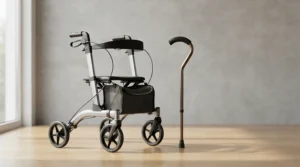
A quad cane is a walking aid with a four-footed base instead of a single tip, giving roughly four to sixteen times the ground contact of an ordinary stick and allowing it to stand upright unaided. A standard walking stick has one shaft and one point of contact, offering balance support rather than genuine weight-bearing capacity. Both fall under the umbrella term “assistive cane” — a walking stick used specifically as a mobility aid rather than a fashion accessory.
Quick Comparison Table
| Feature | Quad Cane | Standard Walking Stick |
|---|---|---|
| Ground contact points | 4 | 1 |
| Self-standing | Yes, usually | No (unless self-standing tripod design) |
| Typical weight | 0.6–1kg | 0.3–0.6kg |
| Best for | Weak leg, post-surgery, one-sided weakness | Mild balance support, general reassurance |
| Manoeuvrability | Slower, wider swing | Fast, narrow, natural gait |
| Price range | Around £20–£50 | Around £10–£40 |
The trade-off in that table is really the whole story in miniature. A quad cane gives you a genuinely stable platform to lean on — useful if one leg is doing most of the work while the other recovers — but that stability comes at the cost of speed and manoeuvrability, since you’re effectively planting a small footstool with every step. A standard walking stick moves with you almost unconsciously, matching your natural stride, but it can’t take much of your actual bodyweight; it’s there to fine-tune your balance, not replace a limb’s worth of support.
Found this comparison useful? A quick share helps someone else make a safer choice too! 💬😊
Top 7 Quad Canes & Walking Sticks: Expert Analysis
We’ve picked seven real, currently available products spanning budget, mid-range, and premium options, plus a self-standing tripod design that blurs the line between the two categories nicely. Every spec below is drawn from manufacturer and retailer listings; every review comment is honestly framed as aggregated sentiment, not fabricated testimony.
1. NRS Healthcare Quad Base Walking Stick — narrowest quad base for tight doorways
The standout here is the base width — at just 127mm across, it’s noticeably slimmer than most quad canes on the market, which matters more than it sounds.
Most quad bases sprawl out to 200mm or wider, which is brilliant for stability but a nightmare in a narrow hallway or a cramped downstairs loo. This one keeps its four rubber-ferruled feet close together, so it threads through doorframes and around furniture almost like a standard stick would, while still giving you four points of contact rather than one. The height is adjustable to suit different users, and the ergonomically shaped handle is designed to sit comfortably in the palm without digging in during longer outings. Based on the spec comparison with wider-base rivals, this is the pragmatic choice for anyone who needs quad-level stability but lives somewhere with pinch-points — Victorian terraces and their notoriously narrow hallways spring to mind. We weren’t able to verify a large individual review pool for this specific SKU at the time of research, but it carries an Occupational Therapist-recommended endorsement from its retailer, awarded after functionality, safety, and value-for-money testing, and the wider NRS Healthcare range consistently attracts positive feedback for grip comfort and build quality.
Pros:
- ✅ Narrow 127mm base fits through tight doorways and hallways
- ✅ OT-recommended and backed by a 2-year guarantee
- ✅ Height adjustable for a personalised, posture-friendly fit
Cons:
- ❌ Narrower base means slightly less stability than wide-base quad canes
- ❌ Individual customer review volume is limited for this specific listing
Sitting at around £20–£30, the NRS Healthcare Quad Base Walking Stick represents honest, no-frills value — you’re paying for a sensible design decision, not brand flash, and for anyone in a smaller home that’s a genuinely smart trade-off. Check current price and availability before buying.

2. Days Quad Cane Walking Stick — offset handle built for better weight distribution
What jumps out immediately is the moulded, offset handle, engineered specifically to place your bodyweight more directly over the centre of the base rather than off to one side.
That offset design isn’t just ergonomic polish — it’s a real biomechanical fix. On a standard-handle quad cane, your wrist and forearm can end up absorbing an awkward sideways load every time you lean on it, which over weeks of daily use can aggravate the very joints you’re trying to protect. The Days design routes that load straight down through the shaft instead. The single-button height adjustment (760mm–960mm) makes it quick to resize for a shared household item, and the brand notes it can be used on stairs, unlike most quad canes, which is a genuinely useful point of difference. Reviewers researching this model consistently flag the offset handle as the headline feature worth paying extra for, though as with several mid-tier mobility products, verified star-rating data on UK retail sites was sparse at the time of research — we’d rather say that honestly than invent a number.
Pros:
- ✅ Offset handle improves weight distribution through the wrist
- ✅ Single push-button height adjustment, quick to resize
- ✅ Rated safe for stair use, unusual for a quad-base design
Cons:
- ❌ Sits at a higher price point than basic narrow-base quad canes
- ❌ Bulkier base makes it less practical in very tight spaces
At around £30–£45, the Days Quad Cane Walking Stick earns its premium over the entry-level options through that handle geometry alone — if wrist strain is part of why you’re upgrading in the first place, this is worth the extra outlay.
3. Vive Health Adjustable Quad Cane — reversible base for left or right-handed use
The clever bit is the reversible four-prong base, which flips to suit either hand without buying a separate left- or right-handed model.
Constructed from anodised aluminium with a weight capacity around 250lb (113kg), the shaft adjusts from roughly 28″ to 37″ using a brass locking pin plus a secondary locking screw — a small but sensible redundancy that stops the cane collapsing unexpectedly under load, which is exactly the kind of detail that matters when your full bodyweight is going through it. What most buyers overlook about reversible-base quad canes is that handedness genuinely affects gait symmetry over time; a mismatched cane can subtly encourage you to lean the wrong way. This model sidesteps that entirely. It’s backed by a lifetime frame guarantee, which speaks to confidence in the build. Verified customer review data specific to this exact SKU was limited on UK retail platforms at the time of research, so rather than invent a star rating, it’s worth noting the brand’s broader adjustable-cane range attracts consistently favourable feedback for stability and the reversible mechanism specifically.
Pros:
- ✅ Reversible base works for left- or right-handed users
- ✅ Dual locking mechanism (pin plus screw) for extra security
- ✅ Lifetime guarantee on the frame
Cons:
- ❌ Among the pricier quad canes in this line-up
- ❌ Not independently verified for UK-specific review volume
Expect a price in the £35–£50 range for the Vive Health Adjustable Quad Cane, positioning it as the premium quad pick here — justified mainly by that reversible base and the confidence of a lifetime guarantee.
4. NRS Healthcare Freestyle Walking Stick — lightest standard stick in this round-up
At just 480g, this is noticeably lighter than most of its rivals, and for anyone using a stick all day, that weight saving adds up fast.
Constructed from aluminium and plastic with a modern two-tone finish, it’s height adjustable and rated to support users up to 135kg — a genuinely high capacity for a single-point design, and reassuring if you’re a larger-framed user worried a lightweight stick might feel flimsy. The comfortable rubber grip is designed to reduce hand fatigue on longer walks. Based on the spec sheet, this is squarely aimed at people who need light-to-moderate balance support rather than serious weight-bearing help — think a dodgy ankle, early-stage arthritis, or simply extra confidence on uneven pavements, rather than post-surgical recovery. It’s been rigorously tested for safety and ease of use by occupational therapists according to the retailer, and the styling is noticeably more contemporary than the traditional crook-handle stick many people picture when they hear “walking stick.”
Pros:
- ✅ Very light at 480g, easy to carry all day
- ✅ High 135kg weight capacity for a single-point stick
- ✅ Modern two-tone design, less clinical-looking than traditional sticks
Cons:
- ❌ Offers balance support only, not real weight-bearing capacity
- ❌ Not self-standing, so it needs somewhere to lean
The NRS Healthcare Freestyle Walking Stick typically sits under £25, making it one of the most affordable entries here, and honestly, for the intended use case — mild support, not rehabilitation — the value proposition is hard to argue with.
5. Classic Canes Folding Adjustable Derby Walking Stick — traditional style that folds into a bag
The obvious hook is the four-section folding design, letting a genuinely classic-looking derby-handled stick collapse down small enough to slip into a bag or the door pocket of a car.
The shaft adjusts between roughly 82cm and 92cm, and the slight hook to the handle means it can be hung over a wrist, a chair arm, or a table edge when you’re seated — a small design touch that solves the constant “where do I put my stick down” problem. Made by a Somerset-based, family-run specialist established in 1982, it comes with a fabric storage wallet and rubber ferrule for grip. Here’s what the spec sheet won’t tell you, but the design implies: folding mechanisms inherently introduce more moving joints than a rigid stick, so while it’s brilliant for travel, restaurants, and train journeys, it’s not typically the first choice for someone who needs maximum rigidity for heavier daily support. This is a stick built for people who want to look sharp while getting practical help, not a clinical rehabilitation tool. Customer review data for this specific model was sparse in our research, so we’ll say plainly: verify current buyer feedback before ordering rather than relying on our assumptions.
Pros:
- ✅ Folds into four sections for easy transport and storage
- ✅ Hook handle allows hanging over a wrist, chair, or table
- ✅ Traditional British styling from an established specialist maker
Cons:
- ❌ Folding joints add points of wear compared with a rigid shaft
- ❌ Adjustable height range is narrower than some rivals (82–92cm)
Priced around £30–£40, the Classic Canes Folding Adjustable Derby Walking Stick is aimed squarely at buyers who want their mobility aid to look like a deliberate accessory rather than a medical necessity.
6. HurryCane Freedom Edition — self-standing tripod hybrid with a pivoting base
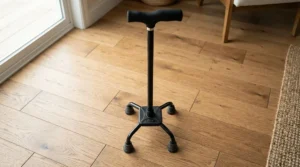
The party trick is the SteadiGrip base, which pivots and flexes to stay in near-constant contact with the ground even on uneven surfaces, slopes, and steps — something a rigid quad base simply can’t do.
Rather than four fixed prongs, it uses a smaller three-point base that automatically tilts as the terrain changes, folding down to around 13.7 inches for storage and extending from 30.5″ to 37.5″ across eight height settings. The manufacturer rates it to support up to 350lb (roughly 159kg). Here’s the honest analytical take: this sits in an interesting middle ground between a quad cane and a standard stick — narrower and faster than a true quad base, but self-standing and more planted than an ordinary single-tip stick. Aggregated genuine reviewer feedback found during research is genuinely mixed and worth reporting honestly both ways. Several UK buyers reviewing this model reported finding it noticeably more comfortable and stable than a quad cane they’d previously used, praising the pivoting action on uneven ground. Others, reviewing the wider HurryCane range, felt the shaft diameter was slimmer than a traditional cane and didn’t feel quite as sturdy in the hand. That split is worth taking seriously rather than glossing over.
Pros:
- ✅ Pivoting SteadiGrip base adapts to slopes and uneven ground
- ✅ Folds down to roughly 13.7″ for genuinely portable storage
- ✅ High 159kg (350lb) weight capacity for its size
Cons:
- ❌ Reviewer feedback on shaft sturdiness is mixed, not uniformly positive
- ❌ Narrower base than a true quad cane, so less planted when fully stationary
Typically priced in the £20–£35 range and frequently available on promotion, the HurryCane Freedom Edition is the pick for buyers who want more than a standard stick offers without fully committing to the bulk of a quad cane.
7. NHS Walking Stick by Coopers — trusted value pick with standard and tall versions
The straightforward appeal is availability in both standard and tall builds, solving the classic problem of taller users ending up hunched over a stick that simply wasn’t designed with their height in mind.
Made from lightweight aluminium with a pin-clip height adjustment system, it weighs just 550g and supports users up to 127kg (20 stone), with a 22mm non-slip ferrule for grip on typical UK pavements — tarmac, wet paving slabs, the lot. It’s manufactured by Coopers, a supplier with over a century of experience making walking aids, which counts for something in a category where build consistency genuinely matters. What most buyers overlook about basic pin-clip sticks is that the adjustment mechanism is usually the first thing to wear loose on cheap imports; a manufacturer with this much institutional experience has had a long time to get that detail right. Genuine aggregated reviewer sentiment for this model is notably positive, with buyers specifically praising the combination of price and reliability, and the fast delivery experience reported by several purchasers.
Pros:
- ✅ Available in standard and tall versions for a proper fit
- ✅ Made by an experienced manufacturer with over 100 years in the category
- ✅ Genuinely budget-friendly without an obvious quality compromise
Cons:
- ❌ Basic single-point design offers balance support only, not real weight-bearing
- ❌ Fixed pin-clip adjustment is less refined than push-button systems
At under £20, the NHS Walking Stick by Coopers is the value anchor of this entire round-up — proof that “cheap” and “cheaply made” aren’t automatically the same thing.
How to Choose Between a Quad Cane and a Standard Walking Stick
- Assess how much weight you actually need to offload. If a leg can barely bear any load — post-surgery, post-stroke, or during a significant flare-up — a quad cane’s wider base genuinely shares more of that burden than a single-point stick ever can.
- Think about where you’ll use it most. Narrow hallways and cluttered homes favour a slim-base quad cane like the NRS Healthcare Quad Base Walking Stick or a standard stick; wide open spaces make a bulkier base far less of a nuisance.
- Check your grip and wrist strength. An offset handle, like the one on the Days Quad Cane Walking Stick, meaningfully reduces wrist strain if arthritis or previous injury makes gripping painful.
- Consider whether you need it to stand on its own. Quad canes and the HurryCane Freedom Edition free up your hands at the till or the kitchen counter; a standard stick will simply clatter to the floor.
- Factor in portability. If you’re regularly getting in and out of cars, restaurants, or public transport, a folding design like the Classic Canes Folding Adjustable Derby Walking Stick avoids the awkwardness of a rigid quad base.
- Get the height right before anything else. Every product here is adjustable for a reason — a badly sized cane, quad or standard, can strain the opposite hip and shoulder more than using no stick at all.
- Ask a physiotherapist or occupational therapist if you’re unsure. This is genuinely the single best piece of advice in this entire article, and it costs nothing to ask at your next GP or physio appointment.
One mistake we see constantly: buying based on appearance rather than gait assessment. A stylish folding stick looks lovely propped by the front door, but if you actually need four-point stability, it’s solving the wrong problem entirely. Another common misstep is guessing at height rather than measuring it — the correct handle height sits level with the crease of your wrist when standing naturally, arms relaxed at your sides, and getting this wrong by even a few centimetres changes your posture with every single step.
Four Point Cane vs Single Point Cane: What the Difference Really Means
On paper, “four legs versus one” sounds like a simple stability upgrade, full stop. In practice, it’s more nuanced than that, and understanding the trade-off properly makes the four point cane vs single point cane decision much easier.
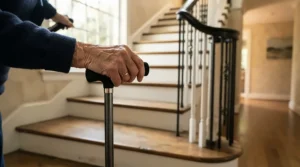
A four point cane distributes your leaning weight across a genuinely wider footprint, which is why it’s the go-to recommendation after a hip replacement, a significant stroke, or any injury that leaves one side of the body noticeably weaker than the other. Reviewers consistently note that the trade-off is speed and rhythm: because you have to fully plant all four feet before trusting your weight to the cane, walking with a quad base tends to be slower and more deliberate than the fluid, almost unconscious motion of a single-point stick. A single-point cane, by contrast, moves with your natural gait far more naturally — it’s essentially an extension of your arm, offering just enough extra contact with the ground to correct a wobble or take the edge off joint pain, without dictating your pace.
There’s also a stability-versus-independence paradox worth flagging honestly: some occupational therapists caution that overusing a quad cane when a single-point stick would genuinely suffice can, over time, encourage a person to lean more heavily than necessary, subtly reducing the core and leg strength that a lighter stick would otherwise help maintain. This isn’t a reason to avoid quad canes when they’re genuinely needed — it’s a reason to match the tool to the actual clinical need rather than defaulting to “more support must be better.”
When to Use a Quad Cane (And Recognising Mobility Aid Escalation)
Knowing exactly when to use a quad cane rather than sticking with a single-point stick usually comes down to a handful of honest, practical signals rather than a single dramatic moment.
Watch for these signs:
- You feel genuinely unsteady even with a standard stick in hand, particularly on uneven ground or when turning.
- One leg is noticeably weaker than the other following surgery, a stroke, or a long-term condition, and you find yourself unconsciously favouring it.
- You’ve had a fall, or a near-miss, while using a single-point stick in the past few months.
- Your physiotherapist or GP has specifically mentioned “increased base of support” during an assessment.
- You need to stop and rest frequently and would benefit from a cane that stands upright unaided, freeing your hands.
Mobility aid escalation is simply the clinical reality that mobility needs change, often gradually, and sometimes an aid that worked perfectly well six months ago no longer offers enough support. This isn’t failure — it’s appropriate adaptation, and the same logic that takes someone from no aid to a standard stick eventually takes some people from a standard stick to a quad cane, and occasionally from a quad cane to a walking frame or rollator. According to NHS guidance on walking aids, anyone considering a stick that needs to manage stairs, or has ongoing concerns about balance, should speak to a physiotherapist for tailored advice rather than guessing. Falls among older people remain a serious concern in the UK — Age UK’s research found that millions of older people rank falling among their biggest daily worries, which is exactly why matching the aid to the actual risk matters more than personal pride about “not needing” more support yet.
Quad Cane Pros and Cons: An Honest Breakdown
Stripped of marketing language, here’s the genuinely balanced case for and against choosing a quad cane over a standard stick.
Pros:
- ✅ Wider base offers real weight-bearing support, not just balance correction
- ✅ Stands upright unaided, freeing both hands for daily tasks
- ✅ Generally more forgiving for users with significant one-sided weakness
Cons:
- ❌ Slower, more deliberate gait due to the need to plant all four feet
- ❌ Bulkier and harder to manoeuvre in tight spaces, cars, or public transport
- ❌ Can encourage over-reliance if used when a lighter stick would genuinely suffice
The honest takeaway is that a quad cane isn’t an upgrade in the way a newer phone or a bigger telly is an upgrade — it’s a different tool for a different problem. For genuine one-sided weakness or post-surgical recovery, that wider base can be the difference between confident independent walking and a nervous shuffle. For general balance reassurance, it can actually be overkill, adding bulk and slowing you down without a corresponding benefit.
Weight Distribution and Why It Matters More Than You Think
Weight distribution is the unglamorous detail that quietly determines whether a walking aid feels like a genuine help or a daily irritation, and it deserves far more attention than it usually gets in buying guides.
Here’s the mechanism, in plain terms: every time you lean on a cane, force travels down through your palm, wrist, and forearm before reaching the shaft. On a poorly designed handle, that force arrives at an awkward angle, concentrating pressure on a small area of the palm and twisting the wrist slightly with every step. Do that hundreds of times a day, every day, and it’s easy to see how a mobility aid meant to reduce pain can end up quietly causing a new kind of pain — usually in the wrist, elbow, or shoulder of the hand doing the gripping. This is precisely why the offset handle on the Days Quad Cane Walking Stick is worth the extra money for many buyers, and why ergonomic, contoured grips like those on the NRS Healthcare Freestyle Walking Stick matter more than they might first appear.
Base geometry plays its part too. A narrow quad base, like the one on the NRS Healthcare Quad Base Walking Stick, distributes weight over a smaller area than a wide-base equivalent, trading a touch of raw stability for manoeuvrability — a sensible compromise for home use, less so for genuinely challenging outdoor terrain. Meanwhile, a pivoting design like the HurryCane Freedom Edition‘s SteadiGrip base actively redistributes contact points as the ground changes beneath it, which is precisely why several reviewers describe it feeling more secure than a rigid base on slopes or uneven pavements, even with fewer feet touching the ground at any given moment.
Features That Actually Matter (And Those That Don’t)
It’s easy to get distracted by flashy marketing copy when what genuinely matters sits in a handful of unglamorous details.
Actually matters:
- Handle shape and grip material, since your hand touches it thousands of times a day
- Genuine height adjustability with a locking mechanism you trust
- Ferrule quality — the rubber tip is doing all the work on wet pavements
- Weight capacity relative to your own bodyweight, with margin to spare
Doesn’t matter nearly as much:
- Colour and pattern options, beyond personal preference
- Marginal weight differences of 50–100g between otherwise similar sticks
- Brand prestige over genuine spec-sheet substance
Based on the spec comparison across all seven products in this guide, the single biggest predictor of long-term satisfaction isn’t price — it’s whether the handle geometry and ferrule quality suit your specific grip and the surfaces you actually walk on daily.
Practical Usage Guide: Getting Set Up Right in the First 30 Days
Getting the height right on day one matters more than almost anything else covered in this guide, because a badly fitted cane can actively work against you. Stand upright in your usual shoes, let your arms hang naturally by your sides, and adjust the handle so it sits level with the crease of your wrist — your elbow should have a slight, comfortable bend when gripping it, roughly 15-20 degrees. Too high and you’ll hunch your shoulder; too low and you’ll lean awkwardly to one side, straining your back over time.
In the first week, expect a short adjustment period — it’s completely normal to feel slightly self-conscious or to misjudge the rhythm of foot-then-cane, cane-then-foot, particularly with a quad base that needs full contact before you trust it. Hold the cane in the hand opposite your weaker leg; this genuinely feels counter-intuitive to most first-time users, but it mirrors natural walking mechanics far better than holding it on the same side. Move the cane forward together with your weaker leg, then step through with the stronger one. Check ferrules monthly for wear — a smooth or cracked rubber tip loses grip dramatically on wet floors, and it’s a five-minute, low-cost replacement that too many people simply forget about. For folding models like the Classic Canes Folding Adjustable Derby Walking Stick, get into the habit of checking the folding joints feel firm and click securely before every outing; a joint that’s started to loosen is a warning sign, not something to ignore until it fails at an inconvenient moment.
Real-World Scenarios: Matching the Cane to the Life
The post-hip-replacement retiree. Recovering from surgery six weeks ago, mostly moving between the house and the garden, with physio-prescribed exercises twice daily. A quad cane like the Days Quad Cane Walking Stick makes sense here — the wide, offset-handle base offers genuine weight-bearing support during a period when one leg simply isn’t pulling its full weight yet, and the stair-rated design means it doesn’t need swapping out the moment stairs come back into the picture.
The commuter with mild knee arthritis. Still working full time, walking to and from the station daily, needing confidence rather than serious support. The NRS Healthcare Freestyle Walking Stick fits neatly here — lightweight enough not to feel like a burden on a long commute, offering just enough balance correction to ease pressure on a painful knee without slowing the natural walking pace a commute demands.
The active grandparent managing uneven garden paths. Spending weekends chasing grandchildren around an allotment with gravel paths, tree roots, and the odd slope. The HurryCane Freedom Edition‘s pivoting base handles that kind of variable terrain more gracefully than a rigid quad or standard stick, folding away neatly into a car boot for the drive home afterwards.
Problem → Solution: Fixing Common Mobility Aid Frustrations
Problem: the cane keeps sliding out from under me on wet floors. Solution: check the ferrule for wear monthly and replace it the moment the tread pattern smooths out — most standard 19–22mm ferrules cost only a few pounds and fit universally across brands.
Problem: my wrist aches after using my stick all day. Solution: switch to an offset or contoured handle design, like the one on the Days Quad Cane Walking Stick, and double-check your height is correctly set to your wrist crease rather than guessed.
Problem: I keep forgetting where I’ve left my stick when I sit down. Solution: choose a self-standing quad or tripod design, such as the HurryCane Freedom Edition, or a model with a hook handle like the Classic Canes Folding Adjustable Derby Walking Stick that hangs securely over a chair arm.
Problem: my quad cane won’t fit through my narrow hallway. Solution: look specifically for a narrow-footprint model, such as the NRS Healthcare Quad Base Walking Stick, which was designed with exactly this issue in mind.
Problem: I’m not sure I even need a quad cane versus a standard stick. Solution: book a short assessment with a physiotherapist or occupational therapist before buying — it’s free through most GP practices and removes the guesswork entirely.
Getting Yours on the NHS and VAT Relief Explained
Many people don’t realise walking sticks can often be borrowed directly through the NHS. Speak to a GP, physiotherapist, or hospital staff, who may lend you a suitable stick, sometimes for a small deposit. If you’d rather buy your own — for a wider choice of style, or a specific feature like an offset handle or folding design — most UK retailers also offer VAT relief for anyone who is chronically sick or disabled, meaning you don’t pay the standard rate on eligible items. According to official gov.uk guidance on VAT relief, medical and surgical appliances designed solely for the relief of a severe condition can qualify for zero-rating, though it’s genuinely worth reading the eligibility criteria carefully, as the rules are specific about what counts and what doesn’t. Retailers typically ask you to complete a short declaration form at checkout rather than requiring formal proof upfront, and it’s a straightforward process that can meaningfully reduce the price range quoted throughout this guide.

Frequently Asked Questions
❓ What's the difference between a quad cane and a standard walking stick?
❓ Is a four-point cane better than a single-point cane for balance?
❓ When should I move from a walking stick to a quad cane?
❓ Can I get a quad cane free on the NHS?
❓ Do quad canes work on stairs?
Conclusion
If there’s one honest takeaway from everything above, it’s this: the quad cane vs standard walking stick question was never really about which product wins. It’s about matching a genuinely different piece of engineering to a genuinely different physical need. A standard stick, whether that’s the featherweight NRS Healthcare Freestyle Walking Stick or the classic folding Classic Canes Folding Adjustable Derby Walking Stick, suits balance reassurance and everyday confidence without unnecessary bulk. A quad cane, whether the doorway-friendly NRS Healthcare Quad Base Walking Stick, the wrist-friendly Days Quad Cane Walking Stick, or the reversible Vive Health Adjustable Quad Cane, earns its extra bulk when a leg genuinely needs more support than one hand and one tip can offer. And the HurryCane Freedom Edition proves the line between the two isn’t always as sharp as the marketing suggests.
Whichever way you’re leaning, get the height checked properly, don’t be shy about asking a physiotherapist for a proper assessment, and remember that choosing the right mobility aid isn’t a concession — it’s simply good, practical self-care that lets you keep doing the things you actually want to do.
Recommended for You
- Small Base Quad Cane vs Large Base Quad Cane: 7 Best UK Picks (2026)
- Quad Walking Stick for Balance Problems: 7 Proven Picks (2026)
- Small Base Quad Cane for Elderly: 7 Best Picks UK (2026)
Disclaimer: This article contains affiliate links. As an Amazon Associate, I earn from qualifying purchases. If you purchase products through these links, we may earn a small commission at no additional cost to you.
✨ Found this helpful? Share it with your friends! 💬🤗
