In This Article
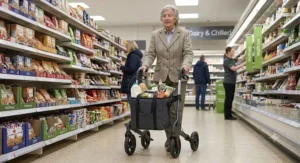
There’s a particular kind of frustration that comes with trying to carry a loaf of bread, a pint of milk and a tin of soup while also trying not to fall over. If you’ve ever balanced a shopping basket on one arm while gripping a walking stick with the other, you already know exactly why a 4 wheel rollator with shopping bag has become such a popular fixture on British high streets. It solves two problems at once: it gives you something sturdy to lean on, and it gives your shopping somewhere to live that isn’t your handbag or your teeth.
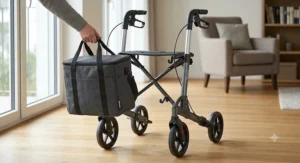
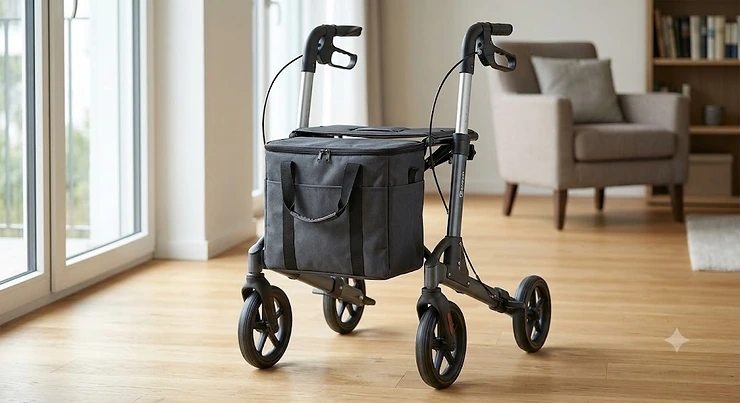
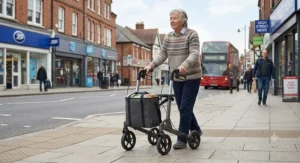
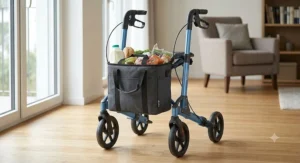
A 4 wheel rollator with shopping bag is, in plain terms, a wheeled walking frame with a built-in or attachable bag, basket, or under-seat pouch, usually paired with a fold-down seat for resting mid-errand. Unlike a basic three-wheeled tri walker, the four-wheel design spreads your weight across a wider footprint, which most users find noticeably steadier on kerbs, in supermarket aisles, and on the slight camber of a British pavement. According to NHS guidance from Guy’s and St Thomas’ Foundation Trust, a rollator frame with a basket is specifically recommended for people with moderate balance problems who want to keep walking outdoors while carrying belongings safely.
This guide walks through seven genuine, currently available models — from no-nonsense budget frames to a Norwegian-engineered premium option — with honest analysis of who each one actually suits, not just a list of specs copied from a listing page. We’ve dug into real aggregated review sentiment, compared weight capacities, folding mechanisms and bag sizes, and worked out where the genuine trade-offs sit. By the end, you should know exactly which rollator with bag and seat fits your build, your local terrain and your budget, without having to trawl through a dozen tabs yourself.
Quick Comparison Table
| Rollator | Weight | User Weight Limit | Bag Type | Price Range | Best For |
|---|---|---|---|---|---|
| NRS Healthcare A-Series | 6.5kg | 135kg | Zipped under-seat pouch | around £55-£70 | Everyday reliability |
| Days 100 Series 105 | 7kg | 165kg | Under-seat storage bag | around £45-£65 | Best-selling all-rounder |
| NRS Compact Easy | 7.5kg | 133kg | 5kg detachable bag | around £60-£80 | Small cars, tight flats |
| Drive Medical R8 Scout | 7kg | 130kg | Under-seat carry bag | around £70-£95 | Taller users, bus travel |
| MobiQuip All Terrain | 10.5kg | 130kg | Spacious shopping bag | around £110-£150 | Uneven ground, allotments |
| Topro Troja 5G | 7.8kg | 150kg | 10kg / 15L magnetic-close bag | around £280-£350 | Premium, long-term daily use |
| Eazy Fold Lightweight | 7-8kg | 100-120kg | Storage bag | under £45 | Budget starter rollator |
Looking across the table, the spread in price isn’t really about quality alone — it’s about what each rollator is engineered to solve. The NRS Healthcare A-Series and Days 100 Series 105 sit at the affordable end and cover most flat-pavement, local-shops use cases perfectly well, while the Topro Troja 5G justifies its premium price tag through TÜV-certified durability and a genuinely larger bag for anyone doing a full weekly shop. If your route to the shops includes anything rougher than tarmac, the MobiQuip All Terrain is worth the extra outlay purely for its pneumatic tyres.
💬 Found a model that catches your eye already? Scroll down for the full breakdown before you decide.
Top 7 4 Wheel Rollators With Shopping Bag: Expert Analysis
Choosing the best rollator for shopping isn’t just about the bag — it’s about how the whole frame behaves once that bag is loaded with a bit of weight. A rollator that feels stable empty can behave very differently once you’ve hung four tins of beans and a newspaper off it. Below, each of these seven models has been assessed on its real-world balance, not just its spec sheet.
1. NRS Healthcare A-Series Lightweight 4 Wheel Rollator — OT-recommended all-rounder
The A-Series has been assessed by occupational therapists for ease of use, which matters more than it sounds — it means the brake tension, seat height and handle range have actually been tested against real mobility needs rather than just engineered on paper. Height adjusts between roughly 830mm and 980mm across five settings, and the whole frame weighs a manageable 6.5kg, so lifting it into a car boot isn’t a two-person job.
Based on the spec comparison, what stands out here is the zipped under-seat bag rather than an open basket — your shopping stays hidden and secure rather than visible to anyone walking past, which several users specifically value on bus journeys. This model suits anyone who wants a dependable, no-fuss rollator for local shopping trips and doesn’t need a big weekly-shop capacity. Reviewers consistently report that the loop cable brakes are easy to operate even with reduced grip strength, which is a genuine win for anyone with arthritic hands.
Pros:
- ✅ OT-assessed design suited to weaker grip strength
- ✅ Zipped bag keeps shopping discreet and secure
- ✅ Light enough at 6.5kg to lift into most car boots
Cons:
- ❌ Bag capacity is modest for a full weekly shop
- ❌ Only 7-inch wheels, less confident on gravel
Priced around £55-£70, this sits comfortably in the mid-budget bracket, and for the OT-recommended badge alone it represents solid value for daily local use.
2. Days 100 Series Lightweight Rollator 105 — best-selling all-rounder
The Days 105 has become one of the most widely stocked rollators in the UK for a reason: it does the fundamentals well without overcomplicating things. At just 7kg with a maximum user weight of 165kg, it manages to be both light to manoeuvre and rated for a genuinely wide range of body types, which isn’t always the case with budget frames.
What most buyers overlook about this model is that the under-seat bag isn’t an afterthought accessory — it’s built into the design from the outset, sitting beneath a padded, curved backrest that several reviewers note is more comfortable than expected for a sub-£70 rollator. The loop-lock brakes click into place when you sit, which Based on the spec comparison is a genuinely useful safety feature that cheaper alternatives sometimes skip. One aggregated review theme worth flagging honestly: a small number of users note the lightweight build feels “not as sturdy as other rollators,” though most still rate it as good value for the price point. This is the rollator we’d point a first-time buyer toward if they want something proven rather than flashy.
Pros:
- ✅ Exceptionally high 165kg weight capacity for its price
- ✅ Padded curved backrest rated comfortable by reviewers
- ✅ Brakes lock automatically when the seat is used
Cons:
- ❌ Some reviewers note the frame feels light-duty over time
- ❌ Fewer colour options than premium competitors
At around £45-£65, this is genuinely one of the best-value rollators with a shopping bag currently sold in the UK.
3. NRS Healthcare Compact Easy Rollator — best for small spaces
If you live in a flat with a narrow hallway, or your car boot barely fits a folded pushchair, the Compact Easy earns its name honestly. It folds by pulling the seat up and unclipping the side levers, collapsing down to a shape that genuinely fits into cupboards and car boots rather than just claiming to.
Here’s what the spec sheet won’t tell you, but reviewers note: the front swivel wheels make a noticeable difference navigating narrow supermarket aisles and doorways compared with fixed-wheel budget models, since you can pivot on the spot rather than three-point-turning a rigid frame. The detachable bag has a stated 5kg load capacity — enough for a proper light shop, though not a full trolley-load. At 7.5kg total weight and a 133kg user limit, it’s a sensible middle-ground choice for anyone prioritising manoeuvrability over maximum capacity, particularly useful for buyers who value independent living in smaller homes where storage space is genuinely at a premium.
Pros:
- ✅ Folds exceptionally compact for tight storage
- ✅ Swivel front wheels ease tight indoor turns
- ✅ Reflectors improve visibility on darker evenings
Cons:
- ❌ 5kg bag limit won’t stretch to a big shop
- ❌ Seat depth is shallower than some competitors
Expect to pay around £60-£80, which is reasonable given the folding engineering involved.
4. Drive Medical R8 Scout (Latitude Healthcare) — best for taller users and public transport
Standing upright is a genuine sticking point for taller rollator users, since a lot of budget frames simply don’t extend high enough. Reviewers consistently report that the R8 Scout is “the tallest I have found,” which is a meaningful differentiator if you’ve previously found yourself stooping over a walking frame that tops out too low.
The rustproof aluminium frame is built for durability rather than ultra-light travel, weighing 7kg with a padded seat and an under-seat carry bag. Based on the spec comparison, the arthritic-friendly loop brakes are a real strength here, and one reviewer specifically praised the rollator for making it easier and safer to board buses — a use case that’s easy to overlook when comparing specs on paper but genuinely matters for anyone reliant on public transport. Honestly, though, real customer feedback does flag one recurring niggle: several reviewers report the seat lid doesn’t always stay upright against the backrest, occasionally causing shopping in the bag to tip backwards. It’s a minor but repeated complaint worth knowing before you buy.
Pros:
- ✅ Tallest handle range among comparable rollators
- ✅ Rustproof frame built for long-term durability
- ✅ Praised specifically for safer bus boarding
Cons:
- ❌ Seat lid reportedly doesn’t always sit flush against backrest
- ❌ Heavier feel than ultra-lightweight competitors
At around £70-£95, it’s mid-range priced but arguably underrated for taller users specifically.
5. MobiQuip All Terrain Rollator — best for rough ground and outdoor shopping trips
Not every shopping trip happens on flat tarmac. If your route to the local shop crosses a gravel car park, a grass verge, or an uneven village pavement, a standard rollator with small solid wheels will judder and catch constantly. The MobiQuip All Terrain solves this with 12-inch pneumatic tyres, which absorb shock in a way that 6- or 8-inch wheels simply cannot.
What the spec sheet doesn’t fully convey is how much of a confidence difference air-filled tyres make on rough ground — reviewers describe it as giving genuine independence back to people who’d otherwise avoid uneven routes altogether. The trade-off, unsurprisingly, is weight: at 10.5kg it’s noticeably heavier than the aluminium indoor-focused models on this list, and its wider footprint makes it less ideal for narrow doorways. The spacious shopping bag and built-in crutch holder are thoughtful additions for anyone doing a proper outdoor shop, such as a trip to a farm shop or market. This is a walking aid with basket built specifically for buyers who refuse to let terrain limit their independence.
Pros:
- ✅ Pneumatic tyres handle grass, gravel and uneven paths
- ✅ Height-adjustable handles from 77cm to 96cm
- ✅ Spacious bag suited to a proper outdoor shop
Cons:
- ❌ Heaviest model on this list at 10.5kg
- ❌ Wider frame less practical for narrow indoor doorways
Priced around £110-£150, it’s a specialist purchase, but one that genuinely earns its premium over standard indoor rollators.

6. Topro Troja 5G — premium pick for daily, long-term use
Norwegian engineering has a reputation for taking unglamorous everyday objects and quietly over-building them, and the Troja 5G is a good example. It’s TÜV-certified to NS-EN ISO 11199-2, the international standard for rollator safety and quality, and separately certified to ISO 10993-1 for biocompatibility — Based on the spec comparison, that’s a meaningfully higher testing bar than most budget frames disclose.
What most buyers overlook about this model is the “Memory Function,” which retains your preset handle height on a numeric scale so you don’t have to re-measure it every time you readjust after someone else has used it. The shopping bag itself holds up to 10kg across a genuine 15-litre volume, with a magnetic closure and an outside pocket — noticeably more considered than a basic mesh pouch. At 7.8kg it remains light for a premium frame, and it supports users up to 150kg. This is the rollator for someone who plans to rely on it daily for years, not just for the odd errand, and who wants the reassurance of proper independent third-party certification behind it.
Pros:
- ✅ TÜV-certified frame with biocompatibility testing
- ✅ Memory Function retains your exact handle height
- ✅ Genuinely spacious 15-litre magnetic-close shopping bag
Cons:
- ❌ Significantly pricier than every other model here
- ❌ Overkill for occasional, light-duty use
Expect to pay in the region of £280-£350, positioning it firmly as the premium choice on this list — but one that reviewers and OTs alike consistently rate among the best rollators on the UK market.
7. Eazy Fold Lightweight Rollator — best budget starter rollator
Not everyone wants to commit hundreds of pounds to a mobility aid before they know how much they’ll actually use it, and that’s exactly the gap the Eazy Fold fills. As one of Amazon UK’s best-selling rollators, it covers the essentials — an aluminium folding frame, adjustable handles, 8-inch wheels, ergonomic brakes, a soft seat and a storage bag — without any premium extras.
Here’s the honest trade-off: at under £45, you’re not getting TÜV certification or a Memory Function, and aggregated review sentiment suggests the build feels noticeably lighter-duty than the mid-range options on this list, particularly under a fully-loaded bag. What most buyers overlook, though, is that for someone recovering from surgery on a short-term basis, or testing whether a rollator suits their needs before investing further, that’s a perfectly reasonable compromise. It’s the sensible entry point rather than the long-term answer, and it’s honest about that trade-off through its price alone.
Pros:
- ✅ Lowest price point of any model on this list
- ✅ Genuinely lightweight and easy to fold one-handed
- ✅ Ideal short-term or trial-purchase option
Cons:
- ❌ Build quality feels lighter-duty under a full bag
- ❌ Lower published weight capacity than rivals
At under £45, it’s the obvious pick for anyone who wants to try a rollator before committing to a bigger spend.
Practical Usage Guide: Getting the Most From Your Rollator
Buying the right rollator with bag and seat is only half the job — using it properly is what actually keeps you steady. In your first week, get the handle height right before anything else: stand naturally, let your arms hang, and the handles should sit roughly level with your wrist crease, giving you a slight, comfortable elbow bend. Too low and you’ll stoop forward, which defeats the purpose; too high and you’ll lose leverage on the brakes.
A common first-month mistake is loading the shopping bag unevenly, which can make the frame pull to one side, particularly on models with a single under-seat pouch rather than a wide basket. Distribute weight evenly, and avoid overloading beyond the stated capacity even briefly — it strains the folding mechanism over time. For maintenance, check the wheels monthly for grit build-up (a stiff brush does the job), and test the brakes weekly by pushing the frame forward on a slight slope with the brakes engaged; if it creeps, the cable tension needs adjusting. Most rollators, including several on this list, have adjustable brake tension specifically for this reason.
✨ Not sure which handle height or bag size suits your build? Check current pricing and product pages for exact sizing charts before you order.
Real-World Scenarios: Who Needs Which Rollator
Picture Margaret, 78, living alone in a two-bedroom bungalow with a small driveway and a corner shop four hundred metres away. She’s steady on flat ground but tires quickly and wants somewhere to sit halfway. For her, the Days 100 Series 105 or NRS Healthcare A-Series makes sense — light enough to manage solo, an under-seat bag for a modest shop, and a seat for the inevitable rest stop.
Now consider Frank, 84, who lives in a rural village where the pavement runs out after the postbox and turns to gravel and grass verge. Standard rollators have let him down before, catching on uneven ground. The MobiQuip All Terrain is built precisely for this scenario — the pneumatic tyres absorb the terrain rather than fighting it, restoring a walk he’d otherwise avoid. And then there’s Sheila, 71, recently discharged from hospital after a hip operation, using a rollator daily for the foreseeable future rather than occasionally. For her, the upfront cost of the Topro Troja 5G makes long-term sense: certified durability, a properly sized bag for weekly shops, and a design built to be relied on every single day rather than occasionally reached for.
Problem → Solution: Common Rollator Shopping Bag Issues
Problem: The bag tips or the seat lid won’t stay upright. This is a documented issue on some models, including reviewer feedback on the Drive Medical R8 Scout. Solution: check the backrest fixing screws are fully tightened before first use, and avoid overloading one side of the bag.
Problem: Wheels struggle on gravel or grass. Standard 6-8 inch solid wheels weren’t designed for rough terrain. Solution: consider an all-terrain model like the MobiQuip All Terrain with pneumatic tyres if your regular route includes anything beyond flat pavement.
Problem: The rollator won’t fit in a small car boot. Solution: prioritise fold width over overall features — the NRS Compact Easy was specifically engineered around this constraint.
Problem: Weak grip makes brakes hard to operate. Solution: look specifically for “arthritic-friendly loop brakes,” a feature explicitly built into the NRS Healthcare A-Series, Days 105, and Drive Medical R8 Scout.
Problem: Shopping is visible to passers-by. Solution: choose a zipped or magnetic-closure bag, such as those on the NRS Healthcare A-Series or Topro Troja 5G, rather than an open mesh basket.
How to Choose a 4 Wheel Rollator With Shopping Bag
- Measure your terrain honestly. If your route includes gravel, grass or cobbles, prioritise pneumatic or larger wheels over a lighter frame.
- Check the weight capacity against your actual weight, not just a rounded estimate — manufacturers build in margin, but it’s not infinite.
- Get the handle height range right for your build, especially if you’re above average height, where several budget frames fall short.
- Decide between a discreet zipped bag and an open basket based on how much you value privacy versus quick access.
- Weigh up folding size against your storage space, particularly if the rollator needs to fit in a small car boot regularly.
- Consider brake type if grip strength is limited — arthritic-friendly loop brakes are worth specifically seeking out.
- Factor in whether this is short-term or long-term use, since that changes whether a budget or premium model represents better value.
Common Mistakes When Buying a Rollator With Bag and Seat
The single most common mistake is buying based on price alone without checking the handle height range against actual height — a rollator that’s too short forces a stooped posture that increases fall risk rather than reducing it, somewhat defeating the point of buying one. A second frequent error is overlooking bag capacity entirely; buyers often assume “a bag is a bag,” then discover the under-seat pouch on their new rollator can’t hold more than a loaf and a few tins. Reviewers consistently report disappointment here more than with any other single feature.
A third mistake is ignoring terrain until after purchase. Someone buying for indoor use at a care setting has entirely different wheel needs to someone walking to allotments across grass. Finally, many buyers skip checking VAT relief eligibility before paying full price — under UK rules, chronically ill or disabled buyers may be entitled to VAT-free purchase on mobility aids, detailed fully in HMRC’s official VAT Notice 701/7 for disabled people, which can meaningfully reduce the price of a premium model like the Topro Troja 5G.
4 Wheel Rollator vs Shopping Trolley Walker: What’s the Difference
A shopping trolley walker and a 4 wheel rollator with shopping bag might look similar in a shop window, but they’re built for different jobs. A traditional shopping trolley is designed primarily to carry goods — it has larger baskets and is optimised for capacity, but it typically offers minimal walking support and no seat. A rollator, by contrast, is a genuine mobility aid first and a shopping carrier second: it’s built to bear your body weight through the handles, has height-adjustable grips, proper brakes, and a seat rated to support you sitting down, none of which a standard trolley is engineered for.
| Feature | 4 Wheel Rollator | Shopping Trolley Walker |
|---|---|---|
| Weight-bearing support | Yes, engineered for it | Minimal to none |
| Seat included | Usually, rated for user weight | Rarely |
| Brakes | Lockable, adjustable | Basic or none |
| Shopping capacity | Moderate (bag/basket) | Higher (dedicated basket) |
| Best For | Mobility support plus light shopping | Carrying goods without walking support |
Reviewers and occupational therapists alike are fairly consistent on this point: if you need genuine physical support while walking, a rollator is the correct choice, and a shopping trolley should never be relied upon as a substitute mobility aid, however sturdy it looks.
Features That Actually Matter (And Those That Don’t)
Marketing copy loves to talk up colour options and “sleek modern design,” but based on the spec comparison across all seven models here, three features consistently separate a good rollator from a mediocre one: brake type (arthritic-friendly loop brakes genuinely matter for grip-limited users), wheel size relative to your terrain, and bag closure type relative to how you’ll use it. A wider colour range or a built-in cup holder is genuinely nice to have, but it won’t affect your day-to-day stability or independence the way those three factors will.
One feature that’s easy to dismiss but shouldn’t be is handle height range — reviewers of the Drive Medical R8 Scout specifically praised it for extending taller than competitors, which for a taller user isn’t a minor convenience, it’s the difference between comfortable posture and constant strain.
Long-Term Cost & Maintenance
A cheaper rollator isn’t automatically better value once you factor in lifespan. The Eazy Fold, at under £45, is excellent value for short-term or trial use, but if you’re using a rollator daily for years, a model like the Days 105 or Topro Troja 5G may work out cheaper per year of genuine service, particularly given the Troja’s TÜV certification and seven-year warranty commonly offered on comparable Topro models. Maintenance costs are generally low across the board — occasional wheel or brake cable replacement — but a sturdier frame typically needs fewer replacement parts over time, which is worth weighing against the higher upfront cost.
Safety, Regulations & VAT Relief Guide
All rollators sold in the UK should meet ISO 11199-2, the international safety standard specifically covering wheeled walking frames — worth checking for on the product listing before buying. Beyond the equipment itself, Age UK’s falls prevention guidance notes that staying active and maintaining strength and balance is one of the most effective ways to reduce fall risk generally, alongside using the right walking aid — a rollator is a tool that supports this, not a replacement for it.
On cost, many buyers don’t realise mobility aids like rollators can qualify for VAT relief if bought for personal use by someone chronically ill or disabled, effectively reducing the price by 20% at checkout on eligible retailer sites — no medical proof is usually required, just a simple declaration form.
4 Wheel Rollators for Independent Living
The phrase “independent living” gets used a lot in this category, but it’s genuinely the point of the whole exercise. A rollator that lets you walk to the shops, sit when you need to, and carry a modest bit of shopping home without asking for help isn’t just a convenience — professional homecare guidance frames the right walking aid choice as directly linked to maintaining confidence and reducing reliance on others for everyday errands. Choosing a rollator that actually fits your terrain, height and grip strength — rather than the cheapest one available — is what turns that independence from theoretical into genuinely usable, day after day.
FAQ
❓ Do I need a prescription to buy a 4 wheel rollator with shopping bag?
❓ Can I get a rollator on the NHS?
❓ What's the difference between a 3 wheel and 4 wheel rollator with bag?
❓ How much weight can a rollator shopping bag hold?
❓ Am I eligible for VAT relief on a rollator with storage pouch?
Conclusion
A 4 wheel rollator with shopping bag isn’t a luxury item — it’s the difference between avoiding the shops altogether and walking there with confidence, knowing you’ve got somewhere to sit and somewhere secure to put your bits and pieces. Across the seven models covered here, there’s genuinely no single “best” choice; there’s a best choice for your terrain, your build, your grip strength and how often you’ll actually use it. Budget buyers are well served by the Days 100 Series 105 or Eazy Fold, taller users and bus travellers should look closely at the Drive Medical R8 Scout, anyone walking on rough ground needs the MobiQuip All Terrain, and daily long-term users will likely get the best value, over time, from the Topro Troja 5G.
Whichever you choose, take the time to check the handle height range against your own build, and don’t skip checking VAT relief eligibility if you qualify — it’s an easy saving that too many buyers miss.
✨ Ready to Find Your Perfect Rollator?
🔍 Take a closer look at any of the models above and check current pricing and availability before you decide. The right rollator with bag and seat could be the simplest change you make to your daily independence this year!
Recommended for You
- Best 4 Wheel Rollator UK: 7 Top Picks Compared (2026)
- Best 3 Wheel Rollator UK 2026: Top 7 Tri Walkers Ranked
- Rollator Walker for Elderly: 7 Trusted Picks for 2026
Disclaimer: This article contains affiliate links. As an Amazon Associate, I earn from qualifying purchases. If you purchase products through these links, we may earn a small commission at no additional cost to you.
✨ Found this helpful? Share it with your friends! 💬🤗
