In This Article
A rollator should give you back your afternoon, not steal it before you’ve even left the front door. If you’ve ever wrestled a clunky old walking frame into a car boot while balancing on one leg and muttering things you wouldn’t say in front of your grandchildren, you already understand why weight matters so much more than most buying guides let on. A lightweight rollator, in the simplest terms, is a wheeled walking frame typically built from aluminium or carbon fibre and weighing under roughly 8kg, designed to be pushed rather than lifted, and light enough for most users to fold, carry and load into a car unassisted.
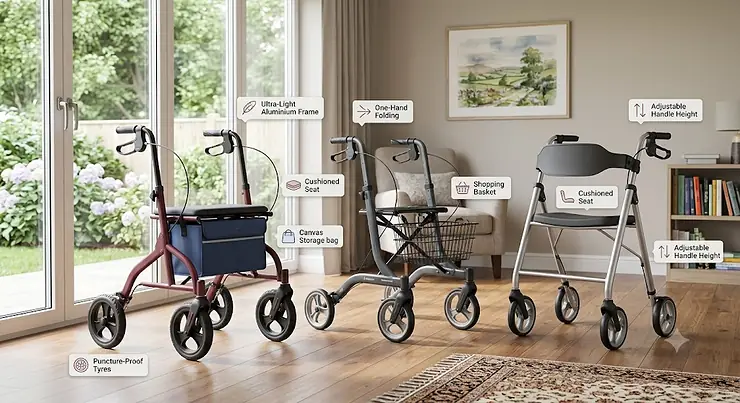
The best lightweight rollator for you isn’t necessarily the lightest one on the shelf. It’s the one that matches your strength, your terrain, and how far you actually plan to walk with it. This guide cuts through the marketing fluff and gets into real specifications, honest aggregated reviewer sentiment, and genuine side-by-side analysis of seven rollators currently sold in the UK, from budget tri-walkers under £90 to a carbon fibre model that’s genuinely one of the lightest four-wheel rollators made for adults. According to NHS guidance from Guy’s and St Thomas’, a wheeled frame helps maintain a more natural walking pattern for people managing moderate balance problems, which is exactly why getting the right one matters so much.
We’ll walk through seven real products, three comparison tables, practical setup advice, and the mistakes that trip up most first-time buyers (sometimes literally). By the end, you should know not just what’s lightest, but what’s actually right for you.
Quick Comparison Table: 7 Lightweight Rollators at a Glance
| Rollator | Weight | Frame | Price Range | Best For |
|---|---|---|---|---|
| Ultra Lightweight Tri Walker | 4.5kg | Steel/aluminium hybrid | Under £90 | Tight indoor spaces, budget buyers |
| Lightest in the UK Folding Rollator | ~5-5.8kg | Aluminium | £80-£110 | Occasional outings, car boot storage |
| MobiQuip Lightweight 4-Wheel Rollator | 6.4kg | Aluminium | £90-£130 range | Everyday budget aluminium pick |
| Topro Troja Original | 6.6-7.4kg | Aluminium | £190-£240 range | Long walks, award-winning comfort |
| Rehasense Space LX | 5.7kg | Aluminium | £240-£280 range | Style-conscious outdoor users |
| VOCIC Z11 X-Way | 8.5kg | Aluminium, all-terrain | £150-£200 range | Rough ground, higher weight capacity |
| byACRE Carbon Ultralight | 4.8kg | Carbon fibre | £700-£900 range | The lightest four-wheel rollator on the market |
Looking at the table, there’s a clear weight split between the sub-6kg cluster and the sturdier 6.5kg-plus models, and that split usually tracks with terrain capability rather than quality. The byACRE Carbon Ultralight and the budget tri-walker both undercut 5kg, but they get there in very different ways — one through premium carbon fibre engineering, the other through a simpler, smaller frame with fewer features. Meanwhile, the VOCIC Z11 X-Way carries the most weight in the table, and that’s the trade-off for its all-terrain wheels and the highest user capacity of the group.
💬 Just one click — help others make better buying decisions too!😊
Top 7 Lightweight Rollators: Expert Analysis
1. Ultra Lightweight Tri Walker — lightest three-wheel design in this line-up
Weighing in at only 4.5kg, this tri-walker is aimed squarely at buyers who find four-wheel rollators too bulky to store or lift. Three wheels mean a genuinely tight turning circle, which matters more than most people expect once you’re navigating a kitchen doorway or a crowded café aisle. Based on the spec comparison, the trade-off for that manoeuvrability is a narrower support base, so it suits people who need light-touch balance assistance rather than heavier weight-bearing support. It comes with brakes and an attached shopping bag, which is unusual at this price point and genuinely useful for short errands.
Reviewers consistently report that the low weight is the standout feature, with several noting it’s noticeably easier to lift into a car boot than their previous rollator. A common thread in aggregated feedback is that the seat, where fitted, is compact — fine for a brief rest but not built for lounging. What most buyers overlook about tri-walkers generally is that the three-wheel geometry can feel slightly less planted when leaning on the frame at a standstill compared with a four-wheel design, so it’s worth testing your balance on it before committing to daily use outdoors.
Pros:
- ✅ Among the lightest tri-walkers widely available in the UK
- ✅ Tight turning circle for narrow indoor spaces
- ✅ Comes with brakes and a shopping bag as standard
Cons:
- ❌ Narrower base feels less stable on cambered pavements
- ❌ Seat space is limited compared with four-wheel rivals
At under £90, this is one of the cheapest routes into a genuinely light rollator, and the value verdict is straightforward: if your main use is short indoor and doorstep trips, it’s hard to beat for the money.
2. Lightest in the UK Folding Rollator — one-hand folding for quick car boot storage
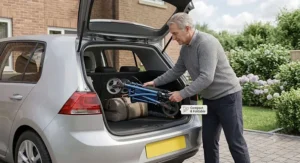
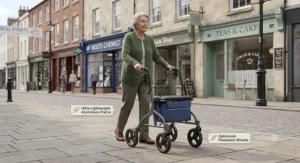
This aluminium rollator is marketed around an under-5kg promise, and while real buyer feedback shows some units have landed closer to 5.8kg due to what the supplier described as a manufacturing variance, it still folds down small enough to be genuinely one-hand manageable for most users. The frame includes a cane holder, locking brakes, and a full backrest, which is a more generous features list than you’d expect at this price. Based on aggregated feedback, the one-hand fold mechanism is the headline strength here: pull the seat strap, and the frame collapses flat enough to slide into most car boots without a struggle.
Here’s what to weigh: a genuine, verified customer noted that the brake levers felt stiff when new but loosened with use, and that some owners solved the “won’t stay folded during transport” niggle with a simple strap or bungee cord rather than treating it as a fault. Reviewers consistently note the backrest strap gives good support “if you sit the correct way”, implying a mild learning curve on first use. For an occasional-use rollator kept mainly in the car for spontaneous outings, it does its job well.
Pros:
- ✅ Genuinely easy one-hand fold for car boot storage
- ✅ Full backrest and cane holder included as standard
- ✅ Comfortable padded seat according to real buyer feedback
Cons:
- ❌ Actual weight has varied from the advertised under-5kg figure
- ❌ Folding mechanism benefits from an added strap for transport
Priced around £80-£110, it represents solid value if you check current listings and reviews before ordering, given the reported weight inconsistency between units.
3. MobiQuip Lightweight 4-Wheel Aluminium Rollator — silver aluminium frame at 6.4kg
The MobiQuip sits in a sensible middle ground: light enough to lift comfortably, but built with a proper four-wheel aluminium frame rather than a stripped-down tri-walker chassis. What most buyers overlook about this weight class is that 6.4kg is still roughly a third lighter than many “standard” steel rollators still sold on the high street, so the jump in stability from three wheels to four doesn’t come with a punishing weight penalty. It includes a basket, loop brakes designed to need minimal hand strength, a walking stick holder, and height-adjustable handles.
A genuine, verified reviewer in their late seventies described it as easy to assemble straight out of the box despite having weak hands, and reported using it confidently around a large retail outlet on the first outing. Aggregated sentiment consistently praises the ergonomic handle height and the zipped storage pocket under the seat, with several reviewers specifically calling out fast delivery. The honest downside, based on the spec sheet, is that loop brakes require a full hand squeeze rather than a light single-finger pull, which may matter if you have significant grip weakness.
Pros:
- ✅ Four-wheel aluminium stability at a genuinely light 6.4kg
- ✅ Easy assembly reported even by users with limited hand strength
- ✅ Height-adjustable handles with a zipped underseat pocket
Cons:
- ❌ Loop brakes need a firmer squeeze than lever-style alternatives
- ❌ Basket capacity is smaller than premium aluminium rivals
In the £90-£130 range, this is a strong all-rounder for buyers who want four-wheel confidence without stepping up to premium Scandinavian pricing.
4. Topro Troja Original — award-winning comfort from a Norwegian specialist
The Troja Original weighs 6.6kg in its smaller size and 7.4kg in the larger, which puts it a notch above the budget aluminium options but still comfortably inside “lightweight” territory. What the spec sheet won’t tell you outright is why this model keeps winning design awards: it’s the combination of ball-bearing hubs in the wheel forks with a slender, low-profile frame that makes it noticeably smoother to push over paving joints and door thresholds than cheaper models with plain bushings. The seat is a washable mesh fabric rather than solid plastic, and the shopping net holds up to 10kg, genuinely useful for a proper supermarket run.
Reviewers and independent reviewers consistently note the tool-free, numbered handle-height adjustment as a standout practical touch, since it lets two people share one rollator and return to their own setting in seconds. Based on the spec comparison, the sealed ball-bearing wheels mean you won’t be dealing with the grinding, sticky wheels that plague loose-bearing budget rollators after a year of daily outdoor use. On the downside, the mesh seat, while breathable, offers less cushioning for longer rests than a padded alternative.
Pros:
- ✅ Ball-bearing wheels for smoother, quieter rolling long-term
- ✅ Tool-free numbered handle height adjustment
- ✅ 10kg-capacity shopping net for proper errands
Cons:
- ❌ Mesh seat is less cushioned than padded rivals
- ❌ Larger size approaches 7.4kg, at the upper edge of “lightweight”
Typically found in the £190-£240 range, the Troja Original earns its price through genuine engineering depth rather than branding alone.
5. Rehasense Space LX — Scandinavian styling at just 5.7kg
The Space LX is one of the lightest full-featured aluminium rollators here, at 5.7-5.8kg depending on size, while still carrying a 150kg (23-stone) maximum user weight. Based on the spec comparison, that strength-to-weight ratio is unusually good for the price bracket, achieved through the same “X-frame” folding geometry used by several premium Danish brands. The patented “Click & Safe” catch is a genuinely thoughtful detail: it locks the folded frame shut so it can’t spring open mid-lift, addressing a complaint reviewers commonly raise about cheaper folding rollators.
Aggregated review sentiment highlights the ease of turning as the standout trait, describing it as one of the easiest X-frame rollators to manoeuvre in tight retail aisles. The seven-year frame warranty is well above the one-to-two-year norm for budget models, which says something about the manufacturer’s confidence in the build. What most buyers overlook is that the shopping bag here is rated for 5kg only, noticeably less than the Troja’s 10kg net, so it suits lighter daily errands better than a big weekly shop.
Pros:
- ✅ 5.7kg frame with a 150kg user weight capacity
- ✅ “Click & Safe” folding catch prevents accidental reopening
- ✅ Seven-year frame warranty, well above the market norm
Cons:
- ❌ Shopping bag capacity (5kg) is lower than some rivals
- ❌ Premium styling and colours push it above true budget pricing
At around £240-£280, it’s positioned as a mid-premium choice, and the analysis stacks up: you’re paying for warranty confidence and folding safety as much as raw weight saved.
6. VOCIC Z11 X-Way — the all-terrain option built for rougher ground
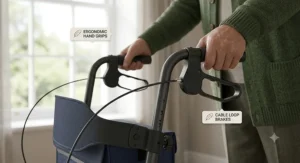
At 8.5kg, the VOCIC Z11 X-Way is the heaviest model on this list, and it’s worth being upfront about that rather than dressing it up. Here’s what to weigh: it earns that extra weight with genuinely all-terrain wheels and a maximum user capacity reported up to 172kg, alongside an ergonomic seat and backrest combination that’s more generously padded than most of the lighter competitors. If your daily walk includes gravel drives, uneven verges, or cobbled market squares, the wider wheelbase and larger wheels here will feel noticeably steadier than a rollator optimised purely for smooth pavement.
Based on aggregated buyer sentiment for this style of all-terrain rollator, the trade-off is expected: extra bulk when folded and more effort required to lift it into a car boot solo. This is honestly the entry on this list least suited to someone prioritising minimum weight above all else, but for buyers who tried a sub-6kg model and found it skittish on rough surfaces, the added stability here can be the more sensible, safer choice.
Pros:
- ✅ All-terrain wheels genuinely cope with gravel and uneven ground
- ✅ Reported user weight capacity up to 172kg
- ✅ Ergonomic padded seat and backrest for longer rests
Cons:
- ❌ At 8.5kg, it’s the heaviest model in this comparison
- ❌ Bulkier folded footprint makes solo car loading harder
In the £150-£200 range, it represents strong value for anyone who needs stability over rough terrain more than they need the lightest possible lift weight.
7. byACRE Carbon Ultralight — the lightest four-wheel rollator on the market
At 4.8kg, the byACRE Carbon Ultralight is, as far as verifiable manufacturer and independent reviewer data shows, the lightest four-wheel rollator built for adults currently sold. Based on the spec comparison, that weight is achieved using a carbon fibre frame paired with aluminium folding cross-bars, the same category of material used in motorsport bodywork, rather than simply shrinking a standard aluminium design. The forward-facing handles are a genuinely distinctive touch: they encourage a more upright walking posture than traditional rearward handles, and the brake cables are routed inside the frame tubing, which keeps the whole unit sleeker and reduces snagging.
An independent reviewer at Able Amsterdam, who tracked a younger rollator user’s real-world experience over two months, reported that the balance and stability held up well despite the ultra-low weight, and that the fold was simple enough to manage solo. Reviewers across multiple retail platforms consistently describe it as easy for even a smaller-framed user to lift into a car’s back seat unassisted. The honest caveat: this is a genuinely premium purchase, and the price reflects the carbon fibre construction and Red Dot Design Award pedigree rather than basic functionality.
Pros:
- ✅ Genuinely the lightest four-wheel adult rollator verified on the market
- ✅ Forward-facing handles encourage a more upright, comfortable posture
- ✅ Lifetime warranty on the carbon fibre frame itself
Cons:
- ❌ Significantly more expensive than every other model on this list
- ❌ Maximum user weight capacity is lower than heavier aluminium rivals
Typically priced in the £700-£900 range (always check current pricing before buying), the value verdict depends entirely on how much genuine weight saving matters to your daily life; for frequent travellers and anyone who struggles to lift a standard rollator at all, it can be worth every penny.
Practical Usage Guide: Getting the Most From Your Lightweight Rollator
Unboxing day matters more than people expect. Most folding rollators arrive partially collapsed, and the single biggest first-week mistake is skipping the handle-height set-up in favour of “just using it as is.” Stand naturally in your usual shoes, let your arms hang relaxed at your sides, and set the handles so your wrists sit roughly level with the crease of your hip — too low forces a stoop, too high pushes you backwards onto your heels.
In the first thirty days, get into the habit of checking the folding lock every single time before you lean on the seat, especially with budget models that don’t include a dedicated safety catch like the Rehasense’s “Click & Safe” system. Brakes deserve a weekly squeeze-test on flat ground; cable-operated loop brakes can loosen slightly as they bed in, and catching that early avoids a nasty surprise on a slope. Wipe wheel axles monthly if you’re walking on wet pavements often, since grit build-up is the single most common cause of a “sticky” rollator that reviewers wrongly assume means poor quality. Finally, resist the urge to overload the shopping bag beyond its stated capacity; doing so shifts the centre of gravity backwards and can make the frame tip when you let go of the handles.
Real-World Scenarios: Which Featherweight Rollator Suits You?
Picture Margaret, 74, who lives alone in a first-floor flat with no lift and relies on her daughter to carry shopping up occasionally. For her, weight during lifting and carrying trumps almost everything else, making the sub-5kg tier — the tri-walker or the byACRE Carbon Ultralight if budget allows — the sensible starting point, since she needs to manage stairs and storage without help.
Then there’s Derek, 68, a keen allotment-goer who walks half a mile of gravel path most mornings. Raw lightness matters less to him than stability on loose ground, so the VOCIC Z11 X-Way‘s all-terrain wheels and higher weight capacity make far more practical sense than shaving off two kilograms he’d barely notice while pushing.
Finally, consider Priya, caring for her father-in-law who’s recently been discharged from hospital and needs a rollator for short, frequent trips to the GP surgery and local shop, with an occasional lift into the car for family visits. A mid-weight, mid-price option like the Topro Troja Original or Rehasense Space LX balances everyday practicality, seating comfort, and manageable lifting without the premium price tag of carbon fibre.
👋 Not sure which of the seven fits your situation? Scroll back up and compare the pros and cons side by side before you decide.
How to Choose the Best Lightweight Rollator
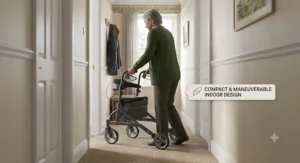
Choosing the right model comes down to seven practical checks, each worth a moment’s honest thought before you buy.
- Weigh your own lifting capacity honestly. If you can’t comfortably lift a 6kg bag of shopping, don’t assume you’ll manage a 7kg rollator into a car boot daily.
- Match wheels to your terrain. Small, hard wheels suit smooth indoor floors; larger, softer tyres cope far better with pavements, gravel, and kerbs.
- Check the seat height against your own leg length. A seat that’s too low makes standing back up unexpectedly difficult.
- Confirm the weight capacity with margin. Manufacturers list maximums, but comfortable everyday use benefits from some headroom below that limit.
- Test the brakes before buying if at all possible. Grip strength varies hugely, and a stiff lever brake can be genuinely unusable for some users.
- Consider storage needs realistically. A daily shopper benefits from a larger bag capacity; an occasional walker may not need one at all.
- Factor in VAT relief eligibility. Many rollators qualify for zero-rated VAT if bought for a chronically sick or disabled person’s personal use, which can meaningfully change the effective price — see the official VAT relief guidance on GOV.UK for the qualifying criteria.
Rollator Under 5kg: Is Lighter Always Better?
The short answer: not automatically. A rollator under 5kg genuinely transforms daily life for someone who struggles to lift anything heavier, but that low weight is usually achieved by narrowing the frame, using a smaller wheelbase, or switching to premium materials like carbon fibre, and each route carries a trade-off. Narrower frames can feel less reassuring on uneven camber; smaller wheels catch more easily on cracks and kerbs; and carbon fibre models, while genuinely strong, generally carry a lower maximum user weight than heavier aluminium alternatives.
Based on the spec comparison across this list, the two genuinely sub-5kg options here, the Ultra Lightweight Tri Walker and the byACRE Carbon Ultralight, sit at opposite ends of the price spectrum precisely because of how that weight was achieved. If your priority genuinely is the lowest possible lifting weight and your terrain is mostly smooth, indoor or suburban pavement, going under 5kg is a sound choice. If you regularly cross rough ground or need a higher weight capacity, chasing the lightest number on the box can work against you.
Aluminium vs Carbon Fibre Rollators: Which Lightweight Build Wins?
Aluminium has been the default rollator material for decades, and for good reason: it’s inexpensive to manufacture at scale, easy to repair, and forgiving of the odd knock against a doorframe. Every mid-range model in this guide, from the MobiQuip to the Rehasense Space LX and Topro Troja Original, relies on aluminium tubing, and reviewers consistently praise its durability over years of daily use.
Carbon fibre rollators, represented here by the byACRE Carbon Ultralight, take a different engineering approach. The material offers a superior strength-to-weight ratio, which is precisely how byACRE reaches 4.8kg on a four-wheel frame without compromising the rigidity needed to support a seated adult safely. The honest trade-off is cost: carbon fibre manufacturing is considerably more expensive, and that’s reflected directly in the price gap between the aluminium models and the carbon option on this list. What most buyers overlook is that aluminium rollators have also improved significantly in recent years, with models like the Rehasense Space LX narrowing the weight gap to under a kilogram versus far cheaper carbon alternatives abroad, so the material alone shouldn’t be the only deciding factor.
Common Mistakes When Buying an Ultra-Light Rolling Walker
The single most common mistake is buying based on the weight figure alone, without checking the folded dimensions against your car boot or hallway storage. A rollator can be admirably light yet fold into an awkward, bulky shape that’s genuinely hard to wedge anywhere. The second frequent misstep is skipping a proper height fitting, often because the buyer is purchasing for a parent or relative remotely and simply guesses a “medium” size; ill-fitting handle height is one of the more preventable causes of poor posture and discomfort reported in aggregated reviews.
A third mistake is assuming every “lightweight” listing is directly comparable; as we saw with the “Lightest in the UK” model, marketed weights and real-world unit weights don’t always perfectly align, so cross-checking independent reviews before buying is genuinely worthwhile. Finally, buyers regularly underestimate brake maintenance, assuming a rollator is a “buy once, never touch again” purchase, when in reality cable-operated brakes on any budget model benefit from an occasional check and adjustment.
What to Expect: Real-World Performance of Lightweight Rollators
On paper, the difference between a 4.8kg and an 8.5kg rollator sounds dramatic, but in daily pushing use, most reviewers report the difference feels smaller than the spec sheet suggests, since you’re rolling the weight rather than carrying it. Where the weight genuinely shows up is at the moments of lifting: into a car boot, up a single step, or over a rug edge. A carbon fibre or sub-5kg aluminium frame noticeably reduces the effort and, for some users, the pain involved in those specific moments, which is precisely why buyers with shoulder or wrist issues often prioritise it above all else.
Braking feel varies more than most first-time buyers expect. Loop brakes, common on budget aluminium models, require squeezing the whole handle and can feel awkward for users with arthritis in the hands, while lever-style brakes on premium models like the Topro and Rehasense generally need less grip force. Seat comfort during actual use also diverges: mesh seats stay cooler on warm days but offer less cushioning than padded alternatives, a detail rarely mentioned in marketing copy but consistently raised in aggregated reviewer feedback.
Lightweight Rollators for Elderly Parents and First-Time Users
Buying for an elderly parent from a distance brings its own challenges, chiefly that you can’t test handle height or brake grip strength in person before ordering. Based on the spec comparison, models with tool-free, numbered height adjustment, like the Topro Troja Original, are genuinely easier to get right the first time, since you can simply match the setting to a measured arm length rather than guessing.
First-time rollator users, regardless of age, tend to do better starting with a four-wheel model over a tri-walker, since the wider base is more forgiving while confidence is still being built. It’s also worth checking whether your GP surgery or local occupational therapy service can carry out a short assessment before buying privately; the British Geriatrics Society’s falls prevention resources note that gait and mobility assessment plays a meaningful role in reducing fall risk, and a professional opinion on frame type can save an expensive buying mistake.
Long-Term Cost & Maintenance of Aluminium and Carbon Rollators
Aluminium rollators are cheap to buy and, generally, cheap to keep running. Replacement wheels, brake cables, and ferrules are widely available and inexpensive, and most mid-range models like the Rehasense and Topro carry warranties of five to seven years on the frame itself, meaning the core structure is unlikely to be your limiting factor. Budget aluminium and steel-hybrid models at the very bottom of the market can wear more quickly, with loose-ball wheel bearings needing more frequent attention than the sealed bearings found on premium aluminium frames.
Carbon fibre changes this calculation. The byACRE Carbon Ultralight‘s significantly higher purchase price is partly offset by a lifetime frame warranty, which shifts long-term risk away from the buyer in a way aluminium warranties, typically capped at seven years, don’t quite match. Total cost of ownership over, say, a ten-year period narrows the gap somewhat between a £900 carbon frame and a £250 aluminium one, particularly if the aluminium model needs a wheel or brake cable replacement along the way, though the aluminium option still generally works out cheaper overall for most buyers.
Safety, Regulations & VAT Relief Guide
Rollators sold in the UK should carry CE or UKCA marking confirming they meet recognised medical device or consumer safety standards, and it’s worth checking product listings for this before buying from lesser-known online sellers. On the financial side, many rollators purchased for personal use by someone who is chronically sick or disabled qualify for VAT relief, meaning the 20% VAT charge is removed at the point of sale rather than reclaimed afterwards; full eligibility criteria are set out on the GOV.UK VAT relief for disabled people page, and most reputable UK mobility retailers include a simple declaration form at checkout.
On safe use, NHS physiotherapy guidance is consistent: always ensure the frame is fully open and the folding lock engaged before leaning on it, apply the brakes fully before sitting on the built-in seat, and never attempt to use a rollator on stairs. If you or the person you’re buying for has recently had a fall, or feels unsteady even with a rollator, it’s worth raising this with a GP or physiotherapist rather than assuming a heavier or lighter model alone will resolve the underlying balance issue.

Frequently Asked Questions
❓ What is the best lightweight rollator for someone with weak hands?
❓ Is a rollator under 5kg strong enough for daily outdoor use?
❓ How much does a carbon fibre rollator cost in the UK?
❓ Can I get a lightweight rollator on the NHS?
❓ What's the difference between a rollator and a walking frame?
Conclusion
Choosing the best lightweight rollator really comes down to being honest about two things: how much weight you can genuinely lift, and what ground you’ll actually be rolling over most days. The sub-5kg tier, from the humble tri-walker to the genuinely remarkable byACRE Carbon Ultralight, transforms daily life for anyone who struggles with lifting, while the sturdier aluminium and all-terrain options, like the Topro Troja Original, Rehasense Space LX, and VOCIC Z11 X-Way, trade a little extra weight for stability, storage, and long-term durability.
There isn’t a single “winner” here, and any guide claiming otherwise isn’t being straight with you. What matters is matching the frame, the wheels, and the price to your own daily reality, not the lightest number printed on a listing. Take the comparison table, revisit the scenario that sounds most like your own situation, and you’ll land on a genuinely sensible choice rather than an impulse buy.
✨ Ready to stop lifting and start rolling? Compare today’s prices on the models above and pick the one that actually fits your life.
Recommended for You
- 4 Wheel Rollator With Shopping Bag: 7 Best Picks for 2026
- Best 4 Wheel Rollator UK: 7 Top Picks Compared (2026)
- Best 3 Wheel Rollator UK 2026: Top 7 Tri Walkers Ranked
Disclaimer: This article contains affiliate links. As an Amazon Associate, I earn from qualifying purchases. If you purchase products through these links, we may earn a small commission at no additional cost to you.
✨ Found this helpful? Share it with your friends! 💬🤗
