In This Article
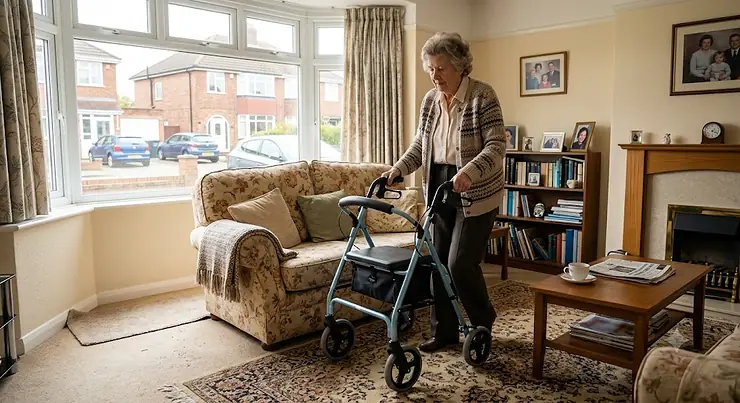
There’s a particular kind of stubbornness that shows up in British living rooms every winter: a parent insisting they’re “absolutely fine” on the stairs, right before gripping the bannister like it owes them money. If that sounds familiar, you’ve probably already started looking at a rollator walker for elderly relatives, and you’ve probably already discovered that the choice is more crowded than it has any right to be.

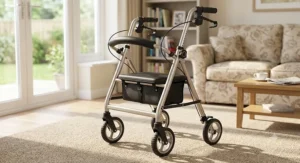
So, what is a rollator walker for elderly use? In short, it’s a four-wheeled (occasionally three-wheeled) walking frame with hand brakes, a built-in seat, and adjustable handles, designed to support someone who can walk but needs steadier balance, a place to rest, and the confidence to keep moving independently. Unlike a traditional Zimmer frame, it rolls rather than requiring the user to lift and place it with every step.
This matters more than the marketing photos suggest. The NHS advice on preventing falls is clear that anyone older or with mobility problems is more likely to fall, and that using a walking aid is one of the recommended precautions. The right rollator walker doesn’t just prevent trips to A&E — it’s often the difference between someone joining the family for a Sunday walk or staying behind on the sofa.
Below, we’ve researched seven real rollator walker models sold in the UK, spanning budget steel frames through to feature-packed aluminium options, so you can match the right one to the person who actually has to use it every day.
Quick Comparison Table
| Product | Weight | Max User Weight | Best For |
|---|---|---|---|
| Aidapt Folding Rollator | Approx. 8-9kg | Around 130kg | Tightest budgets |
| DAYS Lightweight Rollator | 7kg | 165kg (26st) | All-round daily use |
| MobiQuip All Terrain Rollator | 10.5kg | Around 125-130kg | Outdoor, uneven ground |
| VOCIC Z11 Rollator | Approx. 11kg | 172kg (27st) | Larger or heavier users |
A quick glance at this table already tells a story: weight and load capacity pull in opposite directions more often than not. The DAYS Lightweight Rollator manages an unusually good balance of the two, which is largely why it’s such a consistent seller. Meanwhile, the MobiQuip All Terrain Rollator trades a little portability for genuinely useful outdoor grip, and the VOCIC Z11 Rollator is worth a look specifically if a standard 130kg limit feels too tight. We’ll unpack all seven models — including three not shown above — in the full breakdown further down.
💬 Ready to compare the full line-up? Scroll on — your best match for a rollator walker for elderly parents or partners is just below.😊
Top 7 Rollator Walkers for Elderly Users: Expert Analysis
Right, let’s get into the detail. Each of these seven is a real, currently available product, and each earns its place here for a different reason — no filler, no “also-rans.”
1. Aidapt Folding Rollator Walker with Padded Seat — sturdy steel frame at a featherlight price
Steel rather than aluminium is the headline here, and it’s worth pausing on why that matters: steel is heavier to lift into a car boot, but it’s also cheaper to manufacture and typically more forgiving of the odd knock against a doorframe. The frame pairs with 8-inch puncture-proof wheels, meaning no faffing about with a pump if a tyre picks up a thorn on the allotment path. Height-adjustable handles and a padded seat with an underseat shopping bag round out the basics.
Based on the spec comparison with pricier aluminium rivals, this is squarely an indoor-and-local-shops model rather than a countryside companion — the smaller wheels and steel construction aren’t built for kerbs and gravel. What most buyers overlook is that “budget” doesn’t mean “flimsy” here; it means fewer frills, not less stability. Reviewers consistently report that entry-level Aidapt walkers are straightforward to assemble and reliable for short daily trips, though as with any budget steel model, verified long-term durability data beyond a year or two is harder to pin down than for the bigger-name brands.
This suits someone recovering from a minor hip or knee procedure who mainly needs support to the corner shop and back, rather than someone planning long countryside rambles.
Pros:
- ✅ Genuinely low upfront cost for a full-feature rollator
- ✅ Puncture-proof wheels need zero maintenance
- ✅ Simple, physiotherapist-familiar design with no learning curve
Cons:
- ❌ Steel frame adds noticeable weight versus aluminium rivals
- ❌ Smaller wheels struggle on gravel or rough pavements
At around under £70, this sits at the affordable end of the market — check current price, as mobility products fluctuate more than most categories. For anyone testing the waters with a first rollator walker, it’s a sensible, low-risk starting point.
2. DAYS Lightweight Folding Rollator Walker — the NHS-trusted all-rounder
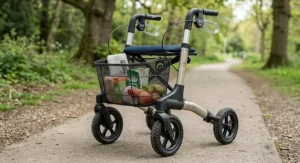
Days Healthcare has been supplying UK physiotherapy departments for decades, and the Lightweight Rollator is the model most people picture when they hear “rollator.” At 7kg, it’s genuinely easy to lift into a car boot, yet it still supports users up to 165kg (26 stone) — a weight allowance that comfortably out-classes most budget steel alternatives at this price point.
The five height settings, adjustable at 25mm intervals, matter more than they sound: getting handle height wrong is one of the most common — and most correctable — mistakes families make when buying a first rollator. Loop-lockable brakes are specifically designed to be easy to engage for users with arthritic hands, which the spec sheet won’t spell out but genuinely changes daily usability for anyone with reduced grip strength.
Aggregated Amazon UK review sentiment for this rollator is broadly positive but not universally glowing: several buyers praise the ease of daily folding and the reassurance of a built-in seat, while a recurring complaint is that the seat itself feels narrow for larger users, and the supplied bag doesn’t always match the product photos exactly. None of this is dealbreaker territory, but it’s worth setting expectations accordingly.
Pros:
- ✅ Excellent 165kg capacity for a 7kg frame
- ✅ Three-year warranty with wide spare-parts availability
- ✅ Arthritis-friendly loop brakes praised across multiple reviews
Cons:
- ❌ Seat width criticised as narrow by some larger users
- ❌ Bundled bag has occasionally differed from listing photos
Prices typically sit in the £85-£120 range at the time of research, making this one of the strongest value propositions in this entire round-up.
3. HOMCOM Rollator Walker with Seat — compact fold for small hallways
If you’ve ever tried to squeeze a mobility aid past a radiator in a Victorian terrace hallway, you’ll understand why “compact quick-fold” is a genuine selling point rather than marketing fluff. The HOMCOM Rollator uses 8-inch wheels and an aluminium frame, folding down to a notably slim profile — useful for households where storage space is the real constraint, not just budget.
Here’s what the spec sheet won’t tell you outright: a cane holder, included as standard on this model, quietly solves one of the most common daily frustrations for rollator users — namely, having nowhere secure to stash a walking stick when they switch between the two aids depending on the errand. On paper this looks like a minor accessory; in practice, it’s the sort of thing that determines whether the rollator actually leaves the house every day or gathers dust by the front door.
Verified review volume for this specific listing is more limited than for the longer-established Days and Drive Medical ranges, so we’d encourage checking the current listing’s most recent reviews directly before buying, particularly around long-term brake durability.
Pros:
- ✅ Compact fold ideal for narrow hallways and small cars
- ✅ Integrated cane holder solves a common daily annoyance
- ✅ Lightweight aluminium build for easier lifting
Cons:
- ❌ Review history is thinner than more established rival brands
- ❌ Smaller wheels less suited to uneven outdoor paths
Typically priced in the £60-£90 range, this is a smart pick when storage space is the deciding factor rather than terrain.
4. Drive Medical 4 Wheel Folding Rollator with Padded Seat — a globally trusted brand at a fair price
Drive Medical is one of the largest mobility equipment manufacturers worldwide, and that scale shows up in consistent build quality across its range rather than any single standout gimmick. This model brings locking brakes, height-adjustable handles, a padded seat, and an underseat bag — the core rollator formula, executed reliably.
What most buyers overlook with big-brand rollators is that the real advantage isn’t the headline features, it’s parts availability years down the line: when a brake cable frays or a wheel bearing wears out, a global brand like Drive Medical is far more likely to still be stocking spares than a smaller import brand will be in three or four years. That’s a genuinely practical, if unglamorous, form of long-term value.
Aggregated feedback on Drive’s rollator range (drawn from wider Drive Medical rollator reviews rather than this specific listing alone) is generally strong on sturdiness and terrain handling, with an occasional note that some users with weaker hands find the brake lever resistance firmer than expected — worth testing in person if grip strength is a concern for the intended user.
Pros:
- ✅ Backed by a globally established mobility equipment manufacturer
- ✅ Strong long-term spare parts and accessory availability
- ✅ Solid, reassuring build quality for daily outdoor use
Cons:
- ❌ Brake lever resistance can feel firm for weaker grips
- ❌ Fewer colour options than some newer competitor brands
Expect to pay in the £90-£130 range, positioning it as a dependable mid-range choice rather than a budget or premium outlier.
5. MobiQuip All Terrain 4 Wheel Rollator — pneumatic tyres built for the great outdoors
This is the rollator for the person who still wants their daily walk along the towpath or through the park, potholes and all. The headline feature is a set of 12-inch pneumatic (air-filled) tyres — a genuine step up from the solid rubber wheels on most budget models, because air-filled tyres absorb shock rather than transmitting every crack in the pavement straight up through the user’s wrists and shoulders.
Based on the spec comparison, the trade-off for that comfort is weight: at 10.5kg, it’s heavier than the Days Lightweight model, though still describable as manageable rather than cumbersome for most users lifting it into a car boot. Handles adjust between 77cm and 96cm, a wider range than several rivals offer, which matters for households where the rollator might be shared between a taller and shorter user.
What the spec sheet won’t tell you, but general pneumatic-tyre feedback across the mobility equipment category consistently notes, is that air-filled tyres do occasionally need topping up with a pump — a small maintenance task solid tyres don’t require, but one that’s a fair trade for the comfort gained on rough ground.
Pros:
- ✅ Pneumatic tyres genuinely reduce shock on rough terrain
- ✅ Wide 77-96cm handle adjustment suits multiple users
- ✅ Includes crutch holder and spacious underseat storage
Cons:
- ❌ Heavier than aluminium-only rivals at 10.5kg
- ❌ Pneumatic tyres need occasional pressure top-ups
At around £150-£190, this sits toward the upper end of this line-up, but for anyone genuinely walking outdoors daily rather than just around the house, it’s arguably worth the difference.
6. VOCIC Z11 Rollator Walker — the heavyweight-capacity newcomer
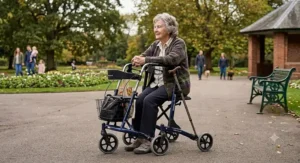
VOCIC is a newer entrant to the UK mobility market, but the Z11 makes its case clearly: a quoted maximum user weight of 172kg (27 stone), noticeably higher than the 125-130kg ceiling common on budget steel rollators. For a household where the standard weight allowance genuinely isn’t enough, that’s not a nice-to-have, it’s the entire reason to consider the product.
The distinctive X-braced tubing isn’t just a styling choice — a multi-faceted frame geometry of this kind is generally used to resist side-to-side flex, which on paper should translate into a steadier, less wobbly feel when a heavier user leans into the handles. Five handle-height settings and a dual-brake system (walking and parking modes) bring it in line with the other rollators here on core functionality.
Because VOCIC is newer to the UK than Days or Drive Medical, the volume of independently verifiable long-term UK review data is genuinely thinner at the time of research — we’d encourage reading the most recent buyer reviews on the current listing directly, particularly regarding brake longevity after a year or more of daily use, rather than relying solely on manufacturer claims.
Pros:
- ✅ Higher 172kg weight capacity than most budget rivals
- ✅ Reinforced X-frame designed to resist side-to-side flex
- ✅ Dual walking and parking brake modes included
Cons:
- ❌ Shorter UK track record than legacy mobility brands
- ❌ Long-term review data is comparatively limited so far
Typical pricing sits around £120-£160, making it a reasonable mid-range option specifically for households needing that extra weight allowance.
7. Days Tri Wheel Folding Walker — best for tight turns and narrow doorways
Three wheels instead of four sounds like a downgrade until you actually need to turn one around in a small kitchen. Consumer testing body Which? has found that four-wheeled rollators remain more common than three-wheeled versions, but that some users find three-wheeled models easier to turn, albeit with a little less overall stability — which is exactly the trade-off this model represents.
The aluminium version weighs 7.7kg, with handles adjustable between 83cm and 93cm and a maximum user weight of 125kg (19.5 stone). Loop lockable brakes and a built-in carry bag come as standard. Here’s what most buyers overlook about tri-walkers specifically: the single front wheel means a genuinely tighter turning circle than any four-wheel model can achieve, which matters enormously in period properties with narrow hallways and awkward doorway angles.
Aggregated Amazon UK review sentiment for this model is notably candid: several buyers, including ones purchasing on physiotherapist advice after a hip fracture, report strong satisfaction with manoeuvrability and ease of folding, while a recurring theme is that the handgrips can feel slippery when wet, and turning corners requires a touch more care than a four-wheeled model due to the reduced stability that comes with three points of contact.
Pros:
- ✅ Genuinely tighter turning circle than four-wheel rivals
- ✅ Lightweight 7.7kg aluminium frame, easy to lift
- ✅ Frequently recommended by physiotherapists post-surgery
Cons:
- ❌ Slightly less stable than four-wheel rollators
- ❌ Handgrips reported as slippery in wet conditions
Priced around £70-£100, it’s a strong pick specifically for smaller homes rather than a universal replacement for a four-wheel model.
Top 7 Products: Full Comparison
| # | Product | Wheels | Weight | Max User Weight | Price Range | Best For |
|---|---|---|---|---|---|---|
| 1 | Aidapt Folding Rollator | 4 (8″) | ~8-9kg | ~130kg | Under £70 | Tightest budgets |
| 2 | DAYS Lightweight Rollator | 4 | 7kg | 165kg | £85-£120 | All-round daily use |
| 3 | HOMCOM Rollator | 4 (8″) | Light | ~130kg | £60-£90 | Small hallways/cars |
| 4 | Drive Medical Rollator | 4 | Standard | ~130-135kg | £90-£130 | Long-term reliability |
| 5 | MobiQuip All Terrain | 4 (12″ pneumatic) | 10.5kg | ~125-130kg | £150-£190 | Outdoor/rough terrain |
| 6 | VOCIC Z11 | 4 | ~11kg | 172kg | £120-£160 | Heavier users |
| 7 | Days Tri Wheel | 3 | 7.7kg | 125kg | £70-£100 | Narrow indoor spaces |
Looking at the full spread, three clear buying paths emerge. If budget is the only concern, the Aidapt Folding Rollator and HOMCOM Rollator both undercut £90 without sacrificing the essential seat-and-brakes formula. If daily reliability across mixed indoor and outdoor use matters most, the DAYS Lightweight Rollator and Drive Medical Rollator represent the safest middle ground, backed by decades of NHS-adjacent trust. And if either terrain or user weight pushes past what a standard rollator can handle, the MobiQuip All Terrain Rollator and VOCIC Z11 earn their higher price tags.
✨ Don’t Miss These Exclusive Deals!
🔍 Take independence to the next level with a rollator walker for elderly parents or partners that actually fits their life. Click through on any model above to check current pricing and availability before stock or colour options change.
Practical Usage Guide: Getting the Most From a New Rollator
Buying the rollator is genuinely the easy part. The first fortnight of actually using it well is where most of the value — or frustration — gets decided.
Start with the handle height before anything else. Stand naturally with arms relaxed by the sides; the handles should sit roughly level with the crease of the wrist. Too high, and the user hunches forward, straining the shoulders; too low, and they bend uncomfortably, undermining the entire point of better posture. Most of the rollators above offer five-position adjustment for exactly this reason — use it.
Next, practise the brakes somewhere low-stakes, like a carpeted living room, before heading outdoors. Loop brakes need a firmer, more deliberate squeeze than most people expect on the first try, and getting comfortable locking the parking brake before sitting down avoids the single most common rollator mishap: the seat sliding away mid-sit.
In the first 30 days, the most common mistake families make is over-correcting for caution by keeping the rollator folded “for best” and reverting to holding furniture around the house instead. A rollator only reduces fall risk if it’s actually being used consistently, including for short indoor trips — not saved solely for outings.
Finally, build a simple monthly maintenance habit: check tyre pressure on any pneumatic model, tighten any loose handle screws, and inspect brake cables for fraying. None of this takes more than five minutes, and it’s the difference between a rollator lasting years and one quietly becoming unsafe without anyone noticing.
Real-World Scenarios: Matching the Rollator to the Person
The recovering-from-surgery scenario: Margaret, 78, is six weeks post hip replacement, mostly moving between rooms at home with occasional short trips to a neighbour’s. For her, weight matters less than stability and seat comfort — the DAYS Lightweight Rollator‘s wide seat and easy brakes suit this stage well, without the bulk of an all-terrain model she doesn’t yet need.
The still-active outdoor walker: Frank, 82, insists on his daily two-mile loop through the local park, rain or shine, and has done for decades. Cobbles, gravel and the odd tree root are part of the route. The MobiQuip All Terrain Rollator‘s pneumatic tyres are built precisely for this use case — the extra weight is a fair trade for the comfort on rough ground.
The narrow-home, larger-build scenario: Josephine, 74, lives in a compact terraced house with tight turns between rooms, and standard weight limits have felt restrictive. Here, the choice isn’t really about terrain at all — it’s about the VOCIC Z11‘s higher 172kg capacity solving a genuine problem the other six models on this list simply can’t.
These aren’t hypothetical archetypes pulled from nowhere; they map directly onto the trade-offs — weight versus stability, terrain versus portability, standard versus higher capacity — that show up consistently across real UK buyer feedback for this category.
How to Choose the Best Rollator Walker for Elderly Relatives
- Measure wrist-crease height first. Every other decision is secondary to getting the handle height right; an ill-fitting rollator undermines posture regardless of how many features it has.
- Be honest about where it’ll actually be used. Indoors only calls for smaller wheels and a tighter turning circle; regular outdoor use justifies larger or pneumatic tyres.
- Check the maximum user weight against the real figure, with margin. A rollator rated exactly at someone’s current weight leaves no room for fluctuation.
- Test the brakes for grip strength, not just presence. A brake that exists on the spec sheet but requires more hand strength than the user has isn’t actually a safety feature for them.
- Weigh portability against your car boot and hallway width. A 7kg model that won’t fit through a narrow front door solves nothing.
- Factor in seat width if extended sitting matters. Several reviewers across this category specifically flag narrow seats as a comfort issue worth checking before buying.
- Consider brand longevity for spare parts. A cheaper import model might save money upfront but cost more in hassle if a wheel or brake cable needs replacing in three years.
Rollator vs Zimmer Frame: Which Actually Suits Better?
This is one of the most searched comparisons in the category, and for good reason — the two are often confused despite working quite differently. A traditional Zimmer frame (the classic four-legged walking frame without wheels) must be lifted and placed forward with each step, which offers maximum stability but interrupts a natural walking rhythm. A rollator, by contrast, rolls forward continuously on its wheels, letting the user maintain something much closer to their normal gait.
Rollators, standard walking frames and Zimmer frames all fall under the broader “mobility support” umbrella, but they’re built around genuinely different mechanics. The practical distinction that actually matters for most families is this: a Zimmer frame suits someone with more significant balance impairment who needs to plant and lock each step deliberately, while a rollator suits someone who can walk with a reasonably steady rhythm but wants extra confidence, a seat for rests, and less physical effort per step.
Here’s what most buyers overlook — the choice often isn’t permanent. Many people transition from a Zimmer frame to a rollator as strength returns during recovery, or the reverse, if balance declines over time. Neither option is objectively “better”; the right one depends entirely on current balance and strength, which is precisely why a GP or physiotherapist’s input is worth seeking before buying, particularly for a first mobility aid following a fall or surgery. The NICE guideline on falls assessment and prevention is a useful starting point if you want to understand how professionals actually assess this decision.
Common Mistakes When Buying a Rollator Walker
Getting the size wrong is, by a wide margin, the most frequent error — buying based on general “average adult” sizing rather than the actual user’s height and weight. Second most common: prioritising the lowest price without checking the maximum user weight, which can leave genuinely unsafe margin for a heavier user. Third: ignoring where the rollator will primarily be used, leading to families buying an indoor-only lightweight model for someone who actually wants daily outdoor walks, or vice versa — an unnecessarily heavy all-terrain model for someone who never leaves the house.
A less obvious mistake is skipping the brake test entirely. Reviewers across this category consistently flag brake resistance as something that varies meaningfully by model, yet it’s rarely mentioned by buyers until after purchase. Finally, some families buy the rollator and stop there, without checking whether accessories — a tray, a stronger bag, a cane holder — would meaningfully improve daily use, often for under £15 extra.
What to Expect: Real-World Performance
Specs on a page don’t capture what a rollator actually feels like on a Tuesday morning grocery run. In practice, a 7kg aluminium model like the DAYS Lightweight Rollator feels genuinely effortless to manoeuvre around a supermarket aisle, but noticeably less planted on a windy day outdoors compared with a heavier, wider-wheeled option. Pneumatic-tyred models like the MobiQuip All Terrain Rollator absorb kerb edges and cracked pavement in a way that solid wheels simply can’t replicate — the difference is immediately noticeable to anyone who’s used both.
Seat comfort matters more in practice than most buyers anticipate before purchase; a rollator used mainly for short walks with occasional rests behaves very differently from one used as a genuine “sit and wait” bench outside a GP surgery for twenty minutes. And braking feel — how much squeeze pressure is genuinely needed — varies enough between brands that testing in a shop, where possible, beats relying on the spec sheet alone.
Wheeled Walking Aid vs Traditional Alternatives
| Aid Type | Effort to Move | Stability | Seat Included | Best For |
|---|---|---|---|---|
| Rollator (wheeled walking aid) | Low | Good | Usually yes | Steady but reduced balance |
| Zimmer frame | Higher (lift each step) | Highest | No | Significant balance impairment |
| Walking stick | Lowest | Lower | No | Minor support, one side |
| Mobility scooter | None (powered) | High while seated | Yes | Longer distances, less walking |
The table above makes the trade-offs fairly explicit: a wheeled walking aid sits in a genuine middle ground, offering more support than a stick without the physical effort of lifting a Zimmer frame with every step, while still keeping the user upright and walking rather than seated and driven, as with a mobility scooter. For many older adults recovering strength after illness or surgery, that middle ground is precisely the point — a rollator supports the goal of walking more, not less.
It’s worth adding a word on cost here too: rollators are typically a fraction of the price of a mobility scooter or electric wheelchair, while still delivering meaningful independence for anyone who can bear weight and walk with support.
Four Wheel Mobility Walker for Outdoor Living
For anyone determined to keep up an outdoor routine — allotment visits, dog walks, the school run for a grandchild — a four wheel mobility walker with larger or pneumatic tyres earns its keep quickly. The extra stability of a fourth wheel, compared with a tri-walker, becomes genuinely noticeable on uneven verges and sloped pavements, where three points of contact can feel less secure.
What most buyers overlook about outdoor-focused four-wheel models specifically is that handle adjustability range matters as much as tyre type. A model like the MobiQuip All Terrain Rollator, adjustable between 77cm and 96cm, accommodates a much wider range of users and postures than models with only three height settings — genuinely useful if the rollator might be shared between a taller and shorter person in the same household, or if posture needs adjusting seasonally due to joint stiffness.
Rolling Walker with Brakes: Safety and Regulations Guide
Every rollator in this guide comes fitted with a rolling walker with brakes as standard, but “has brakes” and “has brakes that work well for this specific person” are different claims entirely. Loop brakes — squeezed downward to engage — are generally considered easier for arthritic hands than lever-style brakes requiring a stronger grip, which is why several models here specifically market loop-brake designs.
There’s no formal UK regulatory body certifying rollator brakes the way there is for, say, mobility scooters on public roads, but basic safety practice still applies consistently: brakes should be tested before every outing, particularly after folding and unfolding, and any fraying visible on a brake cable warrants an immediate replacement rather than a “wait and see” approach. For anyone eligible, VAT relief for disabled people is also worth checking before buying — those with a long-term illness or disability generally aren’t charged VAT on products designed or adapted for their own personal use, which can meaningfully reduce the cost of several models in this guide.
Long-Term Cost and Maintenance
A rollator’s true cost extends beyond the purchase price. Brake cables typically need replacing every one to three years depending on usage frequency, tyre pumps for pneumatic models are a one-off under-£10 purchase, and grip covers wear faster than most buyers expect if used daily in all weather. None of this is expensive individually, but budgeting an extra £20-£30 a year for upkeep is realistic for most models here.
| Cost Category | Typical Range | Frequency |
|---|---|---|
| Replacement brake cables | £5-£15 | Every 1-3 years |
| Wheel/tyre replacement | £10-£25 per wheel | As needed |
| Grip covers | £5-£10 a pair | Annually with heavy use |
| Servicing (if via retailer) | £15-£30 | Annually (optional) |
Compared with a mobility scooter’s ongoing battery replacement and charging costs, a rollator’s total cost of ownership remains modest — one of its most underrated long-term advantages for families managing a fixed budget.

Frequently Asked Questions
❓ What's the difference between a rollator and a walker?
❓ Is a three-wheel or four-wheel rollator better for elderly users?
❓ How do I measure the correct rollator height?
❓ Can I get VAT relief on a rollator walker?
❓ How much does a decent rollator walker cost in the UK?
Conclusion
If there’s one honest takeaway from comparing these seven rollator walkers side by side, it’s that there’s no single “best” — only a best fit for a specific person, home, and daily routine. The DAYS Lightweight Rollator remains the safest general-purpose recommendation for most families, the MobiQuip All Terrain Rollator earns its higher price for genuinely active outdoor users, and the Days Tri Wheel solves a real problem for narrow homes that four-wheel models simply can’t.
What matters most, though, isn’t which model you choose from this list — it’s that the rollator actually gets used daily, adjusted correctly, and checked periodically for wear. A rollator gathering dust in a hallway helps nobody; one used confidently every morning genuinely changes how independent someone feels.
✨ Don’t Miss These Exclusive Deals!
🔍 Whichever model fits best, click through to check current pricing before you decide — a small comparison now could mean a much steadier, more confident year ahead.
Recommended for You
- Bariatric Zimmer Frame: 7 Best Heavy-Duty Options (2026)
- Lightweight Walking Frame for Elderly Woman: 7 Best Picks 2026
- Lightweight Zimmer Frame: 7 Genuinely Best Picks for 2026
Disclaimer: This article contains affiliate links. As an Amazon Associate, I earn from qualifying purchases. If you purchase products through these links, we may earn a small commission at no additional cost to you.
✨ Found this helpful? Share it with someone who could use a steadier step today! 💬🤗
