
In This Article
Try wheeling a standard rollator through a 1930s hallway and you’ll understand the problem in about four seconds flat. The frame catches the skirting board. The wheels clip the doorframe. And suddenly the thing that’s meant to give you confidence is the thing knocking ornaments off the side table. This is exactly why so many people go searching for the best indoor rollator rather than just grabbing whatever’s cheapest on the shelf — because a walking aid built for pavements and shopping trips is a very different animal to one built for hallways, kitchens and bathroom doorways.
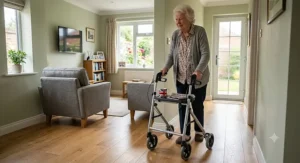
An indoor rollator is a compact, four-wheeled walking frame with a narrower footprint, smaller wheels and a lighter build than a standard outdoor model, designed specifically to move through tight doorways, cramped hallways and furniture-filled rooms without you having to turn side-on or barge through. Reviewers and physiotherapists alike point to the same handful of things that separate a genuinely useful indoor model from a rebadged outdoor one: overall width, turning circle, and how it behaves on hard flooring rather than pavement.
We’ve spent time digging through real product listings, genuine aggregated customer feedback, and manufacturer specifications for models actually sold in the UK, so what follows isn’t a rewritten Amazon page — it’s honest analysis you can act on. If mobility issues are new to you or a family member, it’s worth pairing this guide with proper physiotherapist-led falls advice, since the right walking aid depends on your specific balance and strength, not just your hallway measurements. With that said, let’s get into the seven rollators actually worth your attention this year, plus how to pick between them.
Quick Comparison Table
| Rollator | Width | Weight | Best For |
|---|---|---|---|
| Days Breeze Indoor Rollator | Approx. 54cm | Approx. 6.3kg | Best all-round budget pick |
| KMINA Narrow Walker with Tray | Approx. 54cm | Approx. 6kg | Narrowest doorways, one-handed use |
| Aidapt Lightweight Rollator (Economy) | Approx. 58cm | Approx. 7kg | Tightest budget |
| Days Lightweight Folding Rollator (X-Small) | Approx. 56cm | Approx. 7.5kg | Shorter or petite users |
| Dunimed Lightweight Foldable Rollator | Approx. 57cm | Approx. 6.8kg | Simple, no-frills basket use |
| NRS Healthcare Ultra Narrow Walking Frame | Approx. 51cm | Approx. 6.5kg | Genuinely tight period-home doorways |
| Topro Olympos Deluxe Rollator (Small) | Approx. 69cm | Approx. 8.6kg | Premium build, indoor and outdoor |
A quick glance tells you most of what you need to know: width and weight move roughly together, and the trade-off almost always sits between manoeuvrability and stability. The NRS Healthcare Ultra Narrow Walking Frame and KMINA Narrow Walker with Tray sit at the slim end for genuinely tight Victorian and 1930s doorways, while the Topro Olympos Deluxe Rollator trades width for a sturdier, more planted feel that copes with door thresholds and uneven kitchen flooring. If your home is mostly open-plan with wider doorways, that extra width buys real stability — but in a narrow terraced house, every centimetre counts.
💬 Found this comparison useful? A quick share helps other families find the right rollator faster. 😊
Top 7 Indoor Rollators: Expert Analysis
1. Days Breeze Indoor Rollator — best all-round budget pick for small homes
The Days Breeze Indoor Rollator is the sort of product that does the ordinary things extremely well, which, in fairness, is exactly what most people actually need. At roughly 6.3kg and around 54cm wide, it’s built with a narrow aluminium frame specifically for hallways, bedrooms and bathroom doorways rather than pavements.
The included fabric basket and removable tray mean carrying a cup of tea or a plate of toast from kitchen to armchair stops being a two-handed balancing act. Its four swivel wheels are sized for smooth indoor flooring rather than kerbs and gravel, which is precisely why it moves so easily on laminate or lino but wouldn’t be your first choice for the garden path.
Based on the spec comparison against pricier rivals, what stands out here is value: you’re getting a genuinely narrow frame and a folding mechanism without paying premium-brand money. Reviewers consistently note that it suits unsteady users who mainly move short distances around the house, and that the tray genuinely gets used daily rather than sitting forgotten in a cupboard.
Pros:
- ✅ Genuinely narrow frame for period-property doorways
- ✅ Removable tray useful for carrying food and drinks
- ✅ Lightweight enough to lift over a single step
Cons:
- ❌ No seat included, so no resting option mid-room
- ❌ Small wheels struggle on deep-pile carpet
Price sits in the under-£150 range at the time of research, and for a dedicated indoor-only model with genuine tray functionality, that represents solid value — check current price before buying, as mobility retailers adjust pricing regularly.

2. KMINA Narrow Walker with Tray — narrowest option for the tightest doorways
If your doorway genuinely measures under 60cm, the KMINA Narrow Walker with Tray (sold as the KMINA PRO) is probably the first model worth measuring against. At 21.2 inches (roughly 54cm) wide and 13.2lbs (about 6kg), it was engineered around exactly this problem: hallways and doorframes that swallow standard rollators whole.
The single-axis handlebar is the clever bit — it lets you steer and brake with one hand, which matters enormously if you’re managing arthritis, a weaker grip on one side, or recovering from a stroke. Five height adjustments and 7-inch wheels round out a frame that’s clearly been designed indoors-first rather than adapted from an outdoor model.
What the spec sheet won’t tell you, but the manufacturer’s own guidance makes clear, is that this is pitched at people with medium-low dependency who are just starting to need support and don’t want to feel like they’ve been handed hospital equipment. One verified buyer review describes a relative who was “very unsteady on her feet and not confident to walk far even in her own home,” noting the tray let her carry a plate of food through the house without worry — exactly the everyday use case this model is built for.
Pros:
- ✅ Among the narrowest indoor rollators available
- ✅ One-handed brake operation for weaker grip
- ✅ Five height settings for a precise fit
Cons:
- ❌ Lower maximum user weight (around 100kg) than most rivals
- ❌ Not designed for outdoor or uneven-surface use
Expect a mid-range price, typically in the £100-£180 bracket depending on colour and retailer — always check the current price rather than relying on last year’s figure.
3. Aidapt Lightweight Rollator (Economy) — best value with a genuine seat
Where the KMINA Narrow Walker with Tray wins on width, the Aidapt Lightweight Rollator wins on comfort-per-pound. This steel-framed model includes a flip-up padded seat and a removable backrest, which the two narrower options above simply don’t offer, and it does so while staying in genuinely budget territory.
Height-adjustable handles (roughly 790-900mm) and 8-inch puncture-proof wheels give it enough presence to handle a kitchen threshold or a slightly uneven hallway rug without feeling twitchy. Because the frame is steel rather than aluminium, it’s a touch heavier at around 7kg net, but that added weight actually contributes to a steadier, more planted feel when someone leans on it to sit or stand.
Here’s what to weigh: Aidapt’s own product documentation notes the brake system needs periodic cable adjustment over time, which isn’t unusual for loop-style brakes but is worth knowing before you buy rather than after. For buyers prioritising an affordable seat over the absolute narrowest frame, this is a sensible trade.
Pros:
- ✅ Flip-up padded seat for mid-room rest breaks
- ✅ Removable backrest and shopping bag included
- ✅ Genuinely budget-friendly steel-frame construction
Cons:
- ❌ Heavier than the narrowest aluminium rivals
- ❌ Brake cable needs occasional manual adjustment
Aidapt’s economy models typically sit under £120, making this one of the cheapest seated indoor rollators with a UK-established brand behind it.
4. Days Lightweight Folding Rollator Walker (X-Small) — best for shorter and petite users
Sizing is the quietly overlooked variable in rollator shopping, and the Days Lightweight Folding Rollator Walker addresses it directly by offering an X-Small frame alongside its standard sizes. Handle height that’s correctly matched to the user’s forearm, not just “adjustable in general,” makes a measurable difference to posture and confidence.
Built from aluminium with a stated 165kg (26 stone) weight capacity, five height settings at 25mm intervals, and loop push lockable brakes, this is a rollator that punches above its size category on load-bearing capacity — useful if a taller carer occasionally needs to lean on it too. Days backs the frame with a three-year warranty, a detail that speaks to genuine confidence in the build rather than marketing spin.
Based on the spec comparison, what most buyers overlook about correctly sized rollators is that an ill-fitting height forces users to hunch or overreach, which paradoxically increases fall risk rather than reducing it. Choosing the X-Small specifically for a shorter user solves that quietly but effectively.
Pros:
- ✅ X-Small sizing genuinely suits shorter or petite users
- ✅ High 165kg weight capacity for the size
- ✅ Three-year manufacturer warranty
Cons:
- ❌ Slightly bulkier folded profile than the narrowest rivals
- ❌ Basic fabric seat, not padded for extended sitting
Prices for the Days range typically fall in the £120-£220 range depending on size and colour — check current pricing, as Days frequently runs seasonal promotions.
5. Dunimed Lightweight Foldable Rollator — simplest no-frills basket option
Not everyone wants five height settings, a tray, and a padded backrest — sometimes the honest answer is “I just need something light with a basket that folds flat.” The Dunimed Lightweight Foldable Rollator answers that brief directly, without unnecessary extras inflating the price.
It’s height adjustable, includes a basket for essentials, and folds down into a genuinely compact package for storage behind a door or in a car boot. Where it saves money is by skipping the tray, the padded backrest, and the wider size-range that pricier models offer, which for many buyers with straightforward, low-to-moderate mobility needs is simply irrelevant extra cost.
Reviewers consistently note this as a sensible first rollator for someone testing whether a wheeled aid suits them before committing to a pricier model — the sort of purchase that doesn’t feel like a big financial risk if it turns out a walking stick would have done the job.
Pros:
- ✅ Straightforward, no unnecessary extras
- ✅ Basket included as standard
- ✅ Compact fold for storage or car transport
Cons:
- ❌ Only available in limited size options
- ❌ No tray or padded backrest included
Typically priced under £100, this is genuinely one of the most affordable entry points into indoor rollator use currently sold on amazon.co.uk.

6. NRS Healthcare Ultra Narrow Walking Frame — for genuinely tight period-home doorways
When even the standard narrow models feel a fraction too wide, the NRS Healthcare Ultra Narrow Walking Frame (model N73223) is the one worth measuring your doorframe against. NRS Healthcare is a well-established UK medical equipment supplier, and this model is built specifically to shave centimetres off a standard rollator’s footprint without collapsing structural stability.
At roughly 51cm wide, it’s noticeably narrower than most rivals on this list, which matters enormously in Victorian terraces, cottages, and older care homes where internal doorways were never designed with mobility equipment in mind. The model is also eligible for VAT relief under HMRC’s disability equipment scheme, which is worth factoring into your actual out-of-pocket cost.
Here’s what to weigh: a narrower base generally trades off a small amount of lateral stability compared with wider frames, so this suits users with reasonably good balance who mainly need width clearance rather than maximum side-to-side support. It’s also worth checking exactly which accessories (basket, tray) are bundled with the specific listing before you buy, as these can vary between retailers.
Pros:
- ✅ Among the narrowest walking frames sold in the UK
- ✅ Eligible for VAT relief, reducing real cost
- ✅ Trusted, established UK healthcare brand
Cons:
- ❌ Narrower base means slightly less lateral stability
- ❌ Accessories vary by retailer, so check the listing
Base prices generally sit in the £90-£150 bracket before VAT relief is applied, making the effective cost lower still for eligible buyers.
7. Topro Olympos Deluxe Rollator (Small) — premium build for indoor and occasional outdoor use
The Topro Olympos Deluxe Rollator is the odd one out on this list, and deliberately so. At roughly 69cm wide and 8.6kg, it’s wider and heavier than every narrow-doorway specialist above — but it earns its place through build quality that reviewers describe, almost without exception, as noticeably more robust than budget alternatives.
Large 27.5cm front and 22.5cm rear wheels roll smoothly over kitchen thresholds, uneven flooring transitions and door strips that smaller-wheeled rivals catch on, while the frame stands upright when folded rather than toppling over — a small detail that saves a surprising number of scraped shins in a narrow hallway. A five-inch height range (150cm-195cm user height) and a genuinely extensive accessory catalogue mean the same frame adapts as needs change.
One verified buyer, caring for a disabled parent, described it as transformative for navigating rough ground the family previously struggled with, while another noted a brake that “sticks occasionally” — a fair, balanced picture that reflects real long-term ownership rather than unboxing enthusiasm. What most buyers overlook about paying premium prices here is that the accessory ecosystem (baskets, bags, walking-stick holders) genuinely extends the frame’s useful life as circumstances change.
Pros:
- ✅ Stands upright when folded, unlike cheaper rivals
- ✅ Large wheels handle thresholds and mixed flooring
- ✅ Extensive official accessory range available
Cons:
- ❌ Wider frame less suited to the tightest doorways
- ❌ Noticeably pricier than budget indoor-only models
Expect to pay in the £220-£280 range — a genuine premium, but one that reflects build quality reviewers consistently praise over years of use, not just first impressions.
Practical Usage Guide: Setting Up Your Indoor Rollator
Getting the height right is the single biggest factor in whether a rollator actually helps or quietly makes things worse. Stand naturally, let your arms hang, and adjust the handles so your wrists sit level with the handgrips — your elbows should have a slight, comfortable bend, never locked straight and never sharply bent. Too low and you’ll hunch forward, which strains the back and increases fall risk rather than reducing it; too high and you’ll shrug your shoulders with every step.
In the first 30 days, the most common mistake isn’t a mechanical fault, it’s habit. People forget to engage the parking brakes before sitting, which on models like the Aidapt Lightweight Rollator or Days Breeze Indoor Rollator can mean the frame rolling away mid-transfer. Build a habit of squeezing both brakes down every single time before lowering yourself onto a seat, full stop, no exceptions.
Maintenance is refreshingly simple for indoor models. Wipe wheels weekly to remove hair, fluff and dust that build up on carpet edges and can jam swivel mechanisms over time. Check brake cables monthly on loop-brake models — Aidapt specifically notes this in its own product guidance — and tighten fixings if you notice any play in the folding hinge. None of this requires tools beyond a small adjustable spanner, and most models, including the KMINA Narrow Walker with Tray, are designed for this kind of user-level upkeep without a callout.
Finally, practise folding and unfolding the frame somewhere spacious before you rely on it daily. Doing this for the first time in a cramped hallway, under time pressure, is how minor frustrations turn into avoidable falls.
Real-World Scenarios: Which Indoor Rollator Suits You?
The apartment dweller with narrow corridors: if you live in a small flat with 55cm doorways and mainly move between two or three rooms, prioritise width over everything else. The NRS Healthcare Ultra Narrow Walking Frame or KMINA Narrow Walker with Tray make sense here, since manoeuvrability through tight turns matters more than seat comfort or maximum load capacity for someone covering short indoor distances.
The petite user in a period cottage: height mismatch causes more discomfort than width in this scenario. The Days Lightweight Folding Rollator Walker (X-Small) solves this directly, matching handle height to a shorter frame rather than forcing an adjustable-but-generic model to compromise.
The carer managing a relative recovering from a hip operation: here, stability and a genuine resting seat matter more than absolute narrowness, since the person will likely sit frequently during short walks around the house. The Aidapt Lightweight Rollator, with its flip-up padded seat, or the sturdier Topro Olympos Deluxe Rollator for a slightly more robust build, both suit this budget-and-comfort balance depending on how tight the actual doorways are.
The budget-conscious first-time buyer: if you’re not yet certain a rollator is the right long-term solution, the Dunimed Lightweight Foldable Rollator offers a low-risk way to test whether wheeled support genuinely helps before spending more on a feature-rich model.
How to Choose the Best Indoor Rollator
- Measure your narrowest doorway first. Not your widest hallway — your tightest pinch point, usually the bathroom or a period-home internal door.
- Check the user’s height against the handle range. A rollator that’s technically adjustable but doesn’t reach a comfortable height for a petite or particularly tall user defeats the purpose.
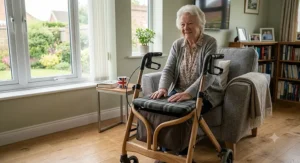
- Decide whether a seat is essential. If rest breaks mid-room are likely, prioritise models like the Aidapt Lightweight Rollator over tray-only options.
- Weigh the frame material trade-off. Aluminium models are lighter to lift and carry; steel models like Aidapt’s economy range are typically cheaper but slightly heavier.
- Confirm the maximum user weight capacity. Narrower frames, such as the KMINA Narrow Walker with Tray, often carry lower weight limits than wider premium models.
- Check VAT relief eligibility. Many indoor rollators, including the NRS Healthcare Ultra Narrow Walking Frame, qualify for VAT-free purchase for chronically sick or disabled buyers.
- Consider flooring type throughout the home. Deep-pile carpet, wooden thresholds and door strips all affect how smoothly small wheels roll.
Common Mistakes When Buying an Indoor Rollator
The most frequent error is buying based on overall reputation rather than actual measurements — a well-reviewed rollator that’s 5cm too wide for your bathroom doorway is objectively the wrong purchase, however many stars it carries. Always measure before browsing, not after.
A close second is assuming “lightweight” and “narrow” are the same thing. The Topro Olympos Deluxe Rollator is genuinely well-built but noticeably wider than dedicated indoor specialists — buyers focused purely on weight sometimes overlook width entirely and end up with a frame that scrapes both sides of a corridor.
Buyers also frequently skip the seat-versus-tray decision until after purchase, then discover the model they’ve chosen offers one but not the other. Decide upfront whether carrying items or resting mid-room matters more for daily use.
Finally, plenty of people buy the cheapest available option without checking maximum user weight, only to find the frame feels unstable or voids its warranty under a heavier user. Cross-reference weight capacity against the user’s actual weight, with a reasonable margin, every time.
Indoor Rollator vs Standard Outdoor Rollator
An indoor rollator and a standard outdoor rollator solve genuinely different problems, and the confusion between the two causes more disappointed purchases than almost anything else on this list. Outdoor models are built with larger wheels (often 15-20cm), wider wheelbases for stability on uneven ground, and puncture-resistant or pneumatic tyres that shrug off kerbs, gravel and grass.
Bring that same frame indoors and the advantages become disadvantages. The wider base that stabilises on a garden path becomes the exact thing that won’t clear a 60cm doorway. The larger wheels that handle a kerb also make tight 180-degree turns in a small kitchen genuinely awkward, sometimes requiring a three-point turn where a narrower model would glide through in one motion.
Indoor-specific models like the Days Breeze Indoor Rollator and KMINA Narrow Walker with Tray flip this trade-off deliberately: smaller wheels sized for smooth flooring, narrower frames built around doorway widths, and lighter overall construction since there’s no need to absorb kerb impacts. The honest takeaway is that if you genuinely split your time between garden, high street and home, a hybrid like the Topro Olympos Deluxe Rollator — narrower than a dedicated all-terrain model but sturdier than an indoor-only frame — may serve you better than owning two separate rollators.
What to Expect: Real-World Performance
On paper, a 6kg aluminium frame with 7-inch wheels sounds identical across several competing brands. In practice, the differences show up the moment you’re navigating a real hallway rather than a showroom floor. Swivel-wheel responsiveness varies noticeably: the KMINA Narrow Walker with Tray‘s 360-degree front wheels turn with minimal resistance, which matters enormously when you’re pivoting around a sofa arm rather than walking in a straight line.
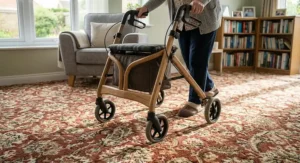
Carpet transitions are where budget models tend to reveal themselves. Thin, hard plastic wheels can catch on the raised edge of a carpet-to-laminate threshold strip, producing a small jolt that’s more startling than dangerous but genuinely undermines confidence over repeated use. Models with slightly larger or softer-tyred wheels, like the Topro Olympos Deluxe Rollator, roll over these transitions with noticeably less resistance.
Brake feel differs too, and this is rarely mentioned on spec sheets. Loop-style brakes, used on the Aidapt Lightweight Rollator and several rivals, require a firm downward push to engage the parking function — manageable for most users, but worth testing if arthritis affects grip strength, in which case the KMINA’s lighter-touch single-axis system may suit better in daily use.
Features That Actually Matter (And Those That Don’t)
Width and turning circle matter more than almost anything else marketed on the box. A rollator described as “compact” without a stated centimetre measurement is a marketing claim, not a spec — always find the actual number before buying.
Brake type matters genuinely, particularly for users with reduced hand strength; loop brakes versus single-axis systems produce real day-to-day differences, not just cosmetic ones. Weight capacity matters too, since exceeding it, even by a small margin, affects both safety and warranty validity.
What matters considerably less, despite prominent marketing, is colour range and cosmetic styling — pleasant to have, but irrelevant to function. Similarly, the number of accessories bundled as standard often inflates price without adding genuine daily value; a tray you’ll use every day is worth paying for, while a rarely-used cane holder often isn’t worth the premium it adds to models like some higher-spec Topro variants.
Safety, Doorway Widths and Regulations Guide
There’s no single UK regulation dictating rollator dimensions, but manufacturers generally design “indoor” models around the common internal doorway widths found in UK housing stock, typically 60-90cm depending on the property’s age. Measuring your specific doorways before buying remains the only reliable method, since “standard doorway” varies significantly between a 1930s semi and a modern new-build.
Safe use matters as much as the equipment itself. Both brake handles should always be squeezed simultaneously before sitting or standing, never one at a time, and the frame should be fully unfolded and locked before any weight is placed on it. If balance concerns are new or worsening, that’s a conversation for a GP or physiotherapist before it’s a shopping decision — a professional assessment can identify whether a rollator, a simpler frame, or something else entirely suits the underlying issue best.
Genuinely narrow frames like the NRS Healthcare Ultra Narrow Walking Frame trade a small amount of lateral stability for width clearance, which is a reasonable trade for confident, steady users but worth discussing with a healthcare professional if balance is more significantly affected. Reliable, evidence-based safety information is also available through the NHS and through charities focused specifically on this issue.
Long-Term Cost & Maintenance
The purchase price is rarely the full cost of rollator ownership, though it’s usually the only figure people budget for upfront. Replacement wheels, brake cables and occasional tyre wear add modest but real ongoing costs, typically in the £10-£30 range per replacement part depending on the model.
Frame material affects this calculation directly. Aluminium models generally resist corrosion better over years of use than steel alternatives, which matters if the rollator regularly gets wet from being brought in from outside. Warranty length is a genuinely useful proxy for expected longevity — the Days Lightweight Folding Rollator Walker‘s three-year cover suggests real manufacturer confidence, while shorter or unstated warranties on some budget imports warrant a touch more scepticism.
VAT relief is the most overlooked cost factor of all. Buyers who are chronically sick or disabled can often purchase eligible mobility equipment without paying the standard 20% VAT, provided they complete the relevant supplier declaration — full detail on eligibility and the VAT relief process for disabled people is published by HMRC. This can meaningfully reduce the real-world cost of models like the NRS Healthcare Ultra Narrow Walking Frame, which is explicitly VAT-relief eligible.
✨ Ready to compare current prices? Click through on any model above to check today’s availability before it changes.
Indoor Rollators for Specific Audiences
For older adults with mild balance concerns, a lightweight model with a genuine seat, such as the Aidapt Lightweight Rollator, tends to offer the best balance of confidence and rest options without overwhelming complexity. For younger users recovering from surgery or injury, weight capacity and stability often matter more than ultra-narrow width, making the Topro Olympos Deluxe Rollator‘s sturdier build a sensible short-to-medium-term choice.
For carers purchasing on behalf of a parent or relative, ease of folding and transport in a car boot becomes a genuinely practical priority alongside the user’s own needs — most models on this list fold reasonably flat, but the Days Breeze Indoor Rollator‘s lighter overall weight makes it easier for a carer to lift unassisted. For those in shared or rented accommodation with particularly narrow internal doors, the KMINA Narrow Walker with Tray and NRS Healthcare Ultra Narrow Walking Frame remain the strongest dedicated options.
FAQ
❓ What is the narrowest indoor rollator available in the UK?
❓ Can I get an indoor rollator free through the NHS?
❓ How do I measure my doorway for a rollator?
❓ What's the difference between a rollator and a Zimmer frame?
❓ How much does a good indoor rollator cost in the UK?
Conclusion
There isn’t a single best indoor rollator for everyone, and honestly, anyone claiming otherwise is skipping the measuring-tape step. What genuinely determines the right choice is your narrowest doorway, whether you need a seat or just a tray, and how much stability you’re willing to trade for width. The Days Breeze Indoor Rollator and KMINA Narrow Walker with Tray cover most narrow-home scenarios affordably, the Aidapt Lightweight Rollator adds a genuine resting seat without breaking the budget, and the Topro Olympos Deluxe Rollator earns its premium price for anyone who also needs occasional outdoor capability.
Whichever model you land on, take the time to measure first, check VAT relief eligibility if applicable, and — particularly if balance concerns are new — have a conversation with a GP or physiotherapist alongside your own research. Reliable, independently produced guidance from organisations like Age UK’s falls prevention resources is worth reading alongside any product comparison, this one included. Getting the choice right the first time saves both money and the frustration of a rollator that simply doesn’t fit your home.
✨ Don’t Miss These Exclusive Deals!
🔍 Take your search for the right walking aid to the next level with the models covered above. Click through on any highlighted product to check current pricing and availability, and give yourself the independence and confidence you deserve at home.
Recommended for You
- All Terrain Rollator Walker Guide: 7 Best UK Picks for 2026
- Best Outdoor Rollator 2026: 7 Tough, Reliable Picks
- Best Rollator With Seat And Back Rest: 7 Top UK Picks 2026
Disclaimer: This article contains affiliate links. As an Amazon Associate, I earn from qualifying purchases. If you purchase products through these links, we may earn a small commission at no additional cost to you.
✨ Found this helpful? Share it with your friends! 💬🤗
