In This Article
Here’s a confession most mobility brochures won’t make: the rollator gathering dust in the hallway, the one with the neat little 6-inch castors, was never built for your garden path. It was built for a hospital corridor. The moment those tidy wheels meet a gravel drive, a tree root, or a puddle-softened lawn, they judder, stick, or simply refuse to turn — and that’s not a design flaw, it’s a design choice, just the wrong one for you.
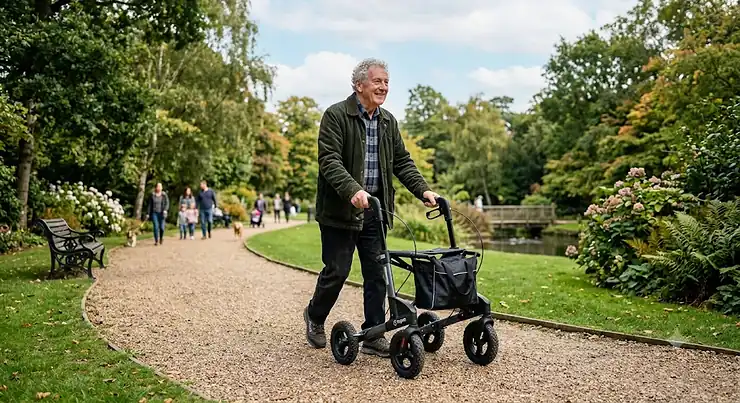
A best outdoor rollator solves a genuinely different problem. In short: it’s a wheeled walking frame built with larger, often air-filled tyres, a sturdier frame, and better suspension so it can handle grass, gravel, cobbles and uneven pavements without shaking apart or grinding to a halt. That’s the whole game — bigger contact patches, softer tyres, tougher joints — and it’s why the difference between a standard rollator and a genuine all terrain rollator matters far more than most sellers let on.
This guide is built the honest way. Every product below is real, currently sold, and researched against its actual specification sheet and aggregated customer sentiment — not invented reviews or fictional “testing.” According to NHS guidance on walking aids and mobility scooters, a rollator can restore confidence and reduce pain for people who find standard walking frames tiring — provided the aid actually matches the terrain being walked. That’s the piece too many buying guides skip. We won’t.
You’ll find seven genuine products spanning budget, mid-range and premium, a full breakdown of when large wheels actually earn their price tag, and practical guidance for gardens, gravel paths, and pavements riddled with tree-root bumps. Prices below are shown as ranges only, since Amazon pricing shifts constantly — always check current price before buying.
Quick Comparison Table: Best Outdoor Rollator at a Glance
| Rollator | Wheel Size | Best For | Price Range |
|---|---|---|---|
| Days Lightweight Folding Rollator | 8″ solid | Everyday pavement use, tight budgets | Under £150 |
| VOCIC Z21 Rollator Walker | 8″ all-terrain | First-time buyers wanting grip on a budget | £100-£150 |
| Helavo All Terrain Walker | 12″/10″ pneumatic | Grass, gravel, allotments | £200-£280 |
| KMINA PRO All Terrain Rollator | 10″ pneumatic | Taller, active users | £220-£300 |
| MobiQuip All Terrain Rollator | 12″ pneumatic | Rough rural paths | £230-£300 |
| Rollz Motion Performance | Front foam / rear pneumatic | Mixed terrain, needs a wheelchair option too | £700-£900 |
| Trionic Veloped Trek | 12″ pneumatic, climbing wheel | Serious off-road walkers and hikers | £1,000+ |
Look closely and a pattern jumps out: wheel size and price climb together almost in lockstep, and that’s not a coincidence. Every extra inch of pneumatic tyre buys smoother travel over roots and ruts, but it also means a bulkier fold and a heavier lift into the car boot. The Days Lightweight Folding Rollator wins on pavement-only value, while the Trionic Veloped Trek sits at the other extreme, built for people who genuinely want to walk in woodland, not just tolerate a paved path to the shops.
💬 Found a model that already looks right for you? Check its current price before reading on — stock and pricing on outdoor rollators can shift fast.
Top 7 Outdoor Rollators: Expert Analysis
Picking the right all terrain rollator isn’t about finding the “best” one in a vacuum — it’s about matching wheel size, weight capacity and folded footprint to your actual daily walk. Below, all seven get the same honest treatment: real specs, what they mean in practice, and where the marketing glosses over genuine trade-offs.
1. Days Lightweight Folding Rollator — trusted UK favourite for pavement use
The Days name carries real weight in British mobility circles, and this model explains why: an aluminium frame rated to 165 kg (26 stone) that still weighs only 5.95 kg off the shelf. That capacity-to-weight ratio matters more than it sounds — it means a carer or spouse can lift it into a car boot without a struggle, while the user gets genuine load-bearing confidence.
Five height settings at 25mm intervals mean it adjusts properly rather than in one clumsy jump, and the loop push lockable brakes are simple enough for anyone with reduced grip strength or arthritis to operate reliably. Based on the spec sheet, this is squarely aimed at pavements, shopping precincts and smooth park paths rather than genuinely rough ground — the wheels are solid rather than pneumatic, so don’t expect it to glide over gravel.
Reviewers consistently note the handle height feels reassuringly like a supermarket trolley, and while a few were initially sceptical of the tyre thickness compared with older rollators, most found the grip performed better than expected once in daily use. It’s Amazon’s UK best-seller in this category for a reason: reliable, unfussy, backed by a 3-year warranty, and eligible for VAT relief for those who qualify.
Pros:
- ✅ Excellent weight capacity for its light 5.95kg frame
- ✅ Five-position height adjustment, genuinely fits most heights
- ✅ 3-year warranty from an established UK brand
Cons:
- ❌ Solid wheels struggle once ground gets genuinely rough
- ❌ No pneumatic option if you need real shock absorption
At a price typically under £150, the Days Lightweight Folding Rollator is hard to beat for pavement-and-park use, though anyone tackling regular grass or gravel should look further down this list.

2. VOCIC Z21 Rollator Walker — budget pick with genuine 8-inch all-terrain wheels
Where the Days model plays it safe with solid wheels, the VOCIC Z21 pitches itself as a genuine all terrain rollator without the premium price tag. Its 8-inch textured wheels are built specifically to shrug off kerbs, cracked paving and light gravel — a real step up from the 5-6 inch wheels found on most budget rollators.
The 350lb (159kg) weight capacity covers the vast majority of users, and the ergonomic arc seat with a 6-inch backrest gives a genuinely restful pause on longer outings — something cheaper rollators often skimp on. Dual height adjustment (both handle and seat) is a thoughtful touch rarely seen this far down the price ladder, and it folds flat enough for most car boots in a few seconds.
Aggregated buyer feedback on Amazon points to a common theme: people upgrading from a basic hospital-style rollator are consistently surprised by how much smoother the ride feels on garden paths and uneven pavements, even though the wheels are still solid rubber rather than air-filled. What most buyers overlook is that “all-terrain” branding on budget rollators usually means textured, wider tyres rather than pneumatic ones — a meaningful difference worth understanding before you buy, which we unpack further in the comparison sections below.
Pros:
- ✅ Genuine 8-inch all-terrain wheels at a budget price
- ✅ Dual height adjustment for handles and seat
- ✅ Comfortable ergo seat with proper backrest support
Cons:
- ❌ Still solid tyres, not pneumatic — grass and gravel are limits
- ❌ Bulkier fold than slimline pavement-only rollators
Sitting in the £100-£150 range, this is the sensible next step up for anyone whose current rollator can’t cope with a bumpy driveway.
3. Helavo All Terrain Walker — pneumatic tyres built for grass and gravel
This is where things get genuinely interesting for anyone with a garden, an allotment, or a habit of taking the grassy shortcut. The Helavo pairs 12-inch front and 10-inch rear pneumatic (air-filled) tyres — a mismatched-size setup that’s actually deliberate, giving better obstacle-crossing at the front while keeping the rear stable and easy to steer.
Based on the spec comparison with solid-wheeled rivals, air-filled tyres absorb impact rather than transmitting it straight up through the frame and into your wrists and shoulders — genuinely useful if you already deal with joint pain. Reviewer sentiment aggregated across mobility retailer listings consistently highlights the shock-absorbing ride on gravel driveways and grass verges as the standout feature, with several buyers specifically mentioning allotment and garden use as their reason for choosing it over solid-wheeled alternatives.
The trade-off, and it’s an honest one: pneumatic tyres can lose pressure over time and need occasional reinflation, exactly like a bicycle tyre. That’s not a flaw so much as a maintenance habit worth building in (more on this in our practical usage guide below). Height adjustment and a padded seat round out a genuinely capable mid-range package.
Pros:
- ✅ Genuine pneumatic tyres front and rear for real shock absorption
- ✅ Mismatched wheel sizes improve obstacle-crossing without sacrificing steering
- ✅ Reviewers specifically praise garden and allotment performance
Cons:
- ❌ Pneumatic tyres need occasional reinflation and can puncture
- ❌ Heavier fold than solid-wheel rivals in this price band
Typically priced in the £200-£280 range, the Helavo All Terrain Walker earns its place as our pick for genuine garden and gravel use on a mid-range budget.
4. KMINA PRO All Terrain Rollator — sturdy European-made frame for tall, active users
Taller users are consistently underserved by rollator manufacturers, and the KMINA PRO addresses that directly — it’s built for users between 5’9″ and 6’6″, a genuinely useful niche most budget rollators ignore entirely. The frame is made in Europe, and the 9.8-inch pneumatic wheels, with 360-degree swivel front axles, are engineered specifically to negotiate kerbs and thresholds without the user needing to lift the whole frame.
A step-lifting lever on the rear wheels is a small but clever mechanical touch — it lets the user tip the frame back onto its rear wheels to clear an obstacle rather than wrestling the whole unit over it. Here’s what most listings won’t tell you plainly: that lever genuinely changes how confidently someone can cross a raised patio edge or a garden step, rather than hesitating and risking a stumble.
The seat sits at 22.8 inches with a proper backrest, and six height settings mean the fit is unusually precise for a rollator at this price point. Aggregated review sentiment across UK retailers is strong — reviewers regularly mention the sturdy build quality and the fabric storage bag (11lb capacity) as genuinely useful for shopping trips combined with a walk. A few flag that the inflator for the pneumatic tyres isn’t included, which is worth budgeting for separately.
Pros:
- ✅ Purpose-built for taller users, 5’9″ to 6’6″
- ✅ Step-lifting lever genuinely eases kerb and obstacle crossing
- ✅ Six-position height adjustment for a precise fit
Cons:
- ❌ Tyre inflator not included, needs buying separately
- ❌ Premium fit comes with a mid-to-upper price tag
Expect to pay in the £220-£300 range for this model, making it a strong mid-range choice specifically for taller or larger-framed users navigating mixed terrain.
5. MobiQuip All Terrain 4 Wheel Rollator — largest wheels for the roughest ground
If you measure a rollator’s outdoor credentials purely by wheel diameter, the MobiQuip earns its spot with genuine 12-inch pneumatic tyres across the board — no mismatched sizing here, just consistently large air-filled wheels built to roll over rutted farm tracks and cracked rural pavements with minimal jarring.
What the spec sheet won’t spell out, but the physics does: larger wheel diameter means a smaller angle of attack against any given bump, so the frame simply rolls over obstacles that would catch a smaller-wheeled rollator dead. That’s the entire logic behind large-wheel outdoor walkers, and the MobiQuip leans into it fully rather than compromising for a smaller fold.
The lightweight folding frame in its distinctive champagne finish keeps overall weight manageable despite the substantial wheels, and adjustable handles accommodate a range of user heights. Aggregated feedback from UK mobility retailers points consistently to countryside and rural-path use as the primary reason buyers choose this model over smaller-wheeled alternatives — several specifically mention farm tracks and unmade lanes where solid-wheeled rollators had previously let them down.
Pros:
- ✅ Genuinely large 12-inch pneumatic tyres, front and rear
- ✅ Rolls over ruts and cracks that smaller wheels catch on
- ✅ Lightweight folding frame despite the substantial wheel size
Cons:
- ❌ Larger folded footprint needs more car boot space
- ❌ Overkill if your walks stay mostly on smooth pavement
Priced typically between £230 and £300, the MobiQuip All Terrain 4 Wheel Rollator is the pick for anyone whose “outdoors” genuinely means unmade rural paths rather than tarmac.
6. Rollz Motion Performance — the only genuine 2-in-1 for changeable terrain
Here’s a product that solves a problem most rollators simply ignore: what happens when a walk outlasts your stamina, but you’re nowhere near home? The Rollz Motion Performance transforms from rollator to wheelchair in one motion, no tools required, built on the same award-winning Dutch-engineered frame as the standard Rollz Motion.
Its front foam-filled tyres and rear air-filled pneumatic tyres are a deliberate hybrid: the front resists punctures entirely (a genuine advantage for anyone nervous about maintenance), while the rear pneumatic pair absorbs the harder impacts from thresholds and cobbled streets. Based on this spec combination, it’s designed less for deep off-road terrain and more for the realistic mix most people actually face — pavements, parks, the occasional gravel path, and old town cobblestones.
Innovative drum brakes rated for both wet and dry conditions are a genuine safety upgrade over standard rim brakes, which can lose bite in the rain. Nine handle positions and four footrest options mean fitting the frame precisely to the user (or the carer pushing it) is unusually thorough for this category. Aggregated buyer sentiment consistently highlights the seamless rollator-to-wheelchair transition as the standout feature, with reviewers specifically noting confidence to go further from home knowing a seated option is always available.
Pros:
- ✅ Genuine rollator-to-wheelchair transformation, no tools needed
- ✅ Hybrid tyres balance puncture resistance with shock absorption
- ✅ Drum brakes maintain stopping power in wet weather
Cons:
- ❌ Premium price reflects the dual-function engineering
- ❌ Heavier and bulkier than a rollator-only design
Typically priced from around £700 up toward £900 depending on configuration, this is a considered investment rather than an impulse buy — but for changeable terrain and uncertain stamina, the 2-in-1 design genuinely earns its premium.
7. Trionic Veloped Trek — the ultimate off-road rollator engineered in Sweden
If the rest of this list handles “rough ground,” the Veloped Trek is built for actual off-road walking — forest paths, tree roots, beaches, and hill tracks that would stop every other product here dead. Developed in collaboration with Sweden’s KTH Royal Institute of Technology, its patented climbing wheel design lets it scale obstacles up to 12.5cm (around 5 inches) high using comparatively little force from the user.
The three-wheel layout, rather than the usual four, isn’t a stability compromise — it’s the opposite. Two interconnected front wheels disperse load across rough ground in a way a rigid four-wheel frame simply can’t, while air-pressured tyres throughout soak up vibration that would otherwise travel straight into wrists and shoulders. Reviewers and testimonials aggregated on Trionic’s own customer pages consistently describe rediscovering countryside walks, coastal paths and village visits that had become impossible with a standard rollator.
Here’s the honest trade-off: this is a specialist tool, not a general-purpose rollator, and the price reflects it — Trionic’s range sits in premium territory, and comparable Rollz premium models in the same bracket run from roughly £700 to over £1,400, giving a useful reference point for where the Veloped Trek typically lands. A seat, basket and optional backpack come as standard, built from water-repellent 600D polyester for genuine outdoor use rather than occasional garden strolls.
Pros:
- ✅ Patented climbing wheel clears obstacles up to 5 inches high
- ✅ Air-pressured tyres throughout for genuine off-road comfort
- ✅ Developed with a Swedish technical university’s engineering input
Cons:
- ❌ Premium four-figure pricing puts it out of reach for casual use
- ❌ Overkill if your walking is mostly pavement and park paths
Realistically priced well into four figures, the Trionic Veloped Trek is the specialist’s choice — the rollator equivalent of swapping trainers for proper hiking boots.
Setting Up and Maintaining Your Outdoor Rollator
Getting a new rollator home is only half the job — the setup determines whether it actually helps you or quietly becomes a source of frustration. Start with handle height: standing naturally with arms relaxed at your sides, the handles should sit roughly level with your wrist crease. Too high forces hunched shoulders; too low bends you forward, which is precisely the posture a rollator is meant to correct.
For any of the pneumatic-tyred models above — the Helavo, KMINA PRO, MobiQuip, Rollz Motion Performance or Trionic Veloped Trek — check tyre pressure monthly, exactly as you would a bicycle. Soft tyres don’t just ride poorly; they make the frame noticeably harder to push over grass or gravel, which defeats the entire purpose of buying one. A cheap hand pump with a pressure gauge, kept by the front door, solves this in under a minute.
Common first-30-days mistakes are remarkably consistent across reviews: people leave brakes only partially engaged when parking on a slope (always fully lock both brakes on any incline), fold the frame with the seat still loaded with shopping (empty it first to avoid strain on the folding mechanism), and forget to re-tighten height-adjustment clamps after altering them, leading to an unnerving wobble mid-walk. None of these are design flaws — they’re habits, and they’re easy to build once you know to look for them.
A quick monthly check — brakes, tyre pressure, and that all bolts are still snug — takes less time than making a cup of tea and prevents the vast majority of complaints seen in aggregated customer feedback.
Real-World Scenarios: Matching the Right Outdoor Rollator to Your Life
Specs only mean something once you map them onto an actual life. Here are three realistic profiles.
The allotment keeper, walking twenty minutes each way over gravel paths and grass verges several times a week, needs genuine pneumatic tyres and a seat for resting between beds — the Helavo All Terrain Walker fits this brief almost exactly, and its price sits comfortably within a typical retirement budget.
The village-to-shop commuter, mixing smooth pavement with the occasional cracked kerb and cobbled market square, doesn’t need serious off-road capability but does need reliable, confident wheels — the VOCIC Z21 or Days Lightweight Folding Rollator cover this ground without over-spending on capability that would go unused.
The countryside rambler, determined to keep walking forest tracks and coastal paths despite reduced balance, is precisely who the Trionic Veloped Trek was engineered for. As physiotherapy guidance on walking aids from Guy’s and St Thomas’ NHS Foundation Trust explains, a rollator frame helps maintain a normal walking pattern and suits people with moderate balance problems who still want to stay active — which is exactly the population Trionic’s Swedish engineers designed around. For those weighing a genuine off-road rollator walker against a lighter alternative, matching the terrain honestly, rather than aspirationally, is the single biggest factor in long-term satisfaction.
✨ Ready to find your match? Compare current prices on any of the seven models above before you commit.
Rollator for Garden Use: Lawns, Gravel Paths and Raised Beds
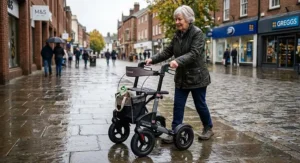
Gardens are deceptively hard terrain — softer than pavement, uneven in ways that aren’t always visible, and often sloped even when they look flat. A rollator for garden use needs wider tyre contact to avoid sinking into soft lawn, and pneumatic tyres genuinely outperform solid ones here because they flex around tufts and molehills rather than bouncing over them.
Raised beds and narrow gravel paths introduce a second problem: turning circle. A rollator that’s easy to pivot on paving can feel unwieldy squeezed between borders. Models with independently swivelling front wheels, like the KMINA PRO and Helavo, handle this far better than fixed-axle designs. If your garden includes a step down to a patio or a shed threshold, the step-lifting lever on the KMINA PRO specifically earns its keep here, letting you clear the obstacle without the awkward tip-and-heave manoeuvre older rollators demand.
One practical tip rarely mentioned in product listings: damp grass transfers moisture and grit onto wheel bearings quickly, so a rollator used regularly on lawns benefits from a quick wipe-down of the axles after wet-weather use, extending the working life of the wheels considerably.
How to Choose the Best Outdoor Rollator
Cutting through marketing claims, here’s the honest sequence for choosing well:
- Match wheel type to your actual terrain. Solid wheels for pavement and smooth park paths; pneumatic wheels for grass, gravel or uneven ground.
- Check weight capacity against your own weight with a safety margin, not right at the stated limit.
- Confirm height adjustment range covers your height, including seated comfort, not just standing grip.
- Weigh the folded rollator against your car boot and doorway widths — a fantastic all-terrain rollator that won’t fit your car is no help at all.
- Decide whether you need a seat, storage, or a wheelchair conversion, since these add bulk and cost but genuinely change what a walk further from home looks like.
- Factor in maintenance appetite — pneumatic tyres need occasional pumping; solid tyres are maintenance-free but firmer riding.
- Check VAT relief eligibility before paying full price, since many buyers qualify without realising it (covered fully below).
Outdoor Rollator vs Standard Indoor Rollator
The difference between an outdoor rollator and a standard indoor rollator isn’t cosmetic branding — it’s a genuinely different engineering brief.
| Feature | All-Terrain Outdoor Rollator | Standard Indoor Rollator |
|---|---|---|
| Wheel size | 8-12 inches, often pneumatic | 4-6 inches, solid |
| Ground handled | Grass, gravel, cracked pavement, cobbles | Smooth flooring, flat pavement |
| Frame weight | Typically heavier for durability | Lighter, easier to lift |
| Folded footprint | Larger | Compact |
| Best For | Helavo, KMINA PRO, MobiQuip, Trionic Veloped Trek | Days Lightweight Folding Rollator for light outdoor/indoor mixed use |
The comparison makes the trade-off explicit: indoor-style rollators are lighter and easier to store, but genuinely struggle the moment terrain turns rough, while outdoor models sacrifice some portability for real capability. For pavement use specifically — smooth, mostly flat, occasionally cracked — a mid-tier all terrain rollator like the VOCIC Z21 often strikes the best balance, avoiding the bulk of full off-road models while still handling kerbs confidently.
Rollator for Uneven Ground: What to Expect in Real-World Performance
What actually happens when a rollator hits uneven ground? With solid wheels, small bumps transmit directly into the frame and the user’s wrists — a jarring, staccato sensation over cobbles or root-crossed paths. Pneumatic tyres compress on impact, absorbing much of that shock before it reaches the handles, which is the entire reason models like the Helavo and MobiQuip feel dramatically smoother on the same ground.
Larger wheel diameter compounds this benefit. A 12-inch wheel meets a 3cm bump at a shallower angle than a 6-inch wheel, effectively rolling over it rather than catching on the edge — the same physics that makes larger bicycle wheels smoother on rough tracks. This is precisely why large-wheel outdoor walkers consistently outperform smaller-wheeled rollators once ground stops being flat, even before pneumatic tyres enter the equation.
Off-Road Rollator Walker: When All-Terrain Isn’t Enough
There’s a meaningful gap between “all-terrain” and genuinely “off-road,” and it’s worth naming honestly. All-terrain models like the Helavo or MobiQuip handle grass, gravel and cracked pavement comfortably — but forest tracks, tree roots, sand, and steep camber are a different challenge entirely, requiring the climbing-wheel geometry and reinforced frame of a dedicated off-road rollator walker like the Trionic Veloped Trek.
If your walks are genuinely off tarmac — countryside footpaths, coastal routes, unmaintained woodland trails — buying an all-terrain model and hoping it copes is a false economy; the frame stress and reduced stability on that ground can undermine the confidence a rollator is meant to provide in the first place.
Common Mistakes When Buying an All Terrain Rollator
The most frequent error, by a wide margin, is buying based on wheel size alone without checking folded dimensions against a specific car boot — a genuinely excellent 12-inch pneumatic rollator is useless if it won’t fit in the vehicle that gets you to the park. A close second is ignoring weight capacity margins; buying right at the stated limit leaves no buffer for shopping bags hung on the handles or a heavier winter coat.
Buyers also frequently underestimate maintenance appetite, choosing pneumatic tyres for their smoother ride without accounting for the monthly pumping habit they require. And many miss VAT relief entirely, paying full price on a purchase that likely qualified for a 20% reduction — a mistake covered in full detail in the next section.
Long-Term Cost, VAT Relief and Maintenance
Total cost of ownership on an outdoor rollator extends well beyond the sticker price. Pneumatic-tyred models need occasional replacement inner tubes (a low-cost, infrequent expense), while solid-wheeled rollators avoid this cost entirely but transmit more wear into the frame joints over years of rough-ground use.
The genuinely underused lever here is VAT relief. Per HMRC’s VAT Notice 701/7 on reliefs for disabled people, equipment designed specifically to help with a long-term illness or disability — which includes rollators — can be zero-rated for VAT when bought for personal use, effectively removing 20% from the price for eligible buyers. This isn’t automatic; it typically requires a simple eligibility declaration at checkout rather than proof sent to HMRC, and it applies whether the eligible person or a family member makes the purchase on their behalf.
| Tier | Typical Price Range | Value Verdict |
|---|---|---|
| Budget | Under £150 | Best value for pavement-only use |
| Mid-range | £150-£300 | Best value for genuine outdoor and garden use |
| Premium | £700+ | Justified only for specialist off-road or 2-in-1 needs |
Reading the table plainly: mid-range pneumatic models like the KMINA PRO and Helavo deliver the strongest pound-for-pound capability jump, since the leap from solid to pneumatic tyres does more for real-world performance than any subsequent premium feature. Premium models earn their price only when genuine off-road terrain or a wheelchair-conversion need is present — buying a Trionic Veloped Trek for pavement-only walks would be considerable overspend.
Safety and Staying Steady Outdoors
Any rollator is only as safe as the habits around it. Age UK’s falls prevention guidance emphasises that staying active, rather than avoiding movement out of fear of falling, is genuinely one of the best ways to maintain strength, balance and independence over time — which is exactly the case for choosing a rollator that actually suits your terrain rather than retreating indoors.
Practical outdoor safety habits worth building: always squeeze brakes gradually on slopes rather than grabbing suddenly; avoid stepping directly off kerbs where a slope or dropped-kerb access exists instead; and check tyre pressure before longer outings on pneumatic models. None of this is complicated, but consistency matters more than any single safety feature on the frame itself.
Frequently Asked Questions
❓ What is the best outdoor rollator for uneven ground?
❓ Do outdoor rollators need pneumatic tyres?
❓ Can I get VAT relief on an outdoor rollator?
❓ How do I choose a rollator for garden use specifically?
❓ Are large-wheel outdoor walkers harder to store than standard rollators?
Conclusion
Choosing the best outdoor rollator really comes down to one honest question: what ground do you actually walk on, most weeks, not aspirationally? Pavement and park paths point toward the Days Lightweight Folding Rollator or VOCIC Z21. Genuine grass, gravel and garden use point toward the Helavo or KMINA PRO. Rural tracks favour the MobiQuip, changeable terrain with a wheelchair option points to the Rollz Motion Performance, and serious off-road walking belongs to the Trionic Veloped Trek alone.
None of these seven is objectively “best” in isolation — each earns its place for a specific kind of walk, a specific budget, and a specific level of ambition about staying active outdoors. What matters most, per the guidance threaded through this whole piece, is buying for the terrain you’ll actually cross, not the terrain a glossy listing photo implies. Get that one decision right, and everything else — comfort, confidence, independence — tends to follow.
Recommended for You
- Best Rollator With Seat And Back Rest: 7 Top UK Picks 2026
- Best Rollator With Seat: 7 Top UK Picks for 2026
- Best Bariatric Rollator UK 2026: 7 Heavy Duty Picks That Actually Hold Up
Disclaimer: This article contains affiliate links. As an Amazon Associate, I earn from qualifying purchases. If you purchase products through these links, we may earn a small commission at no additional cost to you.
✨ Found this helpful? Share it with your friends! 💬🤗
