
In This Article
Nobody tells you that buying walking sticks for elderly parents is oddly emotional. You’re not just choosing a stick — you’re choosing whether Mum feels steady crossing the car park, or whether Dad admits he’s been “managing fine” while secretly gripping every wall between the kitchen and the front door. It’s a small purchase with a surprisingly large job to do.
Here’s the good news: a walking stick is one of the simplest, cheapest, most effective pieces of kit in the whole mobility-aid world. A well-chosen stick takes weight off a sore hip or knee, widens your base of support, and, as the NHS explains, can offer real confidence and reassurance when walking becomes harder. This guide walks through seven real, currently available options — from a £15 traditional wooden cane to a self-standing all-terrain design — with honest analysis of who each one actually suits, not just a features list lifted from the product page.
We’ve researched real specifications, genuine aggregated review sentiment, and the safety guidance that occupational therapists actually give patients. Where we can’t verify something (individual review quotes, for instance), we say so rather than making it up. What follows is commentary and comparison you won’t find on the Amazon listing itself — the kind of honest analysis that should sit alongside, not replace, proper professional advice.
Quick Comparison Table
| Product | Type | Best For | Price Range |
|---|---|---|---|
| Flexyfoot Shock-Absorbing Cork Handle Walking Stick | Single-point, adjustable | Everyday comfort on hard pavements | £25-£35 range |
| NRS Healthcare Traditional Chestnut Derby Walking Stick | Fixed wooden cane | Classic look, occasional light support | Under £20 |
| NRS Healthcare Folding Walking Stick | Folding aluminium | Travel, car boots, occasional use | £15-£25 range |
| Flexyfoot Comfort Fischer Handle Walking Stick | Single-point, adjustable | Arthritic hands, weak grip | £35-£45 range |
| NRS Healthcare Tetrapod Quad Base Walking Stick | Quad-base, self-standing | Users needing significant extra stability | £30-£40 range |
| KMINA Quad Cane | Heavy-duty quad-base | Taller, heavier users needing robust support | £45-£60 range |
| HurryCane Freedom Edition All-Terrain Cane | Folding self-standing pivot cane | Uneven ground, travel, users wanting the stick to stand alone | £50-£70 range |
Looking at this spread, there’s a clear budget-to-premium ladder: the two NRS Healthcare basics sit under £25, the Flexyfoot pair occupies the sensible mid-range with genuine ergonomic upgrades, and the quad-base and HurryCane options justify their higher price tags through extra stability engineering rather than branding alone. If you’re buying for someone with arthritic hands or a nervous grip, don’t default to the cheapest option — the Fischer handle on the Flexyfoot Comfort Fischer Handle Walking Stick genuinely changes the experience for sore joints, and that’s worth the extra tenner or two.
💬 Found a stick that looks right already? Check its current price and availability before reading on — stock (and colour options) shifts fast on popular mobility aids.
Top 7 Walking Sticks for Elderly: Expert Analysis
1. Flexyfoot Shock-Absorbing Cork Handle Walking Stick — best all-rounder for daily pavement use
The standout here is the flexible ferrule — a shock-absorbing “foot” that flexes on impact instead of transmitting every jolt straight up your arm. Most standard sticks use a rigid rubber ferrule that clatters on hard pavement; this one visibly rocks with the surface.
The stick telescopes to fit users roughly between 4’10” and 6’8″, which covers almost everyone in a household without buying a second size. The cork handle is contoured rather than a plain dowel, which spreads pressure across the palm instead of concentrating it on one pressure point — something that matters a lot after twenty minutes of continuous use. Based on the spec comparison with basic aluminium sticks, the flexible ferrule is the genuine differentiator: it’s the same core design idea used in walking poles for people with joint pain, just brought down to everyday cane form.
This is the stick for someone who’s still walking regularly — to the shops, round the block, to church — and whose main complaint is aching wrists or shoulders by the end of the walk, rather than someone who needs maximum standalone stability. Reviewers consistently report that the flex is noticeable within the first few steps and that it reduces the “clack” feeling on tarmac, though a handful note the ferrule needs replacing sooner than a standard rubber tip because the flexing material wears with use.
Pros:
- ✅ Flexible ferrule genuinely reduces impact shock through the arm
- ✅ Wide height range suits most adult users in one product
- ✅ Contoured cork handle spreads pressure across the palm
Cons:
- ❌ Flexible ferrule wears faster than a rigid rubber tip
- ❌ Doesn’t stand unaided, so it can be dropped if leant against furniture
At around £25-£35, this sits mid-pack for price but earns it through genuine engineering rather than marketing — a fair everyday value pick for anyone walking distances longer than a quick trip to the letterbox.
2. NRS Healthcare Traditional Chestnut Derby Walking Stick — classic wooden stick at a genuinely low price
The standout advantage is simplicity: this is the traditional, hospital-style cane made from chestnut wood with a “D”-shaped Derby handle, and it costs less than a round of coffees for four.
The Derby handle shape gives the fingers more room than a straight crook, spreading grip pressure and improving comfort for longer holds. Because it’s solid wood rather than telescopic aluminium, there’s no clicking button mechanism to fail — the trade-off is that height isn’t adjustable, so it needs to be the right length from the start (or professionally cut to size, which some mobility shops offer). On paper, that fixed length is the single biggest catch with this design.
This suits someone who needs occasional, light support rather than constant weight-bearing use — a steadying presence on uneven pavement, or reassurance on a longer walk, rather than a primary mobility aid for someone with significant balance loss. As wood is a natural material, the exact diameter and grain vary stick to stick, which some buyers actually prefer for the individual character, while others find it a slightly unpredictable ordering experience. Aggregated reviewer sentiment tends to praise the finish and weight, while a recurring theme in feedback is uncertainty over correct sizing before purchase — worth measuring carefully first.
Pros:
- ✅ Genuinely low price point for a solid wood stick
- ✅ Derby handle shape is comfortable for extended grip
- ✅ No adjustment mechanism to loosen or fail over time
Cons:
- ❌ Fixed height means no adjustment for different users
- ❌ Not suitable as sole support for significant balance impairment
At under £20, it’s one of the cheapest genuinely well-made sticks on this list, and a sensible starter purchase if you’re not yet sure how much support is really needed.
3. NRS Healthcare Folding Walking Stick — best for travel, car boots and occasional use
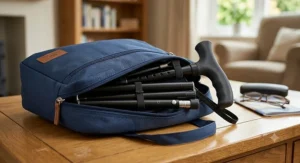
The headline feature is portability: this aluminium stick folds down into a compact bundle with a carry wallet, so it disappears into a handbag, glovebox or suitcase pocket rather than rattling around loose.
Underneath the folding mechanism, the specs are otherwise sensible rather than flashy — a wooden crook handle, adjustable within a set height range, and a standard rubber ferrule. What most buyers overlook about folding sticks generally is that the joints, while sturdy in normal use, do introduce very slightly more flex than a one-piece stick under heavy sideways load, so it’s better suited to walking support than to genuinely leaning your full weight on repeatedly.
This is the ideal second stick — the one that lives in the car for days out, or travels in a suitcase for a holiday, backing up a primary stick used at home. It’s also a sensible low-commitment first purchase for someone who’s not sure yet whether they’ll need a stick regularly, since the investment is modest and the folded size means it won’t become clutter if it ends up unused most days. Reviewers commonly mention how quickly it collapses and expands, and the fitted wrist cord is regularly flagged as a nice touch for keeping it close without having to carry it constantly.
Pros:
- ✅ Folds compactly for cars, bags and travel
- ✅ Comes with a carry wallet and wrist cord included
- ✅ Low price makes it a low-risk trial purchase
Cons:
- ❌ Folding joints add slightly more flex than a rigid stick
- ❌ Less confidence-inspiring for full-weight leaning than fixed designs
At £15-£25, this earns its place as the sensible “spare” — every household with a primary stick should probably own one of these for the boot of the car.
4. Flexyfoot Comfort Fischer Handle Walking Stick — best for arthritic or weak hands
The standout feature is the Fischer-style handle — a moulded, anatomically shaped grip specifically designed for users who struggle with a standard round handle, referenced directly in NHS physiotherapy literature as a grip style for those with hand or wrist difficulty.
Beyond the handle, this shares the same flexible shock-absorbing ferrule as the cork-handled Flexyfoot above, and the same wide telescopic height range. What most buyers overlook is that grip shape often matters more than cushioning material for arthritic hands — a soft foam grip that’s still round can still concentrate pressure on inflamed knuckles, whereas the Fischer shape distributes load across the whole hand rather than a single point. Here’s what to weigh: this handle style genuinely divides opinion because hand size and grip preference are personal, so it’s worth trying to hold one in a shop before committing if that’s an option locally.
This is squarely aimed at users with rheumatoid arthritis, osteoarthritis in the hands, or general grip weakness where a standard crook or cork handle causes discomfort within minutes rather than after a long walk. Reviewers consistently note the handle feels noticeably different to a standard stick and that it reduces hand fatigue on longer outings, though a minority mention the shaped handle can feel awkward for anyone with a smaller hand.
Pros:
- ✅ Moulded handle shape reduces pressure on arthritic joints
- ✅ Same flexible shock-absorbing ferrule as the cork model
- ✅ Wide adjustable height range for most adult users
Cons:
- ❌ Handle shape may not suit smaller or larger hand sizes equally
- ❌ Sits at a higher price point than basic aluminium sticks
At £35-£45, this is a specialist upgrade rather than an everyday default, but for the right hands it solves a real, specific problem that a generic stick simply can’t.
5. NRS Healthcare Tetrapod Quad Base Walking Stick — best for users needing serious extra stability
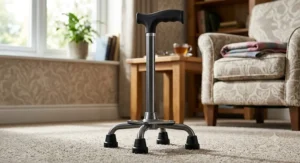
The standout here is the four-legged base itself — instead of a single ferrule, the stick plants four separate rubber feet on the ground, dramatically widening the support footprint compared to any single-point stick on this list.
The large-base version has a footprint of roughly 40cm by 22cm, and — unusually for a walking stick — it’s genuinely capable of standing on its own when set down, rather than needing to lean against a wall or chair. It’s height adjustable across a wide range and rated to support up to 127kg (20 stone). On paper, this means a meaningfully different level of reassurance for someone with significant balance impairment, a recent fall, or weakness affecting one side of the body more than the other. What the spec sheet won’t tell you, but occupational therapists routinely note, is that quad sticks are explicitly not designed for stairs — the offset base can catch or tip on a step edge, so it’s a flat-ground and indoor/outdoor pavement tool rather than an all-purpose aid.
This suits someone stepping up from a standard single-point stick because balance has deteriorated, or recovering from a hip or knee procedure where extra base stability during the healing period matters more than speed or lightness. Aggregated review sentiment repeatedly highlights the confidence boost from the wider base, particularly from family members buying for a relative after a fall, alongside occasional comments that the wider footprint takes a little getting used to on narrow pavements or doorways.
Pros:
- ✅ Four-point base offers significantly more stability than single-tip sticks
- ✅ Genuinely stands unaided when set down
- ✅ Height adjustable with a generous 127kg weight rating
Cons:
- ❌ Not designed or recommended for use on stairs
- ❌ Wider base is more cumbersome in narrow spaces
Priced around £30-£40, it’s excellent value for the amount of genuine extra stability engineered into the base, and it’s the kind of product occupational therapists commonly recommend after a falls assessment.

6. KMINA Quad Cane — best heavy-duty option for taller or heavier users
The standout advantage is build weight capacity paired with a genuinely ergonomic handle — this is a European-made quad-base cane engineered for users who need serious load-bearing support rather than light reassurance.
Where it differs from the NRS tetrapod above is handle design and overall robustness: the ergonomic grip is shaped to sit naturally under the palm rather than being gripped like a traditional crook, which reduces wrist strain for users leaning heavily rather than lightly touching the stick for balance. Based on the spec comparison, this is a stick built explicitly for users over roughly 5’1″ needing to actually bear weight through the arm, rather than for occasional touch-and-go support — a distinction that matters enormously for anyone recovering from lower-limb surgery or living with significant one-sided weakness.
This is the pick for a taller or heavier user whose main complaint with lighter quad sticks has been the handle feeling flimsy or the base feeling under-built for their needs. It’s a lesser-known brand outside the UK’s traditional mobility retailers, which means the review pool on Amazon UK is smaller than the more established NRS Healthcare range — worth noting honestly rather than pretending otherwise. What feedback does exist tends to focus on the sturdiness of the build and the comfort of the ergonomic handle compared with cheaper quad canes, with occasional comments that the base, while stable, is noticeably heavier to carry than a standard single-point stick.
Pros:
- ✅ Ergonomic handle reduces wrist strain under real weight-bearing
- ✅ Height adjustable for taller users, not just average heights
- ✅ Robust build feels sturdier than budget quad-base alternatives
Cons:
- ❌ Smaller UK review pool than more established brands
- ❌ Noticeably heavier to carry than a single-point stick
At £45-£60, this is a considered mid-to-premium choice specifically for users the standard quad sticks weren’t really built for — worth the extra outlay if bearing real weight is the priority.
7. HurryCane Freedom Edition All-Terrain Cane — best for uneven ground and travel
The standout feature is the patented SteadiGrip base — a compact tripod-style foot with three points of ground contact that pivots to stay flat on uneven surfaces, letting the cane stand independently by itself rather than needing to be leant against something.
It folds down to roughly 13.7 inches for storage in a bag or under a car seat, then extends and locks for use, with adjustable height covering a broad range of user heights. On paper this means a stick that behaves like a rigid, reliable support during use but packs away small for travel — a combination that’s genuinely hard to find elsewhere on the market. What most buyers overlook is that the self-standing feature isn’t just a gimmick: for someone who struggles to bend down and pick a dropped stick back up, a cane that reliably stays upright when set down is a real, practical safety feature, not a novelty.
This is the pick for an active senior who travels, eats out, or needs the stick to behave predictably on pavements, cobbles, gravel driveways or uneven garden paths — situations where a standard single ferrule tip can catch or slip. Reviewers frequently describe it as feeling more “planted” than a conventional stick on rougher ground, while a recurring theme in feedback is that the compact SteadiGrip base, while stable on most surfaces, feels less reassuring than a full quad base on very soft or uneven ground like grass after rain.
Pros:
- ✅ Self-standing design reduces bending down to retrieve a dropped stick
- ✅ Folds compactly for travel and storage
- ✅ Pivoting base copes well with uneven outdoor surfaces
Cons:
- ❌ Less stable than a full quad base on very soft ground
- ❌ Sits at the premium end of this comparison
At £50-£70, it’s the most expensive stick on this list, but the combination of portability and standalone stability genuinely justifies the price for an active, travelling user rather than someone who mainly walks indoors.
Walking Aids for Elderly: Practical Usage Guide
Buying the stick is only step one — using it correctly is what actually prevents falls. Get the height wrong, and even the best walking sticks for elderly users become useless or, worse, actively dangerous.
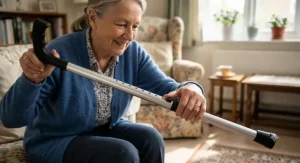
To measure correctly: stand naturally in normal shoes, arms relaxed at your sides, and measure from the floor to the crease of your wrist. That measurement is roughly the handle height you want, and it should let your elbow bend to a comfortable, slight angle when gripping the stick — not locked straight, not sharply bent. Hold the stick in the hand opposite your weaker or more painful leg; this feels counterintuitive to almost everyone at first, but it lets the stick and the weak leg share the load together on alternate steps.
In the first thirty days, check the ferrule (the rubber foot) weekly rather than waiting for it to visibly wear through — a smooth, worn ferrule loses grip long before it looks obviously bald, and it’s one of the most common preventable causes of a slip. Practise the stand-up and sit-down motion specifically: keep the stick near the arm of the chair, push up off the chair arms rather than the stick itself, then pick the stick up once you’re steady. A common early mistake is leaning on the stick to push up out of a chair — sticks aren’t designed to bear that kind of leverage force and can slip out sideways. Replace ferrules roughly every six to twelve months with regular use, or sooner if the tread pattern has visibly smoothed.
✨ Ready to find your fit? Compare the height ranges above against your own measurement before choosing — the right length matters more than the price tag.
Real-World Scenarios: Matching the Right Stick to Your Situation
Real product choice depends heavily on individual circumstances, so here are three common profiles and the reasoning behind a sensible match for each.
Margaret, 78, recovering from a hip replacement, mostly walking indoors and on flat garden paths: the extra base stability of the NRS Healthcare Tetrapod Quad Base Walking Stick makes sense here — recovery periods are exactly when balance is most compromised, and the self-standing quad base means she isn’t fumbling to retrieve a dropped stick while still building confidence on her feet.
David, 71, still driving, gardening and travelling to visit grandchildren regularly, with mild knee osteoarthritis: the HurryCane Freedom Edition All-Terrain Cane suits an active lifestyle where the stick needs to fold into a car boot, cope with gravel driveways, and stand by itself at restaurant tables and garden benches without constant management.
Joan, 84, with rheumatoid arthritis affecting both hands, walking short distances to the local shop most days: the Flexyfoot Comfort Fischer Handle Walking Stick addresses her specific pain point directly — a standard round handle would concentrate pressure on inflamed knuckles within minutes, while the moulded Fischer grip and shock-absorbing ferrule together tackle both the hand discomfort and the jarring impact of short, frequent outdoor walks.
None of these are prescriptive — they’re illustrations of how the right choice depends on mobility level, hand health, environment and lifestyle far more than on brand name or price alone.
Walking Stick Safety Tips for Elderly: Problem → Solution Guide
Even a well-chosen stick can cause problems if it’s used incorrectly or maintained poorly. Here are five common issues and honest, specific solutions.
Problem: the stick slips on wet or icy surfaces. Solution: check the ferrule tread depth regularly and replace it as soon as it smooths out — a worn ferrule is one of the single biggest preventable slip risks, and it’s an inexpensive, five-minute fix that’s routinely overlooked.
Problem: shoulder or wrist pain after using the stick. Solution: this is very often a height problem rather than a stick problem — recheck the wrist-crease measurement described above, and consider a shock-absorbing model like the two Flexyfoot options if the pain is specifically from repeated jarring impact rather than incorrect height.
Problem: the stick keeps falling over when set down. Solution: switch to a self-standing design — either a quad-base stick or the HurryCane’s SteadiGrip base — rather than relying on leaning it against furniture, which is a common and entirely avoidable cause of a bend-and-reach fall risk.
Problem: uncertainty over whether a stick is even the right aid. Solution: this genuinely warrants a proper occupational therapy assessment rather than guesswork — see the dedicated section below on getting professionally fitted.
Problem: gripping the handle causes hand pain within minutes. Solution: the handle shape matters more than most buyers expect; a Fischer or Derby handle spreads pressure differently to a standard round grip, so trying different handle styles is worth the small extra cost before assuming a stick simply “isn’t for you.”
Your Buyer’s Decision Framework: Which Walking Stick Type Fits You?
If you’re still weighing up options after all seven products above, this simple priority checklist should help narrow things down quickly.
If balance is your main concern rather than joint pain, choose a quad-base stick — the wider footprint directly addresses instability in a way a single-point stick cannot.
If you’re mostly walking indoors on flat, predictable surfaces, choose a standard single-point stick with an adjustable height — you don’t need the bulk or cost of a quad base if the environment doesn’t demand it.
If hand or wrist pain is your limiting factor, choose a stick with a shaped handle — Fischer or Derby style — over a plain round grip, regardless of the base type you also need.
If you travel, drive, or eat out regularly, choose a folding or self-standing design — a stick that has to be carefully leant against something every time becomes a genuine hassle in daily life rather than an occasional inconvenience.
If budget is the primary constraint and needs are modest, start with a basic adjustable or folding stick under £25 — it’s a low-risk way to establish whether more specialised support is actually needed before investing further.
Choosing the Right Walking Stick for Seniors: How to Choose
Beyond individual product features, these are the criteria worth working through methodically before buying.
- Measure height properly first. Every other decision is secondary to getting the wrist-crease measurement right — an incorrectly sized stick can cause back, shoulder or neck strain regardless of how good the product otherwise is.
- Match the base type to the balance level. Single-point sticks suit light support; quad or tripod bases suit genuine instability or recent falls.
- Consider the hand and grip health. Arthritic or weak hands benefit disproportionately from a shaped handle, even at a higher price point.
- Think about the actual environment. Mostly flat and indoors calls for a different stick than gravel paths, cobbled streets or frequent travel.
- Check the weight rating. Larger or heavier users should confirm the maximum user weight, particularly on quad-base and folding designs, where the mechanism itself has a load limit.
- Decide whether it needs to stand alone. If bending down to retrieve a dropped stick is a genuine difficulty, prioritise a self-standing design over a cheaper option that must lean against something.
- Don’t guess if there’s any doubt. A proper assessment, discussed below, removes the guesswork entirely and is free through the NHS in many areas.
For readers wanting a broader look at reducing fall risk generally rather than stick choice specifically, Age UK’s guidance on staying steady and reducing your risk of falling is a genuinely useful companion resource alongside this article.
Common Mistakes When Buying a Walking Stick for an Elderly Relative
The single most frequent mistake is buying by eye rather than by measurement — a stick that “looks about right” propped against a family member in a shop is not a substitute for the wrist-crease method described earlier, and an incorrectly sized stick can genuinely make balance worse rather than better.
The second common mistake is assuming a fixed-length wooden stick, like the traditional Derby model on this list, will suit anyone — without cutting or professional adjustment, a stick that’s even a few centimetres wrong in either direction changes posture and weight distribution meaningfully.
A third mistake is buying purely on price without considering hand health — a £15 basic stick might genuinely be the wrong false economy for someone with arthritic knuckles who would benefit far more from a £40 shaped-handle model that actually gets used, rather than a cheaper one that ends up abandoned in a hallway because it’s uncomfortable.
Finally, many families buy a stick as a one-off decision and never revisit it — but mobility needs change, sometimes gradually and sometimes suddenly after a fall or a procedure, and what worked well a year ago may no longer offer enough support today.

Walking Sticks vs Walking Frames and Rollators
It’s worth being honest about when a walking stick simply isn’t enough support, because recommending a stick to everyone regardless of need would be poor advice, not helpful commentary.
A walking stick offers a single point (or, with quad designs, four points) of extra ground contact and works well for users who need moderate support, reassurance, or to offload weight from one side. A walking frame, by contrast, offers a full four-point base held with both hands, providing substantially more stability but requiring more upper body strength and coordination to lift and place with each step — and frames are generally recommended for indoor use only, since uneven outdoor surfaces make them unsteady. A rollator (a wheeled frame, often with a seat) removes the lifting requirement entirely and adds a place to rest, which suits users who tire over distance but can still walk safely with wheeled support, though rollators require good hand-brake control and aren’t suitable for users with poor grip strength.
The practical dividing line: if someone needs to bear meaningful weight through both arms simultaneously to feel safe, or has significant balance impairment affecting both sides of the body, a stick — even a quad-base one — is likely under-supporting them, and a frame or rollator conversation with a GP or occupational therapist is the more honest next step. Choosing the “wrong tier” of aid, in either direction, is a genuine safety issue rather than a minor preference.
NHS Mobility Aid Guidance and UK Safety Regulations
In the UK, walking sticks sit in an interesting middle ground: they’re widely available to buy outright on the high street or online, but many types can also be borrowed through the NHS. NHS guidance on walking aids explains that you can speak to a GP, physiotherapist, occupational therapist or hospital staff about borrowing certain walking sticks, sometimes for a small deposit, rather than automatically needing to buy one privately.
There’s also a genuine financial consideration many buyers miss entirely: VAT relief. Products designed or adapted specifically for disabled use, or for someone with a long-term illness, can often be purchased VAT-free, and the government’s own guidance on VAT relief for disabled people confirms that qualifying disability-designed products don’t attract VAT when bought for personal or domestic use, provided a simple eligibility declaration is made at the point of purchase — worth checking on individual product listings, since eligibility depends on both the product and the buyer’s circumstances rather than being automatic for every mobility item.
On safety more broadly: sticks aren’t formally regulated the way medical devices are, but reputable UK suppliers design to general product safety standards covering things like weight ratings and structural integrity under load. The practical safety takeaway isn’t really about certification labels, though — it’s that a correctly sized, well-maintained stick with a sound ferrule consistently outperforms an expensive but poorly fitted one on actual fall prevention.
Occupational Therapy Assessment: When to Get Professionally Fitted
If there’s one piece of advice in this entire guide worth acting on immediately, it’s this: if you or a family member has had a recent fall, feels persistently unsteady, or simply isn’t sure which type of aid is right, a professional occupational therapy assessment is free through the NHS in many areas and removes almost all the guesswork covered in this article.
An occupational therapist doesn’t just hand over a stick — they assess gait, grip strength, home environment, and specific pain points, then recommend not just the aid type but often the exact handle style and base needed. This matters because, as this guide has hopefully shown, the “right” stick genuinely varies enormously between someone recovering from surgery, someone with arthritic hands, and someone simply wanting light reassurance on longer walks — and a fifteen-minute professional assessment can save months of trial and error with the wrong product. To start the process, NHS guidance on getting a needs assessment explains how to contact local social services, who will typically involve a social worker or occupational therapist to assess everyday mobility and daily living needs.
For readers buying on someone else’s behalf — an adult child buying for an ageing parent, for instance — raising the idea of a formal assessment can feel like a bigger conversation than simply ordering a stick online. It’s worth having anyway. A stick bought without any assessment is a reasonable stopgap, but it shouldn’t be treated as a substitute for professional input if instability, pain or fall risk is a genuine, ongoing concern rather than mild inconvenience.
Features That Actually Matter (And Those That Don’t)
After comparing seven real products across three price tiers, some patterns emerge about which specifications genuinely affect real-world safety and comfort, and which are closer to marketing noise.
Actually matters: correct height adjustment range for the user, ferrule tread condition and replacement schedule, handle shape relative to grip strength and hand health, and base type relative to actual balance level. These four factors, more than any brand name, determine whether a stick gets used daily or ends up abandoned.
Matters less than it seems: exact material of the shaft (aluminium versus wood makes less practical difference than people assume, provided weight rating is adequate), and colour or pattern options, which are genuinely just a personal preference matter rather than a functional one — though it’s worth saying that a stick someone actually likes the look of is a stick they’re more likely to use consistently, so this isn’t entirely irrelevant either.
Genuinely overrated in marketing copy: vague claims like “ergonomic design” or “premium comfort” without any specific mechanism behind them. The products on this list that back up such claims with an actual specification — a named handle shape, a measurable base footprint, a specific weight rating — are the ones worth trusting; generic superlatives without supporting detail are usually not.
FAQ
❓ What height should a walking stick be for an elderly person?
❓ Which hand should an elderly person hold a walking stick in?
❓ Are quad-base walking sticks better than standard sticks?
❓ Can you get a walking stick free on the NHS?
❓ How often should a walking stick's rubber tip be replaced?
Conclusion
There’s no single “best” walking stick for elderly users, because the honest answer depends entirely on balance level, hand health, environment and lifestyle — which is exactly why this guide leaned so heavily on comparison and context rather than a single crowned winner. For everyday comfort on pavements, the Flexyfoot Shock-Absorbing Cork Handle Walking Stick is a genuinely sound all-rounder. For serious extra stability, the NRS Healthcare Tetrapod Quad Base Walking Stick and the heavier-duty KMINA Quad Cane both do real, measurable work that a single-point stick simply can’t. For arthritic hands, the Flexyfoot Comfort Fischer Handle Walking Stick solves a specific, common problem. For active, travelling users, the HurryCane Freedom Edition All-Terrain Cane earns its higher price through genuine portability and standalone stability, while the two budget NRS Healthcare options remain sensible starting points or reliable spares.
Whatever you choose, the biggest safety factor isn’t the brand on the handle — it’s correct sizing, a well-maintained ferrule, and honest awareness of whether a stick is actually enough support, or whether a frame, rollator, or a proper occupational therapy assessment is the more appropriate next step. Buy thoughtfully, measure carefully, and don’t be afraid to ask for professional input if there’s any real doubt.
✨ Don’t Miss These Exclusive Deals!
🔍 Take mobility shopping to the next level with the options compared above. Click through on any highlighted product to check current pricing and availability, and choose the stick that genuinely fits — not just the first one you find.
Recommended for You
- Walking Sticks for Women: 7 Brilliant Picks for 2026
- 7 Best Walking Sticks for Men in 2026: Tall, Grip; Style
- Folding Walking Stick vs Wooden Walking Stick: 7 Picks for 2026
Disclaimer: This article contains affiliate links. As an Amazon Associate, I earn from qualifying purchases. If you purchase products through these links, we may earn a small commission at no additional cost to you.
✨ Found this helpful? Share it with your friends! 💬🤗
