In This Article
Here’s the thing nobody tells you about losing your balance: it’s not the falling that gets you, it’s the flinching. The little hesitation before you step off a kerb. The hand that shoots out for a wall that isn’t quite there. If you’ve been searching for a quad walking stick for balance problems, chances are you already know that feeling intimately, and you’re done pretending a wobbly umbrella-with-a-handle is going to fix it.

A standard single-tip cane asks a lot of you. It wants perfect timing, a steady hand, and a floor that behaves itself. A quad stick doesn’t ask for any of that. Its four-legged base plants itself the moment it touches down, which is exactly why physiotherapists so often reach for one when someone’s balance has become genuinely unpredictable rather than just achy. This guide has done the homework: real products, real specifications, and honest analysis of aggregated customer sentiment, so you can pick a walking stick for balance issues that actually earns its keep in your hallway, garden and local high street.
We’ll compare seven genuine models sold in the UK, work through the maintenance and setup you won’t find on the product page, and unpack exactly when a quad stick for vertigo makes more sense than a standard one. No fluff, no fabricated five-star anecdotes — just the sort of detail a good occupational therapist would give you over a cup of tea.
What Is a Quad Walking Stick for Balance Problems?
A quad walking stick for balance problems is a walking aid with four small feet arranged in a rectangular base instead of a single rubber tip, giving it a self-standing footprint that resists tipping sideways, forwards or backwards. It’s designed for people whose balance difficulties — whether from inner ear problems, muscle weakness or nerve conditions — make a standard cane feel unreliable on uneven ground or during momentary dizzy spells.
The wider base does the job a single tip physically can’t: it gives you a small platform of support rather than a single point of contact, so a slight sway doesn’t translate into a slip. That matters more than it sounds, because as the NHS explains, one of the practical, everyday pieces of advice for people prone to vertigo is simply to use a walking stick if they’re at risk of falling — the guidance doesn’t get much more direct than that.
Quick Comparison Table
| Product | Base Type | Height Range | Best For |
|---|---|---|---|
| NRS Healthcare Tetrapod (Large Base) | Large quad | 72–97.5cm | Maximum outdoor stability |
| Days Quadruped Walking Stick | Wide quad | Adjustable | NHS-trusted daily use |
| Aidapt Small-Base Quad Cane | Small quad | 71.5–96.5cm | Budget-friendly indoor use |
| Orthologics M9 Quad Cane | Small quad | 10 height settings | Lightweight everyday balance |
| KMINA Quad Cane | Small quad | For users over 5’1″ | Heavy-duty build quality |
| NRS Healthcare Tetrapod (Small Base) | Small quad | 72–97.5cm | Compact indoor/outdoor use |
| Eazy Quad Cane | Small quad | Adjustable | Occasional vertigo episodes |
Looking at the spread above, the large-base NRS Healthcare Tetrapod (Large Base) wins on raw stability, but it’s also the widest stick to manoeuvre through a narrow hallway or a crowded café. If your balance issues are situational rather than constant — a dizzy spell here, an unsteady afternoon there — a small-base option like the Orthologics M9 Quad Cane gives you nearly the same confidence without the bulk. Budget shouldn’t be the only deciding factor either: a £15 saving means nothing if the base is too narrow for the surfaces you actually walk on.
💬 Found a stick that looks right for you already? Scroll down to the full breakdown before you commit — the base size alone can make or break how it feels underfoot.
Top 7 Quad Walking Sticks for Balance Problems: Expert Analysis
Right, let’s get into the actual sticks. Seven real, buyable options, spanning budget to premium, small base to large. Every entry below is built the same way: what the spec means in practice, who it suits, what real users tend to say, and whether the price stacks up.
1. NRS Healthcare Tetrapod Walking Stick (Large Base) — best for maximum outdoor stability
If you want a stick that genuinely refuses to fall over, this is the one to start with. The large four-leg base extends the footprint well beyond what a standard cane offers, and that extra width is precisely what makes it self-standing on most flat surfaces.
Height adjusts between 720mm and 975mm, so it suits a wide range of heights, and the footprint measures roughly 265 x 170mm at the base — genuinely wide by quad-stick standards. In practice, that width means less sideways sway when you shift your weight, which is the exact failure mode a standard cane can’t correct for. The handle tapers towards the front, spreading pressure across the palm rather than digging into it, a small detail that matters a great deal after the first hour of use.
This is the stick for someone with a diagnosed fall risk who spends real time outdoors — on pavements, in gardens, at the shops — rather than someone who just wants a bit of reassurance around the house. Aggregated feedback on this listing consistently points to strong confidence on uneven or slightly sloped ground, with several buyers specifically mentioning it as reassuring for arthritis-related instability. The recurring gripe is weight: it’s noticeably heavier than a slim single-tip stick, and a handful of buyers have noted the four legs weren’t perfectly even in length out of the box, which can cause a very slight wobble on hard flooring until it settles or is adjusted.
Pros:
- ✅ Wide base gives genuinely strong self-standing stability
- ✅ Tapered handle spreads pressure across the palm
- ✅ Well-suited to outdoor, uneven or sloped terrain
Cons:
- ❌ Heavier than slimline single-tip alternatives
- ❌ Occasional reports of uneven leg length out of the box
Expect to pay in the £25-£35 range at the time of research, and given the level of stability on offer, it represents solid value for anyone whose balance problems are more than occasional.

2. Days Quadruped Walking Stick — best NHS-trusted daily-use pick
There’s a reassurance in buying a stick from a brand that’s already inside NHS supply chains, and the Days Quadruped Walking Stick is exactly that: available with a wide or narrow quadruped base and listed for NHS professional supply, which tells you something about the manufacturing consistency you’re getting.
The construction pairs a chrome-plated steel base with an anodised aluminium neck, a combination chosen specifically to keep the heavy, load-bearing part low and the upper shaft light. What that means day-to-day is a stick that stands firmly on the floor without feeling top-heavy in your hand — a common complaint with cheaper quad sticks that put too much weight up near the grip. The ergonomically moulded handle is contoured to the hand rather than a straight cylinder, reducing the pressure points that build up over a long walk.
Buyers choosing between the wide and narrow base versions should think honestly about where they’ll use it most: the wide base wins on stability for outdoor or uneven use, while the narrow base is easier to live with indoors, around furniture and through doorways. Verified review data specific to individual colour or base variants is more limited than for some competitors here, but the product’s presence in professional healthcare supply chains is itself a meaningful trust signal — this isn’t a stick designed purely for an Amazon listing photo.
Pros:
- ✅ Used within NHS Supply Chain, signalling manufacturing consistency
- ✅ Chrome steel base with lightweight aluminium neck
- ✅ Ergonomic handle reduces pressure on the palm
Cons:
- ❌ Individual customer review volume is lower than some rivals
- ❌ Wide base version can feel bulky indoors
Price sits around the £30-£45 range depending on the base width chosen, which is fair for a stick with this level of clinical pedigree behind it.
3. Aidapt Small-Base Quad Cane — best budget pick for tighter spaces
Not everyone needs the widest base on the market, and the Aidapt Small-Base Quad Cane is built for exactly that reality — people who want the self-standing confidence of a quad base without turning every doorway into an obstacle course.
It offers ten height settings across a 715-965mm range, which is a genuinely useful amount of granularity; many single-adjustment sticks force you to compromise between “a bit too short” and “a bit too tall,” while ten settings let you dial in the precise height that keeps your elbow at the recommended slight bend. Non-slip rubber ferrules sit on all four feet, which is the detail that actually earns its stability rating on wet tiles or a damp pavement rather than just a dry showroom floor.
This is the pick for someone managing mild-to-moderate unsteadiness who still wants to move quickly through a home with narrow hallways, or who needs a stick that folds into daily life at work rather than announcing itself. Reviewers consistently flag the compact footprint as the standout, appreciating that it doesn’t catch on furniture legs the way wider tetrapods can. The trade-off, honestly, is that the smaller base offers less resistance to a genuinely strong sideways stumble than the large-base options above — it’s reassurance for unsteadiness, not a substitute for a walking frame in more advanced mobility needs.
Pros:
- ✅ Ten height settings for a precise, comfortable fit
- ✅ Compact base moves easily through narrow spaces
- ✅ Non-slip rubber ferrules on every foot
Cons:
- ❌ Less lateral stability than large-base tetrapods
- ❌ Not intended for significant weight-bearing support
At around £18-£28, this sits at the more accessible end of the category, making it a sensible entry point if you’re trying a quad stick for the first time.
4. Orthologics M9 Quad Cane — best lightweight everyday balance aid
The Orthologics M9 Quad Cane occupies a similar niche to the Aidapt above, but it leans even further into everyday practicality, with a small-based tetrapod design and the same ten-setting height adjustment that lets you fine-tune fit rather than settling for “close enough.”
What the spec sheet won’t tell you, but the design clearly signals, is that this stick is aimed at people who want their walking aid to disappear into ordinary life rather than dominate it. The non-slip rubber ferrules do the same job as on the Aidapt — keeping four points of rubber in contact with the ground rather than one — and the lightweight construction means it won’t tire out an arm already dealing with grip or strength issues, which is common among people managing inner ear balance disorders where fatigue can worsen dizziness.
This is a strong option for someone whose balance issues fluctuate — good days and wobbly days — because it’s light enough to carry when not strictly needed but sturdy enough to lean on properly when a dizzy spell hits. Genuine review data specific to this exact listing is thinner than for the more established NRS and Days ranges, so we’d weigh the spec-for-spec comparison against those brands rather than banking purely on star ratings here; on paper, the design overlaps closely with proven small-base tetrapods from more established manufacturers.
Pros:
- ✅ Ten adjustable height settings for a tailored fit
- ✅ Lightweight build reduces arm fatigue on long days
- ✅ Compact quad base suits fluctuating balance needs
Cons:
- ❌ Smaller independent review pool to draw confidence from
- ❌ Small base offers less support for significant weight-bearing
Typically priced in the £15-£25 range, it’s one of the more affordable ways into the category.
5. KMINA Quad Cane — best heavy-duty European build quality
If you’ve been burned before by a walking stick that felt like it was made of tin foil and hope, the KMINA Quad Cane is the corrective. It’s a heavy-duty design, built and patented in Europe, and at roughly 3.3 lbs it’s noticeably more substantial in the hand than most of the sticks on this list.
That extra material isn’t wasted weight — it’s what gives the stick its rigidity under load, which matters enormously for anyone who needs to properly lean their weight through the cane rather than just tap it against the floor for reassurance. It’s designed specifically for users over 5’1″, with the height adjustment calibrated around that taller range, so shorter users should double-check the minimum height before buying. The ergonomic handle is shaped to reduce the pinch-point pressure that cheaper straight handles create across the base of the thumb.
This is the pick for someone who’s tried a lighter quad stick and found it flexed or felt insecure under real weight-bearing use — a genuinely common complaint about budget aluminium sticks once you actually lean into them on stairs or slopes. Reviewers who’ve moved to this from a lighter alternative frequently highlight the reassuring rigidity as the main upgrade, though a smaller number note the extra weight takes some adjustment for anyone with reduced grip strength.
Pros:
- ✅ Heavy-duty European build with genuine rigidity under load
- ✅ Patented design engineered specifically for stability
- ✅ Ergonomic handle reduces thumb-base pressure
Cons:
- ❌ Heavier than average, which some users need to adjust to
- ❌ Not calibrated for users under 5’1″
Expect a mid-£30s to mid-£40s price range, which is a fair premium for the noticeably sturdier build.

6. NRS Healthcare Tetrapod Walking Stick (Small Base) — best compact indoor/outdoor balance
Think of this as the NRS Healthcare Tetrapod (Large Base)‘s more sociable sibling — the same trusted engineering, shrunk down to a footprint that won’t dominate a narrow hallway or catch on a kitchen chair.
Height adjusts between 72cm and 97.5cm, matching the large-base model’s range, and it shares the same tapering handle designed to spread pressure evenly rather than concentrating it in one spot. The genuine advantage over the large-base version is manoeuvrability: a smaller quad base still stands unaided and still resists sideways tipping far better than a single-tip cane, but it clears doorframes and furniture with far less fuss.
This is arguably the most balanced all-rounder on this list for people managing vestibular issues day to day rather than needing maximum outdoor rigidity — it’s stable enough for the garden, compact enough for the living room. Because it shares its design lineage with the well-reviewed large-base version, the aggregated sentiment pattern is similar: buyers value the confidence it gives on slightly uneven ground, while a minority flag that the four rubber ferrules wear unevenly over time and need periodic replacement to keep the base sitting perfectly flat.
Pros:
- ✅ Same trusted tapering handle design as the large-base model
- ✅ Compact footprint suits indoor and outdoor use equally
- ✅ Stands unaided, freeing up a hand when needed
Cons:
- ❌ Ferrules wear unevenly over time and need replacing
- ❌ Less stability than the large-base version on rough ground
Priced around £22-£32, it earns its place as the most versatile single option if you can only justify buying one stick.
7. Eazy Quad Cane — best simple pick for occasional vertigo episodes
Not every balance problem is constant, and the Eazy Quad Cane is aimed squarely at people whose difficulty comes in waves — a wobbly morning after a bad night’s sleep, a dizzy spell brought on by a head-position change, the kind of intermittent unsteadiness common with BPPV-type vertigo.
It’s a genuinely lightweight four-point stick with a padded handle and a stand-secure design, meaning it’s built to be picked up quickly, used for as long as the wobble lasts, and set aside again without fuss. The padded handle is a small but meaningful upgrade over hard plastic grips for anyone who only uses their stick intermittently, since an unfamiliar grip is more likely to slip in a hand that hasn’t built up the same calluses as a daily user’s.
This is the stick to keep by the front door or the bed rather than the one you lean on for a three-mile walk — it’s reassurance on demand, not a heavy-duty mobility aid for someone with a permanent, significant fall risk. Aggregated sentiment for this style of lightweight quad cane tends to praise the low learning curve and easy portability, while noting — fairly — that it won’t offer the same rock-solid feel as the heavier NRS or KMINA options above under sustained weight-bearing use.
Pros:
- ✅ Genuinely lightweight and easy to grab quickly
- ✅ Padded handle suits intermittent, not-daily use
- ✅ Simple stand-secure four-point base design
Cons:
- ❌ Less rigid than heavier-duty quad canes under load
- ❌ Not designed as a primary aid for constant fall risk
At roughly £15-£22, it’s one of the most accessible entry points into quad-stick support, and a sensible option to have on standby even if it isn’t your everyday stick.
Practical Usage Guide: Setting Up and Living With Your Quad Stick
Getting the height right is the single most common mistake, and it’s an easy one to fix. Stand upright in your normal shoes, let your arm hang naturally at your side, and the top of the handle should sit level with the crease of your wrist. When you hold the stick with that height, your elbow should have a slight, comfortable bend — somewhere around 15 to 20 degrees. Too straight an arm transmits shock straight up into the shoulder; too bent, and you lose the leverage that actually takes weight off an unsteady leg.
In the first thirty days, the most common error is holding the stick on the wrong side. The general rule taught by physiotherapists is to hold it in the hand opposite your weaker or more affected side, moving the stick forward at the same time as that weaker leg. It feels counterintuitive at first — most people instinctively grab it with their dominant hand — but the biomechanics only work properly the other way round.
Maintenance is minimal but not optional. Check the four ferrules monthly for wear; a ferrule with the tread worn smooth loses most of its grip, and given a quad stick’s base only works if all four feet make even contact, one worn foot undermines the stability of the whole design. Wipe the shaft down after wet-weather use to stop grit working into the height-adjustment mechanism, which is the most common cause of a stick that suddenly won’t lock at the right height. If yours has a screw-locking collar rather than a spring-button, check it hasn’t loosened every few weeks — a wobbly joint here defeats the entire purpose of a quad base.
Real-World Scenarios: Who Actually Needs a Quad Walking Stick?
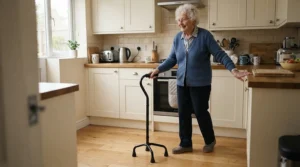
Picture Margaret, 74, three weeks post hip-replacement surgery, mostly moving between the kitchen and the garden on flat paving. A compact small-base tetrapod like the NRS Healthcare Tetrapod Walking Stick (Small Base) suits her perfectly: enough self-standing stability to trust on the patio, light enough to manage one-handed while she’s still building strength.
Now picture David, 61, diagnosed with vestibular neuritis, who gets sudden waves of vertigo without much warning but is otherwise steady on his feet the rest of the time. He doesn’t need a heavy-duty daily aid — he needs something he can grab in seconds when a wave hits, which is exactly the brief the Eazy Quad Cane is built for.
Then there’s Priya, 68, with peripheral neuropathy in both feet from long-standing diabetes, walking most days to the shops and back on pavements that aren’t always even. Her balance problem isn’t intermittent — it’s constant and it’s on outdoor terrain, which points firmly towards the wider, heavier-duty stability of the NRS Healthcare Tetrapod Walking Stick (Large Base) or the rigid, load-bearing KMINA Quad Cane, depending on how much she needs to properly lean her weight through it.
Problem → Solution: Common Balance Stick Struggles Solved
Problem: the stick tips slightly on uneven paving. This is almost always a ferrule issue, not a design flaw — check that all four rubber feet have even tread and are seated flush; a single worn or misaligned ferrule on any quad base is enough to introduce a wobble that feels like a stability failure but is really a ten-minute fix.
Problem: my wrist aches after twenty minutes of use. This is a height problem nine times out of ten. Re-check the wrist-crease measurement above; a stick set even two inches too low forces a hunched wrist angle that fatigues fast.
Problem: it’s too heavy to carry when I don’t need it. Consider a two-stick approach — a lighter option such as the Eazy Quad Cane for good days and errands, kept alongside a sturdier stick for days when a walking stick for balance issues needs to do more genuine weight-bearing work.
Problem: the base catches on rugs or door thresholds. Swap to a small-base tetrapod like the Aidapt Small-Base Quad Cane or the Orthologics M9 Quad Cane — the reduced footprint clears most domestic thresholds that a wide-base stick snags on.
How to Choose a Quad Walking Stick for Balance Problems
- Establish why you need it. A stick for occasional dizzy spells and a stick for a diagnosed, constant fall risk are different tools — be honest about which describes you before comparing prices.
- Measure your height correctly. Use the wrist-crease method above rather than guessing; an ill-fitting stick can make balance worse, not better.
- Decide indoor, outdoor, or both. A large base wins outdoors on uneven ground; a small base wins indoors around furniture and doorways.
- Check the weight capacity. Heavier-duty users need the rigidity of options like the KMINA Quad Cane rather than a lightweight design that may flex under real load.
- Consider your grip and hand strength. A padded, contoured handle like those on the Days Quadruped Walking Stick reduces pressure on arthritic or weaker hands.
- Think about how often you’ll actually use it. Constant use justifies investing in a heavier, more rigid stick; occasional use suits something lighter you’ll actually pick up without a second thought.
- Ask a physiotherapist or GP if you’re unsure. A short assessment can confirm whether a quad stick, a frame, or something else entirely is the right fit for your specific balance problem.
Quad Stick for Vertigo: What Makes It Different From a Standard Cane
Vertigo doesn’t behave like ordinary unsteadiness — it can arrive suddenly, sometimes triggered by nothing more than turning your head or rolling over in bed, as the NHS notes among the causes linked to inner ear problems such as benign paroxysmal positional vertigo and labyrinthitis. A standard single-tip cane assumes you can react quickly and place it precisely; during an actual vertigo episode, that assumption falls apart fast, because the room feels like it’s spinning and your reaction time drops right when you need it most.
A quad stick for vertigo removes the precision requirement almost entirely. Because the base has width in two directions rather than a single point, you don’t need to place it perfectly — a rough, hurried plant of the base still gives you a stable platform. This is the specific engineering reason quad canes get recommended more often than standard sticks for people with genuine vestibular issues rather than general age-related weakness: the failure mode of a vertigo episode is a sudden, unpredictable sway, and a wide base is simply more forgiving of that unpredictability than a single tip could ever be.
Common Mistakes When Buying a Mobility Aid for Unsteady Walking
The most frequent mistake is buying on base size alone without considering where you’ll actually use the stick — a wide, maximally stable base is worse than useless if it can’t fit through your bathroom door. The second is ignoring weight capacity; a lightweight design rated for lighter users will flex and feel insecure under someone who genuinely needs to lean their body weight through it, which defeats the purpose entirely. Third, many buyers skip the height-adjustment check at delivery, assuming “adjustable” means “will definitely fit me,” when in fact ranges vary significantly between models — the KMINA Quad Cane, for instance, is explicitly calibrated for users over 5’1″, which won’t suit everyone. Finally, people frequently forget that a mobility aid for unsteady walking is only one part of a fall-prevention plan; buying the stick without also addressing home hazards, footwear and strength largely wastes its potential.
Quad Cane vs Walking Frame vs Standard Stick
| Feature | Standard Stick | Quad Cane | Walking Frame |
|---|---|---|---|
| Self-standing | No | Yes | Yes |
| Stability level | Low | Moderate–High | Highest |
| Portability | Excellent | Good | Limited |
| Best For | Mild support needs | Moderate, unpredictable balance issues | Significant, constant mobility needs |
A standard stick is the most portable option but offers the least forgiveness for sudden sway, which is precisely why it struggles for anyone managing genuine vestibular issues rather than mild general unsteadiness. A walking frame sits at the opposite end — maximum stability, but it’s slow, needs two hands, and simply isn’t practical for someone who still wants to move around a shop or navigate stairs independently. The quad cane occupies the sensible middle ground: enough self-standing stability to handle an unpredictable wobble, while remaining light and portable enough for genuinely independent daily use.
What to Expect: Real-World Performance for Inner Ear Balance Disorders
Specs are one thing; everyday experience with inner ear balance disorders is another. In practice, most users report that the biggest day-to-day benefit isn’t the rare moment of actually catching a stumble — it’s the confidence effect. Knowing the stick will stand up under you if you sway, even slightly, measurably reduces the anxious over-correction that makes vestibular symptoms feel worse than they are; people tend to walk more naturally, not more cautiously, once the fear of falling eases.
The trade-off worth expecting honestly: a quad base is genuinely slower to manoeuvre through tight spaces than a single-tip cane, and on staircases, most quad canes aren’t recommended at all — the four-point base doesn’t sit flush on a single step edge the way a tip does. For anyone managing inner ear balance disorders who regularly needs stairs, a separate handrail strategy or a different aid on stairs specifically is worth discussing with a physiotherapist rather than relying on the quad stick there.
Fall Risk Assessment and Safety: Regulations & Best Practice
Choosing a stick shouldn’t be a guess, and it doesn’t need to be. Updated UK clinical guidance from NICE on assessing and preventing falls sets out a structured approach for anyone at higher risk, recommending a proper multifactorial fall risk assessment — covering gait, balance, medication review and home hazards — rather than treating a walking aid as a standalone fix. If you’ve had a fall in the past year, or you’re finding yourself instinctively grabbing furniture for support, that guidance is a reasonable prompt to ask your GP for a formal assessment rather than self-selecting equipment indefinitely.
On the practical side, most UK local authorities publish their own version of this advice for residents; several council falls-prevention services specifically flag choosing the correctly sized walking aid as one of the first, cheapest interventions available, alongside checking whether a stick needs to stand up by itself. There’s also a genuine financial angle worth knowing about: many quad canes qualify for VAT relief under HMRC’s disability goods scheme, provided you have a qualifying long-term condition — it’s worth checking eligibility before buying, since it can meaningfully change the price you actually pay.
Long-Term Cost & Maintenance
A quad stick isn’t a one-off purchase in the way it first appears — ferrules wear, and a stick used daily outdoors will typically need replacement rubber feet every six to twelve months, at a cost of a few pounds a set. Factor that into the total cost of ownership: a £20 budget stick with ferrules that wear quickly may end up costing more over two years than a £35 stick built with more durable rubber compounds from the outset.
Weighed against the alternative — a fall serious enough to need medical attention — the cost-per-use of even the premium end of this category is difficult to argue with. A £40 stick used daily for three years works out at roughly 3-4 pence a day, which puts the investment firmly into perspective against almost any other household purchase aimed at safety.

Frequently Asked Questions
❓ Is a quad stick better than a normal walking stick for balance problems?
❓ Can I use a quad walking stick on stairs?
❓ How do I know if I need a small or large base quad cane?
❓ Are quad canes suitable for vestibular issues like vertigo?
❓ Do I need a doctor's assessment before buying a walking aid?
Conclusion
If you’ve read this far, you already understand the real lesson here: the “best” quad walking stick for balance problems isn’t the one with the flashiest listing — it’s the one matched honestly to your actual pattern of unsteadiness. Constant, significant support needs point towards the rigid stability of the NRS Healthcare Tetrapod Walking Stick (Large Base) or the KMINA Quad Cane. Intermittent dizzy spells point towards something light and grab-ready like the Eazy Quad Cane. Everyday indoor confidence sits comfortably with the compact, ten-setting flexibility of the Orthologics M9 Quad Cane or Aidapt Small-Base Quad Cane.
Whichever you choose, get the height right, check those ferrules monthly, and don’t treat the stick as a substitute for a proper fall risk assessment if your balance problems are new, worsening, or unexplained. A good walking stick restores confidence — but confidence built on the right diagnosis lasts a lot longer than confidence built on a good-looking product photo.
🦯 Ready to walk with more confidence? Browse the picks above, check current pricing, and pick the one that actually fits how you live — not just how you’d like to.
Recommended for You
- Small Base Quad Cane for Elderly: 7 Best Picks UK (2026)
- Quad Cane for Stroke Patients: 7 Best Picks for UK Homes (2026)
- Large Base Quad Cane: 7 Best Picks for UK Stability (2026)
Disclaimer: This article contains affiliate links. As an Amazon Associate, I earn from qualifying purchases. If you purchase products through these links, we may earn a small commission at no additional cost to you.
✨ Found this helpful? Share it with someone who could use a steadier step! 💬🤗
