In This Article
Standing in the mobility aids aisle — or, more likely these days, scrolling through Amazon at eleven at night trying to make sense of dozens of near-identical-looking sticks — most people hit the same wall. A quad cane clearly has four little feet instead of one rubber tip, but nobody tells you why some have a footprint the size of a beer mat and others sprawl out like a mini step-stool. That’s the small base quad cane vs large base quad cane decision in a nutshell, and it matters more than the product photos let on.
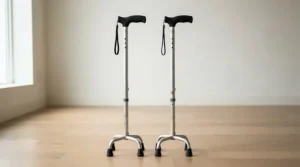
This isn’t a cosmetic choice. The base size on a tetrapod stick changes how it feels on your stairs, whether it tips over a threshold strip, and how much genuine extra stability you actually get versus how much bulk you’re now hauling around Tesco. Get it wrong and you end up with a stick that either doesn’t reassure you enough or one that clatters against your ankles every time you turn a corner.
Below, we’ve pulled together seven real, currently available UK quad canes — a proper mix of small base and large base tetrapods, from budget NHS-style aluminium sticks through to sturdier premium builds — alongside honest, spec-grounded commentary on who each one suits. We’ll also walk through the practical footprint differences, indoor versus outdoor performance, and where the real stability trade-offs lie, so you can make a decision based on how you actually live, not just what a product listing claims.
What Is a Small Base Quad Cane vs Large Base Quad Cane?
A small base quad cane vs large base quad cane comparison comes down to footprint: a small base tetrapod has four compact feet (typically around 15 x 20cm) for easier manoeuvring indoors, while a large base version spreads its four feet wider (often 20 x 30cm or more) for greater side-to-side stability, at the cost of extra weight and bulk. Both types offer more support than a standard single-point walking stick.
Quad canes — also called tetrapod sticks — are recommended for people who need more weight-bearing support than a conventional cane provides, often following joint surgery, a stroke, or a diagnosis affecting balance. Unlike a single-tip stick, a quad cane can stand upright on its own, which matters more than people expect once you’re the one bending down to pick it up off the kitchen floor for the third time that day.
Quick Comparison Table: Small Base vs Large Base Quad Canes
| Feature | Small Base Quad Cane | Large Base Quad Cane |
|---|---|---|
| Typical footprint | ~15 x 20cm | ~20 x 30cm |
| Typical weight | 1.0–1.1kg | 1.1–1.4kg |
| Best For | Indoor use, tight hallways, stairs | Outdoor terrain, higher weight-bearing needs |
| Manoeuvrability | Easier to angle through doorways | Bulkier to turn in confined spaces |
| Stability ceiling | Good, but limited by narrow footprint | Higher, especially on uneven ground |
| Typical price range | Around £15–£25 | Around £20–£35 |
The table above makes the trade-off fairly stark: a small base buys you convenience and a slimmer walking profile, while a large base buys you a genuinely wider safety margin on rough or sloped ground. Neither is objectively “better” — a large base quad cane that’s too wide for your stairs is a hazard, not a stability upgrade, and a small base stick that can’t cope with your garden path defeats its own purpose. The right call depends heavily on where you’ll use it most, which is exactly what the sections below unpack in more detail.
A quick comparison only gets you so far — scroll down for the full breakdown of all seven picks, including where each one genuinely earns its price tag.
Top 7 Quad Canes: Expert Analysis
We’ve researched seven real, currently listed quad canes spanning budget, mid-range and premium price points, and covering both small and large base designs. Every product name below stays in bold throughout the article so you can scan and compare at a glance.
1. NRS Healthcare Tetrapod Walking Stick – Small Base — lightest small-base option for tight indoor spaces
The NRS Healthcare Tetrapod Walking Stick – Small Base is one of the most widely stocked small base tetrapods in the UK, and its compact footprint is precisely the point — it’s built to slot through doorways and along narrow hallways without catching a leg on the skirting board. Height adjusts between roughly 72cm and 97.5cm, it’s made from lightweight aluminium weighing around 1kg, and it supports users up to 127kg (20 stone), which covers the vast majority of buyers without needing a bariatric-rated stick. The handle can be turned for left- or right-handed use, a small detail that matters enormously if you switch hands to rest a tired arm.
Based on the spec sheet, this is a stick built for people who spend most of their day indoors — recovering from a hip or knee procedure, managing early-stage balance issues, or simply wanting a self-standing stick that won’t clatter to the floor every time they let go of it. Reviewers consistently note that the stick feels sturdy underfoot and rarely tips over when left standing, and several specifically praise how easily the handle switches between hands. What most buyers overlook is that the “small” base still delivers meaningfully more stability than a single-tip cane; you’re not sacrificing safety, just outdoor footprint.
Pros:
- ✅ Genuinely lightweight at around 1kg for all-day carrying
- ✅ Height range suits most adult users without extension
- ✅ Reversible handle for left- or right-hand use
Cons:
- ❌ Narrower footprint offers less lateral stability outdoors
- ❌ Not rated for users needing bariatric weight support
At around £15–£20, the NRS Healthcare Tetrapod Walking Stick – Small Base is one of the most affordable genuine tetrapods on the market, and for predominantly indoor use it represents excellent value — you’re not paying extra for stability you won’t use in your own hallway.

2. NRS Healthcare Tetrapod Walking Stick – Large Base — sturdiest budget pick for uneven ground
Sharing the same core design as its small base sibling, the NRS Healthcare Tetrapod Walking Stick – Large Base simply widens the footprint of the four feet, adjusting between roughly 76.5cm and 102cm in height. That wider stance is what changes the experience: the stick resists tipping sideways far more effectively on gravel, uneven paving or a sloped garden path, which is exactly where a small base tetrapod starts to feel unstable.
What most buyers overlook is that this extra security is not free — the wider base means the stick occupies more floor space and is genuinely harder to angle through narrow doorways or up a tight staircase, where two legs can end up on different steps if you’re not careful. Aggregated customer sentiment for this model consistently flags it as reassuringly stable and worth the extra bulk for people recovering from significant surgery or managing more advanced balance loss, though a recurring theme in the same reviews is that the stainless-steel build can feel heavy for frailer users to lift and carry around. This is a stick built for people who need maximum floor contact more than they need to slip it discreetly through a narrow hallway.
Pros:
- ✅ Wider four-point footprint resists sideways tipping
- ✅ Well suited to outdoor paths, gravel and slopes
- ✅ Height range extends further for taller users
Cons:
- ❌ Bulkier profile is harder to manage on stairs
- ❌ Noticeably heavier than the small base equivalent
Typically priced in the £20–£30 range, the NRS Healthcare Tetrapod Walking Stick – Large Base earns its slightly higher cost through genuinely improved outdoor stability, making it a sound pick for anyone whose daily walking includes anything beyond flat carpet.
3. Aidapt Small-Base Quad Cane/Tetrapod — best swan-neck design for weight distribution
The Aidapt Small-Base Quad Cane/Tetrapod takes a slightly different engineering approach: its swan-shaped neck curves the shaft so the user’s weight sits more directly over the centre of the base, rather than off to one side. On paper this means less rotational wobble when you lean on it — the kind of subtle tipping motion that a straight-shafted stick can produce when the handle sits outside the base’s centre of gravity. It offers ten height settings across a 715–965mm range, four non-slip rubber ferrules, and a 16mm ferrule size that’s easy to source replacements for.
Here’s what the spec sheet won’t tell you outright: that swan-neck geometry is genuinely useful for anyone with a slight lean or asymmetric gait, since it actively corrects some of the sideways pull that straight-necked quad canes can introduce. Based on the design comparison with straighter alternatives, this model suits users who’ve noticed their walking stick “fighting” them slightly when they put full weight through it. Verified customer review data specifically for this listing wasn’t available at the time of research, so we’d encourage checking current buyer feedback on the retailer page before ordering — but the swan-neck design itself is a well-established stability feature used across the Aidapt range and several competing brands.
Pros:
- ✅ Swan-neck shaft centres weight over the base
- ✅ Ten height settings for a precise fit
- ✅ Compact footprint still suits doorways and hallways
Cons:
- ❌ Individual review data was limited at time of research
- ❌ Swan-neck shape adds slightly more visual bulk near the handle
Priced in a similar £15–£25 bracket to other small base options, the Aidapt Small-Base Quad Cane/Tetrapod is worth considering specifically for its weight-distribution engineering rather than raw footprint size alone.
4. Aidapt Large Base Quad Cane — best large-base pick for surgery recovery
The Aidapt Large Base Quad Cane pairs that same swan-neck weight distribution with a wider four-point stance, aiming to combine two stability mechanisms rather than relying on footprint alone. It shares the ten-height-setting adjustability of its small base sibling, which is a genuinely useful feature for households where more than one person might use the same stick, or where a user’s needs change during recovery.
What most buyers overlook with combined-design sticks like this one is that the swan neck doesn’t replace the need for a wide base — it complements it. If you’re recovering from a hip replacement or managing a condition where your surgeon has specifically flagged a fall risk, a large base tetrapod with corrected weight distribution addresses both the “how wide is my safety margin” question and the “does the stick fight my natural lean” question simultaneously. Reviewers of the Aidapt range broadly report satisfaction with build quality and the ease of the ten-setting height adjustment, though as with the small base version, granular review data specific to this exact listing was not independently verifiable during our research, so we’d suggest confirming current buyer ratings before purchase.
Pros:
- ✅ Combines wide base with corrective swan-neck shaft
- ✅ Ten height settings suit multiple users or changing needs
- ✅ Well suited to post-surgical recovery periods
Cons:
- ❌ Wider footprint less practical on narrow staircases
- ❌ Heavier overall than swan-neck small base equivalent
Expect a price in the £20–£30 range for the Aidapt Large Base Quad Cane — reasonable for a stick combining two genuine stability features rather than relying on base size in isolation.
5. Coopers Tetrapod Walking Stick with Small Base — best budget entry point
If cost is the deciding factor, the Coopers Tetrapod Walking Stick with Small Base is one of the most accessible genuine four-point sticks currently available, typically priced under £25. It follows the standard small base tetrapod formula — compact footprint, adjustable height, rubber ferrules — without extra engineering flourishes, which keeps the price down but also keeps the design refreshingly simple to understand and maintain.
Based on the spec comparison with pricier alternatives on this list, the trade-off here is mostly about materials and finish rather than core function: you’re still getting genuine four-point ground contact and a self-standing stick, just without swan-neck geometry or bariatric weight ratings. This makes it a sensible choice for short-term recovery use — after a minor procedure, a sprained ankle that’s dragged on longer than expected, or as a spare stick kept by the front door for visiting relatives. Spare ferrules for this model are also readily available separately, which matters more than people expect, since a worn ferrule is one of the most common — and most dangerous — faults on any walking stick.
Pros:
- ✅ One of the lowest-cost genuine tetrapod sticks available
- ✅ Simple, easy-to-understand four-point design
- ✅ Replacement ferrules are readily available separately
Cons:
- ❌ Fewer premium features than swan-neck alternatives
- ❌ Standard aluminium finish rather than reinforced build
At its typical sub-£25 price point, the Coopers Tetrapod Walking Stick with Small Base offers solid value for short-term or occasional use, though frequent daily users may eventually want to step up to a more feature-rich model.

6. Drive Medical Large Silver Adjustable Quad Walking Cane — best heavy-duty large base for daily use
The Drive Medical Large Silver Adjustable Quad Walking Cane is aimed squarely at users who need a large base tetrapod for extended daily use rather than short-term recovery. Drive Medical is a well-established name in mobility aids, and this model reflects that with a noticeably more robust build than entry-level alternatives — a heavier-gauge aluminium frame and a wide, stable four-point base designed to take repeated daily loading without flexing.
What the spec sheet won’t tell you, but the broader category of heavy-duty quad canes consistently demonstrates, is that a stiffer frame matters more than people initially assume: a stick that flexes slightly under weight can feel unnervingly “springy” at exactly the moment you’re relying on it most, such as stepping off a kerb. Based on the build quality relative to price, this model suits users who walk with the stick for the majority of the day, every day, rather than using it occasionally — the extra rigidity pays for itself in reduced long-term wear and a more confident feel underfoot.
Pros:
- ✅ Reinforced frame designed for heavy daily use
- ✅ Wide base offers strong outdoor stability
- ✅ Established mobility brand with wide parts availability
Cons:
- ❌ Heavier to lift than entry-level alternatives
- ❌ Silver finish shows scuffs more than darker models
Typically priced around £25–£35, the Drive Medical Large Silver Adjustable Quad Walking Cane justifies its position above the cheapest options through genuinely improved rigidity for users who depend on their stick every single day.
7. KMINA Quad Cane — best premium pick for taller or heavier users
The KMINA Quad Cane sits at the premium end of this line-up, and its standout feature is a patented base design engineered specifically for durability, weighing in at a claimed 3.3lbs (around 1.5kg) — heavier than the budget options, but by design rather than accident. It’s height adjustable specifically for users over 5’1″ (155cm), which addresses a genuine gap in the market: many budget tetrapods max out at a height that leaves taller users stooping uncomfortably.
Based on the spec comparison with the rest of this list, the KMINA Quad Cane‘s heavier build and reinforced base translate into a stick that feels notably more planted underfoot, particularly for users at the upper end of typical weight ranges where flex and wobble become more noticeable in lighter alternatives. The ergonomic handle shape is also worth flagging on its own merits — a well-contoured grip reduces the hand fatigue that can build up over a full day of use, something budget handles with a simple round profile don’t always manage as well. Made in Europe, it’s positioned as a durability-first option rather than a lightweight-first one, which is precisely the trade-off some buyers are actively looking for.
Pros:
- ✅ Reinforced patented base built for long-term durability
- ✅ Extended height range suits taller users comfortably
- ✅ Ergonomic handle reduces hand fatigue over long days
Cons:
- ❌ Heavier overall than most budget alternatives
- ❌ Premium positioning sits at the higher end of the price range
Priced in the mid-£30s to £40 range, the KMINA Quad Cane is best suited to buyers who value durability and a taller height range over shaving off every possible gram.
Top 7 Quad Canes at a Glance
| Product | Base Size | Best For | Price Range |
|---|---|---|---|
| NRS Healthcare Tetrapod Walking Stick – Small Base | Small | Indoor use, tight spaces | Around £15–£20 |
| NRS Healthcare Tetrapod Walking Stick – Large Base | Large | Outdoor paths, uneven ground | Around £20–£30 |
| Aidapt Small-Base Quad Cane/Tetrapod | Small | Users needing corrected weight distribution | Around £15–£25 |
| Aidapt Large Base Quad Cane | Large | Post-surgical recovery | Around £20–£30 |
| Coopers Tetrapod Walking Stick with Small Base | Small | Short-term or occasional use | Under £25 |
| Drive Medical Large Silver Adjustable Quad Walking Cane | Large | Heavy daily use | Around £25–£35 |
| KMINA Quad Cane | Large | Taller or heavier users | Mid-£30s to £40 |
Looking at the comparison above, the NRS Healthcare Tetrapod Walking Stick – Small Base delivers the strongest value for predominantly indoor recovery, while the KMINA Quad Cane justifies its premium price for taller or heavier users who need a genuinely reinforced base. Budget-conscious buyers who only need a stick short-term should note that the Coopers Tetrapod Walking Stick with Small Base covers the essentials without the added engineering of swan-neck models like the two Aidapt options.

Quad Cane Base Size Guide: Choosing the Right Quad Cane Base Size
Choosing the right quad cane base size isn’t really about picking the “safest” option in the abstract — a large base isn’t automatically the safer choice if it doesn’t fit your stairs, and a small base isn’t automatically inadequate just because it’s compact. This quad cane base size guide breaks the decision into the factors that actually matter in daily use.
1. Measure your tightest doorway or hallway. If any regular route through your home is narrower than around 75cm, a large base tetrapod may catch or require you to angle it awkwardly on every pass.
2. Check your staircase width and layout. Quad canes generally shouldn’t be used on stairs without a handrail regardless of base size, but a large base makes single-step use even more precarious if you do need it briefly.
3. Consider your outdoor terrain. Gravel drives, sloped gardens, and uneven pavements all favour a wider base, since the additional ground contact reduces the tipping risk on surfaces that aren’t perfectly flat.
4. Factor in your own strength and stamina. A large base tetrapod typically weighs 10–30% more than its small base equivalent — negligible for some, meaningful for users with limited grip strength or arm fatigue.
5. Think about how often you’ll lift and carry it. If the stick needs to go in and out of a car boot daily, the smaller, lighter option reduces cumulative strain.
6. Ask what your physiotherapist actually recommended, if you’ve had one. Height, base size and handle type are often specified for a reason tied to your particular gait or recovery stage, not just personal preference.
7. Re-evaluate after the first fortnight. Many users find their ideal base size shifts as recovery progresses — starting wider for early-stage confidence, then moving to a smaller base as balance improves.
Narrow vs Wide Base Quad Cane: Base Footprint and Stability Trade-Offs Explained
The narrow vs wide base quad cane debate ultimately comes down to a simple physics trade-off: a wider base footprint increases the “cone of stability” beneath the user, meaning the stick can absorb more sideways lean before tipping, while a narrower footprint sacrifices some of that lateral safety margin in exchange for a slimmer, more manoeuvrable stick.
In practice, this plays out differently depending on where you’re standing. On a flat, carpeted floor, the stability trade-off barely registers — both a narrow and wide base quad cane will resist tipping under normal use, because the surface itself is already stable and predictable. The gap widens considerably on uneven ground: a narrow base quad cane relies on all four feet finding solid contact simultaneously, which becomes harder on gravel, tree roots, or a camber in the pavement, whereas a wide base is more forgiving of small variations in ground height across its larger footprint.
What most buyers overlook is that a wider base doesn’t just add stability — it also changes how the stick handles turns and pivots. Reviewers of wide base tetrapods consistently mention needing to lift and reposition the stick more deliberately when changing direction in a confined space, rather than simply pivoting on the spot as you might with a narrower design. This is precisely why so many mobility specialists recommend trying both types, where possible, before committing — the “objectively more stable” option on paper isn’t always the one that feels more secure in your actual home and daily routine.
Indoor vs Outdoor Use: Which Base Size Wins Where
The indoor vs outdoor use question is arguably the single biggest factor in the small base quad cane vs large base quad cane decision, because most people’s walking conditions genuinely differ sharply between the two environments.
Indoors, floors are flat, predictable, and typically free of major obstacles beyond the odd rug edge or door threshold. Here, a small base quad cane’s compact footprint is a clear practical win — it slips through internal doorways without catching, tucks neatly beside a chair, and doesn’t require the wide turning space that a large base demands in a hallway. Based on the spec comparison, most small base tetrapods are specifically marketed around this indoor use case, and the numbers back it up: their footprint dimensions are consistently sized to clear a standard UK internal doorway with room to spare.
Outdoors, the picture flips. Pavements slope towards drains, garden paths are rarely dead level, and gravel or bark chippings can shift slightly underfoot — all conditions where a large base’s wider four-point stance earns its keep. What the spec sheet won’t tell you is that this isn’t purely about the base width itself; it’s about how forgiving the design is of one foot sitting marginally higher or lower than the others, which happens constantly on natural outdoor surfaces. A large base tetrapod distributes that unevenness across a bigger footprint, reducing the chance that a single foot bears disproportionate load and tips the stick.
Many users, understandably, end up owning one of each — a small base tetrapod kept by the front door for pottering around the house, and a large base version reserved for trips out. If budget only stretches to one stick, the honest answer is to weight the decision towards wherever you spend more of your actual walking time, rather than defaulting to “bigger is safer” as a blanket rule.
Practical Usage Guide: Setting Up and Living With Your Quad Cane
Getting the height right is the single most important setup step, and it’s one that’s frequently rushed. Stand upright in your usual shoes, let your arm hang naturally by your side, and adjust the stick so the top of the handle lines up with the crease of your wrist. Your elbow should sit at a slight, comfortable bend — roughly 15 to 20 degrees — when you grip the handle. Too low forces you to stoop; too high pushes weight awkwardly through your shoulder.
In the first fortnight of use, a few habits make a genuine difference. Always plant all four feet flat before shifting weight onto the stick — resting on just two feet, which happens more easily than you’d think on a slight incline, undermines the entire point of a quad base. Hold the stick in the hand opposite your weaker or more painful leg, so the stick and the affected leg move together rather than in opposition. On stairs, if you must use one without a handrail available, lead with your stronger leg going up and your stick going down first when descending.
Maintenance is refreshingly simple but easy to neglect. Check the rubber ferrules on all four feet every few weeks — a worn, smooth, or cracked ferrule dramatically increases slip risk and is one of the most common causes of falls involving otherwise well-maintained walking aids. Most manufacturers, including several featured above, sell replacement ferrules separately and cheaply, so there’s little excuse for continuing on a worn set. Wipe down the shaft periodically, particularly after outdoor use in wet weather, and check that height-adjustment buttons or pins still click firmly into place, since a loose adjustment mechanism can allow the stick to slip height mid-stride.
A common first-30-days mistake is buying based on the shortest possible height range “just in case,” then discovering the stick sits a notch too short or too tall for genuinely comfortable use. Buying a model with a wider adjustable range, even if you only need the middle settings today, provides useful flexibility if your needs change during recovery.
Real-World Scenarios: Who Should Choose Small vs Large Base
Scenario one — recovering at home after knee surgery. Someone spending the majority of their day moving between bedroom, bathroom and kitchen, on flat carpeted or laminate flooring, with only occasional short trips outside, is generally better served by a small base quad cane such as the NRS Healthcare Tetrapod Walking Stick – Small Base. The compact footprint suits tight turns around furniture, and the lighter weight reduces strain during a period when overall stamina is already reduced.
Scenario two — an active retiree who still gardens and walks the dog daily. Someone whose typical day includes gravel paths, a sloped garden, and uneven pavement on dog walks needs the wider safety margin of a large base model like the Drive Medical Large Silver Adjustable Quad Walking Cane or the NRS Healthcare Tetrapod Walking Stick – Large Base. The extra weight is a worthwhile trade for the improved stability on the terrain they actually encounter most days.
Scenario three — a taller user with a chronic balance condition managing daily use long-term. Someone over 6ft who needs a stick for the foreseeable future, uses it heavily every day, and has previously found budget sticks feel flimsy underfoot is a strong candidate for a premium, reinforced option such as the KMINA Quad Cane, whose extended height range and durability-focused design are built for exactly this kind of sustained daily load.

Common Mistakes When Buying a Quad Cane
One of the most frequent mistakes is buying based on price alone without checking the height-adjustment range against your own measurements first — a stick that’s a few centimetres too short is genuinely uncomfortable and can create bad postural habits over weeks of use. Another common error is assuming “quad cane” automatically means the same base size across brands; footprint dimensions vary meaningfully even within the small base category, so checking the actual measurements matters more than the label alone.
Buyers also frequently overlook ferrule size compatibility when it eventually comes time to replace worn rubber feet — different manufacturers use different diameters, and an ill-fitting replacement ferrule is a genuine safety risk rather than a minor inconvenience. Finally, many people choose a base size based purely on what “sounds safer” (larger) without considering their actual living space, ending up with a stick that’s technically more stable but practically harder to live with day to day, which paradoxically can reduce how consistently it actually gets used.
Long-Term Cost & Maintenance
A quad cane is a relatively low-maintenance purchase compared to most other mobility equipment, but the total cost of ownership isn’t purely the upfront price. Replacement ferrules typically need swapping every six to twelve months with regular outdoor use, and cost a small fraction of the original stick’s price — factoring this in makes the cheaper budget models, like the Coopers Tetrapod Walking Stick with Small Base, even better value over a year of ownership, since ferrule replacement cost is roughly the same regardless of which stick you started with.
Where the value equation shifts is build longevity. A reinforced, heavier-duty model such as the Drive Medical Large Silver Adjustable Quad Walking Cane or the KMINA Quad Cane is designed to withstand years of daily heavy use without the frame flexing or the height-adjustment mechanism wearing loose, whereas a budget stick used at that same intensity may need replacing sooner. For occasional or short-term recovery use, that durability premium simply isn’t necessary — but for anyone expecting to rely on a quad cane as a permanent daily aid, spreading a slightly higher upfront cost over several years of reliable use often works out cheaper per year than replacing a budget model twice in the same period.
Safety, Regulations & Compliance Guide
Quad canes sold in the UK as walking aids generally fall under Class I medical device regulations, meaning manufacturers self-certify conformity rather than requiring third-party approval — worth knowing if you’re comparing technical claims between listings. Beyond formal classification, the practical safety guidance is consistent across the NHS and physiotherapy community: get your stick’s height properly assessed, check ferrules regularly, and speak to a GP or physiotherapist before relying on any walking aid for stairs. The NHS’s own guidance on walking aids covers how to get a stick assessed and fitted correctly, and is worth reading alongside any product-specific instructions.
Falls remain a serious concern for the age groups most likely to use a quad cane, and recent NICE guidance on assessing and preventing falls emphasises that a properly fitted walking aid is only one part of a wider risk-reduction picture that also includes strength and balance, home hazards, and medication review. If you or someone you’re buying for has had a previous fall, it’s worth raising the base-size decision with a healthcare professional rather than choosing on footprint measurements alone.
On the cost side, many buyers in the UK don’t realise that quad canes and similar mobility aids can often be purchased VAT-free if bought for someone with a long-term illness or disability — full eligibility criteria are set out in official guidance on VAT relief for disability goods, and it’s worth checking with individual retailers whether they offer a VAT-relief declaration at checkout, since not all do automatically.
Problem → Solution: Fixing Common Quad Cane Frustrations
Problem: the stick wobbles slightly even on flat ground. This is almost always a ferrule issue rather than a design fault — worn, uneven, or partially detached rubber feet prevent all four points from making equal contact. Solution: check and replace ferrules as a first step before assuming the base size itself is inadequate.
Problem: the stick catches on doorframes or furniture. This typically signals a base-size mismatch with your living space rather than a fault with the product. Solution: measure your tightest regular route and compare it against the specific footprint dimensions of a small base model before switching, rather than assuming all small base sticks are equally compact.
Problem: your wrist or forearm aches after a day of use. This is frequently a height or handle-shape issue. Solution: recheck the wrist-crease height rule above, and consider a model with a more ergonomically contoured handle, such as the KMINA Quad Cane, if a standard round grip is causing discomfort.
Problem: the stick feels unstable on gravel or grass. Solution: this is precisely the scenario a large base tetrapod is designed to address — if you’re currently using a small base model primarily outdoors, upgrading to something like the NRS Healthcare Tetrapod Walking Stick – Large Base directly targets this issue.
Problem: it’s genuinely tiring to lift and carry between rooms. Solution: prioritise weight over base size for this specific frustration — the lightest options on this list, such as the NRS Healthcare Tetrapod Walking Stick – Small Base, are specifically built to minimise this burden.
Features That Actually Matter (And Those That Don’t)
Height adjustability range genuinely matters — a stick that only just reaches your required height leaves no room to fine-tune as posture or footwear changes. Ferrule replaceability matters just as much, since it directly affects both safety and long-term running cost. Handle ergonomics matter more than marketing photos suggest, particularly for anyone using the stick for more than a couple of hours a day.
What matters considerably less than the marketing suggests is colour and cosmetic finish — a silver, black, or patterned shaft performs identically in terms of stability, and choosing based on appearance is entirely reasonable once the functional criteria above are satisfied. Branding claims around “premium materials” also deserve scrutiny; aluminium is aluminium, and the meaningful differences between models come down to gauge thickness, base geometry, and ferrule quality rather than which name is printed on the shaft.

FAQ
❓ What is the difference between a small base and large base quad cane?
❓ Can I use a quad cane on stairs?
❓ How do I know what height to set my quad cane to?
❓ Do quad canes qualify for VAT relief in the UK?
❓ Is a large base quad cane always safer than a small base one?
Conclusion
The small base quad cane vs large base quad cane decision isn’t really a competition between one “correct” answer and one inferior alternative — it’s a genuine trade-off between manoeuvrability and maximum lateral stability, and the right side of that trade-off depends entirely on where you actually spend your walking hours. If your days are mostly spent indoors, on flat, predictable flooring, a compact option like the NRS Healthcare Tetrapod Walking Stick – Small Base or the Aidapt Small-Base Quad Cane/Tetrapod will likely serve you better day to day than a bulkier alternative you have to wrestle through doorways.
If gravel drives, sloped gardens, or genuinely uneven pavements feature heavily in your routine, the wider safety margin of the NRS Healthcare Tetrapod Walking Stick – Large Base, the Aidapt Large Base Quad Cane, or the Drive Medical Large Silver Adjustable Quad Walking Cane is worth the extra bulk and weight. For taller users or anyone expecting to rely on their stick heavily for years rather than weeks, the reinforced build of the KMINA Quad Cane offers durability that budget models simply aren’t designed to match, while the Coopers Tetrapod Walking Stick with Small Base remains a sensible, low-cost entry point for short-term or occasional need.
Whichever base size you land on, get the height properly fitted, check your ferrules regularly, and don’t hesitate to involve a physiotherapist or GP in the decision if you’ve had a previous fall or a recent diagnosis affecting your balance — the right stick is the one that actually gets used consistently, not just the one with the most impressive spec sheet.
✨ Ready to compare current prices and availability on today’s top picks? Check the latest listings before you decide! 🛒
Recommended for You
- Quad Walking Stick for Balance Problems: 7 Proven Picks (2026)
- Small Base Quad Cane for Elderly: 7 Best Picks UK (2026)
- Quad Cane for Stroke Patients: 7 Best Picks for UK Homes (2026)
Disclaimer: This article contains affiliate links. As an Amazon Associate, I earn from qualifying purchases. If you purchase products through these links, we may earn a small commission at no additional cost to you.
✨ Found this helpful? Share it with someone who’s shopping for a quad cane too! 💬🤗
