
In This Article
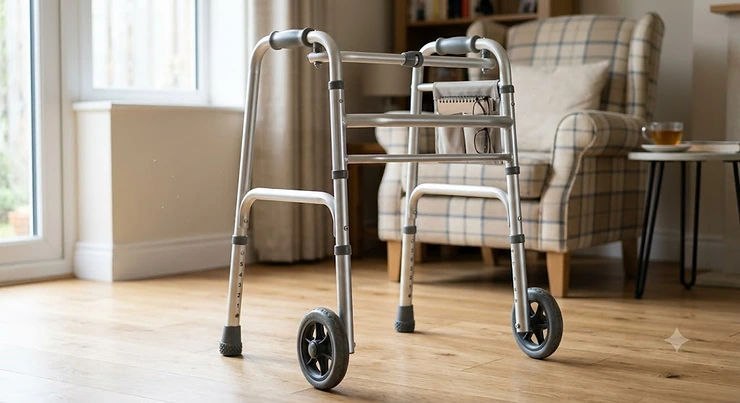
Here’s a confession nobody puts in a brochure: the moment you actually need a wheeled zimmer frame is rarely a calm, unhurried research project. It’s usually a Tuesday afternoon after a hip operation, or a phone call from a district nurse, or your mum quietly admitting she’s “gone a bit wobbly on the stairs.” So a wheeled zimmer frame is a walking aid with two, three or four wheels fitted to a lightweight aluminium frame, letting the user glide it forward instead of lifting it with every step. It’s the same basic idea as the classic lift-and-place zimmer frame your gran might have used, just with the friction taken out of the equation.
That single change matters more than it sounds. Lifting a frame with every stride is tiring, and tired arms and shoulders are exactly what you don’t want in someone already unsteady on their feet. A wheeled walking frame for elderly users keeps the natural rhythm of walking closer to normal, which occupational therapists consistently flag as better for confidence and gait pattern.
This guide digs into seven real, currently-sold models on Amazon UK, breaks down what actually separates a good frame from a mediocre one, and walks through buying mistakes, maintenance, and the regulations around VAT relief. No fluff, no invented five-star reviews — just honest analysis grounded in real specs and real aggregated feedback, because that’s genuinely what you need before spending your own money, or your parent’s.
Quick Comparison Table
| Product | Wheels | Best For | Price Range |
|---|---|---|---|
| NRS Healthcare Walking Frame (Wheeled) N73259 | 2 front | All-round budget pick | around £30-£45 |
| NRS Healthcare Ultra Narrow (Wheeled) N73223 | 2 front | Tight doorways/hallways | around £35-£45 |
| Eazy Folding Walking Frame with Wheels | 2 front | Fastest to fold and store | around £35-£45 |
| The Helping Hand Company Ultra Lightweight | 2 front | Lightest to lift and carry | around £40-£55 |
| Aidapt Foldable Wheeled Frame with Seat | 2 front + seat | Resting mid-walk | around £70-£90 |
| Drive DeVilbiss Narrow Walking Frame N73296 | 2 front | Tall users, front-wheeled stability | around £35-£45 |
| Days Lightweight Folding Rollator | 4 wheels + brakes | Outdoor gliding with full braking control | around £60-£90 |
Glancing across the table, you can already see the split forming: the sub-£50 frames are all two-wheel, no-frills designs built for indoor and short outdoor trips, while anything with a seat or four wheels pushes the price up because you’re paying for extra engineering — brake cables, folding hinges, padded upholstery. The Days rollator sits apart from the rest because it’s really a step up in category, not just in price; it swaps ferrules for a full braking system, which matters hugely once you’re thinking about slopes or pavements. If budget is tight and the main need is indoor support, the NRS or Eazy models make more sense than stretching for a seated model you might rarely sit on.
💬 Just one click — help others make better buying decisions too!😊
Top 7 Wheeled Zimmer Frames: Expert Analysis
1. NRS Healthcare Walking Frame (Wheeled) N73259 — best all-round budget pick
The standout here is simplicity done well — this is the frame most occupational therapists in the UK will recognise on sight, and for good reason. Built from aluminium with a maximum user weight of 160kg (25 stone), it adjusts in height from roughly 70-75cm and weighs around 2kg, so lifting it in and out of a car boot isn’t a workout in itself. Two front wheels do the gliding while the rear legs keep their non-slip ferrules for grip, meaning you get forward glide without sacrificing the “brake” effect that stops the frame shooting off on smooth flooring.
Based on the spec sheet, this is squarely a beginner-friendly, general-purpose frame — ideal for someone recovering from a hip or knee replacement who needs support indoors and on short trips to the shop. Reviewers consistently report that it fits comfortably through standard UK doorways and copes well in tighter house layouts, with several noting it made a real difference after knee surgery specifically. A recurring theme in feedback is that assembly is straightforward, though a few buyers mention that the plastic glide caps supplied for carpets are easy to misplace.
Pros:
- ✅ Genuinely lightweight at under 2kg for easy lifting
- ✅ Simple push-button height adjustment
- ✅ Fits most standard UK doorway widths
Cons:
- ❌ No seat, so no resting option mid-walk
- ❌ Replacement carpet glides sold separately if lost
At around £30-£45, this sits at the affordable end of the market, and for a first-time buyer unsure how long they’ll need a frame, it’s hard to argue with the value — you’re not committing much money to find out if a wheeled frame suits you.

2. NRS Healthcare Ultra Narrow Walking Frame (Wheeled) N73223 — best for tight doorways and hallways
What most buyers overlook when frame-shopping is width — a standard frame that’s a comfortable 60cm across can suddenly feel enormous in a 1930s terrace hallway or a bathroom doorway. This model’s standout feature is its genuinely ultra-narrow footprint, measuring roughly 860 x 930mm overall, specifically engineered to squeeze through spaces a standard frame would jam in.
The frame is made from the same strong aluminium as its standard sibling, supports up to 160kg, and weighs around 1.8-1.9kg. Two front wheels handle the glide while rear ferrules provide stability when stationary. Here’s what the spec sheet doesn’t tell you outright, but user reports make clear: this narrow width does come with a slightly reduced sense of side-to-side stability compared with wider frames, so it suits people with moderate rather than severe balance impairment.
Aggregated customer sentiment is strongly positive on the “fits everywhere” claim specifically — multiple reviewers mention it clearing narrow gaps between furniture, and one describes it as ideal for a six-foot user needing to move between a bed and dressing table. A minority of reviews flag confusion around compatible wheel and glide accessories from other product lines.
Pros:
- ✅ Clears doorways and hallways as narrow as 86cm
- ✅ Height adjustable to suit tall or short users
- ✅ Wipeable aluminium frame and handgrips
Cons:
- ❌ Marginally less side stability than wider frames
- ❌ Accessories aren’t always interchangeable across ranges
Priced around £35-£45, it’s a smart pick specifically for period properties or small flats — anywhere a standard-width frame becomes a daily obstacle course rather than a mobility aid.
3. Eazy Folding Walking Frame with Wheels (2-Wheel Zimmer Frame) — best for quick folding and storage
If you’ve ever tried to wrestle a bulky frame into a car boot already stuffed with shopping, you’ll appreciate why this model’s standout feature is its compact one-button fold. It’s explicitly built and marketed as a 2 wheel walking frame, keeping the classic simplicity of the design while trimming the fuss around storage.
Constructed from lightweight aluminium, it adjusts for height and folds flat in seconds via a single mechanism, rather than the multi-step folding some competitors still use. In practice, that means less fiddling for someone with arthritic hands or limited grip strength, which is exactly the audience most likely to be using it in the first place. Reviewers consistently mention how easy the one-button fold is to operate one-handed, and several specifically compare it favourably to older, stiffer folding mechanisms they’d previously owned.
On the flip side, a genuine trade-off with compact folding frames is that the mechanism itself can loosen slightly with heavy daily use over many months, something a handful of reviews mention needing an occasional tightening check.
Pros:
- ✅ One-button folding mechanism, quick to operate
- ✅ Compact enough for car boots and cupboards
- ✅ Lightweight aluminium build
Cons:
- ❌ Folding joints may need periodic tightening
- ❌ No padded seat option in this range
Sitting around £35-£45, this is the natural choice for anyone who needs the frame to travel — day trips, hospital appointments, or simply a household with limited storage space.
4. The Helping Hand Company Ultra Lightweight Walking Frame with Wheels — lightest to lift and carry
The standout feature is right there in the name: this is built specifically to shave every possible gram off the frame without compromising the 160kg-plus weight capacity typical of this category. For someone with limited upper-body strength — think post-stroke recovery, or an older user with reduced grip — every kilogram removed from the frame itself is a kilogram less effort spent lifting it up steps or into a boot.
Height adjustable aluminium construction with front wheels and rear ferrules follows the standard formula, but The Helping Hand Company has built a reputation specifically around senior mobility products, which shows in small ergonomic touches like handgrip shaping. Based on the spec comparison against the NRS and Eazy models above, the weight savings here are modest rather than dramatic — this is refinement of a known design, not reinvention.
Aggregated review sentiment highlights ease of manoeuvring as the standout theme, with multiple users specifically praising how little effort is needed to turn or reposition the frame in confined spaces. A less common but recurring complaint concerns handgrip comfort for users with larger hands, who found the grip diameter slightly narrow for extended use.
Pros:
- ✅ Genuinely among the lightest frames in this category
- ✅ Adjustable height for varied user needs
- ✅ Easy to reposition and turn indoors
Cons:
- ❌ Handgrip diameter may feel narrow for larger hands
- ❌ Premium branding pushes price slightly above basic models
Expect to pay around £40-£55, a modest premium over the entry-level frames that buys genuinely easier day-to-day lifting rather than any dramatic feature upgrade.
5. Aidapt Foldable Wheeled Walking Frame with Seat — best for resting mid-walk
This is the model that answers a question the purely wheeled frames above can’t: what happens when you need to stop and rest halfway to the postbox? Its standout feature is the integrated fold-down seat, transforming a simple mobility aid into something closer to a mini rollator without the bulk of a full four-wheel model.
Aluminium construction, adjustable height, and a quick-fold mechanism collapsing the whole unit to around 13cm wide for storage round out the practical specs. What most buyers overlook about seated frames like this one is that the seat changes the balance point of the whole device — you’re now trusting it to bear your full weight while stationary, not just support you while walking, so the sturdier build and slightly heavier frame here is a deliberate trade-off, not an oversight.
Reviewers consistently frame the seat as the deciding factor in their purchase, particularly for outdoor use where benches aren’t always nearby. Feedback on the anti-slip ferrules and stability when folded is broadly positive, though a few reviews mention the frame is noticeably bulkier to manoeuvre through narrow doorways than the non-seated models above — an unsurprising consequence of the added structure needed to support seated weight safely.
Pros:
- ✅ Integrated seat for resting during longer walks
- ✅ Folds to just 13cm wide for storage
- ✅ Non-slip ferrules aid stability when stationary
Cons:
- ❌ Bulkier width than standard 2-wheel frames
- ❌ Heavier overall due to seat structure
At around £70-£90, it costs roughly double the basic models, but for anyone whose walks are limited by stamina rather than balance alone, that seat can be the difference between staying active and staying home.

6. Drive DeVilbiss Narrow Walking Frame N73296 — best front-wheeled walker for taller users
Drive DeVilbiss has built decades of NHS-adjacent credibility in mobility equipment, and this narrow frame’s standout feature is genuinely comfortable height coverage for taller users who often get overlooked by “one-size-fits-most” frame ranges. As a front wheeled walker, the two front wheels take the strain out of forward movement while rear ferrules keep things planted when stationary — the same trusted mechanical logic running through this entire category.
Dimensions land around 83 x 49 x 44cm with a weight close to 1.9kg, and the narrow profile mirrors the NRS Ultra Narrow model above, making it another strong pick for tight interior layouts. Here’s what the spec sheet won’t spell out, but is worth weighing: “narrow” and “tall-friendly” aren’t automatically the same thing, so anyone above roughly six foot should double-check the maximum height adjustment before assuming any narrow frame will suit them.
User reports specifically mention this model fitting a six-foot user comfortably, alongside praise for how sturdy the aluminium feels despite the low weight. A minority of reviews note some initial uncertainty over compatible wheel accessories when ordering replacement parts, echoing feedback seen on the NRS narrow model.
Pros:
- ✅ Comfortable adjustable height range for taller users
- ✅ Narrow profile suits tight indoor spaces
- ✅ Trusted, long-established mobility brand
Cons:
- ❌ Replacement wheel parts require careful model-matching
- ❌ No seat option within this specific line
Priced around £35-£45, it’s a near-identical value proposition to the NRS narrow frame, so the choice between the two often comes down to brand preference or straightforward stock availability at the time.
7. Days Lightweight Folding Rollator — best for outdoor gliding with full braking control
Step outside the front door and the demands on a wheeled walking frame change completely — kerbs, slopes, uneven pavement. That’s precisely why this model earns its place as our pick for outdoor use: it’s built around four wheels and full handbrake-style lockable brakes rather than the simpler ferrule-and-glide setup of the frames above, giving genuinely controlled stopping power on a hill rather than just friction and hope.
As a zimmer frame with wheels and brakes rather than a traditional two-wheel design, it functions more like a compact rollator: padded seat, adjustable ergonomic handles, and a lightweight but rigid aluminium chassis that folds for transport. Based on the spec comparison with the purely wheeled frames earlier in this guide, the trade-off is fairly stark — more stability and control outdoors, in exchange for a bulkier folded size and a higher price tag.
Reviewers consistently highlight the locking brakes as the standout safety feature, particularly for users managing gentle inclines on daily walks, and the padded seat draws similar praise to the Aidapt model above. A recurring criticism concerns the folded footprint still being on the larger side for very compact car boots or narrow hallway storage.
Pros:
- ✅ Full lockable brakes for genuine hill control
- ✅ Padded seat plus backrest for longer outings
- ✅ Four-wheel stability on uneven outdoor surfaces
Cons:
- ❌ Bulkier folded size than two-wheel frames
- ❌ Higher price reflects the added mechanics
Expect to pay around £60-£90 depending on colour and retailer stock, making it the most expensive entry here — but for regular outdoor use on anything other than flat pavements, that braking system earns its keep.
Practical Usage Guide: Setting Up and Living With Your Wheeled Zimmer Frame
Getting the height right is the single most important step, and it’s the one most people rush. Standing naturally in your usual shoes, arms relaxed at your sides, the handgrips should sit level with your wrist bone — not your knuckles, not your forearm. Too low and you’ll hunch forward; too high and you’ll be reaching upward with every step, which tires the shoulders fast and undermines the whole point of switching to wheels.
In the first thirty days, the most common mistake is skipping the “practice lap” indoors before venturing outside. Walk a familiar room a few times, get a feel for how much push it takes to glide the frame versus how much it resists, and check the ferrules on the rear legs aren’t already showing wear from the factory. According to NHS guidance on walking aids, ferrules wear out faster than people expect and need regular checking, since a worn ferrule turns a stable frame into a slip risk almost overnight.
Maintenance itself is refreshingly low-effort: wipe the frame down weekly, check that folding joints haven’t loosened (a known quirk on compact folding models like the Eazy frame above), and replace ferrules or glide caps the moment they look shiny and smooth rather than waiting until they’re bald. A genuinely underused optimisation trick is swapping standard ferrules for carpet glide caps when moving between hard flooring and carpet, rather than forcing the frame across carpet on wheels not designed for the extra resistance.
Real-World Scenarios: Who Actually Needs Which Frame
Picture Margaret, 78, three weeks post-hip-replacement, living in a two-bed semi with narrow internal doors. Her physio wants her mobile around the house but cautious outdoors for now. The NRS Ultra Narrow or Drive DeVilbiss narrow frame suits her precisely because doorway width, not outdoor terrain, is her daily obstacle.
Now picture Frank, 84, with mild Parkinson’s-related balance issues, who insists on his daily walk to the corner shop regardless of weather. He needs the confidence of full brakes on a slope and somewhere to sit if his legs tire halfway — which points squarely at the Days Lightweight Folding Rollator, even though it costs more than double the basic frames.
And then there’s Priya, helping her mother-in-law who splits time between two households and needs a frame that folds down small enough to travel in the car boot each fortnight. For her, the Eazy Folding Frame’s one-button mechanism solves the actual problem — portability — far better than a slightly lighter but less foldable alternative would.
Problem → Solution: Fixing the Most Common Wheeled Zimmer Frame Complaints
Problem: the frame runs away on smooth flooring. This usually means the rear ferrules have worn smooth or the front wheels are set slightly too loose. Solution: replace ferrules at the first sign of shine, and check wheel tension against the manufacturer’s instructions rather than assuming a new frame is faulty.
Problem: it won’t fit through a doorway. Rather than forcing a standard-width frame through repeatedly, switch to one of the ultra-narrow models covered above — trying to squeeze a wide frame daily just accelerates wear on both the frame and the door frame itself.
Problem: arms and shoulders ache after short walks. This is very often a height problem rather than a fitness problem. Re-measure to the wrist bone as described in the setup guide above before assuming a wheeled frame simply isn’t suited to the user.
Problem: the frame feels unstable on an incline. Two-wheel frames with ferrules aren’t designed for meaningful gradients. A four-wheel braked model like the Days rollator is the honest solution here, not a workaround.
Problem: folding mechanism feels stiff after months of use. A light application of a dry lubricant on the hinge points, plus a check for grit lodged in the mechanism, resolves the vast majority of these complaints according to aggregated user feedback across folding models.
✨ Don’t Miss These Exclusive Deals!
🔍 Take your mobility shopping to the next level with these carefully selected frames. Click on any highlighted item to check current pricing and availability. These practical, honestly-reviewed picks will help you create a genuinely safer, more independent daily routine for yourself or a loved one!
How to Choose a Wheeled Zimmer Frame
Choosing the right frame comes down to answering a handful of practical questions in order, rather than starting with brand names or reviews.
- Measure the user’s wrist-bone height first — every other decision follows from getting this number right, since an ill-fitting frame undermines even the best design.
- Check every doorway and hallway width the frame needs to pass through daily, not just the widest one.
- Decide indoor-only or outdoor-too — this single choice determines whether ferrules or full brakes are the sensible option.
- Weigh portability against seating — a seat adds comfort but also bulk and weight, so match it to actual walking stamina, not hypothetical need.
- Confirm the maximum user weight rating against the actual user’s weight, since most standard frames cap around 160kg but seated and premium models can differ.
- Ask about VAT relief eligibility before paying full price, since many buyers qualify without realising it.
- Read aggregated review themes, not star ratings alone — a 4.5-star frame with a recurring complaint about your specific need (say, narrow hallways) may suit you worse than a 4.2-star frame built precisely for that problem.
Common Mistakes When Buying a Wheeled Walking Frame for Elderly Relatives
The single biggest mistake is buying based on a family member’s guess rather than an actual wrist-bone measurement — it sounds pedantic, but an inch out on height translates directly into hunched shoulders and reduced walking confidence. A close second is assuming “wheeled” automatically means “safe on any surface”; two-wheel frames with ferrules are genuinely not designed for meaningful outdoor slopes, and pretending otherwise is how falls happen.
Buyers also frequently underestimate storage space needed, particularly with seated or four-wheel models, only to find the “folded” size still doesn’t fit the intended cupboard or car boot. Finally, many people simply don’t check VAT relief eligibility before paying, effectively donating an extra 20% to the retailer unnecessarily on a purchase that likely qualified for zero-rating.
2 Wheel Walking Frame vs Front Wheeled Walker vs 4-Wheel Rollator
These terms get used almost interchangeably in casual conversation, but the mechanical differences genuinely matter for safety and suitability.
| Type | Wheels/Brakes | Best Environment | Best For |
|---|---|---|---|
| 2 wheel walking frame | 2 front wheels, rear ferrules | Indoors, flat outdoor paths | Moderate balance needs, budget buyers |
| Front wheeled walker | 2 front wheels, rear ferrules | Same mechanical category as above | Those wanting a specific narrow or tall-fit model |
| 4-wheel rollator | 4 wheels, full brakes | Outdoors, slopes, longer walks | Users needing rest stops and hill control |
A 2 wheel walking frame and a front wheeled walker are, mechanically, the same idea described with different marketing language — both rely on front wheels for glide and rear ferrules for grip when stationary. The genuine fork in the road is the 4-wheel rollator category, which trades the simplicity and low weight of the two-wheel design for full braking control and a seat, at a real cost in bulk and price. Buyers chasing the lightest possible frame should stick with the two-wheel category; those prioritising outdoor confidence on anything but flat ground should budget for the rollator instead.
Zimmer Frame With Wheels and Brakes: What to Know Before You Buy
Not every wheeled frame has brakes, and that distinction trips up more buyers than you’d expect. Standard two-wheel frames rely on friction from rear ferrules to stop movement — effective on flat, dry indoor flooring, but not something to trust on a slope. A genuine zimmer frame with wheels and brakes, like the Days rollator covered above, uses a cable-operated locking brake system similar in principle to a bicycle brake, letting the user actively stop and hold the frame still rather than relying on friction alone.
What most buyers overlook is that brakes also need occasional maintenance — cables can stretch slightly over time, reducing stopping power exactly when it’s needed most. If a braked frame starts feeling less responsive than it did when new, that’s a sign for a cable check, not a sign the whole unit is failing.
Gliding Walking Frames Explained: Ferrules, Skis and Wheel Combinations
The word “gliding” gets used loosely, but it specifically refers to how smoothly a frame moves across a given surface — and that’s determined by the combination of wheels and ferrules fitted, not by branding. A gliding walking frame with front wheels and rear ferrules glides forward but grips when pushed down on, which is precisely why lifting-and-placing frames were redesigned this way in the first place: less effort, same stability.
On carpet specifically, plain rear ferrules can create noticeably more drag than on hard flooring, which is where plastic glide caps — sometimes called skis — come in, clipping over the ferrule to let the frame glide rather than catch on carpet fibres. Reviewers across several of the models above specifically mention swapping to glide caps once they moved from tiled to carpeted rooms, describing an immediate, noticeable difference in how easily the frame moved.
What to Expect: Real-World Performance Indoors and Outdoors
On paper, a 160kg weight rating and a 2kg frame weight are just numbers. In practice, that combination means most adults can lift the frame one-handed over a single step or threshold without strain, while still trusting it to bear real body weight when leaned on. Indoors, on hard flooring, the two-wheel frames covered above glide with genuinely minimal effort — closer to pushing a supermarket trolley than lifting a suitcase.
Outdoors is where expectations need recalibrating. Even a gentle camber on a pavement can make a two-wheel ferrule frame feel less predictable than it does on a flat kitchen floor, and a proper incline changes the picture entirely — this is precisely the gap the four-wheel braked rollator category exists to close. Reviewers consistently describe the difference between “manageable” and “reassuring” as coming down almost entirely to whether brakes are present once any gradient is involved.
Wheeled Mobility Frames for Elderly Users: Choosing by Condition and Living Situation
A wheeled mobility frame chosen for a specific condition tends to perform far better than one chosen generically. Post-surgical recovery, where balance is only temporarily affected, usually suits a basic two-wheel frame perfectly well, since the need is largely support and confidence rather than serious instability. Progressive conditions affecting balance more permanently — certain neurological conditions, for instance — often benefit more from a seated or braked model from the outset, since stamina and stopping control tend to matter more over time, not less.
Living situation matters just as much as the underlying condition. A period cottage with narrow doors calls for the ultra-narrow models covered earlier regardless of the user’s balance level, while a bungalow with wide, flat-threshold access might suit almost any frame equally well, leaving budget and portability as the deciding factors instead.
Long-Term Cost & Maintenance of a Wheeled Walking Frame
Sticker price is only part of the real cost. Ferrules typically need replacing every few months with regular use, at a modest cost per set, and folding mechanisms on budget models may need occasional tightening with a simple hex key over a year or two of daily folding. None of this is expensive in isolation, but it’s worth factoring in in the same way you’d budget for tyres on a bicycle rather than assuming the upfront price is the whole story.
Viewed as a total cost of ownership, a £35 basic frame with occasional £5-10 ferrule replacements over several years still comes out significantly cheaper than a £80 seated or braked model — but only if the basic frame genuinely meets the user’s needs. Buying cheap and discovering it’s unsuitable within weeks, requiring a second purchase, is the false economy to actually avoid.
Safety, Regulations and VAT Relief Guide
Beyond fit and function, there’s a genuinely useful financial angle many buyers miss entirely: VAT relief. Under current HMRC rules, mobility aids designed for disabled use can often be bought VAT-free, and certain mobility aids may also qualify for a reduced VAT rate for buyers aged 60 or over, even without a formal disability, provided the item is supplied correctly. It’s worth checking eligibility before paying full price, since the saving is applied automatically at checkout rather than reclaimed later.
On the safety side, NHS guidance describes wheeled zimmer frames as offering more support and stability than a walking stick, while specifically noting they aren’t generally suited to outdoor use on uneven or sloped ground — a distinction worth taking seriously rather than testing the hard way. Getting a proper physiotherapist or occupational therapist assessment before buying, where possible, remains the single best way to match frame type to actual need rather than guesswork.

FAQ
❓ What's the difference between a zimmer frame and a walking frame?
❓ Can I get a wheeled zimmer frame free on the NHS?
❓ Do wheeled zimmer frames work on carpet?
❓ Are wheeled walking frames safe for outdoor slopes?
❓ How do I know what height to set my walking frame to?
Conclusion
If there’s one theme running through every product and every section above, it’s that the “best” wheeled zimmer frame genuinely depends on the doorway you need to fit through, the ground you’ll be walking on, and how much resting your legs actually need — not on which model has the flashiest listing. A basic NRS or Eazy frame will serve most indoor, short-outing needs brilliantly and cheaply; a seated Aidapt model earns its higher price the moment stamina becomes the limiting factor; and the braked Days rollator is worth every extra pound the second slopes or longer outdoor walks enter the picture.
Whichever you choose, get the height right, check the VAT relief box before paying, and keep an eye on those ferrules — small habits that make a genuinely bigger difference to safety and comfort than any single spec on the page. Comparison shopping like this takes a bit of legwork, but for a device you or a loved one will lean on daily, quite literally, it’s legwork well spent.
Recommended for You
- Walking Frame After Hip Replacement: 7 Best Picks for 2026
- Standard Zimmer Frame UK: 7 Best Picks Reviewed for 2026
- Best Zimmer Frame UK 2026: 7 Expert Picks for Elderly & Mobility Support
Disclaimer: This article contains affiliate links. As an Amazon Associate, I earn from qualifying purchases. If you purchase products through these links, we may earn a small commission at no additional cost to you.
✨ Found this helpful? Share it with your friends! 💬🤗
