
In This Article
There’s a particular kind of dread that comes with booking a flight when you rely on a walking frame. Not the packing, not the passport panic — the frame itself. Will it fold small enough for the overhead locker? Will some overworked gate agent shove it into the hold and hand it back three days later with a bent leg? Will it even survive the jet bridge? A folding walking frame for travel solves most of that anxiety before it starts, because it’s built around one job: collapsing down small, light and fast, so it travels with you rather than against you.
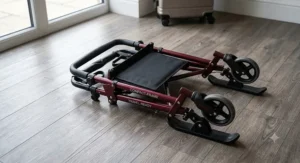
This isn’t a like-for-like swap with the sturdy frame you keep by the kitchen door. Travel frames trade a bit of bulk for portability, and that trade-off changes everything from how you clear airport security to how you manoeuvre a narrow aircraft aisle chair transfer. Reviewers and occupational therapists alike tend to agree on one thing: the “right” travel walking aid is the one that folds in under ten seconds, weighs less than your carry-on toiletries bag, and doesn’t need an engineering degree to reassemble at the other end.
As the NHS explains in its social care and support guide, a walking frame offers more support than a stick and can be used both around the home and out and about, with prices varying considerably depending on features and build. Below, we’ve dug into seven real, currently available folding walking frames (and a couple of clever travel rollators that fill the same holiday niche), weighed up their genuine strengths and weaknesses, and worked out exactly who should be packing which one.
Quick Comparison: Best Folding Walking Frames for Travel
| Product | Weight | Folded Footprint | Best For |
|---|---|---|---|
| Stander EZ Fold-N-Go Walker | 3.2kg | Compact, one-hand fold | Best all-round travel frame |
| NRS Healthcare Ultra Narrow Wheeled Frame | 1.8kg | Slim, ultra-narrow | Lightest option for tight spaces |
| Aidapt Folding Aluminium Walking Frame | Light aluminium | One-button fold | Budget-friendly first-time buyers |
| Drive DeVilbiss WA008 Folding Frame | 3kg | Independent-leg fold | Uneven paths and cobbled streets |
| Drive DeVilbiss Folding Frame with Wheels | Lightweight alloy | Two-wheel glide fold | Those who struggle to lift a frame |
| Days Lightweight Tri Wheel Rollator | Aluminium, foldable | Slim fold with carry bag | Full days of sightseeing |
| GYMAX Folding Rollator with Seat | Aluminium, foldable | Compact with storage | Rest stops on longer holidays |
Looking at this table, a clear pattern emerges: the lighter and narrower a frame is, the better it copes with the pinch points of travel — narrow toilets, aircraft aisles, cobbled old-town streets — but you sacrifice some of the stability and storage you’d get from a bulkier rollator. If your trip involves a lot of standing and resting (museums, galleries, long airport queues), a rollator with a seat earns its extra bulk. If you just need dependable support from taxi to hotel room, a genuinely lightweight frame wins every time.
💬 Already got a favourite? Tap through to check today’s availability before you finish reading!
Top 7 Folding Walking Frames for Travel: Expert Analysis
1. Stander EZ Fold-N-Go Walker — smallest fold on the market
Marketed, not unreasonably, as one of the smallest folding walkers you can buy, the Stander EZ Fold-N-Go Walker collapses with a single-finger pull and drops flat enough to slide beside a suitcase in the boot. At around 3.2kg, it’s genuinely light for something rated to support users up to 28 stone (180kg), and the two front swivel wheels plus rear glide feet mean it rolls over hotel carpets and pavement seams without catching. Based on the spec comparison with heavier standard frames, this one earns its “travel” branding rather than just borrowing the word for marketing.
Reviewers consistently report that the one-handed fold mechanism is the standout feature — useful when you’re also wrangling a suitcase, a boarding pass and a nervous travel companion. A common theme in aggregated feedback is that the compact folded size fits easily into a car boot or a large hold bag, though a handful of users note the glide feet can feel slightly less stable than four-wheel rollators on loose gravel. It comes in three colourways, which sounds trivial until you’re trying to spot yours on a baggage carousel.
Pros:
- ✅ One of the smallest folded footprints available
- ✅ One-hand fold mechanism, no fiddly buttons
- ✅ High 180kg weight capacity for its size
Cons:
- ❌ Glide feet less sure-footed than four-wheel designs
- ❌ Narrower base than bulkier rollator alternatives
Typically positioned in the mid-price bracket for branded travel walkers, it’s worth checking the current price before booking, as availability and cost shift with demand. For the size-to-stability ratio it offers, most buyers will find it represents solid value.

2. NRS Healthcare Ultra Narrow Wheeled Walking Frame — lightest frame for tight spaces
If your priority is pure portability, the NRS Healthcare Ultra Narrow Wheeled Walking Frame (built on the well-regarded Coopers design) is hard to beat at roughly 1.8kg — lighter than a bag of sugar and a bit of veg. Its slim 520mm width is the real headline here: aircraft toilets, narrow hotel en-suites in older European buildings, and cramped cruise-cabin corridors are exactly where standard-width frames get stuck.
What most buyers overlook about ultra-narrow frames is that the reduced width does slightly narrow the support base too, so it suits people with moderate rather than heavy weight-bearing needs — the 160kg (25 stone) limit reflects that. Reviewers frequently mention that this model has transformed access around smaller homes and hotel rooms, with several noting it was “the perfect width” for flats and older properties with narrow doorways. It’s also eligible for VAT relief for disabled or chronically sick users buying for personal use, which shaves a meaningful amount off the price.
Pros:
- ✅ Among the lightest wheeled frames available
- ✅ Ultra-narrow build clears tight aircraft and hotel doorways
- ✅ VAT relief eligible for qualifying UK buyers
Cons:
- ❌ Narrower base offers less lateral stability than standard frames
- ❌ Lower maximum user weight than heavier-duty models
Priced at the budget end of the wheeled-frame category, this is often the one occupational therapists suggest first when a client mentions “the bathroom on the cruise ship was tiny.”
3. Aidapt Folding Aluminium Walking Frame — best budget first-time buy
The Aidapt Folding Aluminium Walking Frame is the sensible, no-frills choice for someone buying their first travel-ready frame without wanting to spend a fortune finding out if they’ll actually use it much. The one-button fold mechanism needs no tools and barely any hand strength, which matters enormously if arthritis or a recent hospital stay is part of the reason you’re shopping in the first place. Height-adjustable legs and a 133kg (21 stone) weight limit cover the vast majority of adult users comfortably.
Here’s what the spec sheet won’t tell you, but the aggregated review sentiment does: buyers repeatedly praise how quickly the one-button system becomes second nature, even for people who’ve never used a folding frame before. The trade-off, honestly, is that this sits at the more basic end of the range — there’s no wheel option baked in on the standard unwheeled version, so it’s built for lifting-and-placing rather than gliding.
Pros:
- ✅ Genuinely simple one-button folding mechanism
- ✅ Comfortable ergonomic handles reduce hand strain
- ✅ VAT relief eligible, keeping the real cost lower
Cons:
- ❌ No integrated wheels on the standard unwheeled version
- ❌ Wide base can feel bulky in the very tightest doorways
Sitting firmly under £50 in most listings — always worth confirming current pricing before you buy — this is the frame we’d point a nervous first-time traveller towards.
4. Drive DeVilbiss WA008 Folding Lightweight Walking Frame — best for uneven pavements
Cobbled old towns and uneven coastal paths are where a lot of travel frames come unstuck, quite literally. The Drive DeVilbiss WA008 Folding Lightweight Walking Frame handles this better than most thanks to its independently operating sides — each leg can move slightly on its own, letting the frame flex a touch as you navigate broken pavements rather than rocking the whole structure. At roughly 3kg and adjustable between 32 and 39 inches, it fits a wide range of heights without needing a different model size.
Reviewers consistently note the anodised aluminium construction feels sturdier than the price suggests, and several mention it folding flat enough to slot into a car boot alongside luggage without a fight. What most buyers overlook is that the independent-leg design, while brilliant on cobbles, means the frame needs slightly more concentration on smooth marble airport floors, where a rigid four-point frame can actually feel more planted.
Pros:
- ✅ Independent leg movement copes well with uneven ground
- ✅ Wide 32-39 inch height adjustment range
- ✅ Anodised aluminium build feels more robust than the price implies
Cons:
- ❌ Requires slightly more balance awareness on very smooth floors
- ❌ No wheels on this unwheeled variant, so it must be lifted and placed
Generally found in the lower-to-mid price range for branded walking frames, it’s a strong pick for anyone whose holiday itinerary includes more Mediterranean side streets than shopping centre corridors.
5. Drive DeVilbiss Folding Walking Frame with Wheels — best for reduced arm strength
For travellers who tire quickly from repeatedly lifting a frame — a real issue on a long airport walk from check-in to gate — the wheeled version of the Drive DeVilbiss Folding Walking Frame with Wheels removes that effort almost entirely. Two front wheels let you glide the frame forward instead of picking it up with every step, while the rear rubber ferrules keep things planted when you need to stop and steady yourself. It’s rated to 180kg (28 stone), the same generous capacity as its unwheeled sibling.
Based on the spec comparison, the wheeled configuration suits people managing conditions like arthritis or reduced upper-body strength far better than a standard frame, since it turns “lift and place, lift and place” into a smoother, continuous push. Aggregated customer feedback consistently praises the fold-and-store convenience for car travel, with several reviewers specifically mentioning holiday use and how sturdy it felt on unfamiliar terrain.
Pros:
- ✅ Front wheels dramatically reduce lifting effort
- ✅ High 180kg weight capacity
- ✅ Folding mechanism praised for quick car-boot storage
Cons:
- ❌ Bulkier folded size than the ultra-narrow options on this list
- ❌ Rolling frames need firmer wrist control on downhill slopes
Typically priced a little above the unwheeled version, this is the model we’d recommend to anyone whose main complaint about their current frame is simply “it’s tiring to keep picking up.”

6. Days Lightweight Tri Wheel Walker Rollator — best for full days of sightseeing
Strictly speaking, a rollator isn’t a walking frame in the traditional four-point sense — but for holiday mobility equipment, it earns its place on this list because it solves a problem no folding walking frame really can: what happens when you need to rest. The Days Lightweight Tri Wheel Walker Rollator folds down with its aluminium frame and includes a carry bag, hand brakes, and adjustable height, making it a genuinely travel-friendly walking aid for people covering real ground on holiday.
What the spec sheet won’t tell you, but user reports suggest, is that the three-wheel design manoeuvres tighter corners more easily than four-wheel rollators — handy in crowded museum galleries or narrow ship corridors — while still offering the confidence of proper hand brakes on a slope. Reviewers frequently cite the included carry bag as a genuine practical touch rather than a marketing afterthought, since it means one less separate bag to juggle at the airport.
Pros:
- ✅ Hand brakes add real confidence on slopes and ramps
- ✅ Three-wheel design manoeuvres tight corners well
- ✅ Comes with a carry bag for transport
Cons:
- ❌ Bulkier to fold than a basic walking frame
- ❌ No seat, unlike four-wheel rollator alternatives
Positioned in the mid-to-premium price bracket for rollators, it suits travellers who walk more than they’d like to admit on holiday and want brakes as a safety net.
7. GYMAX Folding Rollator with Seat and Storage Bag — best premium all-rounder for longer holidays
Rounding out the list is the GYMAX Folding Rollator with Seat and Storage Bag, a four-wheel rollator built for the traveller who wants the option to simply sit down when a queue drags on. Height-adjustable, foldable, and fitted with all-terrain wheels, it manages pavements, gravel paths and uneven flooring more confidently than a standard two-wheel frame, while the built-in seat and storage bag mean you’re carrying less separately.
Here’s the honest analytical take: this is the heaviest and bulkiest item on this list, and it will never win a “smallest fold” contest against the Stander or the NRS Healthcare frame. But for holidaymakers managing stamina issues — where the real risk isn’t falling but simply running out of energy halfway round a castle — the ability to stop and sit changes the whole day. Aggregated reviews consistently mention the seat as the deciding factor in the purchase, alongside praise for the all-terrain wheels coping well with cobblestones and gravel garden paths.
Pros:
- ✅ Built-in seat allows genuine rest stops
- ✅ All-terrain wheels handle gravel and cobbles confidently
- ✅ Storage bag reduces the number of items to carry
Cons:
- ❌ Heavier and bulkier fold than a standard frame
- ❌ Less practical for very narrow spaces like aircraft toilets
Usually the most expensive option here, it still tends to sit under £150 in most listings, making it a reasonable investment for anyone planning several trips a year rather than a single holiday.
Folding Walking Frame vs Rollator vs Walking Stick for Travel
It’s worth being honest about what each of these mobility aids actually does, because Amazon listings blur the lines constantly. A rollator generally suits someone who can still walk independently but tires easily, needs rest breaks, or wants extra support on longer outdoor walks, whereas a walking frame provides the highest level of stability, supporting weight on both sides of the body for people who need firm, reliable support while moving. A walking stick, meanwhile, offers the lightest touch of reassurance and works best for people who are mostly steady but want backup on uneven ground.
| Aid Type | Support Level | Travel Suitability | Best For |
|---|---|---|---|
| Walking Stick | Light | Excellent — fits in hand luggage easily | Steady walkers wanting reassurance |
| Folding Walking Frame | High | Very good with the right model | Firm, reliable bilateral support |
| Rollator | Medium-high, plus rest option | Good, but bulkier to fold | Longer distances, tiring easily |
For most people specifically searching for a folding walking frame for travel, the frame category hits the sweet spot: more support than a stick, less bulk than a full rollator. But if your actual holiday problem is stamina rather than balance, don’t force yourself into a frame just because it sounds more “travel-friendly” — a folding rollator with a seat may genuinely serve you better.
✨ Not sure which category fits you? Read the case studies further down this article before you commit to a purchase.
How to Choose a Folding Walking Frame for Travel
What is a folding walking frame for travel? In short, it’s a height-adjustable, lightweight aluminium frame that collapses flat or narrow enough to carry through an airport, fit in a car boot, or squeeze into a hotel room, while still offering the four-point stability of a standard walking frame at home.
Choosing between the seven products above comes down to seven practical questions:
- How much can you lift? If repeated lifting tires you, prioritise a wheeled model over an unwheeled one.
- How narrow are the spaces you’ll navigate? Cruise cabins and older European hotels favour ultra-narrow frames.
- What’s your realistic weight capacity need? Check the stated limit against your own weight with a sensible margin.
- Do you need to rest mid-walk? If yes, lean towards a rollator with a seat rather than a standard frame.
- How will you fold and unfold it solo? One-button and one-hand mechanisms matter far more once you’re tired at an airport.
- What terrain will you actually cover? Cobbles and gravel favour independent-leg or all-terrain designs.
- Is it eligible for VAT relief? Many models qualify for disabled or chronically sick UK buyers, which meaningfully reduces cost.
A therapist can advise on whether a wheeled or non-wheeled frame suits you best, and as the Independent Living Centre’s walking frames guide sets out, handle height should be adjusted so you can stand normally with your hands by your side and a slight bend at the elbow — a detail that matters just as much for a travel frame as it does for one used at home.

Airline Rules, Airport Security and What “Airline Approved” Really Means
Let’s address the secondary keyword that brings a lot of people here: “airline approved” and “TSA approved” walking frames. Being honest is more useful than being reassuring, so here’s the reality — there isn’t an official certification scheme, from the UK Civil Aviation Authority or the US Transportation Security Administration, that stamps individual walking frame models as “approved.” What listings usually mean by this phrase is that the frame complies with standard security screening and cabin/hold storage requirements, not that it holds a specific licence the way, say, a TSA-approved luggage lock does.
What’s genuinely regulated is how mobility aids are treated at the airport. The UK Civil Aviation Authority’s guidance on mobility and medical equipment sets out your legal rights when travelling with electric wheelchairs, mobility aids and medical equipment, and confirms that anyone using a powered wheelchair or scooter must give the airline advance battery and equipment details to ensure safe loading and storage. Standard folding walking frames without batteries are far simpler: most UK airlines carry them free of charge as essential mobility equipment, separate from your regular baggage allowance, though walking frames are generally more likely to be stored in the hold than the cabin unless the frame folds small enough to travel with you all the way to the aircraft door.
Practically speaking, that means the compact frames on this list — the Stander EZ Fold-N-Go and the NRS Healthcare ultra-narrow model in particular — have a genuine chance of staying with you right to the aircraft door, while bulkier rollators are more likely to be tagged and checked into the hold at the gate. It’s always worth phoning your airline’s special assistance team in advance, whichever frame you choose, rather than assuming.
⚡ Booking a flight soon? Check your airline’s special assistance page as soon as your dates are confirmed — most ask for 48 hours’ notice.
Getting Your Frame Airport-Ready: Setup, Packing and Check-In Tips
A lightweight folding walking aid for holidays only earns that reputation if you actually prep it properly before you fly. Start at home: fold and unfold your frame several times so the mechanism feels automatic under stress, not just relaxed on your living room carpet. Check every rubber ferrule for wear — airport floors are typically smooth, polished stone, which is unforgiving on a tired ferrule that would be perfectly fine on carpet at home.
At check-in, tell the desk agent you’re travelling with a mobility aid before you’re asked; this triggers the airline’s standard procedure for tagging it and, if needed, providing airport wheelchair assistance to the gate. Guidance from Guy’s and St Thomas’ NHS Foundation Trust recommends checking ferrules regularly since they wear out quickly, and replacing them as soon as they look worn rather than waiting until they fail. Walk with your frame as far as security allows, since most UK airports let you keep it right up to the aircraft door if it folds compactly enough. In the first 30 days of owning a new travel frame, the most common mistake isn’t a broken part — it’s people forcing an unfamiliar folding mechanism under time pressure at the gate, which is precisely when fingers get pinched. Practise at home until it’s boring.
Pack a spare set of ferrule tips in your hand luggage — they weigh nothing and solve the single most common in-transit failure. If your frame will travel in the hold, a simple padded cover reduces scuffing and reassures you it’ll arrive in the same shape it left in.
Real Traveller Scenarios: Matching the Right Frame to Your Trip
The city-break couple: Flying for a long weekend with one carry-on each, minimal hold luggage, lots of walking between cafés and galleries. The Stander EZ Fold-N-Go Walker suits this pace perfectly — light enough to lift into an overhead locker, quick enough to unfold the moment you land, and unobtrusive in a boutique hotel room.
The cruise passenger: Cabins and corridors on most ships are notoriously tight, and older cruise-ship bathrooms weren’t designed with any mobility aid in mind. Here, the NRS Healthcare Ultra Narrow Wheeled Walking Frame genuinely changes the experience, clearing doorways that a standard-width frame simply can’t.
The multi-generational family holiday: A week at an all-inclusive resort with grandchildren means long, unpredictable days — pool one hour, a market the next, a late dinner after that. The GYMAX Folding Rollator with Seat buys the stamina to keep up without needing to retreat to a sun lounger by mid-afternoon, and the seat doubles as a handy spot to watch the grandchildren from.
Your Quick Decision Framework: Which Frame Suits Your Holiday?
If balance is your main concern and you’re mostly steady on flat ground, choose a standard folding frame because the four-point support is more stable than a rolling design. If lifting tires your arms or shoulders, choose a wheeled frame because gliding removes the repeated lift-and-place motion. If your accommodation or transport involves narrow spaces — cruise cabins, older hotels, small aircraft toilets — choose an ultra-narrow frame because width, not weight, is usually the real obstacle. If stamina rather than stability is the issue, choose a rollator with a seat because the option to rest changes what you can realistically do in a day.
Best Folding Walking Frames for Different Types of Travellers
For the frequent flyer who travels for work as much as pleasure, the priority is speed: fold, stow, retrieve, repeat, without drama. The Stander and the Drive DeVilbiss wheeled frame both suit this rhythm well. For the occasional holidaymaker taking one or two trips a year, a budget model like the Aidapt Folding Aluminium Walking Frame makes more financial sense than a premium rollator you’ll use twice. For the active retiree determined to keep exploring new cities well into their eighties, investing in a genuinely lightweight, ultra-narrow frame pays for itself in reduced fatigue over a fortnight-long trip. And for anyone managing a temporary recovery — post-surgery, post-fracture — a straightforward, no-fuss unwheeled frame like the Drive DeVilbiss WA008 avoids overcomplicating something you’ll hopefully only need short-term.
Common Mistakes When Buying a Travel Walking Frame
The single biggest mistake is buying based on weight capacity alone and ignoring folded dimensions — a frame rated for 180kg is no good if it doesn’t fit through your hotel bathroom door. A close second is assuming “TSA approved” or “airline approved” language on a listing means something officially certified; as covered above, it generally doesn’t, and the real question is whether your airline treats mobility aids as free-of-charge essential equipment (most do). Buyers also frequently underestimate how much ferrule wear matters on smooth airport flooring, only to notice the frame feels less secure the moment they actually need it. Finally, people sometimes buy the lightest possible frame without checking it still fits their genuine support needs — shaving off a kilogram isn’t worth it if the narrower base leaves you less stable than you were before.
What to Expect: Real-World Performance vs the Marketing Hype
Marketing copy loves phrases like “ultra-lightweight” and “effortless fold,” and in fairness, most of the frames on this list genuinely deliver on those claims. What the glossy photos don’t show is the reality of a jet-lagged 6am transfer: cold hands fumbling with an unfamiliar mechanism, a queue building behind you, a folded frame that’s slightly heavier than it felt in the shop once you’re also holding a passport wallet and a coffee. Features that actually matter in that moment are simple, tactile ones — a fold you can operate one-handed, a ferrule that grips polished floors, a weight you can genuinely lift above your head into an overhead locker. Features that matter far less on a real trip include cosmetic colourways and marginal weight differences of a few hundred grams, which sound significant on a spec sheet but rarely change how a holiday actually feels.
Frequently Asked Questions
❓ Is a folding walking frame free to bring on a flight?
❓ What is the best walking frame for flying?
❓ Is there such a thing as a TSA approved walking frame?
❓ Do folding walking frames go in the hold or the cabin?
❓ What's the best lightweight folding walking aid for holidays with lots of walking?
Conclusion
Choosing a folding walking frame for travel isn’t really about finding the single “best” product — it’s about matching a frame’s genuine strengths to the specific shape of your trip. A weekend city break rewards the smallest, lightest fold you can find. A cruise or an older European hotel rewards width over almost everything else. A long, activity-packed family holiday rewards a seat more than a few saved grams. Every product on this list is a real, currently available option with honest trade-offs, not a marketing fantasy, and the right choice comes down to being clear-eyed about where you’re actually going and how much walking that trip will really demand of you.
Whichever frame you land on, the preparation matters as much as the product: practise folding it at home, check your ferrules before you fly, and call your airline’s special assistance team with plenty of notice. Do that, and the frame becomes what it’s supposed to be — a quiet, reliable piece of holiday mobility equipment that lets you focus on the trip instead of the walk to the gate.
✨ Ready to Book Your Next Trip With Confidence?
🔍 Compare current prices and availability on any of the seven travel-friendly walking aids above before your next getaway. A little preparation now means one less thing to worry about at the airport.
Recommended for You
- Folding Zimmer Frame: 7 Best Picks for 2026
- Wheeled Walking Frame for Parkinson’s: 7 Top Picks for 2026
- Wheeled Zimmer Frame UK: 7 Best Picks for 2026 (Honest Guide)
Disclaimer: This article contains affiliate links. As an Amazon Associate, I earn from qualifying purchases. If you purchase products through these links, we may earn a small commission at no additional cost to you.
✨ Found this helpful? Share it with a fellow traveller who needs it! 💬🤗
