In This Article
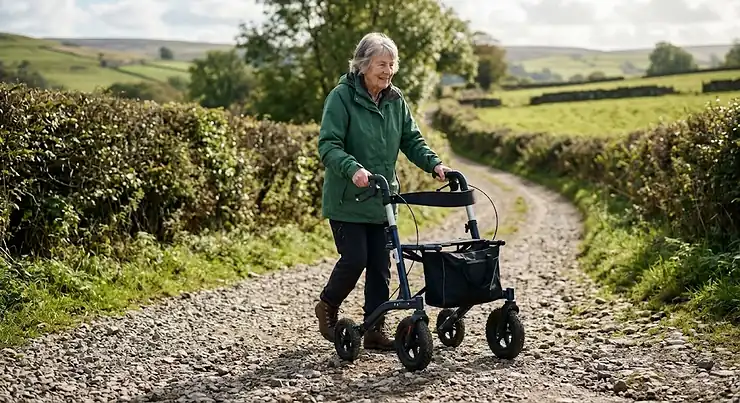
Here’s the thing nobody tells you when your GP hands over a leaflet about walking aids: the standard rollator, the one built for hospital corridors and supermarket aisles, falls apart the moment it meets a muddy towpath or a Cotswold cobbled high street. Small castor wheels catch on grit. Frames judder over tree roots. Suddenly a lovely afternoon walk to the postbox becomes a white-knuckle negotiation with the pavement. An all terrain rollator walker solves a specific problem: it lets you keep walking outdoors, on the surfaces real life actually throws at you, without trading away stability or confidence.
Getting outdoors with limited mobility takes a bit more planning than it used to — the Ramblers’ own guide to identifying accessible walks is a genuinely useful starting point for scouting routes before you commit to them. This guide is built around genuine specifications, real customer sentiment gathered from UK and international listings, and honest comparative reasoning rather than marketing fluff. We’ve dug into seven real products spanning budget, mid-range and premium price points, so whether you’re after a large wheel mobility walker for weekend park strolls or a proper heavy-duty outdoor rollator for daily countryside rambles, there’s something here that fits. We’ll cover pneumatic tyres versus solid ones, why an off-road rollator behaves so differently to its indoor cousin, and exactly what to expect from an outdoor walking aid rough terrain models when the going gets bumpy. Prices below are shown as ranges, since retailer pricing shifts constantly — always check the current price before buying.
Quick Comparison Table
Before we get into the detail, here’s the shortest possible answer to “which all terrain rollator walker should I buy?” — a snapshot of all seven, side by side.
| Product | Best For | Wheel Type | Price Range |
|---|---|---|---|
| VOCIC Z11 | Budget daily outdoor use | 8″ all-terrain wheels | £130-£190 |
| HOMLAND All-Terrain Rollator | Kerbs and tight budgets | 8″ curb-climber wheels | £90-£140 |
| KMINA PRO All Terrain Rollator | Comfort seating outdoors | 10″ pneumatic | £220-£280 |
| Drive Nitro Rollator | All-round reliability | 10″ front castors | £180-£240 |
| Topro Olympos ATR | Serious off-road walking | 28cm off-road tyres | £300-£380 |
| Rollz Motion Performance | 2-in-1 rollator/wheelchair | Front foam, rear pneumatic | £700-£930 |
| Trionic Veloped 14er | True countryside off-roading | 14″ pneumatic, climbing wheel | £800-£1,050 |
Looking at the spread here, the gap between the cheapest and most expensive option isn’t really about “better” or “worse” — it’s about how far off the beaten path you actually plan to go. The VOCIC Z11 and HOMLAND models handle gravel paths and uneven pavement competently, but the Trionic Veloped 14er is engineered to climb a 12.5cm kerb or root without you breaking stride. If your idea of “outdoors” is a flat park loop, don’t overspend; if it’s a coastal path in Pembrokeshire, the extra investment buys real capability.
💬 Found the shortlist useful already? A quick tap on any product below helps you compare real specs before you decide — no obligation, just information.
Top 7 All Terrain Rollator Walkers: Expert Analysis
We’ve picked these seven specifically to cover the full range of UK buyers — from someone testing the waters with an £100 model to a keen rambler ready to invest in Swedish engineering. Every entry below is a real, currently available product with genuine specifications.
1. VOCIC Z11 — best budget large wheel mobility walker for daily strolls
The VOCIC Z11 opens the list because it nails the basics without overcomplicating things. Its 8-inch all-terrain wheels and puncture-resistant tyres make it noticeably more forgiving on cracked pavement and gravel than the 5-6 inch wheels found on typical indoor rollators.
The frame supports users up to around 172kg (roughly 27 stone), which is unusually generous for a walker in this price bracket, and the five-level height adjustment (approximately 93cm-109cm) means it suits a wide range of heights without needing a different frame size. Weighing around 6-7kg, it folds down small enough to fit in a car boot, which matters more than people expect until they’re stood in a car park trying to wrestle a stiff frame into a hatchback.
Based on the spec comparison with rivals in this bracket, the dual sensitivity braking system is the standout feature — most budget rollators use a single crude lever, while this one offers graduated deceleration as well as a full stop, genuinely useful on a gentle slope. Reviewers consistently report that the ergonomic seat and backrest are comfortable for rest stops, though a recurring theme in aggregated feedback is that the storage bag, while generous, isn’t fully waterproof in sustained rain.
Pros:
- ✅ Supports up to 172kg — unusually high for the price
- ✅ Dual-sensitivity brakes handle slopes confidently
- ✅ Folds compact for car boot storage
Cons:
- ❌ Storage bag isn’t fully weatherproof
- ❌ Backrest padding is thinner than pricier rivals
At around £130-£190, the VOCIC Z11 represents strong value for anyone whose “all terrain” needs stop at cracked pavements, gravel paths and the odd grass verge — check current price before buying, as this bracket shifts often.
2. HOMLAND All-Terrain Rollator — best kerb-climbing budget pick
Where the VOCIC Z11 wins on brakes, the HOMLAND All-Terrain Rollator wins on tackling actual obstacles. It’s built around 8-inch big wheels paired with a genuine curb climber mechanism — a small ramped guide at the front that helps the wheel roll up a kerb edge rather than stalling against it.
At just 16.4lb (roughly 7.4kg), it’s one of the lighter units on this list, yet it still carries a 300lb (136kg) weight capacity, which is a solid balance of portability and support. What most buyers overlook about this model is that the height adjustment and seat height are both independently adjustable, so a shorter user doesn’t end up with an uncomfortably low seat just to get the handles at the right height.
Aggregated review sentiment across UK and international retailers points to genuine praise for how easily it folds one-handed, useful if you’re also managing a walking stick or shopping bag. The recurring criticism is that the plastic components around the brake housing feel less premium than the aluminium-heavy competitors further down this list — a fair trade-off, given the price.
Pros:
- ✅ Genuine curb-climber design for real kerbs
- ✅ Independently adjustable seat and handle height
- ✅ Very light at roughly 7.4kg
Cons:
- ❌ Brake housing plastic feels less durable
- ❌ Basket capacity is modest versus rivals
Priced typically in the £90-£140 range, the HOMLAND is arguably the best-value entry point if your daily walk genuinely involves kerbs, driveways and uneven pavement edges rather than open countryside.
3. KMINA PRO All Terrain Rollator — best pneumatic comfort under £300
Step up to the KMINA PRO All Terrain Rollator and the biggest change is the tyres: proper 10-inch pneumatic (air-filled) wheels rather than solid rubber. Here’s what the spec sheet won’t tell you outright, but the mechanics explain clearly — air-filled tyres flex and absorb small shocks that solid tyres transmit straight up through the frame and into your wrists and shoulders.
The front wheels swivel through 360 degrees, and a rear step-lifting lever helps you tip the frame over a genuine obstacle like a raised paving slab or a rutted verge, rather than relying purely on wheel size to power through. Seat height sits at roughly 22.8 inches with a proper backrest, useful for anyone who tires on longer outings and needs somewhere comfortable to pause.
On paper, this means the KMINA PRO slots neatly between the budget picks above and the specialist off-road rollator models further down — genuinely capable outdoors, without the four-figure price tag of dedicated adventure walkers. Reviewers commonly flag that the pneumatic tyres do need occasional reinflation (a hand pump isn’t always included), which is a fair maintenance trade for the comfort gain.
Pros:
- ✅ Genuine pneumatic tyres cushion rough ground
- ✅ 360° front swivel wheels for tight turns
- ✅ Comfortable seat with proper backrest
Cons:
- ❌ Pneumatic tyres need occasional reinflation
- ❌ Inflator often sold separately
Sitting around £220-£280, the KMINA PRO rewards buyers who want real shock absorption without stepping into premium territory.
4. Drive Nitro Rollator — best all-round reliability for everyday outdoor use
The Drive Nitro Rollator has been a familiar sight in UK mobility shops for years, and there’s a reason it keeps reappearing on recommendation lists: it does the fundamentals extremely well. Oversized 10-inch front wheels are specifically designed to make turning and manoeuvring easier on rough ground, backed by swivelling forks that tighten the turning circle noticeably compared with fixed-axle rivals.
Available in mini, standard and tall sizing, the frame accommodates users up to roughly 21 stone, and the push-button height adjustment means swapping between users (a couple sharing one rollator, say) takes seconds rather than tools. Here’s what most buyers overlook about this model: the brake cables are routed inside the frame tubing rather than exposed along the outside, which meaningfully reduces the risk of snagging on brambles or a garden gate latch during outdoor use.
At roughly 8kg, it’s genuinely light for a frame this size, and the side-to-side folding mechanism collapses it into a slim profile for the car. Aggregated customer sentiment repeatedly highlights how smoothly it steers compared with older, heavier rollator designs, though a fair number of reviewers note the seat, while comfortable, is on the firmer side for very long rest stops.
Pros:
- ✅ Three size options fit almost any height
- ✅ Internal brake cables resist snagging outdoors
- ✅ Excellent turning circle on rough ground
Cons:
- ❌ Seat cushioning is firmer than premium rivals
- ❌ Basic bag capacity for longer outings
Typically priced between £180-£240, the Drive Nitro is the sensible middle-ground pick — genuinely reliable, unfussy, and easy to find UK stock and spare parts for.
5. Topro Olympos ATR — best premium off-road build quality
Manufactured in Norway and tested to TÜV NS-EN ISO 11199-2 standards, the Topro Olympos ATR is where this list moves from “capable outdoors” to “purpose-built for it.” Its 28cm front wheels are genuinely large by rollator standards, paired with shock-absorbing off-road tyres designed specifically for unsurfaced roads, gravel and cobblestones.
The wide frame stance is a deliberate trade-off: it sacrifices a little manoeuvrability indoors in exchange for meaningfully better stability outdoors, particularly on cambered or uneven ground where a narrower frame would feel tippy. Based on the spec comparison, the ErgoGrip handles are a genuine upgrade over standard grips — they offer multiple hand positions and double as stable armrests when you’re seated, which matters more than it sounds when rising from a seated position on soft or sloped ground.
Weighing under 9kg despite its size, and backed by a seven-year warranty, it’s built for people who plan to use it hard, for years, rather than occasionally. What the spec sheet won’t tell you, but reviewers note repeatedly, is that the two width options (standard and Slim) genuinely matter for comfort — a frame too wide for your shoulder width causes arm strain over a long walk, so it’s worth checking which size suits before buying.
Pros:
- ✅ TÜV-tested, purpose-built off-road tyres
- ✅ Seven-year warranty signals serious build confidence
- ✅ ErgoGrip handles double as stable armrests
Cons:
- ❌ Wide frame trades some indoor manoeuvrability
- ❌ Premium price versus mid-range rivals
Expect to pay around £300-£380, with VAT relief potentially available for eligible buyers (more on that later) — genuinely strong value for a rollator engineered specifically for rough terrain rather than adapted for it.
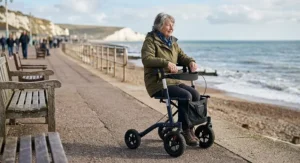
6. Rollz Motion Performance — best 2-in-1 rollator and wheelchair combo
The Rollz Motion Performance takes a different approach entirely: it’s an all-terrain rollator that converts into a wheelchair with a single lever motion, front foam-filled tyres paired with rear pneumatic tyres for genuine shock absorption on bumpy ground. Developed by the Dutch company Rollz, it’s engineered around the idea that mobility needs change hour to hour, not just year to year.
The practical case for this model is straightforward: if fatigue means you sometimes need to walk and sometimes need to be pushed, owning two separate pieces of equipment is expensive and impractical, whereas this converts in seconds without transferring between devices. Thickly padded armrests and height-adjustable footrests mean the wheelchair mode is genuinely comfortable rather than a bolted-on afterthought, and the frame handles cobblestones and forest paths with the same rear pneumatic cushioning found on the walking mode.
Aggregated customer sentiment, including feedback from UK suppliers, consistently praises how quickly the conversion mechanism works once you’ve practised it a few times, and several buyers specifically mention it suiting taller users well (one supplier reviewer noted comfortable use at 6’4″). The trade-off, honestly, is weight and price — a combination unit of this sophistication is heavier to lift into a car boot than a simple folding rollator.
Pros:
- ✅ Converts rollator to wheelchair in seconds
- ✅ Rear pneumatic tyres smooth out cobblestones
- ✅ Well suited to taller users
Cons:
- ❌ Heavier to lift than simple folding rollators
- ❌ Significant price step over standard models
Priced from roughly £700-£930 depending on retailer and VAT eligibility, this is a considered investment for anyone whose walking stamina varies day to day, rather than a casual outdoor accessory.
7. Trionic Veloped 14er — best true off-road walker for serious countryside use
If the Topro Olympos ATR is built for rough terrain, the Trionic Veloped 14er is built for terrain that barely qualifies as a path. Developed in Sweden with input from KTH Royal Institute of Technology, its patented climbing wheel design (two interconnected front wheels, slightly offset lengthwise) can climb an obstacle up to 12.5cm high — a kerb, root or rock — using surprisingly little force, something no standard four-wheel rollator design can match.
Every wheel runs on genuine air-pressured tyres, and the frame includes suspension specifically tuned for a smooth ride over grass, gravel, cobbles and forest trails. Here’s what most buyers overlook about the “rollator” classification: despite looking closer to an off-road jogging buggy than a hospital walking frame, it’s fully tested and approved as a rollator, which matters for VAT relief eligibility and insurance purposes.
The 14-inch wheel option specifically suits softer ground, sand and uneven tracks better than the smaller 12-inch frame, making it the pick for anyone whose walks genuinely include coastal paths or countryside terrain rather than tarmac. Reviewers and owner testimonials consistently describe a transformation in confidence and range — several accounts mention being able to walk to a village or meet friends again after previously feeling housebound by rough terrain. The realistic downside is cost and bulk; this is a specialist tool, not a everyday errand-runner.
Pros:
- ✅ Patented climbing wheel handles genuine obstacles
- ✅ Full suspension smooths grass, gravel and forest paths
- ✅ Tested and approved as a genuine rollator
Cons:
- ❌ Premium price reflects specialist engineering
- ❌ Bulkier than compact everyday rollators
Typically priced £800-£1,050 depending on frame size and accessories, the Trionic Veloped 14er is the clear choice for anyone whose walking ambitions genuinely include the open countryside.
Practical Usage Guide: Getting the Most From Your All Terrain Rollator Walker
Buying the right all terrain rollator walker is only half the job — setting it up correctly determines whether it actually delivers the stability it promises. Start with height: stand upright, arms relaxed by your sides, and adjust the handles so your wrists sit level with your hip crease. Too low and you’ll hunch forward, straining your back; too high and you’ll lose the leverage needed to control the frame on a slope.
In the first 30 days, the most common mistake is leaving tyre pressure unchecked on pneumatic models like the KMINA PRO or Trionic Veloped 14er — under-inflated tyres feel sluggish and increase rolling resistance, ironically making rough terrain harder work, not easier. Check pressure monthly, and inspect brake cables for fraying, particularly on models routed externally.
A simple maintenance routine extends the life of any outdoor rollator: wipe down the frame after wet or muddy walks (salt and grit accelerate corrosion on aluminium joints), tighten fold-locking mechanisms every few weeks, and store the unit somewhere dry rather than in a damp shed. One optimisation trick rarely mentioned in manuals — slightly under-tightening the front swivel wheel lock (where fitted) improves manoeuvrability on tight turns, while fully locking it improves straight-line stability on longer stretches like a towpath.
Real-World Scenarios: Who Actually Needs Which Rollator
Matching the right model to your actual walking pattern matters more than chasing the “best” spec sheet. Consider three realistic profiles.
The retired teacher who wants a rollator for countryside walks with her grandchildren twice a week, covering roughly two miles of mixed farm track and canal towpath, is well served by the Topro Olympos ATR or KMINA PRO — enough off-road capability for genuine countryside conditions, without the bulk or price of specialist adventure equipment. The budget-conscious retiree managing a short daily walk to the local shop over cracked residential pavement is better matched to the HOMLAND or VOCIC Z11 — kerb-friendly, light enough to lift into a car boot, and priced sensibly for occasional outdoor use rather than serious mileage.
Staying active is genuinely protective here too — Age UK’s guidance on preventing falls notes that keeping moving, rather than avoiding activity out of caution, is one of the best ways to maintain strength and balance as we age, which is a strong argument for the right outdoor rollator over simply staying indoors. Then there’s the more active user, perhaps managing a progressive condition, who wants a rollator for countryside walks that genuinely include unpaved trails, beaches or forest paths several times a week, and who values the option to sit and rest mid-walk without turning back early. This is where the Trionic Veloped 14er earns its price tag — its climbing wheel and full suspension are engineered precisely for this use case, not merely tolerant of it.
Problem → Solution: Fixing Common All-Terrain Rollator Walker Issues
Several problems come up repeatedly for outdoor rollator owners, and most have a straightforward fix. If the frame feels unstable on camber (a sloped pavement edge, for instance), check that both rear wheels are making even contact — uneven tyre pressure on pneumatic models like the Rollz Motion Performance is a common, easily missed culprit. If brakes feel spongy on a descent, inspect cable tension first; a quick adjustment at the cable barrel usually restores full stopping power without needing a full service.
Wheels catching repeatedly on kerbs typically point to insufficient approach angle — models with a genuine curb climber, like the HOMLAND, solve this structurally, whereas standard wheels rely entirely on user technique (approach at a slight angle, not head-on). Finally, users who find their storage bag inadequate for longer countryside outings should look at models like the Topro Olympos ATR, whose 15kg-capacity bag is genuinely built for a proper outing rather than a quick errand.

How to Choose an All Terrain Rollator Walker
Working through these seven criteria in order will get you to the right decision faster than scrolling endless listings.
- Define your actual terrain. Cracked pavement and kerbs need less than forest trails and gravel — be honest about where you’ll really walk, not where you aspire to.
- Check the weight capacity against your needs, including anything carried in the bag, since manufacturer figures rarely build in much margin.
- Prioritise wheel type over wheel size alone. Pneumatic tyres cushion better than large solid wheels of the same diameter, particularly on cobbles.
- Confirm the height range fits you, ideally testing in person, since handle height affects posture and long-term comfort significantly.
- Weigh portability against stability. Lighter frames are easier to lift into a car but often sacrifice some outdoor confidence versus heavier, wider designs.
- Consider whether you need a seat, brakes with graduated control, or a wheelchair conversion — these aren’t universal features even at similar price points.
- Check VAT exemption eligibility before paying full price, since many genuine mobility aids qualify for relief for disabled or chronically ill buyers. If you’re still unsure whether a rollator is the right category of aid for you, the NHS’s own guide to walking aids and mobility equipment is a solid starting point before you spend anything.
A common mistake buyers make at this stage is choosing based on price alone rather than terrain match — an expensive rollator that’s overkill for flat pavements is just as poor a fit as a budget model that can’t handle genuine gravel.
Large Wheel Mobility Walker: Why Wheel Size Actually Matters
It’s tempting to assume bigger wheels simply mean better performance, but the physics are a little more specific than that. A large wheel mobility walker rolls over small obstacles — a stone, a raised paving edge, a root — more easily than a small-wheeled equivalent because the contact angle with the obstacle is shallower; picture trying to roll a bicycle wheel versus a skateboard wheel over the same kerb.
That said, wheel diameter alone doesn’t determine outdoor capability — tyre material matters just as much. The 10-inch solid wheels on the Drive Nitro Rollator genuinely outperform smaller castors on rough pavement, but they still transmit more vibration than the 10-inch pneumatic tyres on the KMINA PRO, because air-filled tyres flex and absorb impact rather than transferring it directly through the frame. What most buyers overlook is that a large wheel mobility walker with solid tyres is often a better fit for firm, dry gravel paths, while pneumatic tyres pull ahead on genuinely varied or wet terrain where cushioning and grip both matter.
Best Rollator for Cobblestones and Uneven Pavements
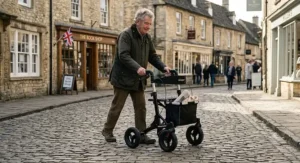
Cobblestones are a specific and genuinely difficult surface — irregular height, awkward gaps, and a jarring ride on anything with small or solid wheels. If you’re searching specifically for the best rollator for cobblestones, prioritise pneumatic tyres and a wider wheelbase over raw wheel diameter alone.
| Model | Cobble Performance | Why |
|---|---|---|
| Rollz Motion Performance | Excellent | Rear pneumatic tyres absorb repeated small jolts |
| KMINA PRO | Very Good | Full pneumatic set with 360° swivel front wheels |
| Trionic Veloped 14er | Excellent | Climbing wheel plus suspension handles irregular gaps |
| Drive Nitro Rollator | Fair | Solid wheels manage cobbles but transmit more vibration |
The pattern here is consistent: every model rated “excellent” or “very good” uses genuine pneumatic tyres somewhere in its wheel setup, while solid-wheeled models manage cobblestones adequately but noticeably less comfortably over a longer walk. If cobbled town centres or historic high streets feature heavily in your daily route, that single spec — air versus solid tyres — should weigh more heavily in your decision than price or brand alone.
Off-Road Rollator vs Standard Rollator: What’s the Real Difference
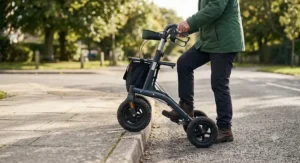
The gap between an off-road rollator and a standard indoor-focused rollator isn’t marketing spin — it comes down to three measurable differences. First, wheel size and material: standard rollators typically use 5-6 inch solid castors optimised for tight indoor turns, while off-road rollators use 8-14 inch wheels, often pneumatic, optimised for rolling over obstacles rather than pivoting sharply.
Second, frame width and stance: standard rollators are built narrow to fit through doorways and supermarket aisles, whereas an off-road rollator, like the Topro Olympos ATR, is deliberately wider for stability on camber and uneven ground — a genuine trade-off, since that same width makes tight indoor manoeuvring harder. Third, braking and suspension: outdoor-focused models frequently add graduated braking (rather than a simple on/off lever) and, in premium cases like the Trionic Veloped 14er, genuine suspension components that standard rollators simply don’t include.
The practical upshot: buying a standard rollator for regular outdoor use isn’t dangerous, but it is limiting — you’ll likely stick to smooth, flat routes by necessity rather than choice, whereas a genuine off-road rollator opens up gravel paths, cobbles and countryside tracks as realistic options.
Heavy-Duty Outdoor Rollator: Weight Capacity, Build and Long-Term Value
A heavy-duty outdoor rollator earns that label through frame material and weight capacity working together, not marketing language alone. Aluminium remains the standard because it balances strength against portability — steel-framed budget models are occasionally heavier without a corresponding capacity advantage, which is worth checking rather than assuming.
Weight capacity varies more than buyers expect across this list: the VOCIC Z11 supports around 172kg, comparable to premium models costing several times more, while others sit closer to 136-150kg. If you’re above an average build, or simply want margin for comfort, checking this figure explicitly matters more than checking the price tag.
On long-term cost, it’s worth thinking in terms of cost-per-use rather than sticker price alone. A £120 budget rollator replaced every two years works out similarly, over a decade, to an £800 premium model bought once and maintained properly — the maths depends heavily on how hard and how often you’ll actually use it. For genuinely frequent outdoor use — daily walks, regular countryside outings — the higher upfront cost of something like the Topro Olympos ATR, backed by its seven-year warranty, often proves the more economical choice over time, since replacement parts and warranty support are already accounted for.
Outdoor Walking Aid for Rough Terrain: What to Expect in Real-World Performance
Spec sheets describe capability in the abstract; real-world use feels different. An outdoor walking aid rough terrain model with pneumatic tyres genuinely feels smoother within the first few metres on gravel — noticeably less jarring through the wrists than a solid-wheeled equivalent, based on the mechanical difference in how each tyre type absorbs impact.
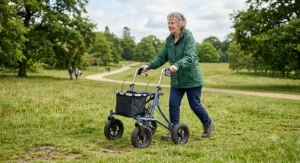
On grass, particularly after rain, wider wheels and a lower centre of gravity (features built into models like the Rollz Motion Performance and Trionic Veloped 14er) resist sinking and tipping considerably better than narrower, lighter frames. Climbing a genuine kerb without a curb-climbing mechanism or climbing wheel typically requires the user to tip the frame manually using the rear step bar — manageable with practice, but noticeably more effort than models purpose-built for the task. The honest takeaway: an outdoor walking aid rough terrain design doesn’t eliminate effort entirely, but it meaningfully reduces the physical toll of covering the same distance compared with a standard model pressed into service outdoors.
Safety, Regulations and VAT Relief Guide
All the rollators featured here are mobility aids rather than powered vehicles, so they fall outside the EAPC and moped classifications that govern electric scooters — no registration or insurance is required to use one on UK pavements or paths. That said, basic safety practice still applies: always engage brakes fully before sitting, avoid steep descents without assistance where possible, and check reflective elements are visible if walking at dusk.
On cost, many buyers overlook that most genuine mobility aids, rollators included, qualify for VAT relief if you’re chronically sick or disabled — this can mean a straightforward 20% saving, provided you complete a simple supplier declaration rather than needing formal medical proof in most cases. It’s worth checking the government’s official VAT relief guidance before purchasing, since eligibility criteria are specific and worth understanding properly.
✨ Ready to Take Your Outdoor Walks Further? 🔍 Compare the current price and availability of any model above with one click. A well-matched all terrain rollator walker can be the difference between staying in and getting back out on the paths you actually enjoy.
Frequently Asked Questions
❓ Can I use an all terrain rollator walker on grass and gravel safely?
❓ What's the difference between a rollator and a walking frame?
❓ Are all terrain rollators available on the NHS?
❓ How much does a good all terrain rollator walker cost in the UK?
❓ Do all terrain rollators fold down for car travel?
Conclusion
Choosing the right all terrain rollator walker really comes down to being honest about where you’ll actually use it. For cracked pavements and the occasional kerb, the VOCIC Z11 or HOMLAND deliver genuine value without overspending. For regular countryside walks with the confidence of pneumatic cushioning, the KMINA PRO, Drive Nitro Rollator and Topro Olympos ATR each offer a sensible step up in capability. And for anyone whose walking ambitions genuinely stretch to forest trails, cobbled towns or coastal paths, the Rollz Motion Performance and Trionic Veloped 14er represent a considered, if larger, investment in staying active outdoors.
Whichever you choose, check current pricing before buying, confirm VAT exemption eligibility if applicable, and — where possible — test the height and handle position in person. The right all terrain rollator walker shouldn’t just support your walk; it should quietly get out of the way and let you enjoy it.
✨ Don’t Miss These Exclusive Options!
🔍 Take your next outdoor walk further with a rollator genuinely built for the terrain you’ll actually face. Click through to check today’s price and availability on any model above.
Recommended for You
- Best Outdoor Rollator 2026: 7 Tough, Reliable Picks
- Best Rollator With Seat And Back Rest: 7 Top UK Picks 2026
- Best Rollator With Seat: 7 Top UK Picks for 2026
Disclaimer: This article contains affiliate links. As an Amazon Associate, I earn from qualifying purchases. If you purchase products through these links, we may earn a small commission at no additional cost to you.
✨ Found this helpful? Share it with your friends! 💬🤗
