In This Article
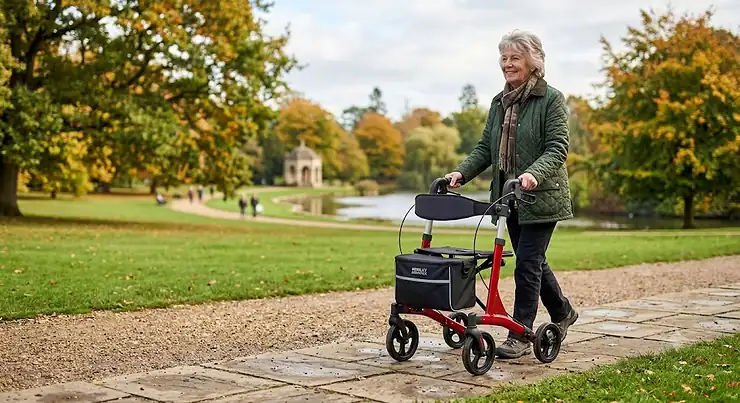
There’s a particular kind of frustration that comes with wrestling a walking frame into a car boot while the rain starts and someone’s waiting behind you in the car park. If that scene sounds familiar, you’re exactly who this guide is for. A folding rollator is a four-wheeled walking aid with a built-in seat that collapses down — usually in one motion — so it can travel with you rather than living permanently in the hallway. The best folding rollator for one person is rarely the best for another, though, because “best” here really means the tightest match between your weight, your boot size, your terrain and your budget.

We’ve spent time digging through real product listings, manufacturer specification sheets and genuine aggregated review sentiment for seven rollators currently sold on amazon.co.uk and via UK mobility retailers, spanning budget aluminium frames right up to a carbon-fibre model that barely tips the scales at under five kilograms. Muscle weakness and balance changes are among the most common reasons people are advised to try a wheeled frame in the first place, and NHS guidance on preventing falls lists using a walking aid alongside other practical steps such as better lighting and suitable footwear. So getting the choice right isn’t just about convenience — it genuinely matters for confidence and safety.
This article breaks down seven real folding rollator options, tells you honestly what the review data says about each one, and walks you through the practical stuff nobody puts on the product page: what actually fits in a Ford Fiesta boot, what “one-hand fold” really means in practice, and which mistakes trip people up in the first month of ownership. No fabricated hands-on stories, no invented five-star quotes — just the research, laid out plainly, in pounds and kilograms you can actually use.
Quick Comparison Table: Best Folding Rollator at a Glance
| Product | Weight | Best For | Price Range |
|---|---|---|---|
| byACRE Carbon Ultralight Rollator | 4.8 kg | Ultimate portability, frequent flyers | £600-£800 range |
| Days Deluxe Lightweight Rollator | 7 kg | All-round everyday and travel use | £100-£150 range |
| VOCIC Z12 Ultra Lightweight Rollator | 6.3 kg | Height-adjustable value pick | Under £120 |
| Fenetic Wellbeing Ultra Lightweight Rollator | 5.8 kg | Lightest budget option | £70-£100 range |
| MobiQuip Lightweight Aluminium Rollator | 6.4 kg | Boot-friendly all-rounder | £100-£150 range |
| HOMCOM Compact Quick Folding Rollator | Approx. 7-8 kg | Tightest fold for small cars | Under £90 |
| Drive Medical Aluminum Rollator | Approx. 7 kg | Clinically trusted, sturdy build | £100-£140 range |
A quick scan of this table tells its own story: there’s roughly a 2.2kg spread between the lightest and heaviest models here, which doesn’t sound like much until you’re the one lifting it in and out of a car boot forty times a week. The byACRE Carbon Ultralight Rollator sits in a different price bracket entirely because of its aerospace-grade materials, while the Fenetic Wellbeing and HOMCOM models prove you don’t need to spend big to get something genuinely foldable. Weight and price roughly correlate here, but not perfectly — the VOCIC Z12 punches well above its price point on the kilogram-for-pound scale, which is worth remembering as you read on.
💬 Just one click — help others make better buying decisions too!😊
Top 7 Folding Rollators: Expert Analysis
1. byACRE Carbon Ultralight Rollator — the world’s lightest folding rollator
Formula 1 cars are built from carbon fibre for the same reason this rollator is: an obscene strength-to-weight ratio. At 4.8kg, the byACRE Carbon Ultralight Rollator isn’t just “lighter than average” — it’s roughly a third the weight of some steel rollators still sold on the UK high street. That difference is the whole point of the design brief.
The carbon-fibre frame is paired with aerospace-grade aluminium fittings and a maximum user weight of 130kg. Forward-facing handles are a deliberate ergonomic choice: instead of pushing a frame in front of you with your shoulders hunched, you draw the rollator in close to your body, which promotes a more upright walking posture. The seat sits forward in the frame too, so you can stand inside it rather than behind it — useful for anyone who finds bending awkward.
Based on the spec comparison with everything else in this guide, this is squarely a premium travel and city-mobility choice rather than a heavy-duty all-terrain option. It’s for someone who flies or takes trains regularly, or whose partner or carer struggles to lift a standard rollator into a car. Reviewers consistently report that the one-hand folding mechanism is genuinely quick, and that the compact folded footprint makes a noticeable difference for buses and small hatchbacks.
Pros:
- ✅ Exceptionally light at 4.8kg — easiest lift in this guide
- ✅ Forward-facing handles support better walking posture
- ✅ Folds completely flat for cars, trains and planes
Cons:
- ❌ Premium price puts it well above budget alternatives
- ❌ Narrower compact/regular sizes may not suit larger users
Prices sit in the £600-£800 range depending on size and colour, so check current pricing before ordering. For anyone whose priority is minimising physical effort above all else, the value case is strong; for occasional or indoor-only use, it’s arguably more rollator than you need.
2. Days Deluxe Lightweight Rollator — best all-rounder for everyday and travel use
If there’s a “default” answer to the best folding rollator question for most UK households, this is close to it. The Days Deluxe Lightweight Rollator weighs 7kg and folds into a standing position just 28cm wide, which — practically speaking — means it slots through most internal doorways without you needing to fully collapse it every time.
Key numbers worth knowing: a 130kg maximum user weight, five-position adjustable handles running from 81cm to 93cm, and front kerb climbers built into the rear legs. That last feature genuinely changes the daily-use experience — dropped kerbs and uneven pavement edges are one of the more common places rollator wheels catch, and a built-in kerb climber means less lifting and jolting.
Here’s what the spec sheet won’t tell you, but user reports suggest: the fold mechanism gets stiffer over time on some units, and a handful of reviewers mention tripping over the rear wheel when it’s folded flat in a hallway, simply because it sits further back than expected. Neither issue seems to affect walking performance, but they’re worth knowing before you buy. This is a sensible pick for someone who wants one rollator to do everything — home, high street and holiday — without paying carbon-fibre prices.
Pros:
- ✅ Folds to just 28cm — genuinely doorway and boot friendly
- ✅ Kerb climbers reduce jolting on uneven pavements
- ✅ Trusted, widely stocked UK mobility brand
Cons:
- ❌ Fold mechanism reportedly stiffens with heavy use
- ❌ Solid plastic-coated wheels can snag on rough ironwork
Expect to pay in the £100-£150 range, with prices varying by retailer and colour — always check current price before ordering.
3. VOCIC Z12 Ultra Lightweight Rollator — best value adjustable travel rollator
At 6.3kg, the VOCIC Z12 Ultra Lightweight Rollator sits in that useful middle ground: light enough to lift without strain, but built from aluminium rather than carbon fibre, which keeps the price down considerably. What most buyers overlook about this model is the range of its handle adjustment — five settings spanning roughly 93cm to 109cm — which means it genuinely fits a much wider range of heights than many budget rollators, from around 5ft to 6ft3.
The ergonomic seat and curved backrest are designed to spread pressure more evenly than the flat canvas seats found on older rollator designs, and the folding mechanism is a single-pull action rather than a multi-step process. On paper this means less fumbling in a car park or on a train platform, which matters more than it sounds when you’re also managing a bag or a walking stick.
Aggregated seller feedback points to strong satisfaction with the height range and the fold speed specifically, though — as with most rollators sold primarily through online marketplaces — the volume of independently verified UK reviews is smaller than for long-established brands like Days or Drive Medical, so it’s worth reading a spread of recent reviews before committing.
Pros:
- ✅ Wide five-level height adjustment (approx. 4’11”-6’3″)
- ✅ Fast single-pull folding mechanism
- ✅ Strong value relative to weight and features
Cons:
- ❌ Shorter UK retail track record than legacy brands
- ❌ Ergonomic seat cushion adds slight bulk when folded
Typically priced under £120, this is a smart pick for anyone who wants near-premium convenience without the near-premium price tag.
4. Fenetic Wellbeing Ultra Lightweight Folding Rollator — lightest budget option
Weighing just 5.8kg, the Fenetic Wellbeing Ultra Lightweight Folding Rollator proves that a genuinely low weight doesn’t have to mean a genuinely high price. The manufacturer builds it with solid, puncture-resistant tyres that need essentially no upkeep, which quietly solves one of the more annoying long-term ownership issues with pneumatic-tyred alternatives — no pumps, no punctures, no trips to a bike shop.
The frame uses an x-shaped folding design that collapses without removing any parts, and — usefully — it’s designed to stand upright unaided once folded, so it won’t topple over in a hallway or a train vestibule while you’re getting yourself settled. Height-adjustable handles and a flip-up padded PU seat round out the feature list.
Here’s the honest trade-off: at this price point, you’re generally getting smaller 15cm wheels rather than the 19-20cm wheels found on the Days Deluxe or VOCIC models, which means a slightly less forgiving ride over gravel or badly maintained pavement. For mostly flat, mostly paved routes — town centres, supermarkets, station concourses — that’s rarely a dealbreaker. For regular use on rougher ground, it’s a genuine consideration.
Pros:
- ✅ One of the lightest rollators available under £100
- ✅ Puncture-proof tyres need virtually no maintenance
- ✅ Stands upright unassisted when folded
Cons:
- ❌ Smaller wheels handle rough terrain less smoothly
- ❌ Fewer height-adjustment increments than pricier rivals
Prices sit around £70-£100 depending on colour, making this arguably the best entry point for anyone trying a folding rollator for the first time.
5. MobiQuip Lightweight 4-Wheel Aluminium Rollator — best boot-friendly all-rounder
The MobiQuip Lightweight 4-Wheel Aluminium Rollator weighs 6.4kg, and what most buyers overlook about that number is how it stacks up against the wider market: it’s roughly a third lighter than many “standard” steel rollators still sold on the high street, while keeping a proper four-wheel aluminium chassis rather than a stripped-down three-wheel frame that sacrifices stability for weight savings.
A compact folding system, loop handle brakes and a flip-up padded seat with an underneath mesh basket are the headline features, alongside height-adjustable handles. The basket detail matters more than it might sound — it turns the rollator into a genuinely useful shopping companion rather than just a walking aid, which is exactly the kind of practical, everyday-use thinking that separates a good rollator from a merely adequate one.
Aggregated customer feedback is genuinely mixed on one specific point: weight consistency between individual units. Some buyers report units that feel noticeably lighter or heavier than the stated 6.4kg, which is worth flagging honestly rather than glossing over — it’s the kind of detail a rewritten product listing would never mention, but a spec-comparison-led review should.
Pros:
- ✅ Genuine four-wheel stability at a lightweight 6.4kg
- ✅ Underseat basket adds real everyday practicality
- ✅ Loop brakes suit users with reduced hand strength
Cons:
- ❌ Some reports of weight inconsistency between units
- ❌ Backrest strap needs correct positioning to work well
Typically priced in the £100-£150 range, this is a sensible middle-ground pick for someone who wants both stability and portability without extremes of either.
6. HOMCOM Compact Quick Folding Rollator — most compact fold for small cars
If boot space is your single biggest concern, the HOMCOM Compact Quick Folding Rollator earns its spot here on folded dimensions alone. Built from powder-coated aluminium with an eight-inch wheel set, it folds without tools via a rear-leg collapsing mechanism, and the six-position adjustable height accommodates a broad range of user heights.
The 136kg maximum load capacity is worth noting because it’s higher than several rivals in this list, making it a reasonable option for larger users who still want something genuinely foldable rather than the wider bariatric-style rollators built primarily for stability over portability. A front storage pocket and side cane holder are small but genuinely useful additions for anyone managing a walking stick alongside their rollator during the transition period.
Reviewers consistently note good value for the price, though — as is common with budget aluminium frames — a handful mention that the dual hand brake takes a little practice to engage smoothly compared with loop-lock systems. That’s a fair trade for the price point, but worth practising indoors before your first outing.
Pros:
- ✅ Compact fold genuinely suits smaller car boots
- ✅ Higher 136kg weight capacity than several rivals
- ✅ Side cane holder and front pocket add convenience
Cons:
- ❌ Dual hand brake has a learning curve for some users
- ❌ Six-position height range narrower than premium rivals
Prices are typically under £90, making this one of the most accessible genuinely-compact options on the market.
7. Drive Medical Aluminum Rollator — trusted clinical-grade choice
Drive Medical is one of the longer-established names in mobility equipment, and the Drive Medical Aluminum Rollator reflects that: a straightforward, no-frills aluminium frame with a padded seat, removable hinged backrest, and 7.5-inch casters suited to both indoor and outdoor use. At roughly 7kg with a 300lb (136kg) weight capacity, it sits comfortably in the mid-range on both counts.
The side-to-side folding design is a genuine one-hand operation, and — usefully — the rollator maintains a standing position once folded, so it won’t topple in a hallway. An easy-turn height-adjustment lever is quicker to operate than the pin-and-hole systems found on some budget alternatives, which matters if grip strength or dexterity is a factor.
Based on the spec comparison, this model’s real strength is consistency rather than any single standout feature — it’s the kind of rollator physiotherapists and occupational therapists have recommended for years precisely because the fundamentals (fold reliability, brake feel, seat comfort) are dependable rather than flashy. That track record carries real weight for anyone who’d rather buy a known quantity than gamble on a newer brand.
Pros:
- ✅ Long-established brand with a strong reliability record
- ✅ One-hand folding design stands upright when collapsed
- ✅ Removable backrest adds flexibility for storage
Cons:
- ❌ Heavier than the carbon and ultralight aluminium options
- ❌ Basic seat padding compared with ergonomic rivals
Expect to pay in the £100-£140 range — solid value for a brand with this much clinical pedigree behind it.
Practical Usage Guide: Getting the Most From Your Foldable Rollator
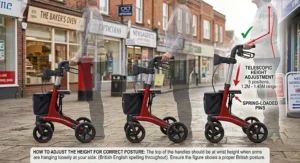
Getting a new foldable rollator home is only the start — the first thirty days are where most of the common frustrations happen, and nearly all of them are avoidable. Start with height adjustment before you take your first proper walk: stand naturally with arms relaxed at your sides, and the handles should sit roughly level with your wrist crease. Too high forces you to hunch your shoulders upward; too low tips you forward over the frame, which undermines the whole point of using one.
Practise the fold-and-unfold motion indoors, on carpet, before you need to do it in a car park in the rain. Most folding rollators use either a single-pull strap or a two-handed squeeze-and-lift motion, and muscle memory genuinely does develop with repetition — what feels awkward on day one is usually second nature by day five. Check the brake tension weekly rather than assuming it’ll stay consistent; cable-operated loop brakes can loosen slightly with regular use, and a brake that engages too late is a safety issue worth catching early.
A common first-month mistake is leaving the underseat bag empty and then overloading it once habit kicks in — heavy shopping shifted to one side can affect balance more than people expect, so distribute weight evenly and keep genuinely heavy items in a backpack instead. Finally, wipe down the wheels and check for hair or thread wrapped around the axles every couple of weeks; it’s a two-minute job that prevents the single most common cause of a rollator that “used to roll smoothly” no longer doing so.
Real-World Scenarios: Who Suits Which Travel Rollator
The frequent flyer. Margaret, 74, visits her daughter in Spain three times a year and hates checking mobility equipment as hold baggage whenever she can avoid it. For her, the byACRE Carbon Ultralight Rollator makes sense despite the price — every kilogram saved matters when she’s the one lifting it through airport security and into overhead compartments on trains. A travel rollator this light also reduces the physical toll of navigating unfamiliar terminals solo.
The weekend visitor. Tom, 68, mostly uses a walking stick at home but wants a rollator in the car boot for longer outings — garden centres, seaside towns, days out with grandchildren. Weight matters less to him than boot space and price, since his rollator will spend most of its life folded flat rather than in daily use. The HOMCOM Compact Quick Folding Rollator or Fenetic Wellbeing Ultra Lightweight Folding Rollator both suit this occasional-but-essential use case well.
The daily-use commuter. Priya, 71, uses her rollator every single day — to the shops, to appointments, around her local high street — and needs something that balances comfort, durability and a manageable fold for the bus. The Days Deluxe Lightweight Rollator or Drive Medical Aluminum Rollator fit this profile best: sturdy enough for daily wear, light enough to manage independently, and backed by established brands with a longer UK track record.
Problem → Solution: Fixing Common Folding Rollator Frustrations
Problem: the rollator won’t fold flat anymore. This is almost always debris in the folding hinge rather than a mechanical fault — a build-up of grit, hair or fabric fibres around the pivot points is the usual culprit. A quick clean with a dry cloth and, if needed, a drop of silicone-based lubricant (never oil, which attracts more dirt) on the pivot usually restores smooth folding within seconds.
Problem: it doesn’t fit in the boot the way it did in the shop. Retail demonstration units are sometimes shown folded to their absolute minimum, which requires removing accessories like baskets or bags first. Before assuming a portable rollator walker won’t fit your car, try the full fold sequence with everything detached, and measure your actual boot opening rather than relying on memory.
Problem: uneven wheel wear on one side. This typically points to slightly uneven walking gait, or a habit of favouring one hand on the brake. It’s worth mentioning to a physiotherapist if you have regular check-ins, since it can occasionally flag a balance issue worth addressing early rather than just replacing wheels repeatedly.
Problem: the seat feels unstable when sitting down. Nearly every folding rollator requires both brakes to be locked before the seat is used for resting — sitting with brakes disengaged is one of the most common (and most avoidable) safety mistakes. Make locking both brakes a genuine habit, every single time, regardless of how briefly you’re stopping.
Problem: handles keep slipping out of adjustment. Height-adjustment mechanisms rely on a spring-loaded pin or lever clamp, and both can loosen with vibration over months of use. A quarter-turn tightening of the clamp screw, checked every few weeks, usually resolves this without needing a replacement part.

How to Choose the Best Folding Rollator
- Weigh yourself against the weight capacity, not just your current weight. Choose a model with headroom above your current weight to account for anything carried in the seat bag or basket.
- Measure your boot opening before you measure the rollator. A rollator that folds to 30cm wide is useless if your boot opening is 28cm — check both numbers, not just the marketing claim.
- Prioritise wheel size for your actual terrain. Larger wheels (18cm-20cm) handle kerbs and gravel more smoothly; smaller wheels (15cm) are fine for flat, paved, mostly indoor-outdoor routes.
- Test the fold mechanism type, not just the fold speed. A one-hand pull suits users with limited grip strength better than a two-handed squeeze-and-lift design, regardless of how quick either claims to be.
- Check the seat height against your own knee height. A seat that’s too low makes standing back up harder work than it needs to be — this is genuinely one of the most overlooked specs on any listing.
- Factor in brake type honestly. Loop brakes are generally easier for reduced hand strength; lever brakes often offer more precise control for those who retain good grip.
- Decide how much you value weight versus features. The lightest options tend to have fewer accessories (baskets, trays, cup holders); the heavier all-rounders usually pack more storage and comfort extras.
Foldable Rollator vs Standard Fixed-Frame Walking Frame
A collapsible rollator walker and a traditional fixed-frame Zimmer-style walker solve genuinely different problems, and it’s worth being honest about which one suits which situation rather than assuming “newer means better.” According to NHS guidance on walking aids, a fixed frame offers more raw support and stability than a walking stick, while a wheeled rollator is easier to manoeuvre and helps preserve a more natural walking pattern — but that extra manoeuvrability comes with a genuine trade-off, since a rollator’s wheels mean it can roll away slightly rather than staying rigidly planted the way a lift-and-place frame does.
The same guidance points to rollators generally suiting people with moderate balance problems rather than more significant instability, which is a useful distinction if you’re choosing between the two for the first time or upgrading from one to the other. In practice, most people who’ve used a fixed frame at home find a folding rollator transformative for anything outside the house — shopping trips, appointments, holidays — precisely because it travels with them rather than staying behind, and the built-in seat means rest breaks don’t require finding a bench.
If you’re genuinely unsure which category suits your specific balance and strength profile, that’s a conversation worth having with a GP or physiotherapist rather than guessing from a product page — they can assess gait and grip strength in a way no spec sheet can replicate.
Folding Rollator for Travel: Trains, Planes and Coaches
Taking a travel rollator on public transport is more straightforward than most first-timers expect, but a little preparation avoids most of the friction. On UK trains, station staff can generally assist with boarding if you book Passenger Assist in advance, and a genuinely folding rollator (rather than a fixed frame) is much easier to store in a luggage rack or vestibule space without blocking the aisle.
Air travel involves a bit more planning, but the protections are stronger than many people realise. A House of Lords Library briefing on air travel for disabled passengers confirms that passengers with a disability or reduced mobility are legally entitled to free assistance — commonly known as “special assistance” — on any flight departing a UK airport, and that travellers are generally advised to give around 48 hours’ notice of the help they’ll need. Most airlines will let you use your own folding rollator right up to the aircraft door before it’s stowed in the hold, then return it to you on arrival.
For coach travel, folded dimensions matter more than weight, since luggage bay space is often tighter than a car boot. This is precisely where a genuinely compact folding rollator for travel — rather than a bulkier all-terrain model — earns its keep. Always confirm folded dimensions against the specific coach operator’s stated luggage allowance before a long journey, since these do vary between operators.
Will a Folding Rollator Fit in My Car Boot?
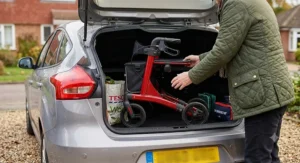
This is one of the most searched, and most poorly answered, questions in the whole category — because “it folds down small” means very different things across different brands. As a genuinely useful rule of thumb: most superminis and small hatchbacks (Ford Fiesta, Vauxhall Corsa, VW Polo) comfortably fit any rollator that folds to around 30cm wide or less, which covers every model in this guide except perhaps bulkier all-terrain designs not featured here.
The real variable isn’t width so much as depth and height once folded — a rollator that folds narrow but stays tall can still be awkward to lay flat in a shallow boot. The byACRE Carbon Ultralight and Days Deluxe both fold into genuinely flat, low profiles specifically designed with car transport in mind, while bulkier bariatric-style rollators (not covered in this guide, since they prioritise stability and load capacity over portability) are a poor match for small cars regardless of their other merits.
Practical tip: before buying online, measure your own boot opening and depth with a tape measure and compare it directly against the manufacturer’s stated folded dimensions — not just the folded width they lead with in marketing copy. A rollator fit for car boot storage should genuinely lie flat without needing to be wedged in at an angle, since repeated wedging can bend brake cables over time.
Portable Rollator Walker: Common Mistakes When Buying
The single most common mistake is buying on weight alone without checking wheel size, which leaves some buyers with a rollator that’s genuinely light but struggles on anything rougher than a smooth pavement. The second most common mistake is the opposite: over-specifying for terrain that will rarely be encountered, ending up with a heavier, harder-to-lift model for the sake of features that go unused.
Ignoring the height adjustment range relative to your own height is a frequent and easily avoidable error — a rollator advertised as “adjustable” can still have a range that excludes taller or shorter users, so check the actual centimetre figures rather than trusting the word “adjustable” alone. Buyers also commonly underestimate how much a seat’s comfort matters over months of regular use; a thin, unpadded seat that feels fine in a five-minute shop demo can become genuinely uncomfortable after twenty minutes of real-world rest breaks.
Finally, price-anchoring on the very cheapest listing without checking genuine review sentiment is a mistake worth naming directly — the very lowest-priced portable rollator walkers on any marketplace are sometimes cheap specifically because of inconsistent build quality between units, as reflected in some of the aggregated feedback discussed earlier in this guide.
Lightweight Folding Rollator: Long-Term Cost & Maintenance
The purchase price is only part of the total cost picture. A lightweight folding rollator with puncture-proof or solid tyres, like the Fenetic Wellbeing model, effectively has zero ongoing tyre maintenance cost, while pneumatic-tyred all-terrain rollators occasionally need a pump or, rarely, a replacement inner tube — a small but real recurring cost worth factoring in if you’re comparing across categories.
Brake cables on loop-brake systems can stretch slightly over one to two years of regular use and occasionally need re-tensioning, which most mobility retailers can do quickly and inexpensively, or which a confident user can often adjust themselves with the built-in tension dial. Replacement wheels, when needed, typically cost a fraction of the rollator’s original price and are widely available for established brands like Days and Drive Medical, which is a genuine long-term advantage of buying a recognised name over an unbranded budget import — spare parts availability matters more after year two than it does on day one.
Where a condition has a substantial, long-term adverse effect on someone’s ability to carry out normal day-to-day activities, HMRC’s VAT relief rules for disabled people mean mobility aids bought for personal use may qualify for zero-rated VAT, which can meaningfully reduce the total cost of ownership on a premium model. It’s genuinely worth checking eligibility at checkout on most UK mobility retailer sites, including for accessories like spare bags or backrests bought later.
Safety, Regulations and Compliance Guide
There’s no formal UK licensing requirement for using a folding rollator, but a handful of practical safety points are worth taking seriously rather than treating as boilerplate. Always lock both brakes fully before sitting down on the built-in seat — this is the single most common preventable rollator-related fall, and it’s avoidable purely through habit. Never use a rollator to descend a full flight of stairs; kerb climbers and small steps are within design tolerance, but stairs are not, regardless of what any listing implies.
Regular brake and wheel checks matter more than most owners realise. Every walking aid, rollators included, relies on a grippy contact point to prevent slipping — on a stick or frame that’s the rubber ferrule, and on a rollator it’s the tyre tread — so keeping wheels free of embedded grit or wear that reduces traction matters, particularly in wet UK weather. If balance or walking difficulties are new, worsening, or accompanied by dizziness, that’s a conversation for a GP rather than a product review — a rollator is a mobility aid, not a substitute for a proper clinical assessment of the underlying cause.
Product-wise, look for CE or UKCA marking on any rollator sold in the UK as a baseline indicator of basic safety compliance, and retain proof of purchase in case a fault develops within the warranty period — reputable brands featured in this guide typically offer at least a one-year warranty, with some extending considerably further.
✨ Don’t Miss These Exclusive Deals!
🔍 Take your search for the best folding rollator to the next level with these carefully selected products. Click on any highlighted item to check current pricing and availability. These picks will help you create genuine independence and confidence on every outing!
Frequently Asked Questions
❓ What is the lightest folding rollator available?
❓ Will a folding rollator fit in a small car boot?
❓ Can I take a folding rollator on a plane?
❓ How much does a decent folding rollator cost in the UK?
❓ Is a rollator or a walking frame better for balance problems?
Conclusion
Choosing the best folding rollator really comes down to being honest with yourself about how it’ll actually be used — daily high-street trips, occasional holidays, or squeezed into flights several times a year all point toward different winners from this list. The byACRE Carbon Ultralight Rollator earns its premium price for genuinely frequent travellers who feel every kilogram; the Days Deluxe Lightweight Rollator remains a dependable, well-rounded choice for daily use; and the Fenetic Wellbeing and HOMCOM models prove that a tight budget doesn’t have to mean a bulky, boot-unfriendly compromise.
What all seven genuinely share is this: a folding rollator that actually gets folded and taken places will always beat a “perfect” one left behind because it felt like too much hassle. Match the weight, wheel size and fold dimensions to your real week — not your ideal week — and you’ll end up with a rollator that earns its keep rather than gathering dust by the front door. Whichever of these seven you land on, check current prices and read the latest reviews before ordering, since availability and colour options shift regularly on amazon.co.uk.
Recommended for You
- Best Indoor Rollator UK: 7 Top Picks for Narrow Homes (2026)
- All Terrain Rollator Walker Guide: 7 Best UK Picks for 2026
- Best Outdoor Rollator 2026: 7 Tough, Reliable Picks
Disclaimer: This article contains affiliate links. As an Amazon Associate, I earn from qualifying purchases. If you purchase products through these links, we may earn a small commission at no additional cost to you.
✨ Found this helpful? Share it with your friends! 💬🤗
