

In This Article
There’s a particular kind of smugness that settles in once you’ve discovered nordic walking poles. You watch someone power past on a flat towpath, arms swinging with unmistakable purpose, and think: they know something I don’t. What they know is that walking with poles turns an ordinary stroll into a full-body workout without turning it into a punishing one. Nordic walking is a technique that pairs specially designed poles with a rhythmic push-off motion, engaging the upper body, shoulders and core alongside the legs — and it’s this technique-poles combination, rather than the poles alone, that separates nordic walking from simply carrying a stick on a hike. Get the right pair, learn the basic push-and-glide motion, and a Sunday walk starts recruiting muscles you’d otherwise only meet at the gym.

This guide digs into seven real, currently available pole options — from budget telescopic sets to premium fixed-length carbon poles — with honest commentary on who each one actually suits. We’ll cover strap systems, rubber tips, technique, and the unglamorous-but-important stuff like maintenance and buying mistakes, because a pair of poles that fits your height and walking style will get used; a pair that doesn’t will end up leaning in the hallway by October. As Nordic Walking is adapted from off-season cross-country ski training and offers good cardiovascular fitness while toning both the upper and lower body and burning more calories than regular walking, according to guidance from Somerset County Council’s health and wellbeing service, it’s one of the few fitness trends that genuinely earns its popularity.
Quick Comparison Table
Before the deep dive, here’s the shape of the market at a glance — budget, mid-range and premium options side by side.
| Pole | Type | Weight (pair) | Best For | Price Range |
|---|---|---|---|---|
| TheFitLife Nordic Walking Poles | Telescopic aluminium | ~460g | Absolute beginners | Under £40 |
| Gipfelsport Carbon Nordic Walking Poles | Telescopic carbon composite | ~420g | Budget carbon upgrade | £30-£50 |
| Swix CT4 Nordic Walking Poles | Fixed/telescopic hybrid | ~370g | Everyday fitness walkers | £50-£70 |
| Komperdell C3 Carbon Compact | Folding carbon-aluminium | ~410g | Travel and commuting | Mid £90s-£110 |
| LEKI Instructor Lite | Fixed-length carbon | ~350g | Technique-focused walkers | £110-£130 |
| Swix Sonic Carbon | Telescopic full carbon | ~340g | Performance walkers | £105-£125 |
| LEKI Traveller Carbon | 3-section folding carbon | ~400g | Frequent travellers | £155-£180 |
The pattern here is fairly predictable once you look closely: weight drops and price climbs as carbon content increases, while folding and travel-friendly designs command a premium over simple telescopic poles regardless of material. Budget picks like the TheFitLife Nordic Walking Poles and Gipfelsport Carbon Nordic Walking Poles are perfectly serviceable for someone testing whether nordic walking is for them, but committed walkers doing three or more sessions a week will likely feel the difference a lighter, stiffer shaft makes on the fortieth kilometre, not the first.
💬 Found a pole that jumps out already? Save this comparison and come back to it once you’ve read the full breakdown below.
Top 7 Nordic Walking Poles: Expert Analysis
1. TheFitLife Nordic Walking Poles — best entry point for total beginners
The obvious appeal here is the price tag, but the TheFitLife Nordic Walking Poles earn their spot for more than just being cheap. These telescopic aluminium poles adjust from roughly 100cm to 130cm using an external lever-lock, which means you can dial in the correct length without any guesswork or tools. The aluminium shaft won’t win any weight-weenie contests — expect a noticeably heavier swing than carbon rivals — but aluminium is far more forgiving if you catch a pole awkwardly on a kerb or drop it on tarmac, something carbon shafts handle less gracefully.
Based on the spec sheet, this is a pole built to survive clumsy first weeks, not to shave grams off a marathon walk. Reviewers consistently report that the strap glove system feels basic but functional, and that the rubber walking tips supplied for pavement use wear down faster than premium alternatives, which tracks with the rubber compound typically used at this price point.
If you’re not certain nordic walking will stick as a habit, this is the sensible way to find out without much financial risk.
Pros:
- ✅ Genuinely low-cost entry into nordic walking poles with straps
- ✅ External lever-lock makes height adjustment quick and tool-free
- ✅ Aluminium shaft tolerates knocks better than carbon
Cons:
- ❌ Heavier swing weight noticeable on longer sessions
- ❌ Basic rubber tips wear down faster than premium compounds
Priced comfortably under £40 as a pair, this is decent value for anyone dipping a toe in — just budget for replacement tips sooner than with the pricier picks below.
2. Gipfelsport Carbon Nordic Walking Poles — best budget carbon upgrade
Step up slightly in price and the Gipfelsport Carbon Nordic Walking Poles hand you a carbon-composite shaft that’s noticeably livelier in the hand than pure aluminium, while still keeping the telescopic adjustability beginners rely on. The blend — carbon fibre reinforced with fibreglass rather than full carbon — brings the weight down to around 420g a pair without pushing the price into premium territory.
What most buyers overlook about this model is that it comes bundled with a carry bag and a spare set of rubber walking tips, which quietly saves you a separate purchase most brands make you fund later. The strap glove system uses an adjustable Velcro closure rather than a quick-release trigger, so swapping poles mid-walk is a touch fiddlier than on the LEKI models further down this list.
Aggregated buyer feedback on this pole is generally positive for the price bracket, with the main recurring gripe being that the telescopic locking collar can loosen slightly on very long walks and needs an occasional re-tighten — a minor maintenance habit rather than a dealbreaker.
Pros:
- ✅ Carbon composite shaft noticeably lighter than aluminium rivals
- ✅ Comes with bag and spare rubber walking tips included
- ✅ Telescopic design suits multiple users of different heights
Cons:
- ❌ Velcro strap glove system is slower to release than trigger systems
- ❌ Locking collar can loosen on longer walks and needs checking
In the £30-£50 range, this is arguably the best value pick on this whole list — real carbon performance without the carbon price.
3. Swix CT4 Nordic Walking Poles — best all-rounder for regular fitness walkers
Norwegian ski-brand pedigree shows up clearly in the Swix CT4 Nordic Walking Poles, which use a two-component synthetic grip and Swix’s signature JustClick strap system — a quick-release mechanism that detaches from the handle with a single squeeze rather than requiring you to loosen a Velcro band.
What the spec sheet won’t tell you, but user reports suggest, is how much this matters on a proper nordic walking session: being able to let go of the pole entirely mid-stride, to check your phone or greet a fellow walker, without breaking stride is the sort of quality-of-life feature that only becomes obvious with repeated use. The Twist & Go tip system swaps between a metal spike for grass and mud and a rubber pad for pavement with a simple rotation, no separate parts to lose in a coat pocket.
Reviewers frequently single out the JustClick strap as the standout feature over cheaper alternatives, and the shock-absorbing internal spring helps take some sting out of repeated pavement pounding on longer routes.
Pros:
- ✅ JustClick strap glove system releases with one squeeze
- ✅ Twist & Go tips switch between terrain types instantly
- ✅ Built-in shock absorption eases repetitive pavement impact
Cons:
- ❌ Synthetic grip feels less premium than cork alternatives
- ❌ Mid-pack weight compared with full-carbon competitors
Sitting in the £50-£70 range, the Swix CT4 Nordic Walking Poles are the pole we’d point most regular walkers towards first.
4. Komperdell C3 Carbon Compact — best for travel and commuting
Folding down to a genuinely luggage-friendly length, the Komperdell C3 Carbon Compact blends carbon fibre with a touch of aluminium alloy for structural reinforcement at the joints — the trade-off point where most folding poles fail first. At around 410g a pair, it’s third-lightest in most head-to-head tests against similarly priced folders, and the external clip lock at each section gives a reassuringly solid click when engaged, unlike some internal cord systems that can feel vague.
Based on the spec comparison, the longer-than-average foam handle is a deliberate design choice for uneven terrain, letting you choke down on the grip for extra control on cambered pavements or gravel paths without repositioning your hand entirely. There’s no dedicated women’s-specific version, which some shorter walkers flag as a minor limitation, and you’ll need to buy the pair rather than mix-and-match.
Aggregated reviewer sentiment rates the external clip lock highly for reliability over a full season of use, with occasional notes that folding poles in general feel marginally less rigid underfoot than fixed-length carbon poles during faster-paced sessions.
Pros:
- ✅ Folds compact enough for hand luggage and daily commuting
- ✅ Reliable external clip lock rated highly in long-term use
- ✅ Extended foam handle aids grip on uneven terrain
Cons:
- ❌ No women’s-specific sizing option available
- ❌ Feels marginally less rigid than fixed-length carbon poles
Expect to pay in the mid-£90s to £110 bracket — a fair premium for genuine packability.
5. LEKI Instructor Lite — best for learning proper technique
If you’re serious about learning poles for nordic walking technique correctly rather than just swinging sticks while you walk, the LEKI Instructor Lite is the pole most UK nordic walking instructors actually teach with. It’s a fixed-length carbon pole rather than telescopic, which sounds restrictive until you realise fixed-length poles eliminate the one variable — a slipping adjustment collar — that most disrupts a beginner’s rhythm mid-lesson.
The Trigger strap glove system clips into the handle with a distinctive click and releases via a button press, letting your hand open fully at the back of the push-off phase, which is precisely the motion proper nordic walking technique depends on. According to Which?’s independent member survey of walking pole brands, the manufacturer behind this pole was rated the gold standard for easy and quick adjustment, poles that stand the test of time, comfortable handles and wrist loops, and excellent shock absorption to reduce stress on joints, which lines up with why instructors default to this family of poles for teaching.
The natural cork grip wicks sweat better than synthetic alternatives over a warm summer walk, and the carbide tip bites confidently into grass verges.
Pros:
- ✅ Trigger strap glove system trains correct hand-release technique
- ✅ Cork grip manages sweat better than synthetic handles
- ✅ Fixed length removes a common beginner adjustment error
Cons:
- ❌ No telescopic adjustment if pole is shared between heights
- ❌ Among the pricier options for a non-folding pole
At £110-£130, this is an investment pole — but one that pays off fastest if you’re taking lessons.

6. Swix Sonic Carbon — best for performance-focused walkers
Full carbon construction puts the Swix Sonic Carbon among the lightest telescopic options here, and that weight saving translates directly into reduced arm fatigue over longer distances — physics rather than marketing spin, since less mass at the swinging end of the pole means less energy spent decelerating and re-accelerating it each stride.
Here’s what to weigh up: telescopic adjustment on a full-carbon shaft is engineering that costs more to get right without introducing flex or rattle, and Swix’s locking mechanism is generally well regarded for holding firm through vigorous use. The asphalt pad tips — Swix’s shoe-shaped rubber walking tips that slip directly over the metal spike — are a smart detail for walkers who alternate between park paths and softer trail sections on the same route, switching in seconds without tools.
Reviewer sentiment aggregated across retailer platforms consistently flags the swing performance and shock absorption as class-leading, with occasional comments that the higher price only fully justifies itself for walkers doing frequent, longer sessions rather than occasional strolls.
Pros:
- ✅ Full carbon shaft minimises swing weight and arm fatigue
- ✅ Shoe-shaped rubber walking tips swap on and off in seconds
- ✅ Telescopic locking mechanism holds firm during vigorous use
Cons:
- ❌ Premium pricing hard to justify for occasional walkers
- ❌ Carbon shaft less forgiving of accidental knocks than aluminium
In the £105-£125 range, this pole rewards frequency of use more than any other on this list.
7. LEKI Traveller Carbon — best for frequent travellers
Folding into a genuinely suitcase-sized 66cm, the LEKI Traveller Carbon is built for walkers who nordic walk on holiday as much as at home. The three-section carbon construction (LEKI’s PRC 1000 carbon blend) uses an external Speed Lock Plus system rather than an internal cord, which the brand claims offers maximum holding force — and based on the spec comparison against Komperdell’s internal-cord folders, external locks generally do resist slippage better under repeated flexing.
The Powergrip Pad, a vulcanised rubber tip, is specifically engineered for asphalt and pavement grip rather than being a generic rubber cap, which matters more than it sounds on wet city pavements. What most buyers overlook is that this pole is compatible with LEKI’s wider Shark strap ecosystem, meaning replacement straps and tips from other LEKI Nordic ranges will fit without hunting for a specific SKU.
Aggregated reviews consistently praise the fold-to-carry ratio and the security of the external lock, with the honest caveat that this level of packability commands the highest price point of any pole on this list.
Pros:
- ✅ Folds to 66cm — genuinely fits inside checked or hand luggage
- ✅ Powergrip Pad rubber walking tips grip wet pavement well
- ✅ Compatible with LEKI’s wider strap and tip ecosystem
Cons:
- ❌ Highest price point of any pole in this guide
- ❌ External lock adds slightly more bulk than internal-cord folders
Sitting at £155-£180, this is a specialist buy — brilliant if you travel often, overkill if you mostly walk from your own front door.
How to Use Nordic Walking Poles: Setup, Grip and Your First 30 Days
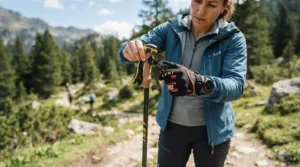
Getting nordic walking poles home is the easy part; setting them up correctly is where most beginners quietly go wrong. Start with length: stand upright, plant a pole vertically beside your foot, and your elbow should sit at roughly a 90-degree angle when gripping the handle — too long and you’ll overreach on the push-off, too short and you’ll hunch. Thread your hand up through the strap glove system from underneath before gripping the handle, not the other way round, so the strap sits against your palm and transfers push-off force through the strap rather than your fingers alone. In week one, focus purely on the diagonal walking pattern — right pole forward with left foot, left pole forward with right foot — before worrying about power or speed. Most instructors recommend two to three short sessions in the first fortnight purely on technique, letting the elbow-extension habit bed in before adding pace.
Maintenance is minimal but not nonexistent. Rubber walking tips wear unevenly if you favour one side on cambered pavements, so rotate or replace them every few hundred kilometres rather than waiting until they’re bald. Telescopic locking collars benefit from an occasional wipe-down to stop grit building up inside the mechanism, and carbon shafts should never be stored bent against a wall for months at a time, since sustained pressure can create a slow-forming stress point. A common first-30-days mistake is gripping the handle too tightly throughout the stride instead of releasing the hand at the back of the swing — this single habit shift is usually what separates people who feel the upper-body workout from those who don’t.

Real-World Nordic Walking Scenarios: Which Poles Suit You?
Picture three walkers. First, a 34-year-old office worker squeezing in 25 minutes over lunch, three times a week, on flat pavement near their workplace — budget matters, portability doesn’t, and the Swix CT4 Nordic Walking Poles fit neatly, offering the quick-release strap needed for grabbing a coffee without fumbling with poles. Second, a 61-year-old recently retired walker easing back into fitness after a hip replacement, attending a weekly instructor-led group session — here the LEKI Instructor Lite shines precisely because instructors already teach with this pole family, meaning any borrowed guidance and group technique tips translate directly. Third, a 28-year-old who nordic walks at home but also travels for work three weekends a month and refuses to let a hotel gym substitute for an outdoor walk — the LEKI Traveller Carbon‘s fold-to-suitcase design earns its premium here specifically because the alternative is not walking at all.
None of these profiles are about spending more or less for its own sake — they’re about matching pole characteristics to how often, where, and under what constraints someone actually walks. A brilliant travel pole wasted on someone who never leaves their local park is money spent solving a problem they don’t have.
How to Choose Nordic Walking Poles: 7 Steps to Get It Right
- Confirm your height bracket first. Nearly every sizing error traces back to skipping this step — measure or use a manufacturer’s height chart before comparing features.
- Decide fixed-length or telescopic. Fixed-length poles are lighter and more rigid; telescopic poles suit shared households or uncertain beginners.
- Check the strap glove system type. Trigger-release systems (LEKI, some Swix) suit technique-focused walkers; Velcro systems are cheaper but slower to detach.
- Weigh material against budget. Full carbon cuts swing weight noticeably but costs more and tolerates knocks less gracefully than aluminium.
- Consider rubber walking tips separately from the shaft. Cheap tips wear fast regardless of how good the pole itself is — check replacement tip availability before buying.
- Think about storage and travel needs honestly. Folding poles cost more; only pay for that if you genuinely need the packability.
- Read aggregated review sentiment, not star ratings alone. A 4.5-star average tells you little; recurring specific complaints (locking collars, strap comfort) tell you much more.
Nordic Walking Poles vs Standard Trekking Poles
It’s a common mix-up, and an understandable one, because both look like a stick with a strap. The core difference is technique-driven: standard trekking poles are typically adjustable and used for stability on uneven or steep terrain, planted more vertically and used passively for balance support. Nordic walking poles are angled backward during the push-off, actively propelling you forward and engaging shoulders, triceps and core in the process — which is precisely why the technique burns noticeably more energy than a standard hike with poles used purely for balance. The strap glove system also differs meaningfully: trekking pole straps are looser, designed to be released quickly on steep descents, while nordic walking straps are snugger, designed to transfer push force without slipping. Trekking poles usually carry a wider, snow-capable basket near the tip; nordic walking poles favour the smaller, pavement-friendly rubber walking tips covered earlier in this guide. If your walks are mostly flat and rhythmic, nordic poles win; if you’re regularly tackling scree or steep descents, standard trekking poles remain the better tool for the job.
Common Mistakes When Buying Nordic Walking Poles
The single most frequent mistake is buying based on price alone without checking height compatibility — a bargain pole that’s the wrong length will actively work against good technique rather than support it. A close second is assuming any walking pole will do; genuine nordic walking poles with straps and the angled push-off tip geometry behave differently from generic hiking poles rebadged for the nordic market. Buyers also frequently overlook replacement tip availability, only discovering months later that their specific pole’s rubber walking tips aren’t sold separately, forcing a full replacement purchase. Finally, many first-time buyers skip a strap-fit check entirely — strap glove systems vary in hand-size ranges between brands, and a strap that’s slightly too large or small undermines the entire push-off mechanic the technique relies on.

Nordic Walking Poles for Beginners, Seniors and Fitness Walkers
Beginners generally do best with telescopic aluminium or budget carbon poles — forgiving of technique errors and knocks while the fundamentals bed in — making options like the TheFitLife Nordic Walking Poles or Gipfelsport Carbon Nordic Walking Poles sensible starting points. Senior walkers, particularly those managing joint conditions or returning to activity after injury, often benefit most from instructor-taught technique using poles like the LEKI Instructor Lite, since correct hand-release reduces strain on wrists and shoulders that a white-knuckle grip would otherwise aggravate. One NHS foundation trust’s staff wellbeing initiative noted that because exercise intensity in nordic walking is determined by upper body effort, people of differing fitness levels can walk and talk together while working to their own level, and the activity is appropriate for rehabilitation and improving general health and wellbeing — a genuinely useful property for mixed-ability walking groups. Committed fitness walkers chasing measurable cardiovascular fitness gains tend to gravitate toward lighter full-carbon options like the Swix Sonic Carbon, where reduced swing weight allows a faster, more sustained rhythm across longer distances.
Long-Term Cost & Maintenance
A £35 pair of telescopic aluminium poles and a £170 folding carbon pair can end up costing surprisingly similar amounts over three years once you factor in replacement parts. Budget poles need rubber walking tips replaced more frequently — often every few months for a regular walker — at roughly £8-£12 per set, and their straps tend to fray sooner under regular use. Premium poles cost more upfront but typically hold their tips and straps longer, and brands like LEKI sell spare parts individually rather than forcing a full pole replacement, which meaningfully lowers total cost of ownership for anyone walking multiple times a week. The practical takeaway: if you’re walking once a fortnight, a budget pole’s higher replacement frequency barely registers financially; if you’re out most days, the maths tips toward paying more upfront for a pole with better-supported spare parts.
Rubber Tips, Straps and the Strap-Glove System Explained
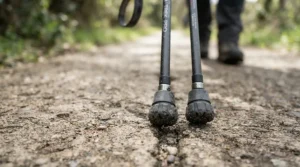
Two small components do most of the unglamorous work on any nordic walking pole, and both are worth understanding before you buy. Rubber walking tips slip over the metal spike beneath the pole and exist specifically for pavement, tarmac and hard-packed trail use — without them, the bare metal tip would skid unpredictably on hard surfaces and wear down fast on concrete. Cheaper tips use a softer rubber compound that grips well initially but wears faster; premium tips like LEKI’s Powergrip Pad use a vulcanised compound engineered specifically for durability on asphalt. The strap glove system, meanwhile, is what actually makes nordic walking technique possible at all — by wrapping around the back of the hand rather than just the wrist, it lets you open your fingers fully during the push-off phase while the strap continues transferring force through the pole, rather than your grip doing all the work. Poorly fitted straps are one of the most common reasons beginners report sore wrists after their first few sessions, so trying a strap on before committing — or checking a retailer’s sizing chart carefully — is worth the extra five minutes.
Safety, Technique and UK Regulations Guide
Nordic walking carries a low injury risk compared with most fitness activities, but a few sensible habits reduce it further. Always check rubber walking tips before heading out in wet weather — a worn tip on rain-slicked pavement is the single biggest slip risk associated with the activity. If you’re walking near roads at dawn or dusk, reflective detailing on the shaft (several poles in this guide, including budget models, include this) genuinely improves visibility to drivers. There’s no specific UK regulation governing nordic walking pole use on public footpaths, though most parks and towpaths treat them the same as standard walking sticks, and some managed trails ask walkers to use rubber tips rather than bare metal spikes to protect boardwalks and historic surfaces — worth checking local signage if you’re walking somewhere unfamiliar. For anyone managing an existing joint or cardiovascular condition, it’s sensible to get a quick note of approval from a GP or physiotherapist before starting, since while nordic walking is broadly low-impact, the increased effort compared with ordinary walking is real and worth clearing first if you have underlying health concerns.
Frequently Asked Questions
❓ What's the difference between nordic walking poles and normal trekking poles?
❓ How do I know what length nordic walking poles I need?
❓ Do rubber walking tips need replacing often?
❓ Are cheap nordic walking poles worth buying for beginners?
❓ Can nordic walking poles improve cardiovascular fitness?
Conclusion
Nordic walking poles are one of those rare fitness purchases where the “right” answer genuinely depends on how, where and how often you plan to walk, rather than which pole scores highest on a spec sheet in isolation. Beginners lose nothing by starting with a budget telescopic pair like the TheFitLife Nordic Walking Poles or the carbon-composite Gipfelsport Carbon Nordic Walking Poles, while committed walkers chasing technique and cardiovascular fitness gains will likely feel the difference a lighter, trigger-strapped pole like the LEKI Instructor Lite or Swix Sonic Carbon makes over months of regular use. Frequent travellers have a clear answer in the LEKI Traveller Carbon, and anyone commuting poles daily should look hard at the Komperdell C3 Carbon Compact‘s fold-to-bag ratio. Whichever you choose, the poles themselves are only half the equation — pairing them with correct technique, a properly fitted strap glove system, and rubber walking tips suited to your usual terrain is what actually turns a stick with a handle into a genuine full-body workout.
Recommended for You
- Nordic Walking Poles For Beginners: 7 Best Picks (2026)
- Hiking Poles For Bad Knees: 7 Best Picks to Try In 2026
- Trekking Poles For Arthritis: 7 Best Picks For Sore Joints (2026)
Disclaimer: This article contains affiliate links. As an Amazon Associate, I earn from qualifying purchases. If you purchase products through these links, we may earn a small commission at no additional cost to you.
✨ Found this helpful? Share it with your friends! 💬🤗
