In This Article
There’s a particular kind of embarrassment that comes with turning up to your first nordic walking session holding what everyone else instantly clocks as hiking poles. Wrong grip, wrong strap, wrong angle — and suddenly a lovely walk in the park feels like a PE lesson you didn’t revise for. If you’ve typed nordic walking poles for beginners into a search bar tonight, you’re probably trying to avoid exactly that scene, and good news: it’s an easy problem to solve once you know what separates a proper set of poles from a garden-variety trekking stick.

Nordic walking uses two poles with angled rubber tips and a specific strap system to turn an ordinary stroll into a full-body workout, engaging your arms, shoulders, back and core alongside your legs. The poles you choose matter more than most beginners expect, because the wrong strap or grip can wreck your technique before you’ve even learned it. Over the next few thousand words, we’ll walk through seven real, currently available options across every budget, unpack what actually makes a pole beginner-friendly, and get into the technique, groups and gear questions that come up in the first few months. Let’s get your hands on the right kit.
What Are Nordic Walking Poles for Beginners?
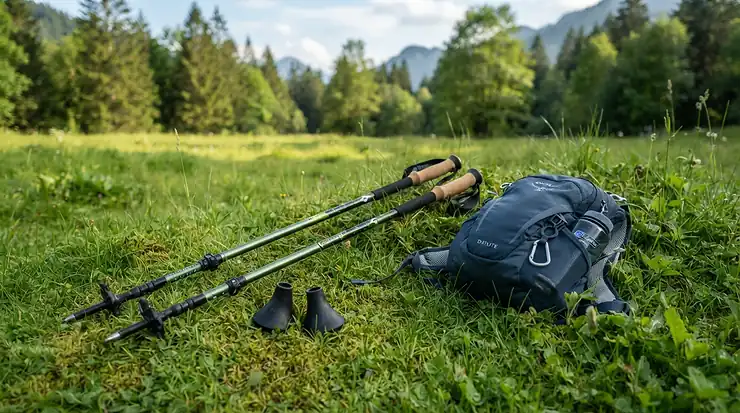
Nordic walking poles for beginners are adjustable, lightweight walking poles fitted with angled rubber “asphalt paws,” ergonomic grips and a glove-style strap system, designed to be planted diagonally behind the body to propel a walker forward. Unlike hiking poles, which are pushed downward for stability on rough ground, nordic poles are used with a pushing-back motion that activates the upper body. According to cardiologist Aaron Baggish, adding poles engages 80 to 90 percent of the body’s muscles compared with roughly 50 percent for ordinary walking, which is the whole point of learning proper technique from day one.
Quick Comparison Table
| Pole | Best For | Weight (per pole) | Material | Price Range |
|---|---|---|---|---|
| Leki Instructor Lite | All-round daily walkers wanting premium feel | ~198g | Aluminium/carbon hybrid | £110-£140 range |
| Urban Poling ACTIVATOR2 | Stability, balance and rehab-conscious beginners | ~300g | Aluminium | £70-£90 range |
| Gipfelsport Nordic Walking Poles | First-timers wanting a complete starter kit | ~230g | Carbon/aluminium | Around £35 |
| Fizan NW Speed | Lightest swing weight on a budget | ~180g | Aluminium 7075 | £60-£75 range |
| Foxelli Carbon Fibre Walking Poles | Shock absorption on hard pavements | ~210g | Carbon fibre | £35-£50 range |
| York Nordic Motivator | Cautious beginners prioritising confidence | ~250g | Aluminium | £35-£50 range |
| BISINNA Carbon Fibre Trekking Poles | Tightest budgets wanting real carbon | ~240g | Carbon fibre | Under £30 |
Looking at the table, the spread here isn’t about one pole being objectively “best” — it’s about matching the pole to what’s actually holding you back as a beginner. If cost is the barrier, the BISINNA Carbon Fibre Trekking Poles and Gipfelsport Nordic Walking Poles get you moving for under £40 without meaningfully compromising the core nordic walking mechanics. If confidence and joint support are the priority, the Urban Poling ACTIVATOR2‘s stability-first design is worth the extra spend. And if you already know nordic walking is for you and simply want the nicest possible daily-use pole, the Leki Instructor Lite justifies its price with genuinely better strap ergonomics.
💬 Found a pair that jumps out already? Bookmark this page and share it with a walking buddy who’s on the fence too!
Top 7 Nordic Walking Poles for Beginners: Expert Analysis
Choosing between seven very similar-looking pairs of sticks is harder than it should be, so here’s the honest breakdown — real specs, genuine aggregated review sentiment where it exists, and who each pole actually suits.
1. Leki Instructor Lite — lightest all-round pole for daily walks
The standout here is the hybrid shaft: an aluminium upper section bonded to a carbon-fibre lower section, which keeps the swing weight down without the fragility some carbon-only poles bring to kerbs and cobbles. Specs-wise, you’re looking at roughly 198 grams per pole, a Speed Lock 2 Plus cam mechanism that adjusts length between 100 and 125cm in seconds, and the Nordic Shark grip-strap system with a breathable mesh glove that clicks in and out for quick breaks.
In practice, that low swing weight matters more than it sounds — a heavier pole tip forces your wrist to work harder on every single pole plant, and over a 45-minute walk that adds up to real fatigue in your forearms. This is the pole for someone who’s already decided nordic walking is sticking around and wants kit that won’t need replacing in a year.
Reviewers consistently report that the strap mechanism is unusually easy to attach and detach one-handed, and that the poles feel noticeably lighter in use than their aluminium-only alternatives, though the length markings are spaced in 5cm increments, so dialling in your exact height takes a bit of trial and error on your first outing.
Pros:
- ✅ Hybrid aluminium-carbon shaft cuts swing weight noticeably
- ✅ Trigger Shark strap detaches in one click for breaks
- ✅ Speed Lock 2 Plus adjusts length in seconds, holds firm
Cons:
- ❌ Sits at the premium end for a first-time buyer
- ❌ 5cm length increments mean some estimation when fitting
At around £110-£140, this isn’t the obvious first purchase, but if you’ve already tried a taster session and know you’ll walk three times a week for years, the value verdict tips in its favour.

2. Urban Poling ACTIVATOR2 — best for stability and balance confidence
What sets this pole apart on the heading alone is the CoreGrip handle, designed by an occupational therapist specifically to engage core muscles and support a neutral wrist position rather than the pinch-grip glove found on most nordic poles. The poles weigh about 655g per pair, adjust across a genuinely wide range for users from 4’2″ to 6’4″, and use a button-locking system rather than a cam or twist lock, which resists loosening over repeated use in a way lever locks sometimes don’t.
Based on the spec comparison, this is the pole to reach for if your hesitation about nordic walking isn’t fitness but confidence — a wobbly first few sessions on uneven pavement can put people off for good, and the wider bell-shaped tips here are built to prevent exactly that kind of stumble.
There are currently 19 independent studies on these poles conducted at hospitals and universities in Canada, alongside the Royal Orthopaedic Hospital in London, largely focused on rehabilitation and mobility support rather than pure fitness walking. Genuine user feedback repeatedly praises the sturdiness and the width of the rubber base, though it’s worth noting the strapless grip design trades some of the propulsion power that glove-strap systems offer for that extra security.
Pros:
- ✅ CoreGrip handle reduces wrist strain, no glove strap needed
- ✅ Button-lock system resists loosening over time
- ✅ Backed by independent rehab and stability research
Cons:
- ❌ Heavier than most dedicated nordic-specific poles
- ❌ Strapless design means slightly less forward propulsion
Priced in the £70-£90 range, this is the pole worth the premium if balance, not fitness level, is what’s holding you back from starting.
3. Gipfelsport Nordic Walking Poles — best budget starter set with eBook guide
This one earns its spot through sheer completeness for a beginner: shock-resistant carbon-aluminium construction, a round metal push-off tip that specifically assists arm movement for people still learning the motion, and — unusually for this price point — a free digital guide included to walk you through the basics before your first outing.
What most buyers overlook about a starter set like this is that the accessory kit matters as much as the shaft material; Gipfelsport bundles multiple tip and basket options for different terrain, meaning you’re not immediately shopping for add-ons the way you would with a bare-bones pole. The ergonomic handles are designed to manage moisture and prevent wrist strain, which is a common early pain point when someone grips too tightly out of nervousness.
Aggregated reviews describe the poles as lightweight yet sturdy across mixed terrain including mud, gravel and asphalt, with the main recurring niggle being that the length-lock screws benefit from an occasional check and re-tighten after the first few walks.
Pros:
- ✅ Complete starter kit with multiple terrain tips included
- ✅ Round push-off tip specifically aids beginner arm movement
- ✅ Genuinely affordable without feeling like a toy
Cons:
- ❌ Lock screws need periodic re-tightening early on
- ❌ Heavier feel than the premium carbon-hybrid options
At around £30-£40, this is arguably the single best value starter nordic walking pole set on this list for someone who isn’t yet sure how often they’ll use them.
4. Fizan NW Speed — lightest aluminium poles for effortless swing
Fizan has been making aluminium poles since 1947, and the NW Speed shows that heritage — these are a two-part pole adjustable from 75cm to 125cm, built from Alu 7075 alloy with e-basket carbide tips and a Nordic-specific rubber tip protector for pavement work. The standout feature is weight: Fizan’s Compact range is independently verified at around 169g per pole, among the lightest aluminium poles tested by outdoor gear reviewers, which on paper means less arm fatigue over a longer session than heavier steel-tipped alternatives.
Here’s what to weigh up: aluminium is generally more durable and cheaper to produce than carbon, so you’re getting a genuinely premium-feel swing weight without paying carbon-fibre prices, though it won’t quite match full carbon for vibration dampening on harder impacts. The twist-lock adjustment and reflective strap insert are small but sensible touches for anyone walking at dusk during the darker months.
Independent testers have logged these poles for thousands of miles with reports of continued solid performance, which speaks well to long-term durability for a beginner who’ll be putting in regular short walks rather than occasional long hikes.
Pros:
- ✅ Among the lightest aluminium poles independently tested
- ✅ Twist-lock system holds length without slipping
- ✅ Reflective strap insert improves visibility in low light
Cons:
- ❌ Twist locks can be fiddlier to adjust than lever locks
- ❌ Narrower length range than some rivals (75-125cm)
In the £60-£75 range, this suits a beginner who’s decided weight matters more to them than having every accessory bundled in.
5. Foxelli Carbon Fibre Walking Poles — best shock-absorbing carbon pick
The headline feature is right there in the name: full carbon-fibre construction paired with natural cork grips, which on paper means better vibration absorption when your pole tip lands on unforgiving pavement, kerbs or gravel paths — a genuine consideration if your regular walking route is mostly hard urban surfaces rather than soft trail. Cork grips have a practical advantage too, wicking moisture away from sweaty palms far better than foam or rubber, so your hands stay drier on warmer days.
The flip-lock adjustment mechanism is designed for quick, tool-free length changes, and the poles come with a full set of four-season accessories — snow baskets, mud baskets and rubber tips — which is useful if you plan to keep walking through a British winter rather than packing the poles away at the first frost.
What most buyers overlook about carbon poles generally is that while they’re lighter and better at damping shock, they’re less forgiving of a hard sideways knock than aluminium, so they suit smooth pavement walkers better than anyone regularly crossing rocky, uneven ground.
Pros:
- ✅ Full carbon shaft absorbs shock well on hard pavement
- ✅ Cork grips manage sweat better than foam alternatives
- ✅ Four-season accessory set included as standard
Cons:
- ❌ Carbon shafts are less impact-tolerant than aluminium
- ❌ Flip-lock clamps need occasional tension checks
At £35-£50, this is a strong pick for the beginner whose walking route is mostly high street pavements and local parks rather than muddy trails.
6. York Nordic Motivator — best for cautious first-time walkers
York Nordic built the Motivator around patented stability grips, and it’s a genuinely wide-fitting pole, adjustable for users from 4’6″ up to 6’2″ with flip-lock adjustment across a two-piece design. The name is on the nose but accurate: this is a pole engineered for people who need a confidence nudge rather than a serious athlete’s tool.
What the spec sheet won’t tell you outright, but the design choices suggest, is that York Nordic is squarely targeting the same market as Urban Poling — walkers who are older, recovering from an injury, or simply new to using poles at all and worried about looking unsteady. The flip-lock system is a sensible middle ground between a twist-lock’s fiddliness and a button-lock’s rigidity, giving quick adjustment without excessive looseness over time.
Because this brand sits in the same rehab-and-fitness-crossover space as Urban Poling but at a noticeably lower price point, it’s worth considering as the budget alternative for beginners who want that stability focus without the premium price tag.
Pros:
- ✅ Wide height range suits most adult users comfortably
- ✅ Flip-lock adjustment is quick without excessive give
- ✅ Stability-focused grip design aids nervous first-timers
Cons:
- ❌ Less well known than Leki or Urban Poling in the UK
- ❌ Heavier swing weight than the dedicated carbon options
In the £35-£50 range, this is the pole to consider if the Urban Poling ACTIVATOR2 appealed to you in principle but not at that price.
7. BISINNA Carbon Fibre Trekking Poles — most affordable true carbon option
The standout advantage on this one is straightforward: genuine carbon-fibre construction at a genuinely entry-level price, with cork handles, a quick-lock adjustment system and a claimed weight as low as 240g per pole depending on the size option chosen. Reinforced metal caps at the joints are a deliberate durability trade-off, adding a touch of weight back in exchange for reducing the risk of the classic carbon-pole failure point — a cracked or split joint after repeated flexing.
Based on the spec comparison against pricier carbon poles on this list, BISINNA is clearly optimised for cost rather than refinement; you won’t get the premium strap glove system of a Leki or the researched CoreGrip of an Urban Poling pole, but for someone testing the waters before committing to nordic walking as a regular habit, that’s a reasonable trade.
The brand offers multiple length ranges to fit different heights, and replaceable wrist straps mean you’re not forced to bin the whole pole when the strap eventually wears through.
Pros:
- ✅ Genuine carbon fibre at a genuinely budget price point
- ✅ Reinforced metal joint caps add durability
- ✅ Replaceable wrist straps extend the pole’s usable life
Cons:
- ❌ Basic strap system compared with premium nordic-specific poles
- ❌ Smaller UK review pool than more established brands
At under £30, this is the pole for a beginner who wants to trial nordic walking properly before investing more, without settling for the very cheapest, flimsiest option on the market.
How to Choose Nordic Walking Poles for Beginners
Picking a pole comes down to seven practical checks, in roughly this order of importance:
- Get the length right first. Your elbow should sit at close to a 90-degree angle when the pole tip touches the ground beside your foot — as a rough guide, multiply your height in centimetres by 0.68 to land near the correct pole length, then fine-tune from there.
- Choose an adjustable pole over a fixed one as a beginner. You don’t yet know your exact optimal length or how your technique will evolve, and an adjustable shaft lets you experiment without buying twice.
- Prioritise the strap system over the shaft material. A proper glove-style strap that lets you open your hand fully during the push-back motion teaches correct technique faster than any amount of carbon fibre.
- Weigh up carbon versus aluminium honestly. Carbon is lighter and dampens vibration better; aluminium is more durable and forgives careless knocks — for pavement-heavy beginners, either works, but budget aluminium is the safer first purchase.
- Check the tip type included. You want a rubber “asphalt paw” tip for pavement and a removable carbide tip for grass, gravel or trail use, ideally both included in the box.
- Factor in your typical terrain. A wider, more stable pole suits parkland and pavement; if you’ll mix in coastal paths or hillier trails, a slightly more rugged aluminium build holds up better.
- Read the aggregated review sentiment before the star rating. A 4.6-star average tells you little; recurring comments about strap comfort or lock reliability tell you a great deal more about how the pole performs after week three, not just day one.
Nordic Walking Technique Basics for Beginners
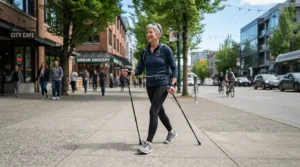
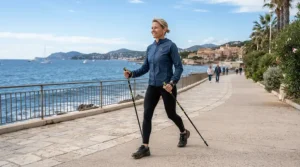
Here’s the part most new walkers skip past, and it’s the single biggest reason people give up on nordic walking within the first fortnight: the poles aren’t meant to go in front of you like a walking stick. The pole plants diagonally behind the body, roughly level with your back foot, at about a 45-degree angle, and the motion is a push-back, not a poke-forward. As your right leg steps forward, your left arm swings forward too — opposite arm to opposite leg, exactly as it does in ordinary walking, just with more deliberate engagement.
The trickiest habit to unlearn is gripping the pole tightly throughout the stride. Proper nordic walking technique means opening your hand at the end of each push, letting the strap take the weight momentarily before your fingers close around the grip again for the next plant. This is what activates the triceps, shoulders and upper back rather than just the forearm, and it’s also precisely why the strap system on your poles matters so much — a poor strap makes this open-hand motion awkward or impossible, which quietly undermines the whole point of using poles in the first place.
Most beginners notice a real improvement within their first session or two of focused practice. A sensible progression is to walk normally for the first few minutes with the poles simply dragging loosely behind you, get comfortable with your natural rhythm, then consciously add the plant-and-push motion once your stride feels settled. Rushing straight into an aggressive push before your coordination catches up is the most common beginner mistake, and it’s usually what leads to sore shoulders rather than the intended full-body benefit.
Easy to Use Nordic Walking Poles: Features That Actually Matter
Marketing copy loves the word “easy,” but a handful of specific features genuinely make a pole easier for a beginner to pick up and use correctly, while plenty of advertised extras add little beyond a higher price tag.
Features that matter: an intuitive lock mechanism you can adjust one-handed without a manual is worth paying for, because you’ll be re-checking length in your first few sessions as you dial in the right fit. A proper glove-style strap rather than a simple loop strap matters enormously, since it’s the mechanism that teaches correct open-hand technique. Lightweight construction in the 180-260g per pole range reduces the arm fatigue that puts beginners off continuing past week one. And a rubber “asphalt paw” tip designed specifically for pavement — angled rather than flat — gives a quieter, more secure plant on hard urban surfaces than a generic trekking-pole rubber cap.
Features that don’t matter much for a beginner: ultra-premium shock-absorbing springs found on some high-end trekking poles are largely wasted on nordic walking’s gentler plant angle. Extremely long adjustment ranges beyond what your own height requires just add unnecessary shaft weight. And elaborate camouflage or fashion colourways obviously make zero difference to performance, however nice they look in the box.
The spec sheet won’t tell you this outright, but reviewers across nearly every pole in this comparison converge on the same theme: strap comfort and lock reliability, not headline weight figures, are what determine whether someone still uses their poles six months later.
Starter Nordic Walking Pole Set: A Practical Usage Guide
Getting the setup right in your first month prevents most of the common early frustrations, and it takes less effort than people expect.
Setting up for the first time: stand upright, hold the pole vertically with your elbow bent at roughly 90 degrees, and adjust the length so the tip touches the ground comfortably in that position — most adjustable poles include printed height charts as a starting reference point. Attach the strap so your hand slides in like putting on a glove, with the strap sitting snugly against your palm rather than loose around your wrist.
Your first thirty days: aim for three short sessions a week of 20-30 minutes rather than one long, exhausting walk, since technique improves through frequency far more than duration at this stage. Walk the first five minutes of every session without actively pushing on the poles, just letting your natural rhythm settle, before layering in the deliberate push-back motion. Expect some shoulder or upper-back stiffness in week one — that’s the muscle engagement working as intended, not a sign you’re doing it wrong, provided it eases within a day or two.
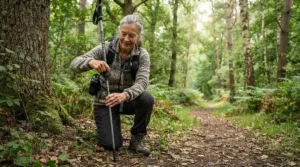
Maintenance that’s easy to skip but shouldn’t be: check your lock mechanism’s tightness every few sessions, since twist-locks and even cam locks can loosen slightly with repeated use. Rinse mud off tips after wetter walks and let the poles dry fully before storing them, particularly for aluminium models, to avoid corrosion at the joints. Swap worn rubber tips before they wear through completely — most brands sell replacement tips separately, and a bald tip loses grip on wet pavement precisely when you need it most.
Common early mistakes to avoid: setting the poles too long, which forces an awkward high-elbow posture; gripping too tightly throughout the stride instead of opening the hand on the push-back; and walking with the poles planted alongside the feet rather than diagonally behind, which turns nordic walking into little more than carrying two sticks for no benefit.
Nordic Walking for Beginners: Real-World Scenarios
Seeing how different beginners actually approach this helps more than another spec table, so here are three realistic profiles matched to the poles above.
The retired commuter walker, budget-conscious, walking local parkland three times a week: someone in this position doesn’t need premium carbon or rehab-grade stability features — a set like the Gipfelsport Nordic Walking Poles or BISINNA Carbon Fibre Trekking Poles covers the fundamentals affordably, and the included guide or lighter carbon build respectively suits gentle, regular use without over-spending on a hobby that’s still being tested.
The office worker recovering from a knee niggle, walking daily on hard pavement at lunchtime: for this scenario, joint support and pavement performance both matter, which points toward the Urban Poling ACTIVATOR2 for its stability-focused CoreGrip design, or the Foxelli Carbon Fibre Walking Poles for their shock-absorbing carbon shaft on unforgiving concrete.
The enthusiastic newcomer who’s already joined a local nordic walking class and knows this is a long-term habit: here it makes sense to invest a little more upfront, and the Leki Instructor Lite‘s refined strap system and low swing weight will genuinely reward someone walking several times a week for years rather than months.
Beginner Fitness Walking: Common Mistakes When Buying Poles
A handful of buying mistakes crop up repeatedly among first-time nordic walkers, and they’re worth flagging before you click purchase.
Buying fixed-length poles before you know your correct height. It’s tempting because fixed poles are cheaper and marginally lighter, but if you get the length even slightly wrong as a beginner, you’ll either need to buy again or persist with poor technique.
Choosing generic trekking poles instead of nordic-specific ones. Trekking poles are designed to be planted in front of or beside the body for stability on descents, which is the opposite mechanic to nordic walking’s behind-the-body push. Nordic walking poles are specifically designed to support a coordinated diagonal movement — opposite arm to opposite leg — creating a more active walking experience that trekking poles simply aren’t built for.
Underestimating how much the strap system matters. Buyers fixate on shaft material and weight, but a poor strap undermines technique more than a slightly heavier shaft ever will.
Ignoring the return policy on a first purchase. Beginner fitness walking gear is exactly the category where trying before fully committing makes sense — buy from a retailer with a sensible returns window in case the fit or feel isn’t right.
Assuming more expensive automatically means better for a beginner. Several of the mid-priced poles on this list outperform pricier alternatives specifically for first-time users, because beginner-friendly features like a wide adjustment range and forgiving grip matter more early on than ultralight carbon.
Nordic Walking Poles vs Regular Trekking Poles
| Factor | Nordic Walking Poles | Trekking Poles |
|---|---|---|
| Pole plant position | Diagonally behind the body | In front of or beside the body |
| Primary purpose | Propulsion, upper-body engagement | Stability, balance on uneven ground |
| Strap style | Glove-style, open-hand release | Simple wrist loop |
| Tip type | Angled rubber “asphalt paw” | Flat rubber or carbide spike |
| Best For | Beginner Nordic Walking Poles (fitness walking, flat terrain) | Trekking Poles (hiking, hills, uneven trails) |
The distinction genuinely matters for a beginner, not just as pedantic terminology. Because trekking poles are engineered for a downward stability push rather than a backward propulsion push, using them for nordic walking technique tends to encourage exactly the wrong habits — planting too far forward, gripping too tightly, and missing the arm-swing engagement that delivers nordic walking’s calorie and muscle-activation benefits in the first place. A peer-reviewed systematic review published in the American Journal of Preventive Medicine found nordic walking produces measurable benefits to resting heart rate, blood pressure and exercise capacity across a wide range of populations, benefits that are specifically tied to the correct pole technique rather than simply holding sticks while you walk.
Local Walking Groups: Finding Your Nordic Walking Community
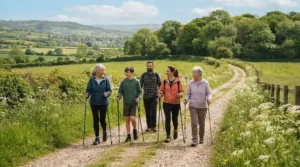
Buying the right poles solves half the problem; learning to use them properly solves the other half, and for most beginners, that second half is genuinely easier with company. Nordic walking is a naturally sociable activity — group sessions are typically paced so no one gets left behind, and instructors can spot and correct small technique errors far faster than you’ll catch them yourself in a mirror.
British Nordic Walking is the UK’s official representative of the International Nordic Walking Association, and its instructor network runs taster sessions and ongoing local groups across the country using a consistent, internationally recognised teaching method. Most instructors provide loan poles for an introductory session, which is a sensible way to test the technique before committing to a purchase at all. Community-run groups have also become part of the NHS’s growing social prescribing approach, connecting people to activities like nordic walking as a genuine alternative or complement to medical treatment for a range of long-term conditions.
If a formal class isn’t your style, informal local walking groups organised through community centres, parkrun-adjacent networks or local Facebook groups are widespread across UK towns and cities, and they solve the single biggest problem beginners report: motivation drops off fast when walking alone, but rarely does when there’s a weekly group waiting for you.
Safety, Long-Term Cost and Maintenance
Nordic walking has a strong safety record precisely because it reduces rather than adds physical strain when done correctly — the poles take a measurable share of the load off your hips, knees and lower back, particularly on descents, where research has recorded meaningfully reduced shear forces at the knee joint compared with ordinary walking. That said, a few sensible precautions apply: always fit tip protectors when transitioning between pavement and grass to avoid slipping on hard surfaces, replace worn rubber tips before they lose grip entirely, and if you have an existing joint condition or are recovering from surgery, it’s worth a quick conversation with your GP or physiotherapist before starting, as the NHS notes in its own guidance on nordic walking.
On long-term cost, the maths generally favours spending a little more upfront if you know you’ll stick with it. A £30 budget pole that needs replacing within a year because a lock mechanism fails costs more over three years than a £70 pole built to last five. Carbon shafts typically last longer under normal use than the very cheapest aluminium, provided they’re not subjected to hard sideways impacts, while premium lock systems like Leki’s Speed Lock rarely fail before the shaft itself does. Replacement tips, the first component to wear on any pole, are inexpensive and widely available regardless of which brand you choose, so factor a small annual accessory cost into your budget rather than treating the initial purchase as the only outlay.
Frequently Asked Questions
❓ What length nordic walking poles do I need as a beginner?
❓ Are carbon or aluminium poles better for beginners?
❓ How many times a week should a beginner do nordic walking?
❓ Can nordic walking poles be used as regular trekking poles?
❓ Do I need to join a class to learn nordic walking technique?
Conclusion
Nordic walking poles for beginners don’t need to be complicated or expensive to get right — they need to fit your height, use a proper glove-style strap, and suit the terrain you’ll actually be walking on most weeks. Whether that’s the budget-friendly completeness of the Gipfelsport Nordic Walking Poles, the stability-first design of the Urban Poling ACTIVATOR2, or the refined, lightweight feel of the Leki Instructor Lite for someone already sold on the habit, the honest answer is that any of the seven poles covered here will get you started properly, provided you pair them with a bit of patience on technique.
What tends to separate people who stick with nordic walking from those who quietly abandon it in a cupboard after a fortnight isn’t the pole brand — it’s whether they took the first few sessions slowly, focused on the push-back motion rather than speed, and ideally found a local group or instructor to iron out the early kinks. Get those two things right alongside a decent pair of poles, and there’s a genuinely enjoyable, low-impact, full-body habit waiting on the other side.
✨ Don’t Miss These Exclusive Picks!
🚶♀️ Take your nordic walking for beginners journey further with any of the seven poles compared above — click through to check current pricing and availability, and give your first proper walking-pole season the best possible start!
Recommended for You
- Hiking Poles For Bad Knees: 7 Best Picks to Try In 2026
- Trekking Poles For Arthritis: 7 Best Picks For Sore Joints (2026)
- Telescopic Trekking Poles For Seniors: 7 Best Easy-Grip Picks (2026)
Disclaimer: This article contains affiliate links. As an Amazon Associate, I earn from qualifying purchases. If you purchase products through these links, we may earn a small commission at no additional cost to you.
✨ Found this helpful? Share it with your friends! 💬🤗
