
In This Article
Telescopic trekking poles for seniors are height-adjustable walking poles whose sections slide inside one another and lock at a chosen length, usually with a lever or a twist mechanism. Paired with easy grips, dependable locks and a sensible weight, they widen your base of support, steady your balance and take load off ageing knees.
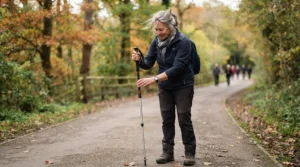
Here’s the thing nobody says out loud at the car park: the hardest part of a hill walk is rarely the climb. It’s the way down. Knees complain, ankles wobble, and a wet Pennine path turns into a skating rink. The NHS inform guidance on keeping active to prevent falls makes the broader point that staying strong and steady on your feet is the best long-term protection. A good pair of poles supports exactly that habit.
So what’s the catch? Choosing. The market is a thicket of jargon: FlickLock, speedlock, anti-shock, EVA, 7075 aluminium. Most guides are written for twenty-somethings chasing gram-shaving. This one starts from a different question: which poles will feel easy on your hands, your wrists and your budget?
A note on method. This guide rests on published specifications, aggregated customer feedback from UK retailers and independent buying guides, and honest reasoning about what the numbers mean in practice. It doesn’t rely on claimed personal testing. Where reliable review data was thin, I say so.
Along the way we’ll cover the lever lock mechanism versus the twist lock mechanism, the pole length adjustment range you actually need, and how a telescopic hiking pole compares with folding and walking-stick styles. If you’re shopping for adjustable trekking poles for seniors, the seven picks below cover budget, mid-range and premium.
Quick Comparison Table: 7 Telescopic Trekking Poles for Seniors at a Glance
Prices below are ranges from the time of research and may vary. Check the current price on Amazon.co.uk before you buy.
| Pole | Lock Type | Grip | Weight | Price Range | Best For |
|---|---|---|---|---|---|
| Trekmates Wanderer Lock | Lever | Push-down T-handle | ~400g each | Around £20-£25 each | First-time users, reduced hand strength |
| Mountain King Wayfarer Speedlock | Lever | Push-down T-handle | ~290g each | Around £25-£35 each | A lightweight walking-stick feel |
| Black Diamond Explorer 2 | FlickLock lever | EVA foam | ~600g per pair | £50-£60 range per pair | Best all-round value |
| Mountain King SuperTrekker Compact Speedlock | Lever | Extended EVA foam | ~290g each | £45-£55 range each | Joint cushioning on hard ground |
| Black Diamond Trail | Double FlickLock | EVA foam, extended section | ~650g per pair | £85-£100 range per pair | Durable step-up quality |
| Black Diamond Trail Cork | Double FlickLock | Natural cork | ~650g per pair | £100-£115 range per pair | Long-term hand comfort |
| Black Diamond Trail Vista FLZ | FlickLock, Z-fold | Cork, rubber and foam | ~520g per pair | £120-£135 range per pair | Travel and packability |
Look at the pattern in that table. Every pole uses a lever lock, which is no accident, as we’ll see shortly. The Black Diamond Explorer 2 delivers the strongest value at around £55 a pair, but if your knees are the priority, the Mountain King SuperTrekker Compact Speedlock justifies its extra cost with switchable shock absorption. Budget buyers should note that the Trekmates Wanderer Lock and Mountain King Wayfarer Speedlock are sold singly, so a matched pair costs double.
💬 Just one click — help others make better buying decisions too!😊
Top 7 Telescopic Trekking Poles for Seniors: Expert Analysis
1. Trekmates Wanderer Lock — the lowest-risk way to try poles
The lowest-cost pick here keeps things blissfully simple. A lever lock sits on a push-down T-handle, much like a traditional walking stick, and rubber ferrules come in the box for pavement use.
The T-handle is the clever bit for newcomers. If you’ve used a stick before, pressing down through the palm feels instinctive, with no strap technique to learn. The lever clips need far less squeeze than a twist collar, which matters if your grip has weakened. The 6061 aluminium is a softer alloy than the 7075 used in pricier poles, and at roughly 400g each it’s the heaviest of the seven. Expect to feel that after a long day, but not on a village stroll.
Reviewer feedback gathered by UK retailer Inglesport is striking for who’s buying. Owners with conditions such as MS, fibromyalgia and bad knees recommend it, and the lever clips get repeated praise. A common practical warning: the carbide tip can wear through the rubber ferrule quicker than you’d expect, so keep a spare.
Pros:
- ✅ Lever lock suits weaker hands
- ✅ Familiar push-down T-handle
- ✅ Rubber ferrules included for pavements
Cons:
- ❌ Heavier than the 7075 alternatives
- ❌ Ferrule wears out faster than expected
Around £20-£25 each at the time of research, which makes this a low-stakes trial. Two poles will cost roughly double, so factor that in.

2. Mountain King Wayfarer Speedlock — the lightest walking-stick style
Mountain King makes this one in Newcastle, and at about 290g it’s a featherweight stick built from 7075 aluminium. The speedlock lever adjusts in a second, and a tungsten carbide tip bites into rock and loose gravel.
What does that mean for a senior walker? A T-handle spreads pressure across the palm rather than making you clench a vertical grip, which many people with stiff fingers find kinder. On paper, it’s a single pole, so it suits canal paths, country lanes and village loops rather than full two-pole trekking technique. Think reliable third leg, not alpine machine.
I could not find a large verified review pool for this specific model, so treat the retailer’s positive framing with a pinch of salt. The specification, though, is strong for the money: lever lock, 7075 alloy, low weight and British manufacture.
Pros:
- ✅ Very light at roughly 290g
- ✅ Lever lock adjusts in seconds
- ✅ Tungsten carbide tip grips rock well
Cons:
- ❌ Sold as a single pole only
- ❌ No shock absorption for hard surfaces
Around £25-£35 each. Value verdict: excellent if one pole is enough, and it beats most twist-lock rivals at that price.
3. Black Diamond Explorer 2 — the best all-round value pair
Black Diamond’s FlickLock is the benchmark for easy adjustment. Flip the lever, slide to your height, flip it shut. The Black Diamond Explorer 2 wraps that in a two-section aluminium shaft, soft EVA foam grips and roughly 600g per pair.
Two sections mean fewer joints, and fewer joints mean a stiffer, more planted feel on a wet limestone path. That rigidity is reassuring when you’re leaning on the pole for balance. It also means a longer collapsed length than the three-section Black Diamond Explorer 3, so it won’t pack as small for suitcases.
Buyer feedback reported by Inglesport describes the dual-density foam grip as secure and the poles as coping with steep, rocky ground. The trade-off is weight compared with carbon poles, which most walkers on outings of a few hours won’t notice. There’s no anti-shock, so pavement walkers may want the SuperTrekker below.
Pros:
- ✅ FlickLock adjusts one-handed
- ✅ Rigid two-section shaft feels planted
- ✅ Sold as a matched pair
Cons:
- ❌ No shock absorption built in
- ❌ Longer collapsed length than three-section rivals
Around £50-£60 a pair. Value verdict: the safest recommendation for most people reading this.
4. Mountain King SuperTrekker Compact Speedlock — switchable anti-shock cushioning
This is the pick for anyone whose joints hate hard ground. A spring-loaded anti-shock system absorbs impact each time the tip strikes, and you can switch it off. That switch matters, because on climbs anti-shock can feel spongy and steal some of your push.
The pole adjusts from about 63cm to 120cm, so it suits a wide range of heights. It then folds to roughly 59cm, so it slips into a car boot or day bag. The EVA grip runs further down the shaft than usual, letting you grip low on steep bits without touching the lever. At about 290g each and made of 7075 aluminium, it’s light enough to swing all day.
Verified review data was limited, so I’m leaning on the specification rather than crowd sentiment. Sensibly, the price is per pole, so a pair lands around £90-£110.
Pros:
- ✅ Switchable anti-shock protects joints
- ✅ 63cm-120cm pole length adjustment range
- ✅ Extended grip for quick choking down
Cons:
- ❌ Sold individually, so pairs cost more
- ❌ Anti-shock feels spongy on climbs
Around £45-£55 each. Value verdict: worth the premium if you walk regularly on tarmac or compacted paths.
5. Black Diamond Trail — a tougher build with double FlickLock
Step up from the Explorer range and you get a lock on each joint, better straps and an extended foam section under the main grip. That extended section lets you shorten your hold on steep ground without stopping to adjust the pole.
Durability is the headline. Owners quoted by Inglesport describe years of use across scrambles and overseas treks, and report the aluminium standing up to drops and hard leaning. Some reviewers who switched from twist-lock poles say the FlickLock held its grip far longer. That’s a strong argument for the lever lock mechanism in general.
There are honest caveats. Foam grips don’t manage sweat as well as cork, so warm-day hands can get clammy. A couple of owners also found the strap adjuster slightly fiddly and prone to loosening, so tighten it before setting off.
Pros:
- ✅ Double FlickLock for extra security
- ✅ Very tough aluminium shaft
- ✅ Extended foam grip aids choking down
Cons:
- ❌ Foam grips can feel clammy when warm
- ❌ Strap adjuster can loosen if not tightened
Around £85-£100 a pair. Value verdict: a good long-term buy if you outgrow entry-level poles.
6. Black Diamond Trail Cork — natural cork that moulds to your hand
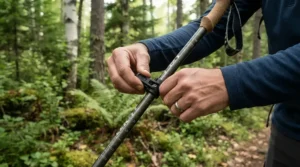
Same platform as the Black Diamond Trail, but with cork grips. Cork wicks moisture, stays comfortable in warm and cold weather, and gradually shapes itself to your palm.
Why does that matter for seniors? Repeated pressure on a hard-edged grip is a recipe for sore hands and, over a season, a pole you stop using. Cork is also said to pass on less vibration than foam, which helps on hard-packed tracks. It feels firmer at first, so give it a few walks before judging.
Specific review counts for this variant were thin, so the case rests on the shared Trail chassis plus the general reputation of cork. The cork option costs a little extra, and it earns that back if you’ll use the poles for years rather than months.
Pros:
- ✅ Cork wicks sweat and moulds to hands
- ✅ Double FlickLock security
- ✅ Tough aluminium shaft
Cons:
- ❌ Firmer feel out of the box
- ❌ Costs more than the foam version
Around £100-£115 a pair. Value verdict: the comfort upgrade for regular walkers.
7. Black Diamond Trail Vista FLZ — Z-fold packing with true adjustability
This is the hybrid of the bunch. Strictly, it folds in a Z rather than sliding telescopically, but it keeps a FlickLock so you can still dial in your height. Folded, it shrinks to about 36.5cm, small enough for a day-pack side pocket or airline hand luggage.
Most folding poles are fixed-length, so you must know your size before buying. This one adds around 15cm of on-the-fly adjustment, which helps on slopes. Grips blend cork inlays with rubber, plus an extended foam section below. Independent reports mention comfort across 15-20 mile days and a secure lock under a heavier hiker with a loaded pack.
The trade-off is weight, at around 520g a pair, and a much higher price than the telescopic options.
Pros:
- ✅ Folds to roughly 36.5cm
- ✅ FlickLock adjustment still available
- ✅ Cork and rubber hybrid grips
Cons:
- ❌ Costs far more than telescopic poles
- ❌ Adjustment range is narrower than a full telescopic pole
Around £120-£135 a pair. Value verdict: pricey, but ideal if you travel by train or plane to walk.
What to Expect: Real-World Performance
Numbers on a spec sheet are one thing. The reality on a steep descent is another.
A widely cited study in the Journal of Sports Sciences measured knee loads when eight men walked down a 25° ramp with and without poles. It reported reductions of roughly 12-25% in peak knee forces such as tibiofemoral compressive and shear forces when poles were used. That’s a small lab sample, so treat it as encouraging rather than definitive, and older or arthritic knees may respond differently.
In everyday terms, expect three things. First, a steadier feel on slippery or uneven ground because you have two extra contact points. Second, a more upright posture. Third, some arm and shoulder fatigue at first, because your upper body now works too. That last one surprises new users. Start with two or three short walks before attempting a long day.

Lever Lock Mechanism vs Twist Lock Mechanism: Which Suits Senior Hands?
If there’s one decision that separates a joyful pole from a frustrating one, it’s the lock. This section tackles the lever lock mechanism against the twist lock mechanism head-on.
How a lever lock mechanism works. An external clamp closes around the joint. Open the lever, slide the section, close it. Some have a small tension knob so you can tighten the grip a quarter-turn if it starts slipping. Independent testers in one long-running guide say all of their reviewers prefer lever locks, and they recommend metal levers over plastic ones for durability.
How a twist lock mechanism works. Rotating the sections in opposite directions expands a wedge or cam inside the tube. That creates friction that holds the length. Twist locks are neat and slim, and can be a touch lighter. But grit, moisture or cold can cause slip or sticking, they’re harder to operate with gloves, and there’s no visual confirmation that they’re tight.
For seniors, hand strength and dexterity are the deciding factors. If you have arthritis, wrist stiffness or reduced grip, a lever is far kinder.
| Feature | Lever Lock Mechanism | Twist Lock Mechanism |
|---|---|---|
| Speed of adjustment | Seconds, one hand | Slower, two hands |
| Hand strength needed | Low | Moderate to high |
| Gloves and cold | Generally easy | Can be awkward or unreliable |
| Visual confirmation | Lever closed = locked | Little to see |
| Field repair | Tension knob adjustment | Internal wedge, harder to fix |
| Best For | Black Diamond Explorer 2, Mountain King SuperTrekker Compact Speedlock | Strong-handed buyers on a tight budget |
The table shows why every pole in this guide uses a lever. Twist locks are cheaper and can be perfectly serviceable if your grip is strong, but they add friction to the moment you most want simplicity. If you’ve a choice between the two at a similar price, take the lever.
✨ Don’t Miss These Exclusive Deals!
🔍 Take your walking to the next level with these carefully selected poles. Click on any highlighted item to check current pricing and availability on Amazon.co.uk. These lever-lock picks will help you walk with steadier, more confident strides.
Pole Length Adjustment Range: Setting Your Poles Correctly
Let’s turn a spec into practical advice. The pole length adjustment range tells you the shortest and longest lengths a pole can reach. It matters for two reasons: your height, and the terrain.
Step 1: find your starting length. A commonly used rule of thumb is your height multiplied by about 0.68. A walker who is 170cm tall would start near 115cm. Treat that as a starting point, then adjust to feel.
Step 2: check the elbow angle. Stand with your upper arm at your side and your forearm level with the ground, holding the grip. Your elbow should sit at roughly 90 degrees. Slightly shorter is fine for hills.
Step 3: adjust for terrain. Lengthen by a few centimetres for descents, shorten a little for climbs. Extended foam grips, as on the Black Diamond Trail, let you grip lower on steep ground without touching the lever.
Step 4: test the lock. Press down firmly with body weight. If a section creeps, tighten the tension screw, then retest.
Step 5: write it down. Note your comfortable length so you can reset the poles after packing them away.
Check the range on the listing. The Mountain King SuperTrekker Compact Speedlock covers about 63cm-120cm, so it suits taller and shorter walkers alike, while the Black Diamond Trail Vista FLZ adjusts by only around 15cm on top of its folded set. Another widely sold example, the TrailBuddy poles, adjust from about 62cm to 137cm, and that shows how broad a good range can be. If you’re near either end of the height scale, always check the listing’s stated minimum and maximum.
How to Choose Adjustable Trekking Poles for Seniors
What is the best way to choose adjustable trekking poles for seniors? Prioritise a lever lock, a comfortable grip, moderate weight and a length range that fits your height. Then decide whether you want a pair or a single stick.
- Pick the lock first. Choose a lever lock unless you’re confident in your grip strength. It’s the single biggest factor in daily satisfaction.
- Match the grip to your hands. Foam is soft, cork moulds and wicks sweat, and a T-handle spreads pressure through the palm.
- Check the weight. Around 250-330g per pole is comfortable for most people, and heavier poles suit shorter outings.
- Confirm the length range. Make sure your ideal height falls comfortably inside the pole length adjustment range, not right at the edge.
- Decide on shock absorption. Anti-shock helps on tarmac and descents, and a switch lets you turn it off for climbs.
- Consider packing size. Three-section or folding poles fit cases and boots more easily.
- Set your budget honestly. Spend a little more if you’ll walk weekly.
Reasoning matters more than ticking boxes. A pole that you enjoy using gets used, and that’s where the joint and balance benefits come from.
Telescopic Hiking Pole vs Folding Pole vs Walking Stick
How does a telescopic hiking pole stack up against the alternatives? The answer depends on what you value.
A telescopic hiking pole slides in two or three sections and locks at any length. It’s the most adjustable, generally the cheapest, and easy to repair. The compromise is a longer packed length.
A folding Z-pole packs small and deploys fast, but many are fixed-length, so a wrong size is a costly mistake. Hybrids like the Black Diamond Trail Vista FLZ add adjustment, at a price. A traditional walking stick, including T-handle models like the Mountain King Wayfarer Speedlock, is simple and familiar but supports only one side.
| Type | Adjustability | Packability | Balance Support | Best For |
|---|---|---|---|---|
| Telescopic hiking pole | Excellent | Good | Excellent as a pair | Black Diamond Explorer 2 |
| Folding Z-pole | Limited or fixed | Excellent | Excellent as a pair | Black Diamond Trail Vista FLZ |
| Walking stick, single | Good | Fair | One side only | Trekmates Wanderer Lock |
Looking at the table, the telescopic option wins for most seniors because you can fine-tune length for slopes. If packing is a priority, the folding hybrid is worth its higher price. Walking sticks make sense for shorter, flatter outings, particularly if you already own one and like the feel.
Real-World Scenarios: Three Walkers, Three Pole Choices
The weekend Dales walker, 72, mild arthritis, budget around £100. Three hours on limestone paths, once a week. The lever lock and soft grip matter most. The Black Diamond Explorer 2 fits the budget with room to spare, and the leftover cash covers spare tips.
The cautious descender, 68, sore knees, regular tarmac walks. Cotswold Way stretches and pavements are punishing. Here the Mountain King SuperTrekker Compact Speedlock, bought as a pair for roughly £90-£110, offers switchable anti-shock and a wide length range. Switch it off on climbs.
The village stroller, 75, wants simple support. Short, flat loops and shop visits. A single stick makes sense. The Trekmates Wanderer Lock or Mountain King Wayfarer Speedlock is enough, and low cost means little risk.
The travelling grandparent, 70, trains and holidays. They need poles that fit into a case. The Black Diamond Trail Vista FLZ folds small, though its price is high, so consider the three-section Black Diamond Explorer 3 as a cheaper compromise.

Problem → Solution Guide: Fixing Common Pole Problems
The pole slowly collapses under weight. Open the lever and tighten the tension knob or screw a quarter-turn. Close and test. If it still slips, the internal parts may be worn.
A twist lock refuses to grip. Grit is the usual culprit. Pull the sections apart, wipe them, and dry them before reassembly.
Sweaty, clammy hands. Move to cork, as on the Black Diamond Trail Cork, or add a thin glove.
Rubber tips wearing through. Carbide tips can eat rubber quickly, particularly on the Trekmates Wanderer Lock. Buy spare ferrules and check monthly.
Pole too long or short. Re-measure using the 90-degree elbow method and mark your ideal length with a strip of tape.
Common Mistakes When Buying Telescopic Trekking Poles for Seniors
The first mistake is buying on weight alone. Ultralight carbon poles can cost several times more, and for a three-hour stroll the saving is marginal. The second is ignoring the lock. A cheap twist-lock pole can turn into a daily annoyance if your grip is weak.
Third, people forget that some poles are sold singly. A £25 stick becomes £50 once you add a partner, so compare true pair cost. Fourth, buyers skip checking the length range and end up with poles that are always slightly wrong. Finally, many forget to test the lock under body weight before setting off.
One more caution: extremely cheap poles carry more risk of bending, cracking or collapsing, according to one long-running independent guide’s analysis of consumer reviews. The lowest-priced options can be fine for light use, but don’t push them on steep descents.
Features That Actually Matter (And Those That Don’t)
Lever locks, grip comfort and length range matter enormously. So does a comfortable strap, because it transfers load to your wrist rather than your fingers.
Some features are marketing gloss. Carbon fibre is lovely but rarely necessary for casual walkers. GPS-style gimmicks and flashy colours don’t improve stability. Basket accessories help on snow or mud but many UK walks don’t need them.
Shock absorption sits in the middle. It’s genuinely useful on hard ground but adds a little weight and can feel spongy uphill.
An unusual but useful reminder from PubMed-indexed research on downhill hiking is that pole use reduced joint moments and power absorption at the ankle and knee. That suggests you don’t need a fancy pole to get the benefit. You need a pole that fits and that you’ll actually use.
Long-Term Cost & Maintenance
Cost per use shifts the calculation. A £110 pair used 50 times a year for five years works out at about 44p per walk. A £25 pole that you abandon after ten walks costs £2.50 each time.
| Tier | Example | Price Range | Value Verdict |
|---|---|---|---|
| Budget | Trekmates Wanderer Lock | Around £20-£25 each | Low-risk trial |
| Mid-range | Black Diamond Explorer 2 | £50-£60 per pair | Best overall value |
| Premium | Black Diamond Trail Cork | £100-£115 per pair | Best for comfort over years |
The table suggests the mid-range tier hits the sweet spot, while premium poles justify their price only if you walk often. Maintenance is light: wipe sections dry after wet walks, store them extended or slightly loose, check the tips monthly and tighten lever tension when needed.
Safety, Health and Trail Etiquette
Poles aren’t a substitute for medical advice. If you’ve balance problems, recent surgery or a long-term condition, speak to your GP or a physiotherapist before starting. They can advise whether a stick, two poles or something else suits you.
On the trail, fit rubber tips on pavements and paths where sharp carbide could scuff or slip. Keep the tips away from other walkers’ feet, and be mindful of fragile ground. Remember that Harvard Health notes descents put compressive forces on the knees roughly three to four times higher than level walking, so it makes sense to slow down and take shorter steps on hills.
Always check the strap fits snugly, and consider loosening it on rough or wet terrain if you’d rather let go of a pole than be pulled over.

FAQ
❓ Do telescopic trekking poles for seniors come in pairs?
❓ How much should I spend on adjustable trekking poles for seniors?
❓ Is a telescopic hiking pole better than a walking stick for balance?
❓ Are twist lock poles ever a good idea?
❓ How often should I check the locks on my poles?
Conclusion
Telescopic trekking poles for seniors aren’t a badge of age. They’re a piece of kit that makes hills kinder and paths steadier. The good news is that you don’t need to spend a fortune. Prioritise a lever lock, a grip that suits your hands, and a length range that fits your height.
For most people, the Black Diamond Explorer 2 is the smart starting point. If joint cushioning matters, the Mountain King SuperTrekker Compact Speedlock earns its premium. If you want the simplest possible start, the Trekmates Wanderer Lock or Mountain King Wayfarer Speedlock lowers the risk. Walk regularly and value comfort? The Black Diamond Trail Cork is a long-term investment, and the Black Diamond Trail Vista FLZ suits those who travel.
Pick the pole that you’ll actually enjoy carrying, set it to the right height, and get out there.
✨ Ready to step out with more confidence? 🔍 Click on any highlighted pole above to check current pricing and availability on Amazon.co.uk, and find the pair that fits your hands and your walks. 🥾
Recommended for You
- Lightweight Trekking Poles: 7 Best Picks for UK Hikers (2026)
- Best Quad Cane for Elderly: 7 Top Picks for Stability (2026)
- Quad Cane vs Standard Walking Stick: 7 Real Picks Compared (2026)
Disclaimer: This article contains affiliate links. As an Amazon Associate, I earn from qualifying purchases. If you purchase products through these links, we may earn a small commission at no additional cost to you.
✨ Found this helpful? Share it with your friends! 💬🤗
