In This Article
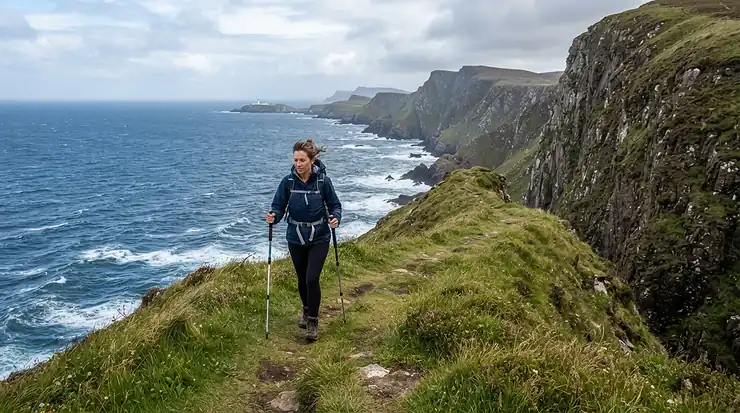
There’s a particular kind of stubbornness in British hillwalkers that makes us resist trekking poles for years, right up until a wet descent off Pen y Fan or a boggy stretch of the Pennine Way finally humbles us. Then, almost overnight, we become converts. If you’re reading this, you’re probably somewhere on that journey — either poleless and curious, or replacing a pair that’s served you well but weighs more than it should.

Lightweight trekking poles aren’t a gimmick. They shift load off your knees on descents, add stability on wet rock and loose scree, and let you set a steady rhythm on long climbs without your legs doing all the work. The trick is finding a pair that’s genuinely light without being flimsy, and that doesn’t cost more than your boots.
This guide walks through seven real trekking poles available on amazon.co.uk, spanning budget aluminium options through to premium folding carbon poles, with honest analysis of what the spec sheets actually mean on British trails. We’ll also cover cheap trekking poles that punch above their price, budget hiking poles for seniors who want extra stability without the premium price tag, and the small features — carbide tips, adjustable strap design, pole weight in grams — that separate a good pole from a forgettable one. For technique and safety advice, the British Mountaineering Council’s guidance on hillwalking poles is worth a read before you head out.
Quick Comparison: Lightweight Trekking Poles at a Glance
| Category | Pick | Weight (per pole) | Price Range |
|---|---|---|---|
| Best Overall | Black Diamond Trail | ~245g | around £75–£95 |
| Best Budget Carbon | Cascade Mountain Tech Carbon Fibre | ~221g | around £45–£55 |
| Best for Seniors | Trekology Trek-Z 2.0 | ~270–306g | around £35–£45 |
| Best Premium Folding | Leki Makalu FX Carbon | ~252g | around £130–£200 |
| Lightest Overall | Fizan Compact 3 | ~158g | around £50–£70 |
This snapshot only tells half the story, though. Weight alone doesn’t determine whether a pole suits you — the locking mechanism, grip shape and adjustment range all matter just as much, especially if you’re buying for varied UK terrain rather than a single big trip. The Fizan Compact 3 wins on raw grams, but the Black Diamond Trail earns its “best overall” tag through sheer usable length range and dual FlickLocks that don’t fail in the wet. We’ll unpack all of this properly below.
💬 Found a favourite already? Bookmark this page and come back before you check out — the comparisons below might change your mind.
Top 7 Lightweight Trekking Poles: Expert Analysis
1. Black Diamond Trail — best all-rounder for UK weather
The Black Diamond Trail has become something of a default recommendation among UK gear reviewers, and it’s easy to see why once you look past the marketing copy. At roughly 245g per pole (490g for the pair), it sits comfortably in the “lightweight without being delicate” category — genuinely light for a 7000-series aluminium shaft, not carbon-fibre light, but tough enough that you won’t baby it on rocky descents.
What the spec sheet won’t tell you is how much difference the dual FlickLock system makes on a typical Welsh or Scottish walk where the weather turns three times before lunch. Stainless-steel external clamps like these keep working with cold, wet or gloved hands in a way that internal twist-locks often don’t — something reviewers consistently flag as the standout feature. The usable length of 64–140cm is unusually generous too, meaning one pair can genuinely suit a couple sharing poles across different heights.
Reviewer sentiment across UK retailers is consistently positive on comfort and adjustability, with the soft-touch EVA grip and padded wrist strap singled out repeatedly; the main recurring niggle is that aluminium simply can’t match carbon for outright lightness. This is the pole for someone who wants one dependable pair for everything from a Sunday Peak District loop to a week in the Lakes, without babysitting a delicate carbon shaft.
Pros:
- ✅ Dual FlickLocks stay secure in wet or cold conditions
- ✅ Generous 64–140cm usable length suits multiple users
- ✅ Interchangeable carbide tips swap easily for rubber ones
Cons:
- ❌ Heavier than the carbon poles further down this list
- ❌ No anti-shock cushioning for hard, repetitive descents
Typically priced around £75–£95, though it’s frequently discounted into the £50s–£60s during sales — check current price before buying. For the durability and adjustability on offer, the Black Diamond Trail represents genuinely solid value rather than a compromise pick.
2. Fizan Compact 3 — lightest aluminium pole you can buy
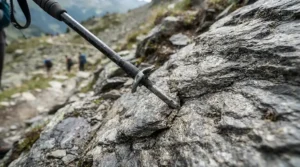
Made in Italy since 1947, Fizan built its reputation on proving aluminium doesn’t have to be heavy, and the Fizan Compact 3 is the clearest evidence of that. At around 158g per pole, it’s lighter than most carbon-fibre poles on the market, while the 7001-grade aluminium alloy shrugs off the kind of sharp impact that can snap carbon outright.
The trade-off for that weight is engineering, not comfort — the three-section shaft uses an internal “Flexy” twist-lock that reviewers describe as reliably slip-free, a notable claim given how often twist-locks earn a bad reputation elsewhere. Based on the spec comparison, this is the pole to choose if you’re counting grams for a multi-day trip and don’t want to gamble on carbon’s fragility on rocky Lakeland or Snowdonia paths.
Aggregated reviewer feedback is broadly enthusiastic about the strength-to-weight ratio and the affordability relative to carbon rivals, though a recurring complaint is that the EVA foam grip doesn’t extend down the shaft, so you can’t choke down for a steep uphill scramble the way you can with extended-grip designs. A minority of reviewers also found the straps fiddly to adjust with cold fingers.
Pros:
- ✅ Among the lightest three-section aluminium poles available
- ✅ 7001 alloy resists snapping better than carbon on impact
- ✅ Genuinely affordable for the weight saving achieved
Cons:
- ❌ Foam grip doesn’t extend for choking down on climbs
- ❌ Some reviewers found the strap adjustment fiddly
Expect to pay around £50–£70 depending on retailer promotions. If ultralight aluminium with a proven track record matters more to you than folding compactness, this is difficult to beat at the price.
3. Cascade Mountain Tech Carbon Fibre — best budget carbon pole
Carbon fibre trekking poles routinely start above £150, which is what makes the Cascade Mountain Tech Carbon Fibre worth a proper look. Independent testing by BBC Countryfile put the per-pole weight at just over 221g, placing it firmly in the midweight bracket for carbon poles — not the absolute lightest, but genuinely competitive against poles costing three times as much.
The cork handle is the standout feature here: cork stays cool and dry-feeling even on warm days, and it won’t develop the slightly tacky feel that cheaper EVA foam grips can get after hours of sweat. What most buyers overlook about this model is the thumbscrew tension adjustment on the quick-lock mechanism, which lets you fine-tune the clamping force — genuinely useful when your fingers are numb on a cold Cairngorms morning and a stiff lock becomes a real obstacle.
Aggregated review sentiment is largely positive on comfort and value, with several long-distance hikers reporting hundreds of miles of use without failure. The recurring concern in user reviews centres on the wrist straps and tip caps wearing faster than expected, with a small number of buyers reporting the carbide tip working loose over time — worth checking periodically rather than assuming it’s maintenance-free.
Pros:
- ✅ Full carbon fibre shaft at a fraction of premium prices
- ✅ Cork grip stays cool, dry and comfortable for hours
- ✅ Thumbscrew tension adjustment helps in cold, numb-finger conditions
Cons:
- ❌ Reviewers report straps and tip caps wearing over time
- ❌ Occasional reports of carbide tips loosening with heavy use
Typically available around £45–£55, this is one of the strongest value arguments in the entire lineup — carbon performance without the carbon price tag, provided you’re prepared to check the tips and straps periodically.
4. TrailBuddy Trekking Poles — best cheap trekking poles for beginners
If you’re searching specifically for cheap trekking poles to try before committing to something pricier, the TrailBuddy Trekking Poles are the obvious starting point, and they’ve built a genuinely large review base doing exactly that job. Constructed from aircraft-grade 7075 aluminium, they weigh around 280g per pole — heavier than the carbon options here, but respectably light for the price bracket.
Here’s what to weigh up: the cork grip is a genuinely premium touch at this price point, and reviewers note it gradually moulds to your hand shape with use, though it takes a fair amount of mileage to get there. The lever-lock adjustment covers an unusually wide 24.5″–54″ range, which is part of why these poles turn up so often in recommendations for older or shorter walkers who need a lower minimum length than many “standard” poles offer.
Independent lab testing found the grip’s contouring doesn’t suit every hand shape equally, marking it down slightly on comfort relative to pricier rivals — a fair critique, though one that thousands of positive aggregated customer reviews don’t fully bear out for casual use. Several verified reviewers specifically mention buying these for older relatives with knee or ankle issues, reporting sturdy, easy adjustment as the standout benefit.
Pros:
- ✅ Wide 24.5″–54″ adjustment suits shorter and taller walkers
- ✅ Cork grip gradually moulds to your hand over time
- ✅ Genuinely low entry price for a full-featured pole
Cons:
- ❌ Heavier per pole than the carbon options on this list
- ❌ Grip comfort rated below pricier rivals in lab testing
Usually priced around £30–£45, making this one of the cheapest genuinely usable trekking poles available on amazon.co.uk — a sensible way to find out whether poles suit your walking style before spending more.
5. Trekology Trek-Z 2.0 — best budget hiking poles for seniors
Marketed explicitly around balance support, the Trekology Trek-Z 2.0 turns up repeatedly in searches for budget hiking poles for seniors, and the aggregated review evidence backs that positioning up. Weight varies by length option — around 270g per pole for the 100–120cm size and up to 306g for the 115–135cm version — assembled from aerospace-grade 7075 aluminium with a foldable, four-section design that packs to just 38cm.
The EVA foam grip is shaped to spread pressure across the palm rather than concentrating it, which matters more than it sounds for anyone with arthritis or reduced hand strength — a detail several verified reviewers mention explicitly, including buyers who note a physiotherapist or doctor recommended poles for exactly this reason. The metal flip-lock system is simple enough to operate one-handed, an underrated feature if grip strength or dexterity is a concern.
Reviewer sentiment is strongly positive on stability and ease of folding for travel, with numerous testimonials from walkers in their seventies describing increased confidence on wet or sloped ground. Independent lab testing, by contrast, marked the poles down specifically for being heavier than rival budget options and slightly fiddly to set up the first time — a fair trade-off given the stability and folding-size benefits most buyers prioritise.
Pros:
- ✅ Foldable to just 38cm, easy to pack or carry
- ✅ Foam grip spreads pressure well for weaker hand grip
- ✅ Strong aggregated reviewer sentiment from older, less mobile users
Cons:
- ❌ Heavier per pole than most other poles in this list
- ❌ Initial setup rated less intuitive than simpler telescopic designs
Typically priced around £35–£45, these represent one of the more thoughtfully designed budget options specifically for anyone prioritising stability and confidence over raw lightness.

6. Leki Makalu FX Carbon — best premium folding carbon pole
Leki’s name in trekking poles carries roughly the same weight that Thermos carries in flasks — a brand that effectively defined the category — and the Leki Makalu FX Carbon is the model most often cited as the reason why. Full PRC 1000 carbon construction brings the weight down to around 252g per pole (roughly 504g for the pair), while the five-section folding design collapses to just 40–41cm for pack storage.
The Aergon Air grip is the standout feature reviewers return to again and again: a hollow-core, lightweight design with a fully rubberised head for downhill control and a foam extension for changing hand position on climbs. Based on the spec comparison against budget carbon alternatives, the difference isn’t really the carbon itself — it’s the Speed Lock 2 Plus external clamp system, which UK reviewers consistently describe as faster and more secure to operate than cheaper quick-lock designs, particularly with gloves on.
Aggregated review sentiment is close to universally positive on build quality, grip comfort and the folding mechanism’s reliability, with several long-term users reporting years of use across UK and Alpine terrain without issues. The clear drawback is cost: this is roughly three to four times the price of the Cascade Mountain Tech Carbon Fibre above for a genuinely superior but not day-and-night different weight saving.
Pros:
- ✅ Full PRC 1000 carbon folds down to just 40–41cm
- ✅ Aergon Air grip rated exceptional for descent control
- ✅ Speed Lock 2 Plus works fast even with gloves on
Cons:
- ❌ Significantly pricier than every other pole in this guide
- ❌ More folding joints mean more parts to eventually maintain
Prices vary considerably by retailer and promotion, typically ranging from around £130 up to the £200 RRP — always check current price, as discounts of 20–30% appear regularly. For serious, frequent hillwalkers who’ll rack up hundreds of miles a year, the investment is easier to justify than for occasional weekend walkers.
7. Black Diamond Trail Ergo Cork — best ergonomic grip for long descents
The Black Diamond Trail Ergo Cork takes the reliable bones of the standard Trail pole and adds one meaningfully different feature: an angled, ergonomic cork grip designed to keep your wrist in a more natural position throughout a stride, rather than forcing it into a straight vertical grip. At around 255g per pole (roughly 510g per pair), it’s marginally heavier than the standard Trail but noticeably more comfortable on long, repetitive descents.
What most buyers overlook about angled grips is that the benefit compounds over distance — on a short walk you’d barely notice the difference, but across a demanding multi-hour descent, reviewers consistently report reduced wrist and forearm fatigue compared with straight-grip alternatives. The cork surface itself wicks moisture effectively, staying comfortable even on humid days when sweat would otherwise make a rubber grip slippery.
Aggregated feedback from testers who’ve used the poles across a genuine mix of terrain — icy New England trails, dry desert paths and multi-day backpacking routes — is consistently favourable on durability, versatility and all-season adjustability. The dual FlickLock system carries over from the standard Trail, so the locking reliability that made that pole a benchmark is present here too.
Pros:
- ✅ Angled ergonomic grip reduces wrist strain on descents
- ✅ Cork surface wicks moisture better than plain rubber
- ✅ Same dependable dual FlickLock system as the standard Trail
Cons:
- ❌ Fixed grip angle won’t suit everyone’s natural stride
- ❌ Costs meaningfully more than the standard Black Diamond Trail
Typically priced around £100–£130, this sits as a genuine mid-to-upper-tier choice for anyone who does enough descending to feel wrist fatigue and wants to solve that specific problem without jumping to full carbon.
Practical Usage Guide: Setting Up and Maintaining Your Poles
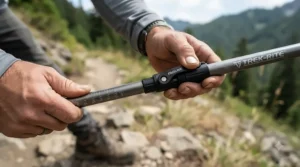
Getting a new pair of lightweight trekking poles home is only step one — how you set them up in the first thirty days makes a real difference to comfort and longevity. Start with length: stand on flat ground, grip the handle with your elbow bent at roughly 90 degrees, and adjust until the tip touches the floor comfortably. Most poles, including every model reviewed above, mark usable length ranges clearly on the shaft, so you’re rarely guessing.
Tighten locking mechanisms fully before your first outing, then re-check them after ten minutes of walking — new locks, particularly quick-lock and flip-lock designs, often need a slight re-tension once the internal mechanism has bedded in. For telescopic poles like the Black Diamond Trail or Fizan Compact 3, alternate which section you extend first occasionally, since uneven wear on one clamp can eventually cause slippage.
A common first-month mistake is leaving carbide tips fitted on hard pavement or rocky scrambles where they’re not needed, accelerating wear unnecessarily; swap to rubber tip protectors for road walking or hut-to-hut sections. Rinse mud from locking mechanisms after wet walks — grit is the main cause of quick-locks and flip-locks eventually sticking or slipping, far more than the mechanism itself wearing out.
Real-World Scenarios: Who Should Buy Which Pole
If you’re a university student heading out on weekend Peak District trips on a tight budget, the TrailBuddy Trekking Poles or Fizan Compact 3 make the most sense — both keep costs low without leaving you with an unusable product, and the Fizan’s exceptional lightness suits a student’s typically smaller pack and lighter overall kit.
If you’re in your late sixties or seventies and walking has become something you want more confidence in rather than more speed, the Trekology Trek-Z 2.0 or TrailBuddy Trekking Poles are worth prioritising specifically for their grip design and stability-focused reviewer feedback, rather than chasing the lightest possible pole on the shelf.
If you’re a regular Munro-bagger or someone racking up 40-plus walking days a year across variable Scottish or Welsh terrain, the extra investment in the Leki Makalu FX Carbon or Black Diamond Trail Ergo Cork tends to pay for itself in comfort over hundreds of accumulated miles — this is where premium features stop being a luxury and start being a genuine quality-of-life upgrade.
Problem → Solution: Fixing Common Trekking Pole Issues
Problem: The locking mechanism slips under load. This is almost always dirt or moisture inside a quick-lock or flip-lock clamp rather than a manufacturing fault. Rinse the mechanism, dry it fully, and re-tension using the thumbscrew where fitted (the Cascade Mountain Tech Carbon Fibre includes exactly this feature for the purpose).
Problem: The carbide tips wear down faster than expected. Carbide tips are genuinely hard-wearing on soft ground, rock and gravel, but road walking and repeated dragging on tarmac blunt them quickly. Fit rubber tip protectors — included with most of the poles above — for any road or pavement sections.
Problem: The adjustable strap digs in or slips off during long descents. An adjustable strap should sit snugly across the back of your hand, not around your wrist bones. Loosen it slightly, reposition it lower across the palm, and re-tighten — a strap set too high is the most common cause of chafing reported in reviews.
Problem: One pole feels noticeably heavier than expected once you’re actually walking. Perceived weight during use often differs from the stated pole weight in grams, since grip shape and balance point matter as much as total mass. If a pole feels front-heavy, the issue is usually basket or tip weight rather than the shaft itself.
What Are Lightweight Trekking Poles? (And Why Weight Matters)
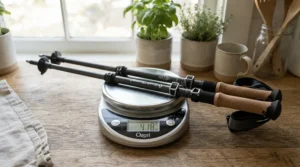
Lightweight trekking poles are adjustable walking supports, typically made from aluminium or carbon fibre, designed to reduce the physical weight carried in the hand while still providing full stability on uneven or steep ground. “Lightweight” generally means under roughly 250–280g per pole, compared with 300g-plus for standard, non-lightweight models.
Pole weight in grams matters more than most buyers initially assume, because it’s a weight you’re actively swinging thousands of times per walk, not simply carrying passively like a rucksack. The cumulative fatigue difference between a 158g Fizan Compact 3 and a 306g Trekology Trek-Z 2.0 adds up meaningfully across an eight-hour day, even though the gap per swing feels negligible.
That said, lighter isn’t automatically better for everyone. A University of Salford study on walking aid use and stability in older adults found that correct technique and a stable, confident grip mattered more to fall prevention than the aid’s weight alone — which is exactly why models like the Trekology Trek-Z 2.0, built slightly heavier with a stability-focused grip, remain a sound choice for anyone prioritising security over minimal grams.
How to Choose Lightweight Trekking Poles: 7 Expert Criteria
- Weight per pole. Aim for under 280g if lightness is your priority, but don’t sacrifice grip comfort chasing the last 50g.
- Material. Carbon saves weight but can snap under sharp lateral impact; aluminium bends rather than breaks, which some hillwalkers prefer for reliability.
- Locking mechanism. External clamp locks (FlickLock, Speed Lock) generally outperform internal twist-locks in wet or cold UK conditions.
- Usable length range. Check the adjustment range covers your height with room to spare, particularly if poles will be shared between walkers.
- Grip material and shape. Cork suits warm, sweaty hands; foam suits cold conditions; angled grips reduce wrist strain on long descents.
- Folding vs telescopic design. Folding poles pack smaller for travel; telescopic poles are typically simpler to maintain long-term.
- Tip type. Confirm carbide tips are replaceable and that rubber tip protectors are included or available separately for road sections.
Lightweight Trekking Poles vs Traditional Walking Sticks
A traditional single walking stick still has its place — for short, flat dog walks it’s simple and needs no setup. But the comparison largely favours pairs of trekking poles once terrain gets genuinely varied, and the difference in stability is well documented rather than just brand marketing.
| Factor | Trekking Poles (pair) | Single Walking Stick |
|---|---|---|
| Points of ground contact | Two | One |
| Weight distribution | Both arms share load | One arm/side only |
| Best for | Hills, uneven ground, long descents | Short, flat, familiar routes |
| Typical weight | 300–600g total | 300–500g |
| Adjustability | Usually fully adjustable | Sometimes fixed length |
The two-point contact that a pair of poles provides is the real advantage: on a single walking stick, a slip on one side leaves you with no backup point of support, whereas poles let you catch yourself on either side almost instinctively. Traditional sticks remain a perfectly reasonable choice for gentle, short walks, but anyone tackling genuine hill terrain gains real, measurable stability from switching to a proper pair.
Common Mistakes When Buying Trekking Poles
The single most common mistake is buying based on stated weight alone, without checking the locking mechanism quality — a featherlight pole that slips under load on a wet descent is a liability, not an asset. Reviewers across multiple UK outlets, including the BBC Countryfile field test of the Cascade Mountain Tech Carbon, consistently rate locking reliability above raw grams saved.
A second frequent mistake is ignoring the usable length range and assuming “one size fits all” — poles genuinely do need to suit your height, and buying a pair with too short a maximum extension leaves taller walkers stooping uncomfortably on descents. Third, buyers often overlook whether replacement tips and baskets are actually available separately; some budget poles use proprietary fittings that become difficult to replace once worn.
Finally, don’t assume the most expensive carbon pole is automatically the right choice — if you’re mostly walking lowland or well-maintained paths rather than technical mountain terrain, a mid-range aluminium pole like the standard Black Diamond Trail will likely serve you just as well for considerably less money.

Budget Hiking Poles for Seniors: What Actually Matters
When searching specifically for budget hiking poles for seniors, weight is genuinely a secondary consideration behind grip design, ease of adjustment and locking security. Reviewers consistently highlight three features as making the biggest practical difference for older walkers: an easy one-handed locking mechanism, a grip shaped to reduce hand strain for those with arthritis, and a strap that supports weight without requiring a tight grip to stay secure.
The Trekology Trek-Z 2.0 scores well on all three, with genuine aggregated reviewer testimonials from walkers in their seventies describing improved confidence on wet or sloped paths — several specifically mention the poles being recommended by a GP or physiotherapist. The TrailBuddy Trekking Poles offer a similarly wide adjustment range at an even lower price point, making them a sensible starting option before committing to a pricier pair.
It’s worth noting that research into walking aids and stability, including work reviewed by the NHS-funded study on walking aid use in older adults, emphasises that correct technique matters as much as the equipment itself — a lightweight pole used incorrectly offers less real-world stability than a slightly heavier one used properly, which is worth bearing in mind before assuming the lightest option is automatically the safest one.
Affordable Telescopic Walking Poles vs Folding Poles: Which Wins?
Affordable telescopic walking poles — where sections slide and lock rather than fold at hinges — dominate the budget end of this market for good reason: fewer moving parts generally means fewer things to go wrong, and repairs or replacements are usually simpler and cheaper. The Black Diamond Trail, Fizan Compact 3 and Trekology Trek-Z 2.0 (a hybrid folding-telescopic design) all sit comfortably in this camp.
Folding poles, like the Leki Makalu FX Carbon, pack down to roughly 40cm rather than the 60cm-plus typical of telescopic designs, which matters considerably for flying with hand luggage or fitting poles inside rather than strapped to a rucksack. The trade-off is more hinge points and folding joints, which genuinely do need more periodic maintenance and checking than a simple telescopic clamp.
For most UK day walkers who drive to a trailhead rather than fly, telescopic remains the more practical, affordable choice; folding earns its premium specifically for travel-heavy hikers who need every centimetre of pack space.
Cheap Trekking Poles: Where the Savings Really Come From
Cheap trekking poles aren’t automatically bad — the genuine savings on models like the TrailBuddy Trekking Poles or Cascade Mountain Tech Carbon Fibre come from manufacturing efficiency and simpler accessory kits, not from cutting corners on the core shaft material or locking mechanism. Both use genuinely capable materials (aircraft-grade aluminium and real carbon fibre respectively) at prices well below premium brand equivalents.
Where the savings genuinely show up is in accessory longevity — straps, tip caps and baskets on budget poles tend to wear faster than premium equivalents, based on the aggregated review patterns across the models in this guide. Total cost of ownership over three or four years might therefore favour a mid-range pole if you’re walking weekly rather than occasionally, since replacement straps and tips add up.
For occasional walkers doing a handful of trips a year, cheap trekking poles represent genuinely sound value; for anyone racking up serious annual mileage, the maths increasingly favours paying more upfront for a pole like the Black Diamond Trail or Leki Makalu FX Carbon that needs less ongoing replacement.
Carbide Tips and Adjustable Straps: Features That Actually Matter
Carbide tips get mentioned on almost every product listing, but what actually matters is whether they’re genuinely replaceable — every pole in this guide, from the budget TrailBuddy to the premium Leki Makalu FX Carbon, uses swappable carbide or Flex Tip designs rather than fixed, non-serviceable points. Carbide itself is simply a harder metal alloy than standard steel, giving better grip on rock and ice without wearing down as quickly.
An adjustable strap matters more than most buyers initially credit it for. A properly fitted strap lets you rest your hand weight on the strap itself between pole plants, reducing grip fatigue over a long day — this is precisely the mechanism reviewers reference when praising poles like the Black Diamond Trail’s padded wrist strap or the Leki Makalu FX Carbon’s Skin Strap.
Marketing hype, by contrast, tends to overstate anti-shock cushioning systems, which several UK reviewers note add weight and cost without a proven meaningful benefit for most walkers on typical British terrain — a feature worth skipping unless you have a specific joint condition your GP has flagged.
Safety, Regulations and the Countryside Code for Pole Users
Trekking poles aren’t subject to specific UK product regulation beyond general consumer safety standards (CE/UKCA marking on manufactured goods sold in the UK), but responsible use on public land does fall under general countryside access guidance. When walking on rights of way or open access land, following the official Countryside Code — staying on marked paths where required, avoiding damage to verges, and being considerate of other path users — applies to pole users just as it does to everyone else outdoors.
One safety point worth repeating from mountain safety guidance: poles are genuinely useful for balance and load-sharing, but they are not a substitute for an ice axe on genuinely icy or snow-covered ground, and shouldn’t be relied on to arrest a slip on steep, frozen terrain. On technical rocky scrambles, it’s worth removing your hands from the straps entirely so poles can be dropped instantly rather than trapping your wrists if you need a hand free for a hold.
For group walks, agree a simple system for anyone stopping to adjust or stow poles, particularly on narrow paths — a planted pole left across a trail is a genuine trip hazard for whoever’s behind you.
Frequently Asked Questions
❓ What is the ideal weight for lightweight trekking poles?
❓ How much do cheap trekking poles cost in the UK?
❓ Are budget hiking poles for seniors safe to use on steep descents?
❓ What's the difference between affordable telescopic walking poles and folding poles?
❓ Do carbide tips wear out, and can they be replaced?
Conclusion
Choosing between lightweight trekking poles ultimately comes down to matching the pole to how and where you actually walk, rather than chasing the lowest weight in grams on the spec sheet. For most UK day walkers, the Black Diamond Trail remains the sensible all-rounder — durable, genuinely adjustable, and reasonably priced. If budget is the deciding factor, the Cascade Mountain Tech Carbon Fibre and TrailBuddy Trekking Poles both prove that cheap trekking poles don’t have to mean compromised build quality.
For anyone shopping specifically for budget hiking poles for seniors, the Trekology Trek-Z 2.0 stands out on grip design and aggregated reviewer trust rather than raw lightness, while serious hillwalkers chasing every possible gram will find the Fizan Compact 3 and Leki Makalu FX Carbon each justify their place at opposite ends of the price spectrum. Whichever pair you choose, correct length adjustment and a properly fitted strap will do more for your comfort and safety than any single spec on the box.
Trekking poles are one of the more affordable ways to genuinely change how a hard day on the hills feels in your knees the next morning — a small investment against a real, tangible benefit that compounds over every mile you walk.
Recommended for You
- Best Quad Cane for Elderly: 7 Top Picks for Stability (2026)
- Quad Cane vs Standard Walking Stick: 7 Real Picks Compared (2026)
- Small Base Quad Cane vs Large Base Quad Cane: 7 Best UK Picks (2026)
Disclaimer: This article contains affiliate links. As an Amazon Associate, I earn from qualifying purchases. If you purchase products through these links, we may earn a small commission at no additional cost to you.
✨ Found this helpful? Share it with your friends! 💬🤗
