In This Article
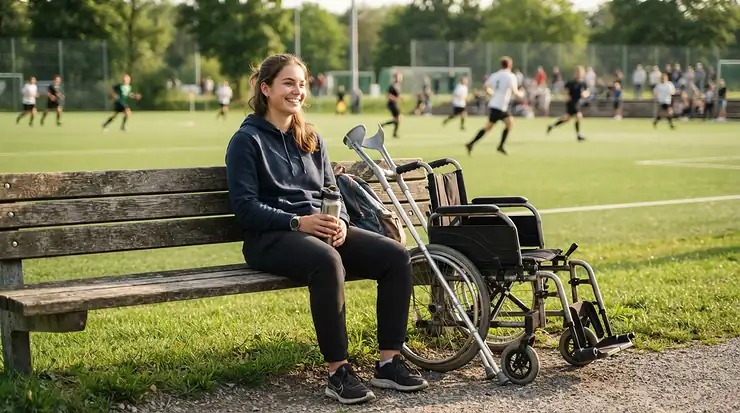
Adjustable paediatric crutches for children are lightweight, height-adjustable walking aids built for smaller bodies. They are usually elbow (forearm) crutches, with a cuff and handgrip that can be tuned to a child’s height and arm length. They let a child take weight off an injured or weakened leg, and they stretch as the child grows.

That last bit matters more than the marketing admits. Crutches are one of humanity’s oldest mobility tools (the history of the crutch runs back millennia), yet the modern child’s version still comes down to a few centimetres of aluminium tube. Get those centimetres right and a nine-year-old with a fractured ankle zips down the corridor. Get them wrong and you have a sore, wobbly, thoroughly fed-up child who has learned to hate the things.
Here’s the awkward truth about this niche. Spec sheets are thin, the same generic models appear under half a dozen retailer names, and “kids” can mean anything from a four-year-old to a six-foot teenager. So this guide does the translating. It compares seven real, UK-available options, explains what each measurement means in practice, and covers the practical side: fitting, school, physiotherapy and the day your child outgrows the lot.
One honest note before we start. The specs below come from manufacturer and UK mobility-retailer listings, and I haven’t handled these products. Amazon listings can differ by seller, so check the current listing on amazon.co.uk before you buy. Prices are ranges only, and they move.
Quick Comparison Table: Our Top 5 Picks at a Glance
| Pick | Handle-to-Floor Range | Price Range | Best For |
|---|---|---|---|
| Days Children’s Double Adjustable Elbow Crutches | 56-80 cm | Under £25 | Growing children on a budget |
| Flexyfoot Soft Grip Double Adjustable Kids Crutches | 57-74.5 cm | Low £20s upwards | Slip-prone surfaces and school floors |
| Flexyfoot Soft Grip Double Adjustable Junior Crutches | 70-90 cm | Low £20s upwards | Tall pre-teens and teens |
| Tiki Children’s Crutches | 52-74 cm | From the mid-£30s | Younger kids who want something fun |
| Children’s Elbow Crutches (4-7 Years) | 37-53 cm | Under £20 | The smallest users |
On paper, the Days Children’s Double Adjustable Elbow Crutches give the widest adjustment for the lowest outlay, which is why they sit at the top for most families. If your child is tall for their age, the Flexyfoot Soft Grip Double Adjustable Junior Crutches are the only one of these five that comfortably reaches into teen territory. Parents of very small children should note that the Children’s Elbow Crutches (4-7 Years) are the only pair here that goes down to a four-year-old’s stature.
💬 Just one click — help others make better buying decisions too!😊
Top 7 Adjustable Paediatric Crutches for Children: Expert Analysis
A quick word on how to read these entries. Each one pairs the specs with what they mean in real life, and the review comments are aggregated sentiment from listings I could actually find, not invented quotes. Where I couldn’t verify a meaningful review pool, I say so.
1. Days Children’s Double Adjustable Elbow Crutches — widest adjustment for the money
The headline here is range. These crutches adjust both from handle to ground (56-80 cm) and from handle to cuff (17-22 cm), and that “double” adjustability is what stretches one purchase across a growth spurt.
The angled neck is designed to ease strain on the wrist, and the closed cuff keeps the crutch on the forearm if the child lets go of the handle. Anyone who has watched a distracted eight-year-old drop a crutch mid-corridor will appreciate that. The maximum user weight is 100 kg, which leaves plenty of headroom for a child. Based on the spec comparison, this is the most versatile all-rounder in the group: simple, durable, and cheap enough to treat as a short-term loan from your wallet.
One detail worth checking: one retailer listing flags these as containing natural rubber latex. If your child has a latex allergy, confirm the exact ferrule material with the seller before ordering.
Review evidence for this specific model was thin on the listings I found, so I can’t offer a verified aggregate. The retailer pages mostly emphasise lightweight build and fit adjustability.
Pros:
- ✅ Widest height range in this round-up
- ✅ Closed cuff keeps crutch attached to arm
- ✅ Angled neck reduces wrist strain
Cons:
- ❌ Listing flags natural rubber latex content
- ❌ Standard grips, with no shock absorption
Price: under £25. Verdict: the best value for most families.
2. Flexyfoot Soft Grip Double Adjustable Kids Crutches — shock-absorbing ferrule for slippery floors
The standout is the Flexyfoot ferrule, a flexible bellows-style tip that acts as a small shock absorber. The maker claims up to 50% more grip than traditional ferrules, which is a manufacturer claim rather than an independent test.
The handle height runs 57-74.5 cm, with double adjustment and soft-grip handles in bright colours. A listing from a retailer in Ireland labels the model as suited to ages 8-15, but treat age bands loosely. A tall seven-year-old and a small thirteen-year-old overlap here.
What does that ferrule mean in practice? Hard school corridors and tiled hallways are where crutch tips fail, so extra grip and a bit of cushioning make sense. Less jarring through the wrists also helps if your child will be on crutches for weeks.
Reviewers on the listings I found weren’t plentiful enough to summarise reliably, so I’ll say plainly that I can’t verify an aggregate sentiment. They are sold singly or as pairs in several colours, so double-check you’re buying a pair, not a single.
Pros:
- ✅ Flexible ferrule absorbs shock on contact
- ✅ Soft grips suit small hands
- ✅ Bright colours children actually like
Cons:
- ❌ Narrower range than the Days pair
- ❌ Sold singly or as pairs; easy to mis-order
Price: low £20s upwards, depending on single or pair. Verdict: the best choice for slippery surfaces and longer recoveries.
3. Flexyfoot Soft Grip Double Adjustable Junior Crutches — the teen-friendly bridge size
This is the same family as the Kids version, but the handle height runs 70-90 cm. That is a different animal. It covers children who have outgrown the standard paediatric range but aren’t yet adult-sized.
What does 70-90 cm mean? It’s the territory of tall pre-teens and most teenagers. The shock-absorbing Flexyfoot ferrule carries over, and so does the soft grip. For parents shopping for teen crutches UK-wide, this is the most obvious bridge between kids’ and adult sizes.
The honest analytical take: if your child is still growing fast, this size avoids the buy-twice problem. The reverse is also true. If your child is small, the minimum 70 cm handle height may be too high, and you’d be better with the Kids model.
Again, I couldn’t verify a meaningful pool of reviews for this exact model, so no aggregate here. Check the “Reviews” section on the current listing before buying.
Pros:
- ✅ Reaches into teenage height territory
- ✅ Same shock-absorbing ferrule as Kids model
- ✅ Double adjustable for fine-tuning
Cons:
- ❌ Minimum height too high for small children
- ❌ Review evidence thin on listings checked
Price: low £20s upwards. Verdict: the sensible pick for tall pre-teens and teens.
4. Tiki Children’s Crutches — forearm-rest design with colour-coded clips
These are a different design philosophy. Instead of a standard closed cuff, the Tiki Children’s Crutches use brightly coloured forearm rests that can be set in three positions. The leg adjusts from 52-74 cm using colour-matched clips, which makes resizing fast and fiddle-free.
Weight is where listings disagree. One UK retailer lists 500 g each, while a manufacturer-style listing from an Irish stockist quotes 0.33 kg. Treat both with caution and check the current listing. Maximum user weight is 100 kg. The natural rubber suction cap is designed to stay elastic in cold weather, which suggests thought about British winters, though it also means checking for latex sensitivity.
Who is it for? Younger children who may struggle with fiddly adjustments, and any child who will accept crutches more willingly if they look good. That matters more than adults think.
I couldn’t verify a meaningful pool of reviews, so I can’t give aggregated sentiment here.
Pros:
- ✅ Colour-matched clips make resizing simple
- ✅ Forearm rests adjust to three positions
- ✅ Corrosion-resistant, wipe-clean aluminium
Cons:
- ❌ Costs more than the basic pairs
- ❌ Weight figures vary between listings
Price: from the mid-£30s. Verdict: worth it if appearance and easy resizing matter.
5. Children’s Elbow Crutches (4-7 Years) — the smallest-user option
Most “children’s” crutches start too tall for a four-year-old. This pair, sold by the UK retailer Essential Aids, is built for the youngest end, with a handle height of 37-53 cm. A companion 6-10 years size runs 43-65 cm.
The bright yellow aluminium finish is cheerful, the pair is sold as a set, and the maximum user weight is 100 kg. The small range does mean it’s a short-term tool. A child who grows quickly will outgrow the 4-7 size, and you’ll need to step up.
Aggregated review sentiment on the retailer’s own page is positive: three reviews carry a 100% rating, mentioning prompt delivery, good quality and a good fit for a nine-year-old with a broken ankle (on the larger size). That is a tiny sample, and it isn’t from Amazon. Treat it as a gentle positive signal, not proof.
Analytically, the best use case is the child who is genuinely small. If your child is borderline between sizes, ask the physio, because a crutch that is too tall is worse than one that is slightly short.
Pros:
- ✅ Genuinely small sizing for ages 4-7
- ✅ Bright, child-friendly finish
- ✅ Lightweight aluminium construction
Cons:
- ❌ Short adjustment range; quickly outgrown
- ❌ Review pool very small
Price: under £20. Verdict: good value when your child is truly small.
6. Double Adjustable Childrens Elbow Crutches — sturdy generic workhorse
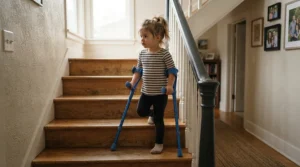
This is the plain-vanilla option: aluminium, double adjustable, and aimed at children who need support during recovery or longer-term. The listing gives a handgrip-to-cuff range of 170-220 mm and a crutch weight of 650 g each, with a 100 kg maximum user weight.
At 650 g, they’re heavier than the Tiki figure but typical for sturdy aluminium paediatric crutches. A heavier crutch isn’t necessarily worse. Many children find a little weight steadier. A smaller child may tire sooner, though, especially over a full school day.
The listing I found didn’t state the handle-to-floor range. A comparable double-adjustable model on another UK retailer’s site lists 56-80 cm, but I can’t confirm the two are identical, so check the specification on the page you’re buying from.
Review evidence for this model was not verifiable on the listings I found. The best read is that it is a no-frills piece of kit with price as its main attraction.
Pros:
- ✅ Double adjustment at a bargain price
- ✅ Robust aluminium build
- ✅ 100 kg maximum user weight
Cons:
- ❌ Heavier at 650 g each
- ❌ Floor-height range not stated
Price: under £25. Verdict: a sensible budget choice if the weight suits your child.
7. Drive Pediatric Forearm Crutches — two sizes with generous growth room
Drive’s range takes a different approach, with two sizes. The small/medium size suits users of roughly 2’6″ to 4’5″ (about 76-135 cm), with a floor-to-grip range of 16.5-25.5 inches. The large suits roughly 4’4″ to 5’5″ (about 132-165 cm), at 24-34 inches.
Both adjust in one-inch increments, with a separately adjustable cuff height and full composite cuffs. Each crutch weighs around 18 oz (about 510 g). Weight capacity is 160 lb for the smaller size and 185 lb for the large, so roughly 72 kg and 84 kg.
A caveat: I found these specs on a Canadian retailer, not a UK listing. Check UK availability and warranty on amazon.co.uk before you rely on any of this. For a UK buyer the two-size system is the draw, because it lets you pick closer to your child’s actual stature.
Review sentiment isn’t verifiable from what I found, so none is offered.
Pros:
- ✅ Two sizes match stature more closely
- ✅ One-inch height increments for fine-tuning
- ✅ Separately adjustable cuff height
Cons:
- ❌ Lower weight limit than UK-style pairs
- ❌ UK availability needs checking
Price: check current price; likely the dearest here. Verdict: worth a look if the two-size system suits your child.
Side-by-Side Spec Snapshot
| Product | Handle-to-Floor | Weight Each | Max User Weight | Price Range | Best For |
|---|---|---|---|---|---|
| Days Children’s Double Adjustable Elbow Crutches | 56-80 cm | Not stated | 100 kg | Under £25 | Growth-proof value |
| Flexyfoot Soft Grip Double Adjustable Kids Crutches | 57-74.5 cm | Not stated | Not stated | Low £20s upwards | Slippery floors |
| Flexyfoot Soft Grip Double Adjustable Junior Crutches | 70-90 cm | Not stated | Not stated | Low £20s upwards | Tall teens |
| Tiki Children’s Crutches | 52-74 cm | 330-500 g (listings differ) | 100 kg | From mid-£30s | Easy resizing |
| Children’s Elbow Crutches (4-7 Years) | 37-53 cm | Not stated | 100 kg | Under £20 | Smallest users |
| Double Adjustable Childrens Elbow Crutches | Not stated | 650 g | 100 kg | Under £25 | Budget workhorse |
| Drive Pediatric Forearm Crutches | 42-65 cm / 61-86 cm | About 510 g | About 72-84 kg | Check price | Two-size fit |
The table makes the trade-offs plain. The Days Children’s Double Adjustable Elbow Crutches give the most flexibility for the least money, while the Flexyfoot Soft Grip Double Adjustable Junior Crutches are the only option that really reaches teen height. Buyers weighing the Drive Pediatric Forearm Crutches should note the lower weight capacity and the need to verify UK availability first.
✨ Don’t Miss These Exclusive Deals!
🔍 Take your search for the right adjustable paediatric crutches for children to the next level with these carefully selected options. Click on any highlighted product name to check current pricing and availability. A good fit now means fewer sore wrists later!
How to Choose Adjustable Paediatric Crutches for Children
Choosing well takes five minutes of thought. These seven steps cover the ground.
- Start with your child’s height, not their age. Age bands are approximate. A tall six-year-old and a small ten-year-old can need the same crutch, so use height as your guide and compare it with each maker’s stated range.
- Prefer double adjustment. Adjusting both handle-to-floor and handle-to-cuff lets one pair follow a growth spurt. Single-adjustment models fix the cuff distance, so they suit only children whose arm length matches.
- Check the cuff style. A closed cuff keeps the crutch on the arm if your child lets go. That’s a safety bonus for younger children, though some physios prefer open cuffs for older ones.
- Look at the ferrule. The rubber tip is the only thing between your child and the floor. A shock-absorbing design, like the Flexyfoot version, is worth having on hard school floors.
- Weigh the crutch. Heavier is steadier but tiring. Lighter is easier to carry but can feel flighty.
- Check latex. Natural rubber appears in some ferrules and caps, so confirm if allergies are a concern.
- Ask your physio first. A clinician can confirm the size, and showing them the listing saves guesswork.

Child Height Ranges: Matching Crutch Size to Your Child
Child height ranges are where most mistakes begin. Manufacturers quote either the child’s stature or the crutch’s handle height, and the two aren’t the same number. Mix them up and you order the wrong size.
The practical rule is to compare like with like. Handle-to-floor is the crutch’s own measurement, and it is the number to check against whoever measured your child. The Drive range, for instance, pairs stature bands (about 76-135 cm and 132-165 cm) with separate grip-height ranges. One now-discontinued Thuasne model quoted a stature of 1.10-1.44 m against a 58-75 cm crutch range, which shows how tight the relationship can be.
Overlapping bands are your friend. A child at the top of one size and the bottom of another is the classic borderline case, and the answer is usually the size with more adjustment room. Take the Days Children’s Double Adjustable Elbow Crutches (56-80 cm) and the Tiki Children’s Crutches (52-74 cm). Both cover a middle band, but the Days pair stretches higher for a growing child.
Physiotherapists typically set the crutch so the handgrip sits around the wrist crease when the child stands relaxed, with a slight bend at the elbow. Treat that as a general principle, not an instruction. The clinician who knows your child’s injury should set the final height, and the NHS leaflet in the physiotherapy section below is explicit that the height shouldn’t be changed afterwards.
Child-Sized Elbow Crutches vs Underarm Crutches and Alternatives
Child-sized elbow crutches aren’t the only option, so it helps to know what else is out there and why elbow designs usually win for children.
| Aspect | Child-Sized Elbow Crutches | Underarm (Axilla) Crutches | Walking Frame |
|---|---|---|---|
| Hand freedom | Cuff allows brief hand release | Hands needed at all times | Hands needed at all times |
| Stairs | Generally manageable | Often awkward | Usually impractical |
| Stability | Moderate | Moderate | Highest |
| Best For | Active children, short and medium recoveries | Short-term use where advised | Children needing maximum balance support |
These are general comparisons, so your clinician’s advice outranks any table. Elbow designs tend to suit children because they’re lighter and less cumbersome, and the cuff lets a child briefly free a hand to open a door.
The trade-off is balance. Frames give the most stability, while elbow crutches demand coordination and some upper-body strength. The honest takeaway is that child-sized elbow crutches suit most recoveries, but children with significant balance difficulties may need a different aid, and a physiotherapist should make that call.
Teen Crutches UK: When Kids’ Sizes Run Out
Teen crutches UK shoppers face the awkward middle. Kids’ crutches stop too low, adult crutches start too high, and a growing 14-year-old can sit anywhere between.
The bridge is the Flexyfoot Soft Grip Double Adjustable Junior Crutches at 70-90 cm. The Drive large size is another candidate, covering statures up to roughly 5’5″ (about 165 cm). By comparison, one manufacturer catalogue lists adult-size crutches at 77-98 cm handle height, so there is real overlap between the junior range and the adult range.
Teenagers add a social factor. A pair that looks “babyish” may end up abandoned in a cupboard. The plainer Flexyfoot Soft Grip Double Adjustable Junior Crutches in black are likely to be an easier sell than bright cartoon colours, though the Flexyfoot range does offer plenty of colours.
A practical tip: let your teen choose the colour. That small sense of control changes how they feel about using the thing, and a crutch that is used beats a perfect one that isn’t. Weight matters too, since larger teens should check the maximum user weight on any pair. The listings here mostly quote 100 kg, while the Drive large size is lower at roughly 84 kg.
School Mobility Support: Getting Crutches Through the Gates
School mobility support is a legal matter as well as a kindness. In England, statutory guidance on supporting pupils with medical conditions sets out what schools must do. It applies to governing bodies of maintained schools, academy proprietors and pupil referral units.
In practice, this means talking to the school before your child returns. Ask about a lift pass, leaving lessons a few minutes early to avoid crowded corridors, and somewhere safe to store the crutches. Many schools also arrange a carry buddy or a bag-carrier, and a personal emergency evacuation plan is common practice, so ask what yours has.
Schools can create an individual healthcare plan for pupils with longer-term needs, and the guidance includes template wording for this. That is most relevant if your child’s crutch use will last beyond a few weeks.
PE is the sensitive area. The guidance expects children with medical conditions to be properly supported, including in physical education and on trips, so ask what adapted activities are available. A pair with a shock-absorbing tip, like the Flexyfoot Soft Grip Double Adjustable Kids Crutches, is better suited to hard corridor floors. Keep a copy of the physiotherapist’s advice in your child’s school bag, because it saves explaining the same thing three times.
Paediatric Physiotherapy: What the Clinic Will (and Won’t) Do
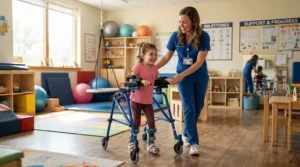
Paediatric physiotherapy is where crutch use should start. A clinician measures your child, sets the height, and teaches the technique, and that sequence matters more than which brand you buy.
NHS guidance for children, such as this paediatric physiotherapy leaflet on using elbow crutches from NHS Borders, is clear on the basics. Crutches are fitted to the child, and the height shouldn’t be altered afterwards because that can make them unsafe. Children keep their hands out of the crutches when standing and sitting, to protect elbows and shoulders.
The leaflet’s walking technique runs along these lines. Hold the crutches together in an “H” shape, put one hand through at a time, and place the crutches slightly ahead and out to the side. Then push down through the arms and bring the unaffected leg up to the crutches. Never move the feet ahead of the crutches, as it makes a child unsteady.
This creates a real tension with adjustable models. The whole point is that you can change the height, but the clinical advice is to leave it alone once it’s set. The resolution is to treat adjustability as a tool for the clinician, or for you under their guidance, as your child grows. If you think your child has outgrown the setting, ring the physio rather than guessing.
For longer distances, the leaflet points families to the British Red Cross, which can lend wheelchairs. That’s a handy backstop for days out when crutches would be too tiring.

Fitting and Using Kids Crutches Adjustable: A Practical Setup Guide
Fitting and using kids crutches adjustable models well comes down to a short routine. This guide supplements, never replaces, what your physiotherapist tells you.
Before first use
- Check every push-button or clip clicks fully through its hole. A half-engaged pin is the classic failure.
- Inspect the ferrules for wear and make sure they sit snugly.
- Compare both crutches side by side on a flat floor. They should match in height and cuff position.
First week
- Practise on a clear, flat floor before tackling stairs, with an adult close by.
- Check the fit again after a couple of days. Children often slouch or hunch, which shows up as sore wrists or shoulders.
- Wipe the grips and cuffs, since wipe-clean aluminium and plastic stay hygienic with little effort.
Maintenance schedule
- Weekly: check the ferrules and pins.
- Monthly: look at the cuff plastic for cracks.
- On every growth spurt: ask the physio before changing anything.
Common mistakes in the first 30 days
- Leaning into the cuff rather than pushing through the handgrip.
- Carrying crutches in a school bag that bangs against other children.
- Swapping heights between siblings without a check.
Real-World Scenarios: Matching Crutches to Real Children
Three profiles show how the choices play out.
The five-year-old with a broken leg, about six weeks of use. Budget is modest, and the child is small. The Children’s Elbow Crutches (4-7 Years) at under £20 fit the stature and the timescale. A cheap, short-term pair makes sense, because the child won’t outgrow it before the cast comes off.
The ten-year-old with a longer rehabilitation, three months or more. Here the school corridors are the problem. The Flexyfoot Soft Grip Double Adjustable Kids Crutches offer shock-absorbing tips for hard floors, and the double adjustment follows any growth. The extra spend over a basic pair is easy to justify across twelve weeks of daily use.
The tall thirteen-year-old with an ongoing condition. Size is the issue, and so is dignity. The Flexyfoot Soft Grip Double Adjustable Junior Crutches reach 90 cm, and letting the teen choose a colour matters. If they plan long-term use, ask the clinic whether a custom or adult-style fit will serve them better.
The pattern is that duration and surface matter more than brand. Short recovery and a small child favour cheap and simple. Long recovery and hard floors favour the cushioned tip.
Problem → Solution Guide for Parents
Five problems come up again and again. Each has a fix.
Sore wrists or hands. Check the grip height with your physio, and look at the angled neck. The Days Children’s Double Adjustable Elbow Crutches are designed with one to ease wrist strain. A cushioned tip may also help.
Slipping on school floors. Inspect the ferrules for wear. The Flexyfoot Soft Grip Double Adjustable Kids Crutches pair a flexible tip with extra grip, according to the maker.
Crutches falling to the floor. A closed cuff solves most of this. It’s a feature of the Days Children’s Double Adjustable Elbow Crutches.
Child refuses to use them. Colour and style matter. The Tiki Children’s Crutches are designed to look fun, and the colour-coded clips make adjusting easy for small hands.
Outgrown mid-recovery. Choose a wide range from the start. The Days Children’s Double Adjustable Elbow Crutches cover 56-80 cm, which gives the longest runway.
Common Mistakes When Buying Adjustable Paediatric Crutches for Children
Common mistakes are mostly avoidable, and the costly ones are predictable.
The first is buying by age band alone. Age labels are rough guides, and a child’s height is the number that counts. The second is buying adult crutches “to grow into”, which sounds thrifty but leaves your child’s wrists and shoulders working at the wrong angle.
The third is ignoring the cuff-to-handle distance. A crutch that is the right height but the wrong arm length will still feel awkward. That’s why double adjustment earns its place.
The fourth mistake is skipping the latex check. Listings for both the Days Children’s Double Adjustable Elbow Crutches and the Tiki Children’s Crutches mention natural rubber, so allergies need a quick confirmation.
The fifth is changing the height at home without clinical advice. The NHS guidance is clear that adjusting the settings can make the crutches unsafe. The sixth is forgetting single versus pair. The Flexyfoot listings sell singles and pairs, and a pair means two, so check the title before you order. And finally, don’t assume a long-standing brand always means the right fit. Spec sheets reward a closer look than logos do.
Long-Term Cost & Maintenance: Is Cheap Really Cheaper?
Long-term cost is where a simple pair of crutches turns into a small economics puzzle. Most of these pairs sit in the low £20s or under, so cost-per-week is surprisingly low.
| Scenario | Likely Use Period | Suggested Pick | Value Logic |
|---|---|---|---|
| Fracture, small child | About 6 weeks | Children’s Elbow Crutches (4-7 Years) | Lowest outlay; short life is fine |
| Recovery with growth | 3+ months | Days Children’s Double Adjustable Elbow Crutches | Wide range avoids a second purchase |
| School-heavy use | Long term | Flexyfoot Soft Grip Double Adjustable Kids Crutches | Cushioned tips justify the extra cost |
| Style-sensitive child | Variable | Tiki Children’s Crutches | Compliance matters more than saving a few pounds |
As a quick illustration, a pair in the low £20s used for six weeks works out at roughly £3-£4 a week. That is cheap enough that fit and comfort should outrank price in your decision.
The practical conclusion is that the “cheapest” pair is rarely the most economical if your child outgrows it halfway through. Maintenance costs are small, mainly replacement ferrules. Keep an eye out for worn tips, because a bald ferrule is a slip waiting to happen. When you’re finished, pass the pair on or ask your clinic whether they take returns, since crutches in good condition can serve another child.

Frequently Asked Questions
❓ Can I get adjustable paediatric crutches for children through the NHS?
❓ How long will kids crutches adjustable models last before my child outgrows them?
❓ Do I need teen crutches UK sizes, or will adult crutches do?
❓ What weight limit do child-sized elbow crutches have?
❓ Are children's crutches latex-free?
Conclusion
Choosing adjustable paediatric crutches for children is less about the brand than the fit. The right pair matches your child’s height, adjusts in both directions, and suits the surfaces they’ll actually walk on.
For most families, the Days Children’s Double Adjustable Elbow Crutches are the sensible starting point, with the widest range for the lowest outlay. If hard school floors are the worry, the Flexyfoot Soft Grip Double Adjustable Kids Crutches add a cushioned, grippy tip. Tall pre-teens and teens should look at the Flexyfoot Soft Grip Double Adjustable Junior Crutches, and the youngest children are best served by the Children’s Elbow Crutches (4-7 Years). If appearance and easy resizing matter most, the Tiki Children’s Crutches are worth the extra. And the Drive Pediatric Forearm Crutches are an option if you want a two-size system and can confirm UK availability.
Whatever you choose, let paediatric physiotherapy set the final height, tell the school early, and let your child pick the colour. A crutch that fits, and that a child is willing to use, does its job.
Recommended for You
- Folding Crutches For Travel: 7 Best Hassle-Free Picks (2026)
- Crutches For Broken Ankle: 7 Best Picks For UK Recovery (2026)
- Underarm Crutches For Tall Adults: 7 Best Proven Picks (2026)
Disclaimer: This article contains affiliate links. As an Amazon Associate, I earn from qualifying purchases. If you purchase products through these links, we may earn a small commission at no additional cost to you.
✨ Found this helpful? Share it with your friends! 💬🤗
