In This Article
Here’s a confession nobody puts in the brochure: most people don’t buy a walking stick because they want one. They buy it because a hip is grumbling, a knee has opinions, or a physio has just written “consider a stick” on a discharge letter and handed it over like a parking ticket. Whatever brought you here, the good news is that today’s adjustable walking stick is a world away from the wobbly wooden pole your grandad kept behind the coat rack.
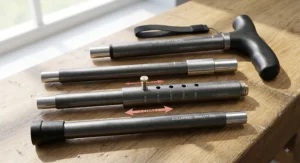
An adjustable walking stick is a mobility aid with a telescopic shaft that lets you set the exact height you need, usually via a spring-loaded push-button, so the same stick can suit a 5ft2in commuter or a 6ft4in gardener. That single feature — adjustability — is the difference between a stick that genuinely takes weight off a sore joint and one that quietly makes your posture worse.
This guide walks (sorry) through seven real, currently available options on amazon.co.uk, spanning budget aluminium models through to all-terrain designs, plus the sizing know-how that most product listings skip entirely: the wrist-crease method, the elbow-to-floor method, and what actually happens to your shoulder when the height is wrong. If you’re shopping specifically for a height adjustable walking stick for a taller relative, or you’ve been told your usual “one size” stick simply doesn’t extend far enough, there’s a dedicated section for that too. According to NHS guidance on walking aids, a correctly fitted stick with an intact rubber ferrule is one of the simplest ways to reduce fall risk — which is exactly why getting the size right matters more than the colour of the handle.
Quick Comparison Table
| Product | Type | Height Range | Best For |
|---|---|---|---|
| NRS Healthcare Adjustable Height Walking Stick (Small) | Standard telescopic | ~710–965mm | Everyday NHS-style support |
| NRS Healthcare Adjustable Height Walking Stick (Tall) | Standard telescopic | ~840–1095mm | Adjustable walking stick for tall users |
| Life Healthcare Folding Walking Stick | Folding, 4-section | Adjustable, folds flat | Travel and occasional use |
| supregear Adjustable Folding Walking Stick | Folding, elastic-corded | Adjustable | Budget-conscious first-time buyers |
| Aidapt Adjustable Height Walking Stick | Standard telescopic | Adjustable | Comfort-focused, wood-effect grip |
| Days Standard Adjustable Walking Stick | Standard telescopic | Adjustable | Clinical-grade daily reliability |
| Rehand All-Terrain Collapsible Walking Stick | Collapsible, pivoting tip | Adjustable | Uneven ground, gravel, countryside paths |
Scanning across this table, you’ll notice the split isn’t really “cheap versus expensive” — it’s “everyday versus specialist.” The NRS Healthcare Adjustable Height Walking Stick (Small) and Days Standard Adjustable Walking Stick cover the bulk of ordinary indoor-and-pavement use, while the Rehand All-Terrain Collapsible Walking Stick‘s pivoting tip earns its keep specifically on uneven ground where a standard ferrule tends to rock. If you’re tall, the standout row is the NRS Healthcare Adjustable Height Walking Stick (Tall), since a handful of “adjustable” sticks quietly stop extending well short of what a 6ft-plus user actually needs.
💬 Already know your height range? Jump straight to the product that fits — full breakdown below.🤗
Top 7 Adjustable Walking Sticks: Expert Analysis
Before diving into each product individually, here’s the side-by-side spec view, since scanning columns beats scrolling seven separate listings.
| Product | Mechanism | Weight (approx.) | Price Range | Best For |
|---|---|---|---|---|
| NRS Healthcare Adjustable Height Walking Stick (Small) | Push-button telescopic | ~550g | Around £10–£20 | NHS-style everyday support |
| NRS Healthcare Adjustable Height Walking Stick (Tall) | Push-button telescopic | ~600g | Around £15–£25 | Taller users, 6ft+ |
| Life Healthcare Folding Walking Stick | 4-section fold + adjust | Lightweight | Around £10–£20 | Travel, car boot storage |
| supregear Adjustable Folding Walking Stick | Elastic-cord folding | Lightweight | Under £15 | First stick on a budget |
| Aidapt Adjustable Height Walking Stick | Push-button telescopic | Lightweight | Around £15–£25 | Comfort grip, gifting |
| Days Standard Adjustable Walking Stick | Push-button telescopic | Lightweight | Around £15–£25 | Clinical/OT-recommended feel |
| Rehand All-Terrain Collapsible Walking Stick | Pivoting-tip, collapsible | Moderate | Around £20–£35 range | Uneven terrain, countryside |
That table earns its place because the numbers alone don’t tell you much until you interpret them: the weight differences between these seven models are honestly marginal — we’re talking a matter of a hundred grams — so don’t let “lightweight” marketing copy be the deciding factor. What actually separates a good pick from a mediocre one is the height range matching your body and the ferrule design matching your terrain, both of which the table above only hints at. Price-wise, most standard aluminium sticks cluster in a fairly narrow band, and paying more typically buys you either a pivoting tip, a nicer handle material, or a folding mechanism rather than fundamentally different support.
1. NRS Healthcare Adjustable Height Walking Stick (Small) — closest thing to the standard NHS-issue stick
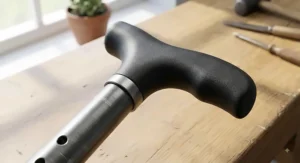
The standout here is familiarity: this is the style many people are handed after a hospital assessment, and buying your own means you’re not stuck waiting on a loan return. The shaft adjusts across a height range of roughly 710–965mm using a spring-loaded push-button, and the large contoured PVC handle spreads pressure across the palm rather than digging into it the way a slim wooden crook can.
Manufacturer information for this model lists a user weight allowance of up to around 127kg (20 stone), which is worth checking against your own needs, since not every budget stick publishes a limit at all. It’s built for right- or left-handed use, which matters more than people expect — holding a stick on the wrong side actively works against your gait rather than supporting it.
Based on the spec comparison with pricier alternatives, this is squarely the “does the job without fuss” option: it won’t fold down, it won’t win style points, but it’s the aluminium workhorse most people actually need for getting round the house and up to the shops. Aggregated customer review themes on Amazon consistently mention sturdiness and good value, with several reviewers specifically noting it “looks like an NHS one” — for some buyers a plus, for others a minor gripe about wanting something less clinical-looking.
Pros:
- ✅ Familiar NHS-style design and fit
- ✅ Generous 127kg (20 stone) rated capacity
- ✅ Contoured handle reduces palm pressure
Cons:
- ❌ Limited to shorter users under the small size
- ❌ Fixed (non-folding) shaft is bulkier to store
Price sits in the around £10–£20 range at the time of research, making it one of the most affordable genuinely adjustable options here — solid value if you just need dependable everyday support.
2. NRS Healthcare Adjustable Height Walking Stick (Tall) — best for taller users needing real extension
This is the sibling model built specifically to answer the most common complaint about “adjustable” sticks: that they simply don’t go high enough. With a height range extending to roughly 840–1095mm, it’s the pick for anyone north of about 5ft10in who has previously bought a standard stick and found themselves hunched over it.
The mechanism is the same reliable push-button telescopic shaft as the smaller sibling, just recalibrated for a taller frame, and the handle geometry stays identical so there’s no trade-off in grip comfort. What most buyers overlook about tall-specific sticks is that height alone isn’t the whole story — a taller shaft also needs to stay rigid rather than flexing under load, and aluminium tubing of this gauge is chosen precisely because it resists that flex better than the thinner tubing sometimes used on ultra-budget folding models.
Aggregated review sentiment specifically calls out the fit for taller users, with several buyers noting a more upright, confident posture once the stick was set correctly — exactly the outcome you’d expect once the elbow bend finally sits in the correct range instead of being forced closed.
Pros:
- ✅ Extends well beyond standard “one size” sticks
- ✅ Same trusted push-button mechanism as the standard version
- ✅ Reviewers specifically praise fit for tall users
Cons:
- ❌ Overkill if you’re under average height
- ❌ Non-folding, so less practical for car boots
Expect a price in the around £15–£25 range — a modest premium over the standard-height version that’s easily justified if you’ve previously been stuck stooping over a too-short stick.
3. Life Healthcare Folding Walking Stick — best all-rounder for travel and occasional use
The standout feature is right there in the name: this one folds. A four-section aluminium shaft collapses down small enough to tuck into a handbag, suitcase, or car door pocket, then pops back out and locks for full support when you need it — genuinely useful if your stick use is occasional rather than constant.
It combines height adjustability with the folding mechanism, comes with a wrist strap so it’s not left leaning (and falling) against furniture, and finishes with a non-slip rubber ferrule as standard. Built for right- or left-hand use, it’s aimed squarely at people who want “confidence insurance” for days out, holidays, or uneven pavements, rather than round-the-clock reliance.
Here’s what the spec sheet won’t tell you, but aggregated reviews do: buyers consistently describe it as excellent quality for the price, praising the compact folded size for travel and holiday use in particular. That’s a meaningfully different use case from the rigid NHS-style sticks above — this is the one you throw in a bag “just in case,” and several reviewers explicitly bought it for exactly that reason before a trip.
Pros:
- ✅ Folds compact for bags, cars and suitcases
- ✅ Wrist strap prevents drops and falls
- ✅ Strong aggregated reviews for travel use
Cons:
- ❌ Folding joints add points that can loosen over time
- ❌ Slightly less rigid feel than a one-piece shaft
Priced around £10–£20 at the time of research, it represents strong value for anyone who wants adjustable support without carrying a full-length stick everywhere.
4. supregear Adjustable Folding Walking Stick — best entry-level pick for first-time buyers
If you’re not yet sure whether you’ll need a stick long-term, the standout advantage here is simply cost of entry. This is a lightweight, elastic-corded folding design — the kind that snaps together section by section — paired with a basic height adjustment mechanism and an ergonomic handle shape.
Because the shaft sections are strung on an internal elastic cord rather than machined into one continuous telescopic tube, the overall build feels noticeably lighter in the hand, which some buyers with limited grip strength genuinely prefer. Based on the spec comparison with the clinical-grade options on this list, it’s fair to say this trades some long-term rigidity for accessibility and price — a reasonable swap if you’re testing whether a stick actually helps before committing to a pricier model.
Reviewers in this budget folding category commonly flag good initial comfort and easy setup out of the box, though — as with most elastic-corded folding sticks generally — long-term joint tightness over months of daily use is the area worth keeping an eye on, since it’s not something Amazon’s own listing photos can show you.
Pros:
- ✅ Genuinely low price point for testing the waters
- ✅ Lightweight, easy to lift and carry
- ✅ Simple folding design for storage
Cons:
- ❌ Elastic-cord joints may loosen with heavy daily use
- ❌ Less robust than fixed telescopic alternatives
At under £15 in most listings, it’s one of the cheapest genuinely adjustable options around, making it a sensible low-commitment starting point.
5. Aidapt Adjustable Height Walking Stick — best for comfort-focused grip and gifting
The standout feature is the handle: a wood-effect grip that looks and feels a step up from standard PVC, which matters more than you’d think if the stick is going to sit in someone’s hand for hours a day, every day. It’s height-adjustable via the usual telescopic shaft and comes with an anti-slip ferrule as standard, plus a hanging carry strap so it can loop over a chair arm rather than sliding to the floor.
What most buyers overlook about handle material is that it directly affects grip fatigue — a smoother, slightly wider profile like this one distributes pressure differently across the palm than a narrow round handle, which can matter for anyone with early-stage arthritis in the hands. Aggregated reviews on this line tend to praise the stability and anti-slip ferrule specifically, alongside general satisfaction with build quality for the price bracket.
This is also a strong option if you’re buying as a gift rather than for yourself — the wood-effect finish reads as considerably less “medical equipment” than a plain aluminium tube, which for some recipients is a genuinely meaningful difference in how willing they are to actually use it.
Pros:
- ✅ Wood-effect handle feels less clinical
- ✅ Anti-slip ferrule included as standard
- ✅ Hanging strap prevents it sliding away
Cons:
- ❌ Handle style adds modest cost over basic models
- ❌ Not a folding design for travel
Sitting around £15–£25 at the time of research, it’s a sensible mid-range pick where appearance and grip comfort genuinely factor into the decision.
6. Days Standard Adjustable Walking Stick — best clinical-grade reliability
The standout here isn’t a flashy feature — it’s pedigree. This model, from the Performance Health Days range, is the sort of stick listed through NHS Supply Chain, which tells you it’s been built to a specification that clinicians are comfortable putting their name behind rather than purely a retail design.
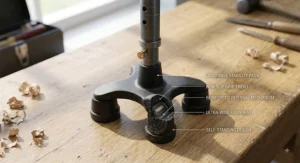
Mechanically it’s the familiar push-button telescopic shaft with a non-slip tip, but the manufacturing tolerances on the locking mechanism tend to feel noticeably tighter than budget alternatives — less shaft wobble once locked, which matters more than it sounds when you’re leaning your full bodyweight through it on a wet pavement. Based on the spec comparison with retail-only brands, this is the kind of stick built to be reissued and re-adjusted repeatedly across different patients, which is a reasonable proxy for durability under daily household use too.
Reviewers and clinical literature around this product line consistently frame it as a dependable, no-surprises daily aid rather than an exciting one — which, frankly, is exactly the review you want to see on a mobility product.
Pros:
- ✅ NHS Supply Chain-listed build quality
- ✅ Tight, low-wobble locking mechanism
- ✅ Consistent, dependable daily performance
Cons:
- ❌ Fairly plain, functional appearance
- ❌ No folding option in the standard line
Expect a price around £15–£25, positioning it directly against the Aidapt Adjustable Height Walking Stick but with a slightly more clinical, less decorative finish.
7. Rehand All-Terrain Collapsible Walking Stick — best for uneven ground and countryside walks
The standout feature is the pivoting tip: instead of a fixed rubber ferrule that only grips properly when the stick meets the ground at close to a right angle, this one rocks slightly to keep full ferrule contact on slopes, kerbs, gravel and uneven paving. If your daily walk isn’t flat pavement, this single feature changes the practical usability more than any handle upgrade could.
It’s also collapsible and height-adjustable, so it packs down for the car while still extending to a proper supportive length once you’re out. Here’s what a flat spec sheet won’t tell you: a pivoting tip only earns its higher price tag if your terrain actually needs it — on smooth indoor flooring it offers no real advantage over a standard ferrule, and some users even describe a very slight “give” underfoot that takes a walk or two to get used to.
Aggregated reviews describe it as sturdy and confidence-inspiring specifically on rougher ground, which lines up with its intended niche — this isn’t the stick for popping to the corner shop, it’s the one for the coastal path or the allotment.
Pros:
- ✅ Pivoting tip grips uneven and sloped ground
- ✅ Collapsible for easy transport and storage
- ✅ Robust build aimed at outdoor terrain
Cons:
- ❌ Pricier than standard flat-ferrule sticks
- ❌ Pivoting action feels unnecessary indoors
At around £20–£35 in the range, it’s the premium pick on this list — worth the extra outlay specifically if uneven terrain is a regular part of your routine rather than an occasional one.
Height Measurement Guide: Finding Your Perfect Walking Stick Height
What height should a walking stick be? As a quick answer: stand upright in your usual shoes, let your arm hang naturally by your side, and the top of the stick handle should line up with the crease of your wrist. That single measurement is the fastest, most widely recommended height measurement guide used across UK mobility retailers and physiotherapy advice sheets alike.
There are two established methods, and it’s worth knowing both because they’re sometimes used interchangeably in product listings, which causes genuine confusion:
- The wrist-crease method. Stand tall, arms relaxed at your sides, feet shoulder-width apart. Measure from the floor straight up to the crease where your hand meets your wrist. That figure is your target stick height.
- Elbow-to-floor sizing. With your arm hanging naturally, measure from your elbow down to the floor, then check that figure against the stick’s stated adjustment range — most standard sticks land you with roughly a 15–20 degree bend at the elbow once the handle is at wrist height, which is the posture physiotherapists actually check for.
- The elbow-bend check. Once adjusted, hold the stick as if walking. Your elbow should sit at that same 15–20 degree bend — not locked straight, not sharply folded.
- The shoulder-level check. Both shoulders should stay level. If one visibly lifts, the stick is too tall; if you’re leaning down into it, it’s too short.
- The walk test. Take several steps. A correctly sized stick should feel like a natural extension of your arm rather than something you’re fighting against.
- Recheck footwear. Always measure in the shoes you’ll actually wear day to day — a 3cm heel changes the maths more than people expect.
- Reassess after ferrule wear. A worn rubber tip effectively shortens the stick over time, so revisit your height setting periodically, not just on day one.
According to a detailed step-by-step walking stick measuring guide, getting this wrong in either direction has real consequences — too short and you’ll stoop forward, straining your back and hips; too tall and your shoulder hikes up, creating tension that compounds over a long day. This is exactly why every product on this list is genuinely height-adjustable rather than fixed-length: it lets you dial in the correct setting rather than compromising with whatever length happened to be in stock.
How the Telescopic Shaft Mechanism Works (And How to Keep It Working)
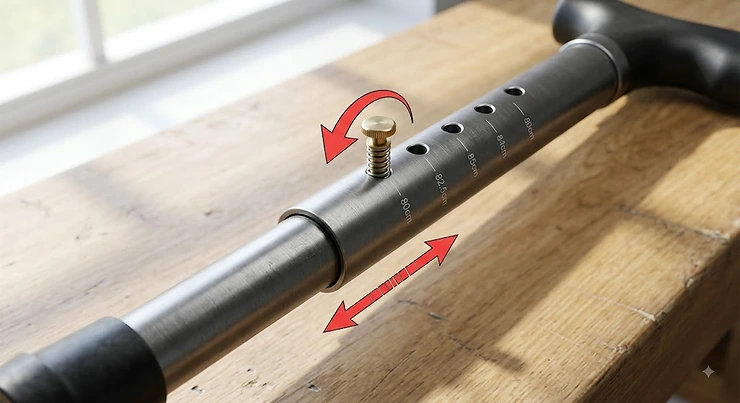
Every stick on this list relies on some version of the same telescopic shaft mechanism, and understanding it takes about thirty seconds but saves a genuine amount of frustration later. The outer tube houses a spring-loaded button; press it, and a smaller inner tube slides freely inside the outer one. Release the button at your chosen height, and it should click firmly into one of a series of pre-drilled holes, locking the shaft rigid at that length.
A few practical tricks that Amazon listings rarely mention: first, always press the button fully before sliding, rather than forcing the tube — forcing it against a half-engaged button is the single most common way these mechanisms get bent or jammed. Second, if the button feels stiff when new, a light spray of silicone lubricant (never oil, which attracts grit) on the inner shaft usually frees it up within a few uses. Third, do a monthly “wobble check”: grip the handle, push down firmly, and feel for any lateral play at the locking point — a small amount is normal, but noticeable movement means the pin or hole has worn and the stick should be retired.
Common mistakes in the first 30 days of ownership are almost always height-related rather than mechanical: people set the stick once, out of the box, standing in socks rather than their usual shoes, and never revisit it. Given that a height adjustable walking stick exists specifically so you can correct this in seconds, it’s worth building a quick monthly recheck into your routine, particularly if you’ve had any changes in footwear, posture, or the condition you’re managing.
✨ Ready to find your fit? Compare the seven picks above against your measured height before you buy.🤗
Adjustable Walking Sticks for Tall Users
If you’re over roughly 5ft10in, you’ve probably already discovered the industry’s dirty little secret: a lot of sticks marketed as “adjustable” simply don’t extend far enough to reach a proper wrist-crease height without you hunching. This isn’t a minor inconvenience — using a stick that’s too short forces you into a stooped posture for every single step, which over weeks can genuinely aggravate back and hip discomfort rather than relieve it.
The fix is straightforward once you know to look for it: check the maximum stated height in the product listing, not just the word “adjustable,” before you buy. The NRS Healthcare Adjustable Height Walking Stick (Tall) on this list is specifically built around this problem, with a maximum extension around 1095mm — noticeably beyond the ceiling of most standard-range sticks, which tend to top out closer to 965mm. If you’re borderline, always size up rather than down; a taller stick set low is a non-issue, but a short stick that won’t reach is a genuine problem.
Tall users also tend to carry proportionally more weight through a longer lever arm, so it’s worth paying attention to the stated maximum user weight where manufacturers publish one, and choosing a shaft gauge that isn’t the thinnest budget option available. Age UK’s falls prevention guidance makes the broader point clearly: a mobility aid only reduces fall risk if it’s actually fitted correctly for the individual using it, and for taller adults that starts with simply buying a stick that goes high enough in the first place.

Real-World Scenarios: Who Actually Needs Which Stick
Scenario one — post-op recovery, mostly indoors and short trips. Someone recovering from a hip or knee procedure, walking short distances around the house and to the local shop, generally benefits most from a standard fixed-shaft telescopic stick like the NRS Healthcare Adjustable Height Walking Stick (Small) or the Days Standard Adjustable Walking Stick — maximum stability, minimal moving parts to worry about, and a familiar, predictable feel underfoot.
Scenario two — occasional use, frequent travel. A retiree who’s steady most days but wants backup confidence on long airport walks, cobbled old-town streets, or day trips benefits from something that packs away when not needed. The Life Healthcare Folding Walking Stick fits this brief precisely — light enough to forget it’s in the bag, sturdy enough to lean on properly when it matters.
Scenario three — active outdoor life on uneven ground. Someone still gardening, walking dogs on countryside paths, or tackling coastal footpaths needs a ferrule that copes with slopes and loose surfaces rather than skating on them. The Rehand All-Terrain Collapsible Walking Stick‘s pivoting tip earns its higher price specifically in this scenario, where a standard flat ferrule genuinely underperforms.
Matching the scenario to the stick — rather than just the budget — is the single biggest factor in whether a purchase actually gets used daily or ends up abandoned by the front door within a month.
Aluminium vs Other Materials: What Actually Matters
Nearly every stick on this list, and the overwhelming majority sold in the UK, is built around an adjustable aluminium walking stick shaft, and there’s a good reason it dominates the market: aluminium offers the best available ratio of strength to weight for a telescopic tube, resists corrosion far better than untreated steel, and can be manufactured to consistent tolerances that make locking mechanisms reliable across thousands of units.
Wood, by contrast, looks classic but is almost always sold as a fixed-length stick that needs cutting to size — a real drawback if your needs change or you’re buying for someone else without their exact measurement in hand. Carbon fibre sticks exist and shave off further weight, but at a price premium that’s genuinely hard to justify for most users, since the weight difference between aluminium and carbon in this size range is a matter of tens of grams, not a transformative difference in daily use.
Features that actually matter: shaft diameter and wall thickness (thicker resists flex under load), locking-pin engagement (a tight click, not a loose wobble), and ferrule tread depth. Features that get marketed hard but matter less than you’d think: handle colour, cosmetic shaft patterns, and “ergonomic” claims that aren’t backed by an actual measurable grip-pressure difference. If a listing leads with colour before it mentions height range or locking mechanism, that’s a fair signal about where the manufacturer’s priorities sat.
Adjustable Walking Stick vs Walking Frame vs Trekking Pole
These three get confused constantly, and picking the wrong category causes more disappointment than picking the wrong stick within the right category.
| Feature | Adjustable Walking Stick | Walking Frame | Trekking Pole |
|---|---|---|---|
| Stability level | Moderate | High | Low–Moderate |
| Portability | Excellent | Poor | Good |
| Typical use | Daily mobility support | Significant balance impairment | Outdoor hiking, single-day use |
| Cost range | Around £10–£35 | Around £25–£60+ | Around £15–£40 |
| Best For | Everyday support, one-sided weakness | Serious balance or stability needs | Active walkers, uneven trails |
A walking stick supports roughly 25% of body weight through one arm and suits people with mild-to-moderate balance concerns or one-sided weakness, whereas a walking frame provides a far wider base and considerably more stability but sacrifices almost all portability — you’re not folding a frame into a handbag. Trekking poles, meanwhile, are designed in pairs for symmetrical, active use on trails and generally aren’t recommended as a substitute for a proper walking stick if the underlying issue is joint pain or balance rather than general hiking support.
The honest guidance from UK physiotherapy resources is to let the underlying need drive the category, not the price tag or appearance — someone with genuine balance instability who buys a stylish stick instead of the frame their GP actually recommended isn’t saving money, they’re taking on unnecessary fall risk.
Common Mistakes When Buying an Adjustable Walking Stick
The first common mistake is buying by eye rather than by measurement — grabbing whatever length “looks about right” in a shop or from a photo online, rather than actually measuring wrist height or elbow-to-floor distance first. The second is ignoring the maximum weight rating entirely; most listings do state one, and it’s worth checking, particularly for taller or larger-framed buyers who put more load through the shaft.
A third mistake is choosing a folding stick purely because it looks neater, without weighing up that folding joints are, mechanically, extra points of potential wear compared with a one-piece telescopic shaft — fine for occasional use, less ideal if you’ll lean on it for eight hours a day, every day. A fourth is forgetting the ferrule entirely: a worn, smooth rubber tip is one of the most preventable causes of a slip, and it’s a five-minute, low-cost fix that many owners simply never think about until it’s caused a problem.
A fifth genuine trap is buying a single stick when a matched pair was actually the appropriate recommendation — if you’ve been advised to use two sticks rather than one, the sizing calculation changes slightly, since paired sticks are typically used marginally longer as they move ahead of the body during a normal gait cycle.
Buyer’s Decision Framework: Which Stick Fits Your Situation
If you’re recovering from surgery and mostly walking indoors, choose a standard fixed telescopic stick like the NRS Healthcare Adjustable Height Walking Stick (Small), because maximum stability with minimal moving parts matters more than portability during recovery.
If you’re over 5ft10in and previous sticks have felt too short, choose the NRS Healthcare Adjustable Height Walking Stick (Tall), because its extended range is built specifically to solve that exact problem.
If you travel regularly or only need occasional support, choose the Life Healthcare Folding Walking Stick, because a folding shaft that disappears into a bag gets used far more consistently than a full-length stick left at home “just in case.”
If your budget is the primary constraint and you’re testing whether a stick even helps, choose the supregear Adjustable Folding Walking Stick, because it offers genuine adjustability at the lowest entry cost on this list.
If handle comfort and appearance matter as much as function — including buying as a gift — choose the Aidapt Adjustable Height Walking Stick, because its wood-effect grip is deliberately less clinical-looking.
If you want the closest thing to a clinically specified stick without an NHS assessment wait, choose the Days Standard Adjustable Walking Stick, because its NHS Supply Chain pedigree signals tighter manufacturing tolerances.
If your daily walking route includes slopes, gravel, or uneven paving, choose the Rehand All-Terrain Collapsible Walking Stick, because its pivoting tip is the only design here engineered specifically for that terrain.
✨ Don’t Miss These Exclusive Deals!
🔍 Whichever profile matches you, click through to check current pricing and availability on today’s top pick — a properly sized adjustable walking stick is one of the simplest upgrades to daily confidence you can make.
Safety, VAT Exemption & UK Regulations Guide
Walking sticks aren’t subject to CE/UKCA marking requirements the way powered mobility equipment is, since they’re simple, non-electrical assistive devices — but that doesn’t mean there’s no regulatory angle worth knowing about. The one that saves UK buyers real money is VAT relief: if you’re chronically sick or disabled, you can typically buy an eligible walking stick VAT-free by completing a simple eligibility declaration at checkout, without needing to provide medical proof upfront.
Per official gov.uk guidance on VAT relief for disabled people, this relief applies specifically to equipment designed or adapted for a chronically sick or disabled person’s own personal or domestic use, and it does not extend to able-bodied people or those with only temporary conditions such as a broken limb. A carer, friend or family member can complete the declaration on someone else’s behalf, which is worth knowing if you’re buying for a parent or partner rather than yourself.
On the safety side, the practical rules are simple but frequently ignored: check the ferrule tread regularly and replace it as soon as it smooths out, don’t use a walking stick as a substitute for a walking frame if that’s what’s actually been recommended, and recheck the height setting after any change in footwear or if the condition being managed changes. None of this is complicated, but skipping it is exactly how a well-chosen stick still ends up contributing to a fall rather than preventing one.
Long-Term Cost & Maintenance
An adjustable aluminium walking stick is, refreshingly, one of the cheaper mobility aids to own long-term. The stick itself is typically a one-off purchase in the £10–£35 range covered across this list, and the only genuinely recurring cost is the ferrule — a replacement rubber tip generally costs a few pounds and is worth budgeting for every six to twelve months of regular use, more often if you’re walking on abrasive surfaces like gravel or concrete daily.
| Cost Factor | Typical Range | Frequency |
|---|---|---|
| Stick purchase | £10–£35 | One-off |
| Replacement ferrule | A few pounds | Every 6–12 months |
| VAT relief (if eligible) | Saves ~20% | Per purchase |
| Folding-joint wear check | Free (self-check) | Monthly |
Set against that modest outlay, the value case is straightforward: a properly fitted stick that genuinely gets used daily is cheap insurance against the far higher personal and NHS cost of a fall-related injury, a point underlined repeatedly in falls-prevention literature. Total cost of ownership over several years is realistically dominated by the initial purchase price rather than upkeep, which makes it sensible to spend slightly more upfront on a stick — like the Days Standard Adjustable Walking Stick or Rehand All-Terrain Collapsible Walking Stick — if its features genuinely match your daily terrain, rather than defaulting to the absolute cheapest option and hoping it fits the bill.
Frequently Asked Questions
❓ What height should an adjustable walking stick be set to?
❓ How does the elbow-to-floor sizing method work?
❓ Can I get an adjustable walking stick free on the NHS?
❓ Are adjustable aluminium walking sticks strong enough for daily use?
❓ What's the best adjustable walking stick for tall users?
Conclusion
Choosing the right adjustable walking stick really comes down to two honest questions: what height do you actually need, and what terrain will you actually be walking on? Get those two answers correct, and almost any of the seven genuine, currently available products covered here — from the budget-friendly supregear Adjustable Folding Walking Stick to the terrain-ready Rehand All-Terrain Collapsible Walking Stick — will serve you well.
What matters more than brand or price is the discipline of actually measuring yourself using the wrist-crease or elbow-to-floor method rather than guessing, checking the maximum height range if you’re tall, and building a habit of rechecking the ferrule and locking mechanism every so often. A telescopic shaft is only as good as the setting it’s locked into, and a five-minute measurement now genuinely beats weeks of unnecessary strain later.
✨ Found the right fit? Check today’s price and availability before you head out!
Recommended for You
- Wooden Walking Stick With Carved Handle: 7 Best Buys 2026
- Derby Handle Walking Stick UK: 7 Top Picks
- Folding Walking Stick Under £20: 7 Brilliant Picks for 2026
Disclaimer: This article contains affiliate links. As an Amazon Associate, I earn from qualifying purchases. If you purchase products through these links, we may earn a small commission at no additional cost to you.
✨ Found this helpful? Share it with your friends! 💬🤗
