In This Article
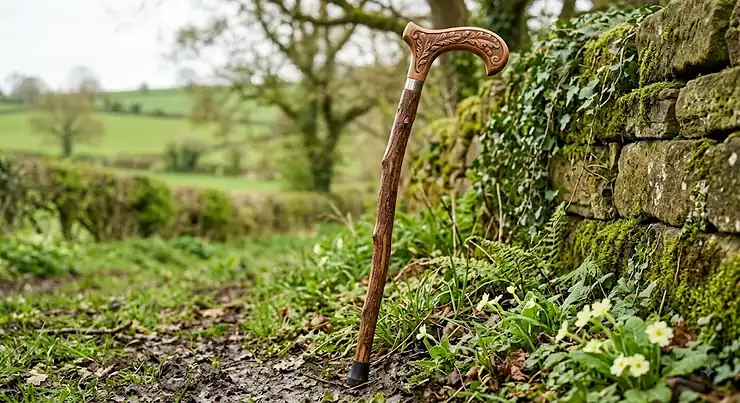
There’s a particular kind of person who buys a wooden walking stick with carved handle and never quite looks at it the same way as a mobility aid again. It becomes something closer to a favourite coat, or a good pair of boots — a thing that earns its keep on every dog walk, church visit, and country ramble, while quietly looking rather good doing it. That’s really the appeal here: proper support dressed up as proper craftsmanship.
This guide walks through seven genuine, currently available sticks — from a humble chestnut crook that costs less than a round of drinks to a gilt-handled heirloom piece from a heritage British umbrella maker. We’ll look at what the wood actually does underfoot, what “hand-carved” really means versus what it often means on a rushed production line, and how to buy one as a gift without accidentally insulting someone’s independence. Along the way you’ll find honest, sourced commentary rather than a rewritten product page — because, frankly, nobody needs another list of dimensions with no opinion attached.
According to NHS guidance on walking aids, getting the height and handle style right matters as much as the material — so we’ll cover fitting alongside aesthetics. Whether you’re shopping for yourself, a parent, or a retirement gift, by the end of this piece you should know exactly which of these seven sticks suits your situation, and why.
What Is a Wooden Walking Stick With Carved Handle?
A wooden walking stick with carved handle is a solid-wood mobility aid — typically chestnut, hazel, beech, or acacia — topped with a hand-shaped or hand-cut grip, ranging from a simple curved crook to an intricately carved animal head. Unlike moulded plastic or aluminium canes, the handle is worked from the timber itself (or a separate carved piece), giving each stick a distinct grain, weight, and character.
Quick Comparison Table
| Product | Wood/Material | Handle Style | Price Range | Best For |
|---|---|---|---|---|
| Traditional Chestnut Crook Stick (NHS Style) | Chestnut | Crook | around £15-£25 | Budget-conscious first-time buyers |
| Linden Leisure Hazel Knob Stick | Hazel, bark-on | Natural knob | roughly £20-£30 | Rustic, countryside look |
| Royal RC Irish Hazel Handcrafted Cane | Irish hazel | Handcrafted knob | £30-£40 range | Everyday support with character |
| Classic Canes Acacia Derby | Acacia | Derby (ergonomic curve) | around £45-£60 | Comfortable daily grip |
| Carved Fox Walking Stick | Hardwood | Carved fox head | roughly £45-£65 | Distinctive gift-giving |
| Classic Canes Derby Folding (Black Floral) | Beech, folding | Derby, decorative | £40-£55 range | Travel and storage |
| Fox Umbrellas FWS7 Gilt Animal Head Stick | Beech shaft, gilt head | Carved animal head | premium, typically £150-£250+ | Heirloom-quality gifting |
Looking at the spread above, there’s a genuine jump in both price and finish once you move from mass-produced hazel and chestnut sticks into heritage-brand territory, and that jump tends to buy you tighter joinery and a handle that’s been individually shaped rather than turned on a lathe in batches. The middle of the table — the Royal RC Irish Hazel Handcrafted Cane and the Classic Canes Acacia Derby — is where most buyers land, because it balances a genuinely comfortable grip against a price that doesn’t feel like a splurge. If you’re buying for daily, practical use rather than as a keepsake, that middle band is worth lingering on before you’re tempted upmarket.
💬 Found a stick you like already? Scroll down for the full breakdown, or jump straight to check current pricing and availability.
Top 7 Wooden Walking Sticks With Carved Handles: Expert Analysis
1. Traditional Chestnut Crook Stick (NHS Style) — best budget starter stick
The standout feature here is honesty: this is essentially the same crook-handled chestnut stick issued in NHS physiotherapy departments up and down the country, just sold direct rather than through a hospital stores cupboard.
Chestnut is a dense, straight-grained hardwood that resists splitting under repeated weight-bearing use, and the crook handle — a simple curved hook rather than a carved figure — distributes pressure across the palm instead of concentrating it in the fingers. Most versions come at a fixed length just under a metre and are designed to be cut down to size at home. Based on the spec comparison with pricier options, what you’re sacrificing isn’t durability so much as ornamentation — this is a working stick, not a display piece.
This is the one to buy if you or a relative need a stick urgently, on a tight budget, and want something that matches what a physiotherapist would actually recommend rather than a novelty item. Reviewers consistently report that the crook shape is comfortable for extended wear and that the stick holds up well to daily outdoor use, though a recurring theme in feedback is that buyers need to take real care and time when trimming it to height, since a stick cut too short can’t be lengthened again.
Pros:
- ✅ Matches genuine NHS-style crook handle design
- ✅ Chestnut wood is tough and weather-resistant
- ✅ Very accessible entry price for first-time buyers
Cons:
- ❌ Requires careful at-home cutting to length
- ❌ Plain crook shape lacks decorative carving detail
At around £15-£25, this is about as close as you’ll get to a like-for-like NHS stick without an appointment, and it represents strong value if function is your priority over flair.

2. Linden Leisure Hazel Knob Stick — most rustic natural finish
The standout feature is the bark-on, root-topped knob handle, which keeps far more of the tree’s natural character than a sanded, stained alternative.
Hazel has long been prized for stick-making because it’s flexible enough to season into a curved handle without cracking, and this model leans into that heritage with a rounded root-ball grip rather than a shaped derby curve. The natural knob sits comfortably in the palm for shorter walks, though it offers less consistent ergonomic support over long distances than a purpose-carved handle. What most buyers overlook about hazel is that its lightness — noticeably less dense than chestnut or acacia — makes it a genuinely easier stick to carry for anyone with weaker grip strength or wrist discomfort.
This suits walkers who want a stick that looks foraged rather than manufactured, ideal for country walks, allotment visits, or simply leaning against a garden fence between uses. Aggregated feedback on similar bark-on hazel sticks tends to flag natural variation as both the appeal and the catch: no two sticks are identical, and buyers should expect knots, colour shifts, and irregular grain rather than a uniform finish.
Pros:
- ✅ Genuinely unique grain and bark pattern each time
- ✅ Lightweight hazel is easy on tired wrists
- ✅ Strong rustic, countryside aesthetic
Cons:
- ❌ Knob shape less ergonomic for long walks
- ❌ Natural variation means no two sticks match exactly
Priced roughly £20-£30, it’s a fair trade for buyers who value character over consistency.
3. Royal RC Cane Authentic Irish Hazel Walking Cane — best character-driven everyday cane
The standout feature is provenance: this cane is cut from genuine Irish hazelwood and finished with a handcrafted knob handle rather than a machine-turned one.
At around 36 inches, it’s built to suit users up to roughly 6’2″, with the handle sanded and polished by hand for a smoother grip than the raw-bark alternative above. Because hazel is a naturally variable wood, the maker is upfront that colour, shape, and knob size will differ between individual sticks — which, on paper, means you’re buying craftsmanship and character rather than factory-line uniformity. Here’s what to weigh: if you want a stick that photographs identically to the listing image every time, this isn’t it; if you want one that feels like it has a story, it’s a strong pick.
It’s well suited to daily walkers who want something with genuine Celtic heritage behind it — hazelwood carries a long folkloric association in Irish tradition — without paying premium-brand prices. Reviewers consistently note the comfortable grip and sturdy feel of the finished knob, alongside occasional comments about the stick arriving slightly different in appearance from what was pictured, which is simply the nature of a handcrafted natural-wood product.
Pros:
- ✅ Genuine Irish hazelwood with cultural heritage
- ✅ Hand-sanded knob handle for a smooth, secure grip
- ✅ Lightweight yet strong for daily support
Cons:
- ❌ Natural variation means appearance isn’t guaranteed
- ❌ Fixed length may need professional cutting for shorter users
In the £30-£40 range, it strikes a genuinely good balance between authenticity and affordability.
4. Classic Canes Gents Classic Acacia Derby Walking Stick — best all-round ergonomic grip
The standout feature is the derby handle itself — a shape specifically engineered, not just carved, to sit naturally under a resting palm.
Acacia is a hard, close-grained timber with an attractive, varied colour pattern, and Classic Canes — a long-established British stick and cane maker — fits this model with a non-slip rubber ferrule and a fixed 36-inch (92cm) length. What the spec sheet won’t tell you, but decades of orthopaedic design will, is that the derby curve is specifically shaped to reduce pressure on the wrist compared with a straight knob, because the hand can wrap around rather than balance on top of it. For anyone walking longer distances or using the stick for genuine daily support rather than occasional style, that difference in wrist strain adds up.
This is the pick for buyers who want a proper everyday support stick that doesn’t look clinical — smart enough for a wedding, sturdy enough for a supermarket run. Aggregated customer sentiment around Classic Canes’ derby range consistently praises the comfort of the handle shape and the quality of the acacia finish, with the main criticism being the fixed length, which won’t suit unusually tall or short users without a trim.
Pros:
- ✅ Ergonomic derby shape reduces wrist strain
- ✅ Attractive acacia grain with genuine hardwood durability
- ✅ Trusted, long-established British stick maker
Cons:
- ❌ Fixed length, not height-adjustable
- ❌ Not foldable for travel or storage
At around £45-£60, it’s arguably the strongest all-rounder on this list for genuine daily use.
5. Carved Fox Walking Stick — Handmade Wooden Cane — best distinctive carved gift
The standout feature is obvious the moment you pick it up: a genuinely hand-carved fox head handle, shaped and finished for both left- and right-handed grips.
The maker states the stick supports users up to around 242 lbs (roughly 17 stone), and the handle is worked from solid hardwood rather than a resin or composite cast — a distinction that matters because cast handles can feel hollow and cold in comparison. Based on the spec comparison with the more minimalist knob and derby sticks above, this is squarely a personality piece: the carving is the entire point, not an afterthought bolted onto a functional shaft. Reviewers consistently flag the detail of the carving and the smoothness of the finish as the highlights, which tracks with its handmade billing.
This is the stick to consider when the person you’re buying for has a genuine fondness for foxes, countryside iconography, or simply wants a conversation piece rather than a purely practical aid. It suits gift-giving occasions — a retirement, a milestone birthday, a “well done on the hip replacement” gesture — more than it suits someone shopping purely on a budget.
Pros:
- ✅ Genuinely hand-carved fox head, not moulded resin
- ✅ Works comfortably for left- or right-handed grip
- ✅ Strong weight capacity for a decorative-style cane
Cons:
- ❌ Premium detailing pushes it above basic knob sticks
- ❌ Carved handles need gentler care than plain wood
Expect to pay roughly £45-£65, which for genuinely hand-worked carving is a fair price point rather than a luxury one.

6. Classic Canes Derby Folding Walking Stick (Black Floral) — best for travel and storage
The standout feature is practicality dressed as decoration: a derby-handled stick that folds into four sections while still carrying a distinctive black floral pattern along the shaft.
Height-adjustable across roughly 82-92cm (32-36 inches), it’s built with a large-base ferrule for extra stability and a sturdy folding mechanism that tucks away into a handbag or car door pocket. On paper this means you get the ergonomic comfort of a proper derby grip without committing to a single fixed-length stick that’s awkward to carry when not in use. Aggregated reviews on Classic Canes’ folding range are broadly positive about the comfort and print detail, though a recurring theme — worth flagging honestly — is that buyers occasionally report receiving a variant with a different pattern or a smaller, less secure grip than expected, so checking current photos and the seller’s return policy before ordering is sensible.
This suits commuters, frequent travellers, or anyone who needs a stick some days but not others and doesn’t want a permanent fixture leaning by the door. It’s a genuinely different use-case from the fixed sticks above, trading a small amount of rigidity for real convenience.
Pros:
- ✅ Folds compactly for bags, cars, and travel
- ✅ Height-adjustable across a useful range
- ✅ Distinctive floral pattern alongside derby comfort
Cons:
- ❌ Folding joints add a small point of mechanical wear
- ❌ Some buyers report pattern or grip variation on delivery
In the £40-£55 range, it’s a sensible premium over a fixed stick if portability genuinely matters to your routine.
7. Fox Umbrellas FWS7 Gilt Finish Animal Head Walking Stick — best heirloom-quality gift
The standout feature is provenance and finish: a black beech shaft topped with a genuine gilt-finished carved animal head, made by a long-established British umbrella and stick maker rather than a mass importer.
The stick measures approximately 35.5 inches (90cm) as standard, can be shortened to a required length, and ships with both a metal ferrule and a removable rubber overshoe — a small but telling detail that shows attention to both formal and everyday use. What most buyers overlook about a stick at this price point is that you’re paying largely for the handle casting and finishing process, not just the timber; the gilt animal head is a separate crafted component fitted to the shaft, which is a genuinely different manufacturing approach from a single block of carved wood. Buyers can also opt for a brass collar with engraving, which turns this from “a nice stick” into a proper personalised gift.
This is the pick for milestone occasions — a significant retirement, an anniversary, a genuinely special thank-you — where budget is secondary to giving something with real heritage and craftsmanship behind it. It’s a British-made piece in a market where a lot of “carved handle” sticks online are imported and mass-produced, and that provenance is reflected in the price.
Pros:
- ✅ Genuine British heritage maker, not a mass import
- ✅ Detailed gilt-finish carved handle with real presence
- ✅ Optional engraved brass collar for personalisation
Cons:
- ❌ Premium, typically £150-£250+ price
- ❌ Overkill for casual, everyday walking needs
This is genuinely the “buy once, keep forever” option on this list, priced accordingly.
Top 7 Products At a Glance
| Product | Approx. Price Range | Handle Comfort | Carving Detail | Best Occasion |
|---|---|---|---|---|
| Traditional Chestnut Crook Stick (NHS Style) | around £15-£25 | Good | Minimal | Everyday, urgent need |
| Linden Leisure Hazel Knob Stick | roughly £20-£30 | Fair | Natural, unshaped | Countryside walks |
| Royal RC Irish Hazel Handcrafted Cane | £30-£40 range | Good | Hand-finished knob | Daily use with character |
| Classic Canes Acacia Derby | around £45-£60 | Excellent | Shaped derby | Everyday, formal-capable |
| Carved Fox Walking Stick | roughly £45-£65 | Good | High (carved head) | Gifts, personality pieces |
| Classic Canes Derby Folding (Black Floral) | £40-£55 range | Excellent | Decorative print | Travel, occasional use |
| Fox Umbrellas FWS7 Gilt Animal Head Stick | premium, £150-£250+ | Excellent | Very high (cast head) | Heirloom, milestone gifts |
Read across the table and a pattern emerges: handle comfort and carving detail don’t rise in a straight line with price — the Classic Canes Acacia Derby matches the far pricier Fox Umbrellas FWS7 on ergonomic comfort despite costing a fraction of the price. Where the premium options genuinely pull ahead is in visual craftsmanship and provenance, which matters enormously for gifting but far less for a stick that’s going to spend its life propped by a back door. If comfort is your only concern, don’t assume you need to spend at the top of this table to get it.
How to Choose a Traditional Wooden Walking Stick
- Measure first, browse second. Stand upright in your usual shoes and measure from the crease of your wrist straight down to the floor — that’s your target stick height, and it matters more than any handle style.
- Match the handle to the hand. A crook or derby handle suits users needing sustained wrist support; a knob suits lighter, occasional use.
- Decide fixed or foldable. Fixed sticks are more rigid and stable; folding sticks trade a little sturdiness for genuine portability.
- Check the wood, not just the look. Chestnut and acacia are denser and more weather-resistant than hazel, which is lighter but softer.
- Confirm the ferrule. A worn or missing rubber ferrule is a genuine slip hazard — always check it’s rated for outdoor use.
- Consider weight capacity. Carved handle sticks vary in their stated support weight — don’t assume every stick suits every body type.
- Think about who’ll actually use it. A stick bought as a stylish gift still needs to function daily, so don’t let carving detail override comfort.
Practical Usage Guide: Caring for Your Carved Handle Walking Cane
Getting a new carved handle walking cane home is only step one — how you treat it in the first few months genuinely affects how long it lasts. Start by checking the ferrule fit before first use; a loose rubber tip is one of the most common early failures and takes seconds to press back into place. If the stick needs cutting to height, measure twice, mark with pencil, and cut slightly long rather than short, since wood can always be trimmed further but never lengthened back.
For maintenance, wipe the shaft down after wet walks rather than leaving it to dry naturally, since standing water at the base can work its way into the grain over time and cause splitting, particularly in unvarnished hazel. A light coat of beeswax polish every few months keeps both plain and carved handles from drying out, and it’s worth avoiding harsh household cleaners on carved detail, since these can strip natural oils from the wood and dull fine carving lines. One common first-30-days mistake is storing a new stick flat on a damp floor or against a radiator — both encourage warping. A simple wall hook or umbrella stand solves this instantly and keeps the handle detail facing outward, which, if we’re honest, is half the reason you bought a carved one in the first place.

Real-World Scenarios: Who a Wooden Walking Stick Gift Actually Suits
Picture three different people, each shopping for the same broad category with very different needs. First, there’s a retired teacher in her seventies, recovering well from a hip operation, who walks the dog twice daily on mixed pavement and park paths — for her, the Classic Canes Acacia Derby makes sense: the ergonomic handle supports daily, sustained use without looking overtly medical.
Second, there’s a nephew buying his grandfather a seventieth birthday present, knowing he’s an avid countryside walker with a soft spot for wildlife — here, the Carved Fox Walking Stick lands perfectly, doubling as both a practical aid and a personality-driven gift that says more than a card ever could. Third, there’s a daughter buying for her father’s retirement after forty years in a firm — a milestone that arguably deserves the Fox Umbrellas FWS7 Gilt Finish Animal Head Walking Stick, engraved collar and all, as something he’ll keep long after the leaving speeches are forgotten.
None of these three needed the same stick. That’s really the point of shopping this category properly rather than grabbing whichever carved stick shows up first in search results.
Problem → Solution: Common Walking Stick Issues Solved
Problem: the stick feels too tall or too short after a few weeks of use. This is usually a fitting issue rather than a faulty product — recheck the wrist-crease measurement and adjust or re-trim accordingly, as posture and gait can shift slightly once someone gets used to walking with support.
Problem: the handle feels slippery in wet weather. A plain varnished handle can become genuinely hazardous when damp; a light wrap of grip tape underneath a decorative handle, or switching to a more textured carved surface like the Carved Fox Walking Stick, solves this without compromising the look.
Problem: the ferrule wears out faster than expected. This is common on sticks used daily on rough or gritty pavements — buying a spare ferrule at purchase time (widely available from pharmacies) avoids an unplanned gap in mobility support later.
Problem: a gifted stick feels too “medical” for the recipient. Swapping a plain crook for something like the Royal RC Irish Hazel Handcrafted Cane or a carved-handle option reframes the object entirely — from clinical aid to genuine accessory — which matters enormously for someone adjusting to needing support for the first time.
Buying a Walking Stick as a Gift: A Decision Framework
If the recipient is newly reliant on support and self-conscious about it, choose a stick with strong aesthetic character — like the Carved Fox Walking Stick — because it reframes the object as a style choice rather than a medical necessity.
If the occasion is a genuine milestone — retirement, a significant anniversary, recovery from major surgery — choose a heritage-brand piece such as the Fox Umbrellas FWS7 Gilt Animal Head Walking Stick, because the provenance and personalisation options carry real sentimental weight.
If budget is the primary constraint but you still want the gift to feel considered, choose the Royal RC Irish Hazel Handcrafted Cane or Linden Leisure Hazel Knob Stick, because natural variation in the wood already makes each one feel individual without a premium price tag.
If the recipient travels frequently or splits time between homes, choose the Classic Canes Derby Folding (Black Floral), because portability will matter more day-to-day than outright carving detail.
Chestnut vs Hazel Wood: Which Makes the Better Walking Stick?
Chestnut and hazel are the two most common British stick-making woods, and they behave quite differently underfoot. According to the Woodland Trust’s profile of hazel, the tree has been coppiced for thousands of years specifically because its stems grow long, straight, and flexible — properties that translate directly into a lighter stick with more natural give. Chestnut, by contrast, is a denser hardwood more closely related to oak, which the Woodland Trust notes is traditionally coppiced for durable poles precisely because it resists splitting under load.
In practice, that means hazel sticks — like the Linden Leisure Hazel Knob Stick and Royal RC Irish Hazel Handcrafted Cane — suit users who value a lighter carry and a more rustic, unfinished look, while chestnut sticks — like the Traditional Chestnut Crook Stick (NHS Style) — suit users who want maximum durability under regular, heavier weight-bearing use. Neither is objectively “better”; the right choice depends on whether you’re prioritising comfort of carry or long-term structural resilience.
Hand-Carved Craftsmanship: What Sets a Real Carving Apart
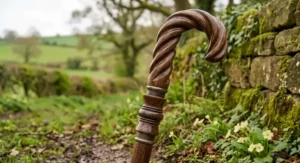
Not every stick marketed as “carved” involves a person with a knife and genuine skill — plenty of budget listings use the word loosely to describe a lathe-turned knob or a cast resin head glued onto a plain shaft. The Carved Fox Walking Stick and the Fox Umbrellas FWS7 Gilt Animal Head Walking Stick sit at the genuine end of that spectrum: one worked directly from solid hardwood, the other cast and gilt-finished as a distinct handle component fitted by a heritage maker.
What most buyers overlook is that genuine hand-carving shows up in small asymmetries — a slightly deeper line on one side, a subtly different curve — that a mould simply can’t replicate twice. On paper this means two things for the buyer: first, that a truly hand-carved stick will never be perfectly identical to its listing photo, and second, that fine carved detail needs gentler cleaning than plain wood, since abrasive cloths or harsh polish can flatten the crispness of the lines over time.
Carved Handle vs Standard Handle: What’s the Real Difference
A standard handle — whether a plain knob, crook, or derby — is shaped purely for grip and weight distribution, with form following function. A carved handle adds a decorative or figurative element on top of that functional base, whether that’s the animal head on the Carved Fox Walking Stick or the cast gilt finish on the Fox Umbrellas FWS7.
The trade-off is fairly consistent across this category: carved handles generally cost more, require more careful cleaning, and occasionally sacrifice a small amount of ergonomic optimisation to accommodate the design, since a fox’s nose or an animal’s ear doesn’t always sit as naturally under the palm as a pure derby curve. Based on the spec comparison across all seven products here, buyers chasing pure daily comfort should lean standard — the Classic Canes Acacia Derby is a strong example — while buyers prioritising personality, gifting, or visual statement should lean carved, accepting the slightly higher maintenance that comes with it.
Common Mistakes When Buying a Traditional Wooden Walking Stick
The single most common mistake is buying on length assumption rather than measurement — a stick that “looks about right” online frequently isn’t, and a stick cut too short can’t be fixed. The second is prioritising decorative carving over handle comfort for someone who’ll be using the stick for hours a day; a beautiful fox head is no substitute for proper wrist support if daily use causes strain.
A third mistake is overlooking wood type entirely — buyers often focus purely on handle style and price, without realising that hazel and chestnut genuinely differ in weight and durability, as covered above. Finally, a surprisingly common error is forgetting to check the ferrule condition on arrival; even a brand-new stick can occasionally ship with a poorly seated rubber tip, and walking on it before checking is a real, avoidable slip risk.
Long-Term Cost & Maintenance
A wooden walking stick’s total cost of ownership is genuinely low compared with most mobility aids, but it isn’t zero. Beyond the initial purchase — say, £20 for the Traditional Chestnut Crook Stick through to £200+ for the Fox Umbrellas FWS7 — expect to budget for the occasional replacement ferrule (typically a few pounds from a pharmacy) every year or two of regular use, plus an occasional pot of beeswax polish to protect the finish.
Compared with a folding aluminium cane, which can develop mechanical faults in the locking joint over time, a solid wooden stick has fewer moving parts to fail, which arguably makes it the better long-term value proposition for anyone using it daily over several years rather than occasionally. The exception is the folding Classic Canes Derby (Black Floral), where the hinge mechanism is worth checking periodically, much like any folding product.
Safety, Fitting & Compliance Guide
Getting the height right isn’t a stylistic detail — it directly affects posture, balance, and long-term joint strain, which is why NHS physiotherapy guidance is consistent on measuring to the wrist crease before purchase. Beyond fitting, it’s worth knowing that if you’re chronically ill or disabled, certain mobility aids purchased for personal use may qualify for VAT relief under UK government guidance on VAT relief for disabled people — though a plain decorative walking stick bought purely for general use typically won’t qualify, so it’s worth checking eligibility criteria before assuming a discount applies.
Practically, always check the ferrule before first use, avoid using any stick — however well carved — on genuinely icy or heavily wet surfaces without extra caution, and replace a cracked or smooth-worn ferrule immediately rather than waiting for a fall to prompt it.
✨ Ready to find your fit? Compare current prices and availability before your next walk.
Features That Actually Matter (And Those That Don’t)
What actually matters: handle shape relative to how you’ll grip it daily, correct height, a properly seated ferrule, and wood density suited to how heavily you’ll lean on it. These four factors genuinely affect comfort, safety, and longevity.
What matters far less than marketing suggests: exotic wood names with no real functional benefit over chestnut or hazel, elaborate box packaging, and handle carvings so intricate they compromise grip texture. A beautifully carved handle that’s slippery in the rain isn’t a good trade, however striking it looks in a listing photo.
Frequently Asked Questions
❓ What is the correct height for a wooden walking stick?
❓ How much does a hand-carved wooden walking stick cost?
❓ Is a wooden walking stick better than an aluminium one?
❓ What wood is best for a walking stick handle?
❓ Can I get a wooden walking stick VAT-free?
Conclusion
Choosing a wooden walking stick with carved handle really comes down to two honest questions: how will it actually be used day to day, and how much of the decision is about sentiment versus function? For pure daily support on a sensible budget, the Classic Canes Acacia Derby and Royal RC Irish Hazel Handcrafted Cane both earn their place through genuine ergonomic comfort. For gifting, the Carved Fox Walking Stick strikes a lovely balance between personality and price, while the Fox Umbrellas FWS7 Gilt Finish Animal Head Walking Stick is the one to reach for when a milestone genuinely deserves an heirloom.
Whichever you choose, get the height right first — every other feature on this list is secondary to a stick that actually fits the person using it. Beyond that, let personality lead: a stick you’re proud to carry is one you’ll actually reach for every single day.
✨ Don’t Miss These Exclusive Deals!
🔍 Take your search for the perfect wooden walking stick with carved handle to the next level with these carefully selected picks. Click through to check current pricing and availability — a stick this good deserves to be out on the road, not sitting in a browser tab!
Recommended for You
- Derby Handle Walking Stick UK: 7 Top Picks
- Folding Walking Stick Under £20: 7 Brilliant Picks for 2026
- Best Rollator for Travelling 2026: 7 Top Picks Ranked
Disclaimer: This article contains affiliate links. As an Amazon Associate, I earn from qualifying purchases. If you purchase products through these links, we may earn a small commission at no additional cost to you.
✨ Found this helpful? Share it with your friends! 💬🤗
