
In This Article
Crutch ice grips are small spiked or high-traction attachments that fit over or onto the base of a crutch. They give the tip something to bite into when a pavement turns to glass. Most are flip-up or retractable, so the spikes go down outdoors and up indoors. In short, they turn an ordinary rubber tip into a winter-ready one.

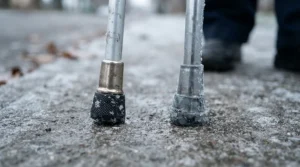
Here’s the uncomfortable truth about winter on crutches. The standard rubber tip is brilliant on a dry hospital corridor. It is frankly hopeless on frosted paving slabs, wet leaves and that grey slush outside the chemist. Forearm crutches are the dominant type across Europe, which means a great many British crutch users are putting their whole weight through a tip often no wider than a 20p coin. One bad placement and the crutch skates away from under you.
That’s why this guide exists. Below you’ll find seven real products, from pocket-money flip-down claws to premium cleated tips. We look at spiked crutch tips, slip-over snow and ice crutch attachments, and the everyday realities of winter crutch feet. We also look at the sobering side of slip-and-fall injuries and what proper winter recovery safety looks like once the grips are on.
A word on method. This article synthesises manufacturer specifications, an independent hard-ice test published by Reviewed, and buyer comments found on retailer listings. None of it comes from hands-on testing by me. Where I couldn’t verify a meaningful pool of customer reviews, I say so rather than guess.
Quick Comparison: Best Crutch Ice Grips at a Glance
| Product | Best For | Price Range |
|---|---|---|
| Ice Grip Claw for Walking Sticks | Trying spikes on a tiny budget | Under £5 |
| Drive Medical Walking Stick Ice Grip | Everyday flip-up convenience | Under £10 |
| DMI Retractable 5 Prong Attachment Tip | Hard ice and packed snow | Budget bracket, check current price |
| Mars Wellness Heavy Duty Metal 4-Prong Ice Cane Tip Attachment | Value for two crutches | Budget bracket, check current price |
| Thomas Fetterman Ice Grip Tips | Standard crutches, sold as a pair | Check current price |
| Tips That Grip Snowboot Crutch Tip | Limited dexterity, no tools | Check current price |
| Ergoactives Ergocap Retractable Spikes X-Treme | Indoor-outdoor use in one tip | Premium, check current price |
Looking at the table, the Ice Grip Claw for Walking Sticks and the Drive Medical Walking Stick Ice Grip are the easy on-ramps for anyone who just wants spikes for a cold week. The DMI Retractable 5 Prong Attachment Tip and Mars Wellness Heavy Duty Metal 4-Prong Ice Cane Tip Attachment are the ones with the strongest independent evidence on hard ice. If screwdrivers and nimble fingers aren’t your thing, the Tips That Grip Snowboot Crutch Tip is the only slip-over option here.
💬 Just one click: help others make better buying decisions too!😊
Top 7 Crutch Ice Grips: Expert Analysis
Every product below gets the same treatment: what the spec means in practice, who it suits, what buyers and testers report, and whether the price makes sense. Prices are ranges only and change constantly, so check the current price and availability before you buy.
1. Ice Grip Claw for Walking Sticks — widest fit range for the money
The headline feature is flexibility. This retractable claw is listed as fitting tube sizes from 16mm to 27mm, a spread that covers slim aluminium sticks and chunkier crutch shafts alike. That matters because the number one reason winter attachments get returned is a ferrule that simply doesn’t fit.
Retractability means you flip the spikes down for the pavement and back up before you step onto the kitchen tiles. On paper, that protects both your floors and your footing indoors. It’s marketed at walking sticks rather than crutches, so measure your own tube before assuming compatibility.
My analytical take is simple. This is the “try before you commit” buy, ideal for a short-term crutch user or a spare set for the car. I couldn’t verify a sizeable pool of customer reviews for it, so treat it as lightly proven rather than battle-tested.
Pros:
- ✅ Very wide 16mm to 27mm diameter range
- ✅ Retractable for safe indoor use
- ✅ Cheap enough to buy a spare
Cons:
- ❌ Marketed for walking sticks, not crutches
- ❌ Little independent test evidence available
Price range: under £5 at the specialist retailer I checked. As a low-risk experiment, the value is hard to argue with.
2. Drive Medical Walking Stick Ice Grip — five-point flip-up from a mobility name
Drive pitches this as a five-point design, and the extra points do real work. On uneven, rutted ice, more points mean a better chance that several will bite at once rather than a single pin doing all the labour. It’s listed as fitting most sticks and crutches with tubing between 19mm and 22mm, so that narrow window is where you need to be careful.
The flip-up feature is the daily-life selling point. You drop the claw at the front door, lift it again indoors, and the rubber tip stays underneath doing its normal job. For anyone with reasonable hand strength, that’s a ten-second routine.
Who is it for? Adult crutch and stick users who want a recognised mobility brand and a simple mechanism. The fitting claims come from the retailer listing rather than from customer reviews, which I couldn’t verify in any real volume, so test the fit on a dry day first.
Pros:
- ✅ Five-point design for better contact on uneven ice
- ✅ Flip-up action for indoor use
- ✅ Established mobility-aid brand
Cons:
- ❌ Narrow 19mm to 22mm fit window
- ❌ Check pack size: you need one per crutch
Price range: under £10 at the specialist retailers I looked at. Good value if your ferrules sit inside the fit range.
3. DMI Retractable 5 Prong Attachment Tip — sharpest bite on hard ice
The standout here is evidence. In Reviewed’s lab test, which involved trays of frozen water and rising force, the DMI’s sharper spikes barely budged on hard ice. It has a slightly larger circular base than a comparable four-prong rival, which spreads load and steadies the tip.
The catch is installation. You need a cross-head screwdriver to attach it to the shaft, and the spring-loaded retractor has a small learning curve. Because it can be used with a regular tip underneath, you can keep your normal rubber tip for indoors.
This one suits confident, dexterous users facing proper winter: rural paths, frozen car parks, compacted snow. Reviewed’s testers flagged that flipping up the spikes demands dexterity. They also noted that it’s sold one per box, so crutch users must buy two. That comes from an independent test rather than a large customer-review pool.
Pros:
- ✅ Sharper spikes held firm on hard ice
- ✅ Works with a regular tip underneath
- ✅ Retractable via spring mechanism
Cons:
- ❌ Needs a screwdriver and some dexterity
- ❌ Sold singly, so budget for a pair
Price range: budget bracket, though UK listings vary, so check current price. Best strength-per-pound pick for hard ice.
4. Mars Wellness Heavy Duty Metal 4-Prong Ice Cane Tip Attachment — the double-pack value pick
Reviewed describes this as almost identical to the DMI, with slightly duller spikes. That small difference nibbled at its test performance, but it still performed very strongly on ice. The big practical advantage is the double pack, which means one purchase covers both crutches.
Like its rival, it needs a screwdriver to fit and has a spring retractor that takes a few goes to master. It fits over standard tips, which keeps your indoor set-up intact.
Think of it as the sensible alternative when the DMI is out of stock, or when you’d rather not pay twice. Reviewed’s verdict was that it would serve you well in that situation. Again, that’s independent testing rather than a verified customer-review pool, so I’m flagging the evidence honestly.
Pros:
- ✅ Double pack covers both crutches
- ✅ Very strong performance on ice in testing
- ✅ Flips up for versatility
Cons:
- ❌ Slightly duller spikes than the DMI
- ❌ Screwdriver installation and learning curve
Price range: budget bracket, check current price. Value is excellent because the pack size removes the hidden second purchase.
5. Thomas Fetterman Ice Grip Tips — a pair built around standard crutches
Fetterman is a US mobility brand known for crutches, tips and hand grips, and these are listed as steel attachments for standard canes and crutches. They’re sold as a pair, which immediately sets them apart from the single-unit rivals above.
The real-world question is fit. Buyer comments on a retailer listing page describe mixed results. Some report the grips being too large for their regular tips so they slide sideways, and others say the pins are spaced so widely that only the centre one meets the ice. One reviewer also noted they wouldn’t fit over Fetterman’s own gel tips. At least one comment described the pins flexing, which sits oddly beside the steel description, so read the current listing carefully.
My take: promising on paper, but not for anyone whose tips are non-standard. If you have plain 7/8″ rubber tips, it could work. If not, choose something with a wider tolerance.
Pros:
- ✅ Sold as a pair for two crutches
- ✅ Designed for standard canes and crutches
- ✅ Established mobility brand
Cons:
- ❌ Fit complaints with non-standard tips
- ❌ Wide pin spacing reported by some buyers
Price range: check current price. Value depends entirely on fit.

6. Tips That Grip Snowboot Crutch Tip — no screwdriver, just slide it on
This is Reviewed’s best overall pick, and the reason is ease. It slides over most standard crutch tips with little effort, which is a godsend for anyone with weak grip or limited dexterity. The sole has a sandpaper-like coating that, in testing, took a lot of force to give way on pure ice.
The trade-off is indoors. Reviewed called it an absolute no-go on carpet, and some users report slipping on tile. It would also wear floors with repeated use. That means you slide it on at the door, take it off at the shop, and put it back on after.
It suits people for whom spikes are fiddly or intimidating, particularly short trips on icy pavements. It may not fit every crutch, and at the time of Reviewed’s update it showed as unavailable, so check availability. Sentiment is from independent testing, not a verified UK customer pool.
Pros:
- ✅ Slides over standard tips with no tools
- ✅ Outperformed traditional tips on hard ice
- ✅ Friendly for limited dexterity
Cons:
- ❌ Not suitable for carpet and some tiles
- ❌ May not fit every crutch
Price range: check current price. Worth it if ease matters more than all-weather versatility.
7. Ergoactives Ergocap Retractable Spikes X-Treme — one tip for indoors and out
The Ergocap is essentially a cleated rubber tip with four extensions jutting out in a cross shape, plus retractable spikes at the centre of the base. That large footprint gives it a more stable stance than a bare spike. Because it can be used indoors, you’re not constantly swapping attachments.
Reviewed liked that it attempted ice protection with spikes. It also noted drawbacks. It was difficult to apply, was less sturdy on large ice patches than the spiked attachments, and had an obvious tipping point. Once past that point the failure was sudden.
It was the most expensive option in that test, and each box contained a single tip, so a pair of crutches means doubling the cost. This is the premium pick for people who want one tip that behaves reasonably everywhere and accept a pricier, fiddlier install. Reviewer evidence only, with no verified customer pool.
Pros:
- ✅ Large cleated footprint for stability
- ✅ Usable indoors without swapping
- ✅ Retractable centre spikes
Cons:
- ❌ One tip per box doubles the cost
- ❌ Hard to fit with a sudden failure point
Price range: premium end of this list, check current price. Value is the weakest here unless you need indoor-outdoor convenience.
Top 7 Comparison: Specs and What They Mean
| Product | Type | Fit Note | Indoor-Friendly? | Independent Test Note |
|---|---|---|---|---|
| Ice Grip Claw for Walking Sticks | Retractable claw | 16mm to 27mm tubes | Yes, flip up | No test found |
| Drive Medical Walking Stick Ice Grip | Five-point flip-up | 19mm to 22mm tubes | Yes, flip up | No test found |
| DMI Retractable 5 Prong Attachment Tip | Spiked attachment | Screw-on over tip | Yes, retract | Sharpest on hard ice |
| Mars Wellness Heavy Duty Metal 4-Prong Ice Cane Tip Attachment | Spiked attachment | Screw-on, double pack | Yes, flip up | Very strong, slightly duller |
| Thomas Fetterman Ice Grip Tips | Steel attachment | Standard tips | Check | Mixed buyer fit comments |
| Tips That Grip Snowboot Crutch Tip | Slip-over boot | Most standard tips | No (carpet, some tiles) | Best overall |
| Ergoactives Ergocap Retractable Spikes X-Treme | Cleated tip + spikes | Replaces tip | Yes | Less sturdy on large ice |
Reading across the rows, the spiked screw-on options from DMI Retractable 5 Prong Attachment Tip and Mars Wellness Heavy Duty Metal 4-Prong Ice Cane Tip Attachment show the strongest bite, while Tips That Grip Snowboot Crutch Tip wins on simplicity. The Ergocap is the only one that’s trying to do everything at once, and that ambition shows in the compromises. The two budget flip-ups are the least tested, so they’re best for lighter winter use.
How to Choose Crutch Ice Grips
The short answer: pick crutch ice grips by measuring your tip first, then matching the mechanism to your hands, and finally matching the spike style to the surfaces you actually face. Here’s the process, step by step.
- Measure the tip or tube diameter. The Drive fits 19mm to 22mm, while the claw covers 16mm to 27mm. A grip that wobbles is more dangerous than no grip.
- Be honest about your dexterity. Screw-on spikes need a screwdriver and flipping them requires finger strength. If that sounds hard, a slip-over option may be safer.
- Decide how often you’ll go indoors. Frequent in-and-out journeys favour flip-up or retractable designs.
- Match spikes to your surface. Reviewed found sharp spikes held on hard ice, while basic grooved tips failed. Packed snow is kinder than glassy black ice.
- Count your crutches. Many spiked options are sold singly, so a pair of crutches may mean buying two.
- Check what’s underneath. Some attachments fit over a regular tip, which keeps your indoor set-up intact.
- Ask your physio or clinic. If you’re recovering from surgery, confirm any tip modification suits your crutch and your gait.
The pattern across these steps is that fit and ease of use decide success more than raw spike sharpness. A technically superior spike you can’t operate won’t protect you.
✨ Don’t Miss These Exclusive Deals!
🔍 Take your winter walking to the next level with these carefully selected crutch ice grips. Click on any highlighted product to check current pricing and availability. A little preparation now can help you stay upright all season long!

Spiked Crutch Tips vs Snow and Ice Crutch Attachments
People often use these terms interchangeably, but there’s a real difference. Spiked crutch tips are typically metal points on a retractable base that bite into ice. Broader snow and ice crutch attachments include slip-over boots with abrasive soles and wider cleated bases, which rely on surface area and texture instead.
Reviewed’s hard-ice test makes the gap clear. Both Kmina 7/8″ Crutch Tips and SureTip Crutch Tips offered more surface area or grooving, yet they failed to hold on a large patch of hard ice. The Kmina was recommended only for slick surfaces short of moderate or heavy ice and snow.
In practice, spikes win on proper ice. Texture wins on convenience. The trade-off Reviewed identified, between versatility and security, is the heart of this choice.
| Option | Ice Performance | Indoor Use | Effort to Fit | Best For |
|---|---|---|---|---|
| Standard rubber tip | Poor | Excellent | None | Dry days |
| Wider grooved tip such as SureTip Crutch Tips | Modest | Excellent | Low | Wet floors, light frost |
| Slip-over boot such as Tips That Grip Snowboot Crutch Tip | Strong | Poor | Low | Short icy trips |
| Spiked attachment such as DMI Retractable 5 Prong Attachment Tip | Strongest | Good if retracted | High | Hard ice, snow |
Looking at the table above, the benefit of spikes over traditional tips grows with the severity of ice, but so does the effort. For occasional frost, a wider tip may suffice. For a proper freeze, I’d lean towards spikes, accepting the fiddly fitting.
Winter Crutch Feet: Why Your Standard Tip Isn’t Enough
Your winter crutch feet do all the work, and they’re often the most neglected part of a crutch. UK mobility specialists put it neatly: the tip changes everything on ice, leaves, snow or slush.
Rubber hardens and wears smooth over months of use. A worn tip on a wet leaf is a lot like a worn tyre on a wet road. Even if you add crutch ice grips, the tip underneath still matters, particularly for attachments that sit over it.
Check for three things. First, tread depth: if the grooves have gone, replace the tip. Second, cracking or splitting, which can let a slip-over attachment shift. Third, a snug fit on the shaft, since a loose tip undermines everything above it.
It’s also worth separating the jobs. Tips that stay on all day should be comfortable indoors and out. Seasonal grips are the specialist kit you add when conditions demand it. Thinking of winter crutch feet as a two-layer system, daily tip plus seasonal attachment, makes the whole choice easier.
Features That Actually Matter (And Those That Don’t)
Marketing for crutch ice grips loves big numbers and tough-sounding adjectives. Here’s what’s worth your attention.
Matters: a diameter range that includes your tip. Everything else is irrelevant if the grip doesn’t fit. Matters: a mechanism you can operate on a cold morning with cold hands. Matters: retractability, because most of us spend as much time indoors as out.
Matters moderately: spike count. Five points on the Drive spread contact, but sharpness and base size seem to matter more in Reviewed’s test, where the sharper DMI beat the duller Mars Wellness despite similar construction.
Doesn’t matter much: the word “heavy duty”. Reviewed tested supposedly heavy-duty tips that failed almost instantly on hard ice. Look for evidence, not adjectives.
Often overlooked: pack size. A single-unit product adds hidden cost for crutch users. Also overlooked: how a grip behaves when it fails. Reviewed noted the Ergocap had an obvious tipping point, after which the failure was abrupt.
The honest framing is that no grip is perfect. Reviewed’s own summary was that there’s no one-size-fits-all choice, and that users will almost always trade versatility against security. The best feature is the one that matches your actual winter.
How to Fit and Use Crutch Ice Grips Safely
A good grip fitted badly is a hazard. Follow this routine when setting up.
Before fitting. Check the ferrule diameter, then clean the tip and shaft of grit and moisture. Confirm your crutch height is right, because correctly set-up crutches are more stable.
Fitting. For screw-on spiked attachments like the DMI Retractable 5 Prong Attachment Tip, keep a cross-head screwdriver to hand and tighten until there’s no wobble. For slip-over designs like the Tips That Grip Snowboot Crutch Tip, push down firmly and check it can’t twist.
First-use tips. Test on a dry, flat surface before heading to ice. Plant the crutch vertically, since Reviewed noted some tips failed unless positioned fully upright. Flip spikes up before entering buildings, and keep a note to do so each time.
Maintenance. Weekly, check for bent spikes, loose screws and cracked tips. After salty, gritty days, rinse and dry the attachment to prevent corrosion.
Common mistakes in the first 30 days:
- Forgetting to retract the spikes indoors
- Assuming one grip suits every crutch
- Skipping the tug test before leaving the house
- Using worn underlying tips
- Overconfidence: moving faster simply because you feel secure
Treat the grips as insurance, not invincibility.
Real-World Scenarios: Which Grip for Which Person
Specs only go so far, so here are three profiles matched to products.
Scenario 1: The post-surgery commuter. Imagine a student on forearm crutches for six weeks, walking 8 minutes to the station each morning on frosty pavements. Budget is tight, usage is short-term, and the route is mostly paved. The Drive Medical Walking Stick Ice Grip or the Ice Grip Claw for Walking Sticks keeps cost low and allows flip-up indoors.
Scenario 2: The long-term user with limited hand strength. Picture someone with arthritis who finds fiddly mechanisms painful. A slip-over like the Tips That Grip Snowboot Crutch Tip removes the screwdriver and flipping altogether. It’s best for short outdoor trips, and you’d slip it off at the door.
Scenario 3: The rural winter walker. Consider someone living on a lane that’s rarely gritted, with daily walks on frozen ground. Here the stronger evidence belongs to the DMI Retractable 5 Prong Attachment Tip or the Mars Wellness Heavy Duty Metal 4-Prong Ice Cane Tip Attachment, whose double pack covers both crutches.
Notice the trade-off in each case. The more severe and frequent the ice, the more the choice should favour spikes. The more limited your dexterity, the more it should favour convenience. Ask your physio if you’re unsure.

Common Problems and Fixes
Problem 1: The grip won’t fit. Measure the tube or tip again. The Ice Grip Claw for Walking Sticks covers 16mm to 27mm, while the Drive Medical Walking Stick Ice Grip is limited to 19mm to 22mm.
Problem 2: The attachment slides sideways. Some buyers of the Thomas Fetterman Ice Grip Tips reported oversized grips sliding on regular tips. Use a standard, snug tip and centre the grip carefully.
Problem 3: It’s slippery indoors. Slip-over designs aren’t made for carpet or some tiles. Remove them at the door, or choose retractable spikes.
Problem 4: Fiddly spikes on cold mornings. Practise the flip action indoors first, and consider a slip-over alternative if your hands struggle.
Problem 5: A sudden failure on ice. Plant the crutch upright and use shorter, slower steps, because several designs give way abruptly past their limit. NHS advice on the penguin walk pairs well with grips for exactly this reason.
Slip-and-Fall Injuries: What the Evidence Says
Slip-and-fall injuries are not a niche concern. NHS England notes that falls are one of the main reasons older people attend busy A&E departments, and its advice during bad weather is to think carefully about going out at all.
Local NHS data tells the same story. In Greater Manchester, the ambulance service received 31,452 falls-related calls in 2023, with 40% occurring in winter months. And NHS Greater Glasgow and Clyde has pointed out that winter accidents resulting in injury are most commonly slips, trips and falls, with thousands admitted to hospital each year.
For crutch users, the stakes are higher. A fall can undo weeks of recovery, and a fall onto a healing joint is a very different proposition. That’s why the spiked crutch tips and slip-over options above aren’t gimmicks but sensible risk reduction. They don’t eliminate slip-and-fall injuries, but they narrow the odds.
The key is to see grips as one layer. Good footwear, daylight travel, gritted paths and a slower gait all stack on top. The goal isn’t heroic confidence but fewer opportunities to fall in the first place.
Winter Recovery Safety: Beyond the Grips
Winter recovery safety starts well before you step outside. NHS guidance across Scotland urges the “penguin walk”: keep your centre of gravity over your feet, take shorter steps and go slowly. NHS Lanarkshire also advises that walking aids should be fitted with non-slip rubber ferrules, and that driveways, paths and steps be kept clear with grit or sand.
Practical habits help. Travel in daylight when you can, since darkness hides black ice. Wear footwear with good grip and ankle support. Ask friends or family to help with errands on the worst days. NHS Greater Glasgow and Clyde’s falls lead also recommends giving your walking aid an “MOT” and speaking to a pharmacist about medicines that might affect balance.
If you do fall, don’t ignore pain or difficulty moving. Seek help promptly, and for minor falls without injury, use furniture or your walking aid to get up carefully and rest. If you’re worried, call NHS 111, and if it’s an emergency, call 999.
One last point on winter recovery safety: speak to your physio or clinic before modifying your crutches, especially after surgery. They know your gait, your weight-bearing limits and which crutch type you’re using.
Long-Term Cost and Maintenance
Cheap isn’t always cheap. For a pair of crutches, a single-unit product doubles your outlay, and several spiked attachments are sold singly. The Ergoactives Ergocap Retractable Spikes X-Treme is the clearest example: the most expensive tip in Reviewed’s test, with one per box. The Mars Wellness Heavy Duty Metal 4-Prong Ice Cane Tip Attachment, as a double pack, spreads cost more sensibly.
| Option | Upfront Cost Bracket | Hidden Costs | Value Verdict |
|---|---|---|---|
| Ice Grip Claw for Walking Sticks | Under £5 | Buy two for a pair | Excellent for trial use |
| Drive Medical Walking Stick Ice Grip | Under £10 | Check pack size | Good if it fits |
| Mars Wellness Heavy Duty Metal 4-Prong Ice Cane Tip Attachment | Budget bracket | Screwdriver | Strong value |
| Ergoactives Ergocap Retractable Spikes X-Treme | Premium | Doubled for a pair | Weakest value |
Judging by the numbers, the best long-term value sits with cheap, durable and fully compatible attachments. Budget grips used for one winter and stored dry may last several seasons, while the real cost saver is avoiding a fall. Spend a little time on maintenance: dry the metal after salty walks, tighten screws monthly and replace worn rubber underneath.

Frequently Asked Questions About Crutch Ice Grips
❓ Can crutch ice grips be used on forearm crutches?
❓ Do spiked crutch tips damage indoor floors?
❓ How do I stop my crutches slipping on ice without spikes?
❓ Are crutch ice grips worth buying for a short recovery?
❓ What should I check before buying winter crutch feet or attachments?
Conclusion
Choosing crutch ice grips comes down to three honest questions. Will it fit your tip? Can your hands operate it in the cold? And does its grip match the ice you really face? The Ice Grip Claw for Walking Sticks and Drive Medical Walking Stick Ice Grip are cheap, flip-up starting points. The DMI Retractable 5 Prong Attachment Tip and Mars Wellness Heavy Duty Metal 4-Prong Ice Cane Tip Attachment offer the strongest independent evidence on hard ice. The Tips That Grip Snowboot Crutch Tip is a friendly slip-over for limited dexterity, the Thomas Fetterman Ice Grip Tips suit standard tips if the fit works, and the Ergoactives Ergocap Retractable Spikes X-Treme is the premium, fiddly all-rounder.
No attachment makes ice safe, and every option involves a trade-off. Pair your grips with good footwear, daylight travel, slow steps and professional advice, and you’ll stack the odds in your favour. Stay steady this winter.
✨ Ready to Winter-Proof Your Crutches?
🔍 Compare the picks above, check current prices and availability, and choose the grip that matches your hands and your route. Your future self, upright and warm, will thank you! 🧊
Recommended for You
- Walking Stick Holder Clip For Tables: 7 Proven Picks (2026)
- Rollator Tray Vs Basket: 7 Best Picks Compared For UK (2026)
- Walking Frame Bags: 7 Best Picks For Safer Carrying (2026)
Disclaimer: This article contains affiliate links. As an Amazon Associate, I earn from qualifying purchases. If you purchase products through these links, we may earn a small commission at no additional cost to you.
✨ Found this helpful? Share it with your friends! 💬🤗
