

In This Article
There’s a particular kind of dread that arrives with the first proper frost. The pavement looks fine. It looks, in fact, perfectly dry. Then your stick’s rubber ferrule meets a film of glaze you never saw coming, and for one long half-second the whole plan (stick, balance, dignity) goes sideways. That thin, nearly invisible glaze is black ice, and it is the reason ice tips for walking sticks exist.

A standard rubber ferrule is a brilliant piece of everyday engineering on dry tarmac and a rather poor one on frozen puddles. Ice tips add metal teeth, claws or carbide points that bite into the surface instead of skating across it. Pick the right one and your stick stops being a third leg on ice skates and goes back to being a stick.
This guide compares seven real options available to UK buyers. They range from flip-up claws costing less than a sandwich to carbide upgrades for pole users. Every verdict rests on published specifications and the genuine review feedback I could verify, not on invented hands-on testing, and I flag clearly where the review evidence is thin.
Along the way we’ll cover the retractable ice spike for walking stick designs, tungsten carbide spikes, anti-slip cane tips for ice, winter walking stick grips and, crucially, indoor floor protection.
Quick Comparison: The 7 Best Ice Tips for Walking Sticks at a Glance
Here’s the whole field on one screen. Skim the “Best For” column first, then jump to the detailed analysis below.
| Product | Type | Fits | Best For |
|---|---|---|---|
| Drive Walking Stick Ice Grip | Five-prong flip-up clamp | 19–22mm | Everyday pavement-to-shop-floor use |
| Aidapt Ice Grip Claw | Push-release claw | 16–27mm | Widest fit on the tightest budget |
| Essential Aids Walking Stick Mud & Ice Grip | Flip-up metal spikes | 16–22mm | Muddy fields plus ice |
| JIUKONG 5-Prong Ice Cane Tip Attachment | Flip-up five-prong | Check listing | Quick online pick |
| Flexyfoot Ice Boot | Pull-on boot with cover | Flexyfoot ferrules | Built-in indoor floor protection |
| Leki Carbide Flexitips | Carbide pole tips (pair) | Standard-size pole tips | Trekking and Nordic pole users |
| Black Diamond Carbide Tech Tips | Carbide pole tips (pair) | Selected Black Diamond poles | Hard ice on compatible poles |
Looking at the table, the three clamp-on flip-up designs (Drive Walking Stick Ice Grip, Aidapt Ice Grip Claw and Essential Aids Walking Stick Mud & Ice Grip) are the sensible default for most single-stick users. The two carbide options only make sense if you walk with a pole that takes replaceable tips. Flexyfoot Ice Boot is the odd one out, because it only works if your stick already wears a Flexyfoot ferrule.
💬 Just one click — help others make better buying decisions too!😊
Top 7 Ice Tips for Walking Sticks: Expert Analysis
Budget options, mid-range picks and specialist upgrades all appear below. Each entry explains what the specification means in practice and where the review evidence is strong or thin.
1. Drive Walking Stick Ice Grip — five-point flip-up all-rounder
The party trick here is the pivot. Five prongs swing down to bite into frozen ground, then tilt up and out of the way when you step into the chemist.
Listed under Drive’s manufacturer part number WSA006RT, it clamps onto sticks, crutches and tubing between 19mm and 22mm, fixed with screws. Five points spread the load across a wider footprint than a single spike, which in practice means less pivoting on glassy surfaces. Flip it up and your normal rubber ferrule takes over again.
Based on the spec comparison, this suits the classic height-adjustable aluminium stick and anyone whose day alternates between pavement and shop floor. What most buyers overlook is the screw fixing. It’s secure once tightened, but a quick recheck after the first few outings is wise because metal clamps and cold rubber settle.
On reviews, I couldn’t verify a sizeable pool of published buyer feedback for this exact model, so I won’t pretend to summarise one. The reassurance is its mainstream pedigree: established UK mobility retailers stock it.
Pros:
- ✅ Five prongs spread load on ice
- ✅ Flips up for indoor use
- ✅ Established mobility-aid brand
Cons:
- ❌ Narrow 19–22mm fit range
- ❌ Few verifiable buyer reviews
Price range: around £7–£9 at UK retailers at the time of research (check current price). Verdict: solid mid-priced value for a branded flip-up design.

2. Aidapt Ice Grip Claw — widest fit range at the lowest price
Where rivals stop at 22mm, this claw keeps going. Aidapt’s product code VS101W is listed for tube diameters from 16mm to 27mm, which covers stout crutches and chunky sticks that other grips simply won’t clamp.
It attaches with two screws, and a simple push mechanism releases the claw when you want it out of the way. In practice the wide range is the headline: measure your stick, and this is the option most likely to fit without improvisation.
Here’s the analytical take. At the lowest price in this round-up, it’s the sensible “try it and see” purchase for a first-time ice-grip buyer, or a spare to keep by the front door. The caveat is information. The product page I found doesn’t state the prong count or the claw material, so you’re buying on the strength of the category rather than a detailed spec.
For review sentiment, I couldn’t find a verifiable pool of published buyer reviews. Treat this as an unproven budget option rather than a proven favourite.
Pros:
- ✅ Fits tubes from 16mm to 27mm
- ✅ Very low price
- ✅ Push-release for indoor use
Cons:
- ❌ Prong count not specified
- ❌ No verified review feedback
Price range: around £3–£5 at the retailer I found (check current price). Verdict: excellent entry-level value, provided the fit is right.
3. Essential Aids Walking Stick Mud & Ice Grip — small spikes for mud and ice
Most winter grips obsess about ice. This one admits that half of Britain’s winter hazard is simply mud. Essential Aids (product code EA12420) describes small metal spikes that grip both ice and soft ground, which suits dog walkers and countryside paths.
It fixes with two screws, fits sticks of roughly 16mm to 22mm, and flips upwards when not needed. The practical meaning of “small spikes” is less aggressive penetration than a heavy claw, but a more forgiving feel on mixed surfaces such as frozen mud and thin ice over gravel.
My analysis: if your winter walking happens on lanes, towpaths and field edges rather than city pavements, this is the better-matched design. The retailer also sells a near-identical five-prong version for 19–22mm ferrules, so compare the two before ordering.
On reviews, the evidence is small but positive. A buyer back in 2013 reported excellent results in very icy conditions, and a 2018 reviewer of the sister five-prong model said it fitted easily. Those are single data points rather than a trend, so weigh them lightly.
Pros:
- ✅ Grips both ice and mud
- ✅ Flip-up design, simple screw fit
- ✅ Suits countryside and dog walking
Cons:
- ❌ Very few reviews, and some are dated
- ❌ Less suited to chunky tubes
Price range: around £7–£8 at the time of research (check current price). Verdict: fair value, and the best match for muddy-icy routes.
4. JIUKONG 5-Prong Ice Cane Tip Attachment — flip-up pick from the marketplace
This is the marketplace-native option, sold as a five-prong folding grip for canes, walking sticks and crutches. Its listing pitches a flip-up mechanism so you can move from icy paths to indoor floors without removing the attachment, which is the right instinct for anyone who hates fiddling with tools in a cold porch.
At the time of research, a product-tracking snapshot showed it ranked in the top ten of its Cane Ice Attachments category, with a perfect 5.0 rating. That rating came from only four reviews, which is far too few to be meaningful. A tidy score on four ratings is a cheerful rumour, not a verdict.
My analytical take: the design logic matches the established clamp-on grips above, so the question is build quality and fit. The snippet I found didn’t confirm a diameter range, so measure your stick against the listing before buying, and confirm availability and seller details on the amazon.co.uk page, as stock can vary.
Pros:
- ✅ Five prongs with flip-up action
- ✅ Low price point
- ✅ Suits canes, sticks and crutches
Cons:
- ❌ Tiny review pool so far
- ❌ Fit range not confirmed in my research
Price range: expected under £10, though the price data I saw was in dollars, so check current price in sterling. Verdict: a reasonable low-cost gamble if you check the dimensions first.
5. Flexyfoot Ice Boot — pull-on boot with a built-in floor cover
Think of this as a winter coat for a ferrule. The Flexyfoot Ice Boot pulls over the foot of a Flexyfoot ferrule and carries a circular array of stainless steel teeth moulded into its underside. A separate cover shrouds those teeth when you’re not on ice, and it’s designed with the same grip properties as the ferrule itself.
That cover is the clever bit. It lets you walk from snow to indoors without removing the boot, and it protects the floor from the sharp teeth. Retailer copy says it’s ideally suited to short-term use, so treat the cover as a bridge across a lobby rather than a permanent indoor setting.
Based on the spec comparison, the catch is compatibility. This only works with Flexyfoot ferrules, so if your stick wears a plain rubber end you’ll be buying the ferrule too. The ferrule itself is described as shock-absorbing, with a 130kg maximum user weight and sizes from 16mm to 25mm.
Reviews are thin. A retailer page shows a full-marks rating from one 2024 buyer who praised the quality. It’s encouraging, but it’s one voice.
Pros:
- ✅ Cover gives real indoor floor protection
- ✅ Wide base for stability
- ✅ Pulls on and off without tools
Cons:
- ❌ Needs a Flexyfoot ferrule
- ❌ Stock varies between retailers
Price range: around £6–£7 each, with multipacks available (check current price). Verdict: the smartest choice if you already use Flexyfoot.
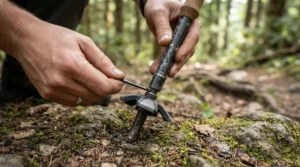
6. Leki Carbide Flexitips — hard-metal tips for pole users
Leki’s replacement tips are built around carbide, the hard-metal family that includes tungsten carbide, and they’re sold as a pair for grip on rock and ice. Retailer listings put the weight at roughly 23–26g per pair, so you won’t feel them on the end of a pole.
They’re described as fitting poles that use standard-size tips regardless of brand. A US-market version is described as flexing up to 30 degrees, which is meant to protect the shaft from sideways knocks.
My honest analysis: this is a pole upgrade, not a clamp-on for a hospital-style cane. If you walk with trekking or Nordic poles, replacing worn rubber or steel with tungsten carbide spikes of this kind gives you a permanently exposed bite. That is brilliant on frozen lanes, and less welcome on polished floors.
Review themes are consistent. A UK retailer lists 32 reviews, though I couldn’t verify the average. US buyers of the equivalent tips say fitting is quick once you warm the glue with a heat gun, but that stubborn old tips can be a fight to remove.
Pros:
- ✅ Durable carbide for ice and rock
- ✅ Very light, sold as a pair
- ✅ Fits many standard pole brands
Cons:
- ❌ Fiddly, glue-based fitting
- ❌ Always exposed, so it needs covers indoors
Price range: £9–£12 per pair at UK outdoor retailers (check current price). Verdict: good value for pole walkers who want carbide.
7. Black Diamond Carbide Tech Tips — dedicated carbide bite for compatible poles
These are the specialist’s choice. Black Diamond describes its interchangeable carbide tips as adding bite on ice and hard surfaces, at a listed weight of 12g, sold in pairs.
Compatibility is the whole story. They’re listed for spring 2012 and later trekking poles and all Z-poles, and explicitly don’t work with First Strike, Trail Back or Syncline poles. A European retailer notes that rubber Tech Tips are the standard for dry rock, with carbide reserved for demanding conditions like hard ice and icy slabs.
The analytical takeaway: if you already own a compatible Black Diamond pole, this is the neatest route to tungsten carbide spikes without buying new poles. If you don’t, it’s an expensive way to learn about thread standards.
On reviews, I couldn’t verify a UK buyer-feedback pool, so I can’t summarise sentiment honestly. That’s the one gap in an otherwise sensible option.
Pros:
- ✅ Strong bite on hard ice
- ✅ Very light, interchangeable design
- ✅ Rubber alternatives exist for dry days
Cons:
- ❌ Narrow pole compatibility
- ❌ No verified review data
Price range: I couldn’t confirm a current UK figure, so check current price before buying. Verdict: excellent if you own the right poles, pointless if you don’t.
Here’s how the seven stack up on fit, price and review evidence.
| Product | Fit | Price range | Review evidence | Best For |
|---|---|---|---|---|
| Drive Walking Stick Ice Grip | 19–22mm | Around £7–£9 | None verified | Everyday sticks |
| Aidapt Ice Grip Claw | 16–27mm | Around £3–£5 | None verified | Budget and wide fit |
| Essential Aids Walking Stick Mud & Ice Grip | 16–22mm | Around £7–£8 | One positive review (2013) | Mud plus ice |
| JIUKONG 5-Prong Ice Cane Tip Attachment | Check listing | Expected under £10 | 5.0 from 4 reviews | Low-cost trial |
| Flexyfoot Ice Boot | Flexyfoot ferrules | Around £6–£7 | One positive review (2024) | Indoor floor protection |
| Leki Carbide Flexitips | Standard pole tips | £9–£12 per pair | 32 reviews, average unverified | Pole walkers |
| Black Diamond Carbide Tech Tips | Selected BD poles | Unconfirmed | None verified | Compatible BD poles |
The honest lesson from this table is that review data is surprisingly sparse across the whole category, so specs and fit matter more than star ratings. Aidapt Ice Grip Claw wins on price and fit range, while Drive Walking Stick Ice Grip wins on brand familiarity. If you’re a pole walker, Leki Carbide Flexitips is the more accessible of the two carbide options.
What Are Ice Tips for Walking Sticks?
Ice tips for walking sticks are small, metal-toothed attachments, whether claws, spikes, boots or carbide points, that fit over or replace a stick’s rubber ferrule to grip frozen surfaces. They flip up, pull off or are covered for winter use, so indoor floors stay safe and the stick behaves normally on dry ground.
In practice they fall into three families. Clamp-on flip-up grips, such as Drive Walking Stick Ice Grip and Aidapt Ice Grip Claw, screw onto the lower tube and pivot between “grip” and “stow”. Pull-on boots, such as Flexyfoot Ice Boot, wrap an existing ferrule and come with a cover. Replacement tips, such as Leki Carbide Flexitips, swap out the end of a pole altogether.
Which family suits you depends on what your stick is, where you walk and how often you walk indoors in between.
How to Choose Ice Tips for Walking Sticks
Here’s a six-step shortlist, with the reasoning behind each step.
- Measure your ferrule or tube diameter. The products here span 16mm to 27mm, with 19–22mm the most common. A grip that’s a millimetre out will rattle or refuse to tighten.
- Decide whether you have a stick or a pole. Clamp-on grips suit single sticks and canes. Carbide replacement tips suit trekking or Nordic poles with removable tips.
- Pick your mechanism. Flip-up grips are quickest. Pull-on boots protect floors best. Fixed carbide is toughest but needs covers indoors.
- Match the terrain. Gritted pavements and car parks rarely need carbide. Frozen lanes and unlit paths often do.
- Think about your hands. Flipping a claw takes a thumb push, so check you can manage it in gloves.
- Check the ferrule underneath. NHS Lanarkshire’s winter advice includes ensuring sticks and frames are fitted with non-slip rubber ferrules, and an ice tip is no substitute for a worn-smooth ferrule.
That last point deserves a second look. A falls-prevention team at a Cambridgeshire NHS trust also advises replacing rubber tips once the tread has worn smooth.
Retractable Ice Spike for Walking Stick Designs: Flip-Up vs Fixed
A retractable ice spike for walking stick use solves the great winter compromise: you want teeth outdoors and none indoors. The flip-up designs in this guide (Drive Walking Stick Ice Grip, Aidapt Ice Grip Claw, Essential Aids Walking Stick Mud & Ice Grip and JIUKONG 5-Prong Ice Cane Tip Attachment) all pivot or push away so the rubber ferrule takes over.
What you gain
Convenience, mainly. You never take the attachment off, so you can’t lose it in a coat pocket. Because the spikes stay on the stick, you also never forget them on the morning the pavement turns to glass.
What you risk
Two things. First, clamp screws can loosen, so recheck them. Second, a flip mechanism is only as good as your habit of flipping it. A retractable ice spike for walking stick users that stays flipped up all morning is just decoration, and one that stays down indoors is a floor scratcher.
Fixed carbide tips avoid the flipping problem but need protective covers inside.
Black Ice: The Winter Hazard That Makes Ice Tips Worth It
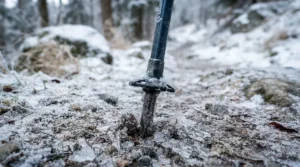
Snow is honest. You see it, you slow down. Black ice is the opposite. The American Meteorological Society’s glossary describes it as a thin sheet of relatively dark-looking ice that can form when light rain or drizzle falls on a surface below 0°C. Because it’s transparent, it looks like a wet patch of pavement, so you tread confidently onto it.
That deceptive look is exactly why metal-toothed tips earn their keep. A rubber ferrule relies on friction with a rough surface, and black ice removes the roughness. Claws and carbide points dig into the glaze instead of sliding over it.
Ice tips aren’t magic, though. Black ice often forms in shaded spots, on bridges and in the early morning, so pair your tip with slower steps, shorter strides and the “penguin walk” that NHS bodies recommend: keeping your centre of gravity over your feet and going slowly. Treat the tip as an insurance policy, not permission to hurry.
Tungsten Carbide Spikes: When Do You Actually Need Them?
Tungsten carbide is an extremely hard compound, which is why it’s used on cutting tools. On a pole tip it means the point stays sharp through far more abuse than rubber or plain steel. Retailer guidance is blunt about the trade-off: carbide tips bite into ice where rubber would slip, which is why they’re recommended for hard ice and icy slabs.
Do you need tungsten carbide spikes for a stroll to the postbox? Almost certainly not. Gritted pavements and short, mostly dry routes are well served by a flip-up claw. Carbide earns its place on frozen lanes, compacted snow, icy slopes and towpaths that never see a gritter.
Be aware of the downsides. Exposed carbide is noisy and can scratch hard surfaces, and reviewers of Leki’s related carbide-bearing pole tips mention exactly that on pavements. Which brings us to covers, caps and the question of indoor floor protection.
Winter Walking Stick Grips: Don’t Forget the Hand End
Everyone obsesses about the foot of the stick, but winter walking stick grips deserve equal attention. Cold hands lose dexterity quickly, and a stick you can’t hold firmly is a stick that fails at the worst moment.
Start with the handle. Gel-handled folding sticks from brands such as Drive Medical are widely sold, and a softer, wider grip can be kinder to cold, stiff fingers. Then consider a wrist strap: retailers describe straps that loop around the wrist so the stick stays up even if you release your grip, which is handy when you’re fumbling for keys with numb hands.
My advice, framed as reasoning rather than testing, is to pick gloves thin enough to feel the handle but warm enough to keep circulation going. Also test that you can still flip a claw or pull a boot with those gloves on. Good winter walking stick grips and good ice tips are a matched pair, because one without the other leaves a weak link.
Anti-Slip Cane Tips for Ice vs Standard Rubber Ferrules
Standard rubber ferrules are not the enemy. They’re quiet, floor-friendly and perfect on dry or damp paving. The question is what you give up when winter arrives, and what anti-slip cane tips for ice add.
| Feature | Standard rubber ferrule | Ice tips (claw, boot or carbide) |
|---|---|---|
| Grip on ice | Limited | Strong, bites into the surface |
| Dry pavement | Excellent | Good once flipped or covered |
| Indoor floors | Safe and quiet | Needs flip-up, cover or cap |
| Cost | Low | Low to modest |
| Maintenance | Replace when worn smooth | Check screws, wipe and dry |
| Best For | Everyday dry use | Frozen pavements and trails |
Using the table as a guide, Flexyfoot Ice Boot and flip-up clamps like Drive Walking Stick Ice Grip give you most of the rubber ferrule’s indoor manners with added winter bite. The sensible approach for most people is to keep a good rubber ferrule underneath and add the ice tip on top, rather than treating them as alternatives. Anti-slip cane tips for ice work best as a layer, not a replacement.

Indoor Floor Protection: Keep Spikes Off Your Kitchen Tiles
Nobody wants to explain a row of tiny punctures in the hallway. Good indoor floor protection comes down to three habits.
First, use the design. Flexyfoot Ice Boot ships with a cover that shrouds the teeth and grips like the ferrule, so you can walk indoors without removing the boot. Flip-up designs such as Aidapt Ice Grip Claw and Essential Aids Walking Stick Mud & Ice Grip let you tilt the prongs out of contact.
Second, protect carbide. Rubber tip protectors that clip over a pole tip are sold for trekking poles, and they’re the simplest indoor floor protection for Leki Carbide Flexitips and Black Diamond Carbide Tech Tips users.
Third, wipe and dry. Wet metal on laminate or tile is slippery, and a damp tip left against a skirting board is a rust spot waiting to happen. Keep a doormat and a towel by the door.
One caution: manufacturers’ claims about floor safety are generally untested by independent bodies, so check delicate floors yourself.
Common Mistakes When Buying and Fitting Ice Tips
Even a cheap grip can disappoint when the basics go wrong. These are the pitfalls I’d watch for, based on the spec sheets and what reviewers tend to report.
- Guessing the diameter. A 16mm-to-27mm range sounds generous until your stick is 15mm.
- Buying pole tips for a cane. Black Diamond Carbide Tech Tips are listed only for specific poles, so a standard cane can’t use them.
- Ignoring the ferrule underneath. If the tread has worn smooth, even a good grip sits on a poor foundation.
- Forgetting to flip. A retractable design needs a habit, not just a part.
- Over-tightening screws. Snug is fine, crushed is not.
- Trusting tiny review samples. A perfect score from four reviews is a hint, not a guarantee.
Avoid these and you’re most of the way to a safe winter.
Long-Term Cost & Maintenance
Ice tips are among the cheapest safety upgrades you can buy. Over a typical cold season, a grip costing around £3–£9 works out at pennies per outing, and one avoided fall is worth far more than any price on this page.
Maintenance is light but real. Rinse off road salt, dry the metal and check clamp screws monthly. Keep an eye on the rubber ferrule underneath, because worn tread is a falls hazard in its own right. Carbide tips like Leki Carbide Flexitips are built to last, but old tips can be stubborn to remove, so don’t leave replacement to the day your grip fails.
For total cost of ownership, the clamp-on flip-up grips are the cheapest, Flexyfoot Ice Boot adds the cost of a Flexyfoot ferrule if you don’t already have one, and carbide tips cost more up front but may outlast several winters.
Practical Guide: Fitting Your Ice Tip and the First 30 Days
A good fit is half the performance. Here’s a simple routine.
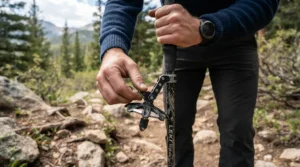
Day 0: fit it. Clean the lower tube, check your ferrule diameter and position the grip so the prongs sit just proud of the rubber when flipped down. Tighten the screws evenly.
Day 1: test indoors. Practise flipping the grip up and down with the gloves you’ll actually wear. Confirm it doesn’t rattle.
Week 1: first outings. Try it on a safe, gritted path before braving black ice. Recheck the screws afterwards.
Weeks 2–4: build the habit. Flip down before leaving the house, flip up on re-entry. Dry the metal and wipe the ferrule.
Council guidance is worth reading before the cold snaps. Stockport Council notes that black ice isn’t always visible and is a greater hazard for pedestrians as well as motorists, and it recommends warm clothing and suitable footwear. Your ice tip works best alongside gripping soles and slower steps.
If you’re unsure about stick height or fitting, an occupational therapist or physiotherapist can advise. This article is general information, not medical advice.
Real-World Scenarios: Which Pick Fits Which Walker?
These are illustrative profiles, not case studies of real people, matched to products by specification.
Scenario 1: The short-trip pavement walker
Budget is tight, trips are short and the walker moves constantly between pavement and shops. Aidapt Ice Grip Claw or Drive Walking Stick Ice Grip fits best, because flip-up convenience matters more than aggressive spikes.
Scenario 2: The dog walker on frozen fields
Early mornings, soft ground and ice patches call for small metal spikes that cope with mud. Essential Aids Walking Stick Mud & Ice Grip is the match, and it’s cheap enough to keep a spare in the car.
Scenario 3: The Nordic pole walker on frozen lanes
Poles, long distances and genuinely hard ice. Leki Carbide Flexitips or, for compatible poles, Black Diamond Carbide Tech Tips deliver tungsten carbide spikes with proper bite, as long as you carry tip protectors for indoor stops.
Scenario 4: The Flexyfoot user who wants simplicity
If your stick already has a Flexyfoot ferrule, Flexyfoot Ice Boot is the least fuss, with its cover doing the indoor floor protection for you. Add winter walking stick grips if cold hands are your weak link.
✨ Don’t Miss These Exclusive Deals!
🔍 Take your winter walking to the next level with these carefully selected products. Click on any highlighted item to check current pricing and availability on amazon.co.uk. These tools will help you step out with the confidence your family will love!
FAQ: Ice Tips for Walking Sticks
❓ Can I leave an ice tip on my walking stick all winter?
❓ What size do I need for a retractable ice spike for walking stick use?
❓ Do tungsten carbide spikes damage indoor floors?
❓ Are anti-slip cane tips for ice worth it over a normal rubber ferrule?
❓ Do winter walking stick grips really help in the cold?
Conclusion
Winter doesn’t ask whether you’re ready. It just sends a frost, a drizzle and a patch of black ice that looks like nothing at all. Ice tips for walking sticks are a small, cheap and sensible answer.
For most single-stick users, a flip-up clamp is the best starting point: Aidapt Ice Grip Claw for the widest fit and lowest price, Drive Walking Stick Ice Grip for a familiar five-prong design, and Essential Aids Walking Stick Mud & Ice Grip for muddy routes. If you own a Flexyfoot ferrule, Flexyfoot Ice Boot wins on indoor floor protection. Pole walkers wanting tungsten carbide spikes should look at Leki Carbide Flexitips first, and Black Diamond Carbide Tech Tips if their poles are compatible.
Remember that the review evidence across this category is thin, so measure carefully, buy from a retailer with sensible returns and keep your ferrules in good order. Add decent winter walking stick grips, slow down, and let the anti-slip cane tips for ice do their job.
✨ Don’t Miss These Exclusive Deals!
🔍 Ready to walk safely this winter? Click any highlighted product above to check current pricing and availability. These carefully chosen ice tips will help you stay steady on every frosty step!
Recommended for You
- Forearm Crutches Vs Elbow Crutches: 7 Best Picks Compared 2026
- Heavy Duty Crutches For Larger Adults: 7 Proven Picks (2026)
- Adjustable Paediatric Crutches For Children: 7 Best Picks 2026
Disclaimer: This article contains affiliate links. As an Amazon Associate, I earn from qualifying purchases. If you purchase products through these links, we may earn a small commission at no additional cost to you.
✨ Found this helpful? Share it with your friends! 💬🤗
