
In This Article
Walking frame bags are fabric, mesh or moulded-plastic storage accessories that attach to a zimmer frame or walker. They let you carry glasses, a phone, keys, medication or light shopping without taking a hand off the grips. The good ones fit securely, stay out of your stride and keep weight where the frame can cope with it.
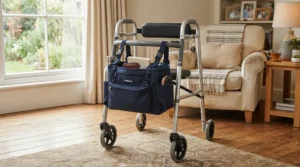
“Good” is doing a lot of work in that sentence. Picture the trip from kitchen to lounge with a mug of tea, a phone and the post. Both hands belong on the frame, so something has to give. Usually it’s a cardigan pocket, a sleeve, or, less wisely, the handgrip itself. A well-chosen bag solves the problem. A badly chosen one swings, snags or nudges the whole frame sideways.
That’s why this guide goes beyond a shopping list. NHS patient guidance says that any bags or baskets should be fitted safely and not overloaded. So we dig into bag attachment methods, weight balance on frames, and what “waterproof” really means on a label, alongside seven real products from a few pounds to a premium caddy.
A few honest notes first. Prices are given as ranges only, and availability on Amazon UK changes quickly, so check the live listing. Some of these products are sold mainly through UK mobility shops. I haven’t personally tested any of these bags. Everything below rests on published specifications and publicly visible buyer feedback, and I flag where that evidence is thin.
Quick Comparison Table: Walking Frame Bags at a Glance
Before the deep dive, here’s the whole field on one screen. Treat it as a map. The detail comes later.
| Product | Type | Attachment | Price range | Best For |
|---|---|---|---|---|
| Homecraft Buckingham Walking Frame Caddy | Rigid caddy with tray | Clips onto frame | Around £30-£50 | Hot drinks and meals indoors |
| Aidapt Apron Bag for Walking Frames | Three-pocket apron | Tie-on straps | Around £9-£20 | Everyday essentials |
| Vive Walker Bag | Water-resistant fabric bag | Loops and straps | Mid-range, check current price | Easy-wash daily use |
| Drive Medical Mobility Bag (RTL10254) | Multi-pocket bag | Back strap or hanging straps | Mid-range, check current price | Organised storage |
| RMS Water Resistant Tote Bag | Light polyester tote | Straps | Check current price | Switching between mobility aids |
| Aidapt Net Bag for Walking Frames | Knotted nylon net | Clips on four corners | Under £10 | Tight budgets, light loads |
| Aidapt Tri Walker Basket | Rigid basket | Hooks on tri walker | Around £15-£20 | Aidapt tri walker owners |
Looking at the table, the Aidapt Net Bag for Walking Frames wins on cost, but the Homecraft Buckingham Walking Frame Caddy is the only one built for hot drinks. The Vive Walker Bag and RMS Water Resistant Tote Bag are the lightest soft options and suit anyone who might meet drizzle. Note that Aidapt Tri Walker Basket only fits one specific walker range, so it’s a specialist rather than a general pick.
💬 Just one click — help others make better buying decisions too!😊
Top 7 Walking Frame Bags: Expert Analysis
Each product below gets the same treatment: what the specs mean in real life, who it suits, and what buyers say. Where review evidence is thin, I say so rather than papering over it.
1. Homecraft Buckingham Walking Frame Caddy — best for carrying hot drinks safely
The standout here is the tray. It’s shaped to carry a plate of food, with a mug holder alongside, which is rare in a category full of soft pouches.
Retailer listings give the caddy about 457mm width with the tray fitted, 310mm depth and 200mm height. It weighs roughly 1kg and has one large and one small compartment. In practice that means a rigid shelf rather than a flapping pocket, so contents stay put and the frame’s handling barely changes. One listing quotes a 2kg capacity, which is a sensible ceiling to treat as firm.
Based on the spec comparison, this is a kitchen-to-chair tool. It’s designed for non-folding, wheeled frames, so folding-frame owners should look elsewhere. The plastic is dishwasher-safe with drainage holes, which matters when tea inevitably escapes.
Buyers describe it as easy to fit and a genuine independence boost. Criticisms are specific: the mug holder suits one cup size, it can’t be stored inside the caddy, and a plate plus a mug together is a squeeze. One Amazon-derived listing placed it second in its walker bag category at the time of research, though rankings shift daily.
Pros:
- ✅ Rigid tray carries meals and drinks
- ✅ Dishwasher-safe plastic wipes clean easily
- ✅ Designed with an occupational therapist’s input
Cons:
- ❌ Only suits non-folding wheeled frames
- ❌ Mug holder fits one cup size
Expect to pay around £30-£50 depending on seller (check current price). For indoor drink-and-meal duty, it’s the most purpose-built option here.
2. Aidapt Apron Bag for Walking Frames — best all-rounder for everyday essentials
The clever part is the shape. An apron bag stretches across the front of the frame, so items sit between you and the front bar rather than dangling to one side.
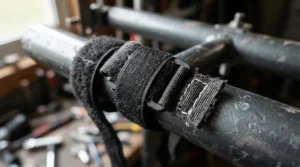
Apron bags of this type are listed at roughly 76cm wide, 28cm high and 18cm deep, weighing around 230g, with three pockets. They attach with simple ties or straps. That width spreads a light load evenly, which is exactly what you want for weight balance on frames. The Aidapt version is described as foldable, so it slips into a handbag when the frame goes in the car boot.
On water protection, treat it as splash-resistant. One UK retailer calls this style of bag “waterproof” on one page and “water-resistant” on another. That inconsistency is the clue: marketing language varies, and a bag with open pockets isn’t a dry bag.
I couldn’t find a large pool of independent buyer reviews for this exact model. Retailer descriptions stress a quick, secure fit and sturdy fabric, so this is a spec-led pick rather than a crowd-proven one.
Pros:
- ✅ Wide shape spreads light loads evenly
- ✅ Tie-on fit suits many frame shapes
- ✅ Folds flat when not in use
Cons:
- ❌ Limited independent review evidence found
- ❌ Water resistance is not full waterproofing
Prices run around £9-£20 depending on brand and seller. It’s the sensible middle ground between a net and a rigid caddy.
3. Vive Walker Bag — best for machine-washable water resistance
The headline feature is practical rather than glamorous: it goes in the washing machine. For something that lives near hands, snacks and the odd spilt drink, that matters.
It’s made from lightweight, water-resistant nylon and weighs around 10.5oz (about 300g). It uses a universal-fit design with multiple loops, and one review roundup counts seven. More attachment points mean you can tension the bag against the frame, which reduces swing. The listing targets folding and rolling walkers.
On buyer feedback, a US retailer listing showed a perfect score from a small pool of 14 ratings. A review roundup rated it 4.7 out of 5. Another advice site cautions it isn’t compatible with every walker. Those sources are mostly American, so I can’t vouch for the UK review picture.
My read: universal-fit claims deserve a measuring tape. Check the tubing shape and spacing of your zimmer frame against the loop positions before assuming it will sit snugly.
Pros:
- ✅ Machine-washable nylon keeps hygiene simple
- ✅ Multiple loops allow a snug fit
- ✅ Light enough not to burden the frame
Cons:
- ❌ Not compatible with every walker design
- ❌ Reviews found were mostly non-UK
Price varies by UK seller (check current price). It’s a strong all-weather everyday choice if the fit works.
4. Drive Medical Mobility Bag (RTL10254) — best for organised multi-pocket storage
The big idea here is sorting. Four front exterior pockets, a key-ring zipper and a large zipped interior mean you can stop rummaging.
Drive lists a side mesh pocket that holds a water bottle, fully lined pockets and a water-resistant treatment. Care is spot-clean with a wet cloth, so it won’t go in the machine. It offers two attachment routes: a back strap with a secure clip, or adjustable hanging straps. In plain English, you can fit it to different frame styles without bodging.
The risk is the temptation. More pockets invite more stuff, and more stuff means more weight. A full water bottle alone is around half a kilo. Use the pockets to organise, not to hoard.
I couldn’t verify a meaningful pool of UK buyer reviews for this specific model. Drive’s UK arm trades as Drive DeVilbiss Healthcare, so check listing names and confirm the exact model on Amazon UK.
Pros:
- ✅ Four front pockets keep essentials sorted
- ✅ Two attachment styles aid fit
- ✅ Side mesh pocket holds a bottle
Cons:
- ❌ Spot-clean only, no machine wash
- ❌ UK review evidence hard to verify
Pricing is mid-range (check current price). It’s best for people who carry many small items and value order over minimalism.
5. RMS Water Resistant Tote Bag — best lightweight pick for switching mobility aids
The selling point is flexibility. It’s marketed for walkers, rollators and scooters alike.
It’s made from polyester, water-resistant, and listed at around 6.4oz (roughly 180g), at about 18in by 10in (around 46cm by 25cm). That makes it the lightest soft bag in this round-up, which means more of your carrying capacity goes to your belongings rather than the bag. A multi-pocket layout adds organisation without much bulk.
If you use a folding frame at home and a rollator for outings, a bag that moves between them saves buying twice. The trade-off is structure. Light fabric flops, so contents can slump to one side. Stuff it evenly and keep heavy items at the bottom centre.
Buyer feedback is thinner than I’d like. One review roundup rated it 4.6 out of 5 and praised its versatility. That’s a single source, so treat it as encouraging rather than conclusive.
Pros:
- ✅ Lightest soft bag in this round-up
- ✅ Moves between walker, rollator, scooter
- ✅ Multi-pocket layout aids organisation
Cons:
- ❌ Floppy when only partly filled
- ❌ Limited review evidence found
Check the current price. It suits anyone who changes mobility aids through the week.
6. Aidapt Net Bag for Walking Frames — best budget option under £10
Simplicity is the hook. A knotted nylon net hooks over the front corners of the frame with metal clips, and that’s about it.
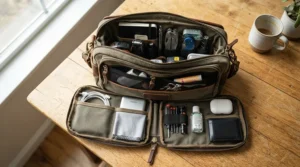
Comparable net bags are listed at around 38cm by 30cm by 15cm and weigh roughly 210g. The open weave makes it very light, and it folds small for storage. Because it hangs inside the frame’s footprint, it sits near your centre of gravity, which is better than a bag hanging off one handle.
Buyers like it. Verified eBay UK reviewers of the Aidapt net bag gave it a strong overall score and described being able to carry dusters, polish and a phone while keeping both hands on the frame. Another reviewer said it makes moving things around the home safer. Those are small, anecdotal samples, but the theme is consistent.
My honest reservation: the mesh is see-through and open. Small items such as pills or keys can slip out of larger gaps, so a zipped pouch inside the net is a cheap fix. It isn’t weatherproof either.
Pros:
- ✅ Cheapest option on this list
- ✅ Hangs close to the frame’s centre
- ✅ Folds small when not needed
Cons:
- ❌ Open mesh offers no privacy or rain protection
- ❌ Small items can fall through
Expect to pay under £10. For light indoor carrying, it’s superb value.
7. Aidapt Tri Walker Basket — best rigid basket for tri-walker owners
The draw is capacity with structure. This is a proper basket, not a pouch.
Retailer specs give a maximum load of 5kg, dimensions of 190 by 275 by 225mm, and a weight of 0.545kg. It fixes with hooks on the walker. A tray is sold separately for carrying a meal. The 5kg figure is generous, but treat it as a ceiling rather than a target. Heavy loads in a front basket change how the frame feels to push.
It only fits the Aidapt Tri-Walker range, so check compatibility before buying. Tri-wheeled walkers are the type NHS physiotherapy leaflets describe as designed for outdoor use, which makes a basket like this useful for trips to the shops.
I couldn’t find an independent review pool for this accessory, so the recommendation rests on specifications and sensible design. If you own a compatible tri walker, it’s a no-brainer. If you don’t, skip it.
Pros:
- ✅ Rigid structure keeps contents upright
- ✅ Clear 5kg maximum load stated
- ✅ Simple hook-on fitting
Cons:
- ❌ Fits Aidapt tri walkers only
- ❌ No independent reviews found
Prices sit around £15-£20, depending on seller (check current price). It’s a precise fix for a specific walker.
Top 7 Compared at a Glance
| Product | Rigid or soft | Attachment | Water protection (as described) | Evidence quality |
|---|---|---|---|---|
| Homecraft Buckingham Walking Frame Caddy | Rigid | Clips | Wipe-clean plastic | Moderate, some detailed feedback |
| Aidapt Apron Bag for Walking Frames | Soft | Ties | Water-resistant | Thin |
| Vive Walker Bag | Soft | Loops and straps | Water-resistant, machine washable | Small, mostly non-UK |
| Drive Medical Mobility Bag (RTL10254) | Soft | Back strap or hanging straps | Water-resistant treatment | Thin |
| RMS Water Resistant Tote Bag | Soft | Straps | Water-resistant | Thin, single roundup |
| Aidapt Net Bag for Walking Frames | Soft net | Clips | None | Small but consistent |
| Aidapt Tri Walker Basket | Rigid | Hooks | None stated | None found |
The pattern is clear: rigid options (Homecraft Buckingham Walking Frame Caddy, Aidapt Tri Walker Basket) offer stability, while soft bags offer adaptability. The Vive Walker Bag is the only soft option explicitly sold as machine-washable. Evidence is thinnest for RMS Water Resistant Tote Bag and Drive Medical Mobility Bag (RTL10254), so check current Amazon UK reviews before committing.
How to Choose Walking Frame Bags: 7 Steps That Actually Matter
What’s the quickest way to choose walking frame bags? Match the bag to your frame type, then your main use, then your carrying weight. Everything else is secondary.
- Identify your frame type. Non-folding wheeled, folding, tri walker or rollator? Rigid caddies suit the first, soft bags suit the second, and basket accessories are often brand-specific.
- Decide the main job. Hot drinks and meals call for a tray or caddy. Phone, glasses and keys call for a soft pouch.
- Check the attachment style. Ties, clips, hooks and straps behave differently. We cover this in the attachment section below.
- Look for a stated weight limit. If the maker doesn’t give one, assume the bag is for light loads.
- Be sceptical about waterproof claims. Water-resistant is not the same as waterproof, as we’ll see shortly.
- Consider cleaning. Machine-washable fabric or wipe-clean plastic saves effort for years.
- Plan for returns. Universal fit is a promise, not a guarantee. Buy from a seller with a straightforward returns policy.
The order matters. People often start at step five (waterproofing) when the real problem is step one (fit).
Zimmer Frame Bag Guide: Matching Style to Your Frame
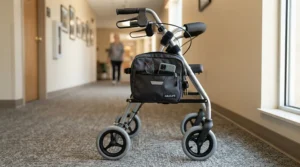
A zimmer frame bag is not one product category. It’s several, and the right one depends on the frame under your hands.
Non-wheeled, lift-and-place frames are the trickiest. You physically lift the frame with each step, so anything heavy or swinging becomes part of what you’re lifting. Light soft bags that sit snugly, such as the Aidapt Apron Bag for Walking Frames or the Aidapt Net Bag for Walking Frames, make the most sense. Rigid caddies like the Homecraft Buckingham Walking Frame Caddy are designed for wheeled frames.
Wheeled zimmer frames tolerate more weight because you push rather than lift, which opens up caddies and baskets. Even so, NHS guidance says that wheeled frames are designed for indoor use, so frame type shapes where a bag makes sense. Outdoor shopping trips are tri-walker or rollator territory.
Folding frames add another wrinkle. The bag must not block the folding mechanism, and straps shouldn’t snag the hinges. Test fold and unfold with the bag on before committing to a long walk.
Finally, check your measurements. Measure the tube diameter and the width between side frames, then compare against the listing. It takes two minutes and avoids a lot of grumbling.
Bag Attachment Methods: Setup, First-Use Tips and Fit Checks
The way a bag attaches matters as much as its size. Here are the main bag attachment methods you’ll meet, and what each is good at.
- Tie-on straps (apron bags): flexible and tolerant of different frame shapes, but they can loosen over time.
- Metal clips (net bags): quick on and off, though clips can mark paintwork or slip on thicker tubing.
- Hooks (tri walker baskets): secure, but only if the hooks match your walker.
- Hook-and-loop or buckle straps (soft bags): adjustable, so you can tension the bag against the frame.
- Dual options (such as the Drive Medical Mobility Bag (RTL10254)): a back strap with a clip, or hanging straps, for different frame styles.
A simple setup routine:
- Fit the bag with the frame standing on a flat floor.
- Tighten straps until the bag doesn’t swing when you push the frame gently.
- Load it with your usual items and check the frame doesn’t tilt.
- Practise a short walk with someone nearby, including a turn.
- Recheck tension after the first week, since fabric settles.
Common mistakes in the first 30 days: leaving straps slack, mounting the bag so it brushes your legs, and overstuffing because “there’s room”. If the bag moves when you do, it isn’t fitted right.
Weight Balance on Frames: How Much Is Too Much?
Here’s the awkward truth about weight balance on frames: walking aids are meant to prevent falls, yet researchers note that their use is paradoxically a risk factor for falling when they aren’t used stably. A badly loaded bag adds to that risk.
The physics is simple. A frame stays upright when its combined weight sits within its footprint. Load a bag on one side and the frame wants to tip that way. Load it too high and it becomes top-heavy. Load it behind the rear legs and the frame can tip backwards when you lean on the handles.
Sensible rules, as reasoning rather than clinical limits:
- Keep heavy items low and centred.
- Split loads evenly left to right.
- Keep weight close to your body and inside the frame’s footprint.
- Don’t hang bags from the handgrips.
- Respect stated limits: the Aidapt Tri Walker Basket quotes 5kg, while the Homecraft Buckingham Walking Frame Caddy is reported at around 2kg.
A one-litre carton of juice weighs roughly a kilo, so two of those in a soft bag is already a lot. When in doubt, ask your physiotherapist or occupational therapist to check your setup.
✨ Want a safer setup?
🔍 Compare the Homecraft Buckingham Walking Frame Caddy, the Aidapt Net Bag for Walking Frames and the Vive Walker Bag side by side. Click any highlighted product to check current pricing and availability on Amazon UK!
Walking Frame Pouch Waterproof: What the Labels Really Mean
Search for a walking frame pouch waterproof and you’ll find plenty of listings using the word loosely. Here’s how to read them.
Water-resistant means the fabric sheds light rain or splashes for a while. Waterproof should mean no water gets through, but that depends on seams, zips and openings as much as fabric. A bag with an open top or a plain zip will leak in sustained rain regardless of the label.
The Vive Walker Bag, Drive Medical Mobility Bag (RTL10254) and RMS Water Resistant Tote Bag are all described as water-resistant. The Aidapt Apron Bag for Walking Frames is described as waterproof on some retailer pages and water-resistant on others, which tells you how loose the language is.
There’s also a reality check. Wheeled frames are indoor aids, so most waterproofing worries belong to tri walkers and rollators. If you do head out in drizzle, use a small zip-lock pouch or dry bag liner for your phone, medication and paperwork. Cheap, effective, and not dependent on a manufacturer’s adjective.
Care matters too. The Vive Walker Bag is machine-washable, the Drive Medical Mobility Bag (RTL10254) is spot-clean only, and the Homecraft Buckingham Walking Frame Caddy wipes clean. A wet bag that can’t be washed or dried becomes a smelly bag.
Walker Side Bag vs Apron Bag vs Net Bag: Which Layout Wins?
Not every bag sits at the front. A walker side bag hangs or straps to one side, which changes both access and balance.
Walker side bag: Easy to reach from where you stand, handy for a phone or tissues. The catch is lopsided weight. Keep it light and balance it with something on the other side, or avoid heavy items entirely. The RMS Water Resistant Tote Bag and Vive Walker Bag can be used this way.
Apron bag: Spreads the load across the front and keeps items central. The Aidapt Apron Bag for Walking Frames is the example here. Access is slightly less convenient, since you reach forward, but balance is better.
Net bag: Sits inside the frame, near the centre of gravity. The Aidapt Net Bag for Walking Frames is lightest and cheapest, though it protects nothing from rain or prying eyes.
For most people, the sweet spot is an apron or front-mounted bag for heavier items, plus a small side pocket for the things you grab constantly. Think of it as a tidy kitchen: heavy pans low and central, teaspoons within reach.
Walking Frame Bags vs Trays, Trolleys and Rucksacks
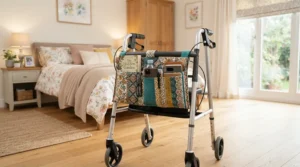
Are walking frame bags really better than a traditional trolley, tray or rucksack? It depends on the job.
| Option | Weight-bearing? | Stability | Best For |
|---|---|---|---|
| Walking frame bags such as the Aidapt Apron Bag for Walking Frames | No, carry only | Good if light and central | Everyday essentials |
| Rigid caddies such as the Homecraft Buckingham Walking Frame Caddy | No, carry only | Very good | Drinks and meals |
| Trolley tray | Not designed to bear body weight | Poor if used as support | Moving items, not walking |
| Rucksack | N/A | Shifts weight to back | Outdoor errands |
A trolley is designed to carry items, not people. Retailer guidance for the Homecraft Buckingham Walking Frame Caddy makes this point explicitly: you remain properly supported by your frame while carrying, unlike with a trolley tray that isn’t built to bear your weight.
The table shows why caddies and bags dominate. They carry without trying to be the support. A rucksack is fine for short errands, but it puts weight on your back and can affect posture. For most daily tasks, a well-fitted bag or caddy on the frame is the safer, more convenient choice.
Real-World Scenarios: Three Users, Three Bags
Scenario 1: Living alone, indoors only. A retired person uses a non-folding wheeled frame to move between kitchen, lounge and bedroom, multiple times a day. The main need is tea and snacks. The Homecraft Buckingham Walking Frame Caddy fits, because its tray and mug holder are designed for exactly that. Budget: around £30-£50. Environment: indoors on flat floors.
Scenario 2: Short errands in changeable weather. Someone uses a folding frame for the post office and pharmacy a few times a week. The Vive Walker Bag or RMS Water Resistant Tote Bag suits, being light and water-resistant. Keep valuables in a zipped pouch inside. Budget: mid-range.
Scenario 3: Buying for a relative on a tight budget. A carer needs something quick, cheap and unfussy for a parent’s frame. The Aidapt Net Bag for Walking Frames (under £10) covers phone, glasses and a magazine. Upgrade to the Aidapt Apron Bag for Walking Frames (around £9-£20) if pockets and privacy matter.
Bonus scenario: Tri walker owner. If you already have a compatible Aidapt walker, the Aidapt Tri Walker Basket adds rigid capacity at around £15-£20 for shopping trips.
In each case, the right bag follows the frame and the routine, not the other way round.
Common Mistakes When Buying Walking Frame Bags
Here are the pitfalls worth dodging.
Trusting “universal fit”. It means “fits many”, not “fits yours”. Measure first.
Assuming waterproof means waterproof. As covered earlier, labels are slippery.
Overloading. More pockets feel like more freedom. Stick to stated limits, and when none are stated, go light.
Ignoring frame height. A bag can’t fix a badly adjusted frame. University of Salford guidance says handgrips should sit just above your wrist when your arms hang by your sides, and never to use a frame on stairs.
Mounting a bag where it catches your legs. Test a few steps and a turn before leaving the house.
Buying a rigid caddy for a folding frame. The Homecraft Buckingham Walking Frame Caddy is designed for non-folding, wheeled frames.
Forgetting hot-drink safety. Even with a mug holder, take it slowly and keep the route clear.
One small habit helps with all of these: after fitting any new bag, ask someone to watch you walk a lap of the house. A second pair of eyes spots swing, snagging and tilt instantly.
Long-Term Cost and Maintenance
Walking frame bags are cheap compared with the frames themselves, but the cost-per-use maths is still worth doing. Spend around £40 on a caddy that lasts three years and you’re paying under 4p a day for hands-free carrying. A bag under £10 costs even less per use, though cheap fabric may need replacing sooner.
Where bags differ most is upkeep:
- Machine-washable (Vive Walker Bag): toss it in as needed.
- Spot-clean (Drive Medical Mobility Bag (RTL10254)): wipe regularly, and don’t let spills dry in.
- Wipe-clean or dishwasher-safe plastic (Homecraft Buckingham Walking Frame Caddy): the easiest to keep hygienic.
- Net bag (Aidapt Net Bag for Walking Frames): rinse and air-dry.
A simple monthly check keeps things safe. Look at straps for fraying, clips for cracks, and hooks for bending. Replace anything that looks tired.
One more cost note: specialist UK mobility shops often advertise VAT relief for eligible buyers, which can change price comparisons with Amazon UK. If you qualify, it’s worth comparing like for like.
Frequently Asked Questions
❓ What is the best bag for a zimmer frame without wheels?
❓ Can walking frame bags go in the washing machine?
❓ How heavy can I make a bag on my walking frame?
❓ Do rollator bags fit a standard walking frame?
❓ Where can I buy walking frame bags in the UK?
Conclusion
The best walking frame bags solve a small problem with a lot of consequences: how to carry the things you need without compromising the frame that keeps you steady.
If hot drinks and meals matter most, the Homecraft Buckingham Walking Frame Caddy is the most purpose-built choice. For a flexible all-rounder, the Aidapt Apron Bag for Walking Frames spreads light loads sensibly. The Vive Walker Bag earns its place for easy washing and water resistance, provided it fits your frame. The Drive Medical Mobility Bag (RTL10254) suits people who love organised pockets, and the RMS Water Resistant Tote Bag is the featherweight for anyone switching between mobility aids. On a tight budget, the Aidapt Net Bag for Walking Frames costs little and does a lot. Tri walker owners should look at the Aidapt Tri Walker Basket.
Whatever you choose, remember the three rules that matter more than any brand: check the fit, keep the load light, low and centred, and treat “waterproof” as a claim to test rather than a guarantee. If you’re unsure, a quick chat with your physiotherapist or occupational therapist is worth more than any review.
Recommended for You
- Replacement Walking Stick Ferrules: 7 Slip-Proof Picks (2026)
- Ice Tips For Walking Sticks: 7 Proven Picks For Icy UK Paths (2026)
- Forearm Crutches Vs Elbow Crutches: 7 Best Picks Compared 2026
Disclaimer: This article contains affiliate links. As an Amazon Associate, I earn from qualifying purchases. If you purchase products through these links, we may earn a small commission at no additional cost to you.
✨ Found this helpful? Share it with your friends! 💬🤗
