
In This Article
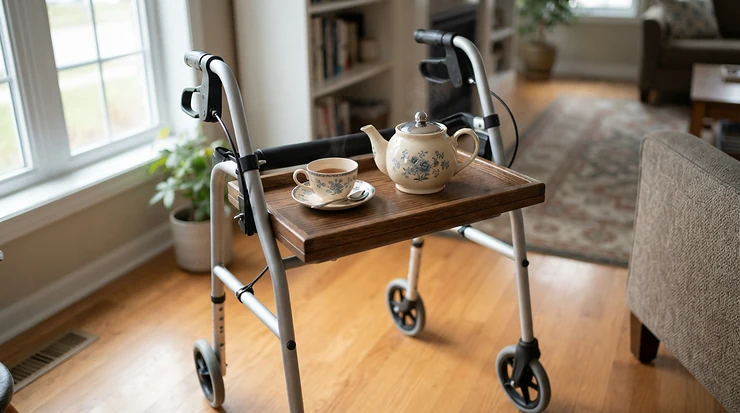
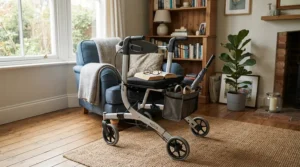
Rollator tray vs basket is the choice between a flat, rigid surface for carrying meals and drinks and a bag-style container for shopping and belongings. A tray suits hands-free carrying of plates and mugs around the home, while a basket handles bulkier, softer loads. Many UK rollators now let you fit both.
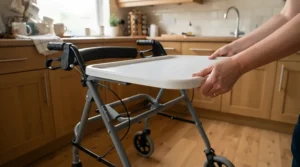
A rollator with nowhere to put anything is a very expensive way to drop a cup of tea. The NHS makes the same point in its guidance on choosing a walking frame. It tells you to think about whether you need a seat, basket or tray attached, and whether it folds into a car. Those storage questions decide whether a rollator earns its keep every day or ends up as a hallway ornament.
This guide compares seven real rollators sold in the UK, and the answer isn’t always “get both”. The specs come from manufacturer and UK retailer pages gathered in October 2026. Where review evidence is thin, I say so rather than invent it. Along the way we’ll cover tray weight limits, rollator model compatibility and carrying drinks safely, which are the details listings tend to skip.
Quick Comparison: Rollator Tray vs Basket at a Glance
| Product | Storage setup | Stated limits | Price range | Best For |
|---|---|---|---|---|
| Drive Tri-Walker | Tray, basket and bag, all removable | 125kg user; 4.7kg frame | £75–£95 | Budget all-in-one starter kit |
| Drive Steel Rollator | Tray and basket, four wheels plus seat | Basket 5kg | £70–£90 | Shoppers who want a seat |
| NRS Aluminium Rollator | Basket and tray, add-on set available | 125kg user; 4.5kg frame | £85–£100 | Lightest three-wheel budget pick |
| NRS Steel Rollator | Basket and tray | 125kg user; 5.9kg frame | £75–£90 | Cheapest steel option |
| Let’s Go Indoor | Tray (5kg) and basket (3kg) | 100kg user; 6.5kg frame | £230–£260 | Meals and drinks at home |
| Let’s Go Out | Large bag (12kg); tray optional extra | 130kg user; about 6.4kg frame | £280–£370 | Outdoor shopping trips |
| Drive Nitro | Optional seat-top tray (5kg) | 130kg user; about 7.2kg frame | £190–£220 | Premium frame with a tray add-on |
The rollator tray vs basket question splits the table neatly. The Let’s Go Indoor is the only model here built around a tray for meals, and the Let’s Go Out is built around a big shopping bag. The two Drive models and two NRS models bundle both on a budget, though the sources I could check don’t publish clear tray weight limits for them. Note that the Let’s Go Indoor has the lowest user weight limit of the seven, so check that figure first.
💬 Just one click — help others make better buying decisions too!😊
Top 7 Rollators for the Rollator Tray vs Basket Decision: Expert Analysis
1. Drive DeVilbiss Aluminium 3 Wheel Tri-Walker — best all-in-one starter kit
Most rivals sell you the walker and then upsell the storage. The Drive Tri-Walker arrives with a tray, a basket and a bag, so you get both sides of the rollator tray vs basket debate in one box.
At 4.7kg with a 125kg user limit (about 19.7 stone), it’s light enough to lift into a boot one-handed, yet rated for a wide range of users. The rustproof frame suits indoor and outdoor use. The three-wheel layout turns tightly in hallways and kitchens, though it’s less planted than a four-wheeler on kerbs.
On paper this is the pick for someone who spends most of the day indoors and nips out occasionally. The tray, basket and bag all come off, so you can strip it back when you don’t need them. The sources I checked don’t publish a tray weight limit, so treat the tray as a plate-and-mug surface, not a roast-dinner trolley.
I couldn’t verify a sizeable aggregated review pool for this model. Read the recent reviews on the Amazon UK listing, looking for comments on tray rattle and how the bag attaches.
Pros:
- ✅ Tray, basket and bag all included
- ✅ Very light at 4.7kg
- ✅ Rustproof frame for indoor and outdoor use
Cons:
- ❌ Tray weight limit not clearly published
- ❌ Three wheels are less stable than four
Expect to pay around £75–£95, which is strong value given the storage is thrown in.

2. Drive DeVilbiss Steel 4 Wheel Rollator — best budget four-wheeler with a seat
If you want somewhere to sit when the walk gets long, the Drive Steel Rollator adds a seat to the tray-and-basket combination.
Its four-wheel design is steadier than a tri-walker’s, and the built-in reflectors help with visibility at night. The basket is rated for 5kg, which is about a loaf, a carton of milk and a few tins. The folding design is simple: take off the basket and tray, then pull the cord under the seat.
Here’s what the spec sheet won’t tell you. Because this model’s tray and basket both come off, it works equally well as a full rollator or a stripped-back seat-and-brakes walker. The manufacturer’s FAQ confirms you can use it without the tray and basket. The trade-off is weight: steel is heavier than the aluminium rivals in this list.
I found no verifiable aggregated review data for this exact model, so check the current Amazon UK reviews for comments on brake feel and folding.
Pros:
- ✅ Seat for rest stops
- ✅ Basket rated at a clear 5kg
- ✅ Reflectors for evening visibility
Cons:
- ❌ Steel frame is heavier to lift
- ❌ Tray weight limit isn’t stated
Expect around £70–£90, which is excellent value for a seated four-wheeler.
3. NRS Healthcare 3 Wheel Aluminium Rollator — lightest budget three-wheeler
The NRS Aluminium Rollator is the featherweight of the budget group at about 4.5kg, and its basket-and-tray set is a genuine selling point.
The handle height range of 810–920mm suits a wide spread of users, and it holds up to 125kg. At 660mm wide it’s a slim fit for older UK hallways and doorways. Crucially, a separate NRS basket-and-tray set attaches to the front and lets you keep the existing bag in place. That means you can add the tray later for under £20 if you start with just the bag.
My analytical take is that this is the clearest answer for anyone who isn’t sure about the tray yet. Buy the frame, live with it for a month, then add the set if you find yourself juggling plates. Just remember that frame weight isn’t the whole story, because accessories add to it.
Review evidence is limited, and I couldn’t verify a pooled rating, so scan recent buyer comments for the fit of the add-on set.
Pros:
- ✅ Light 4.5kg aluminium frame
- ✅ Add-on tray set is cheap
- ✅ Narrow enough for tight hallways
Cons:
- ❌ Three wheels mean less stability
- ❌ Tray load limit not published
Look for roughly £85–£100 for the frame, and check current availability, which varies by seller.
4. NRS Healthcare 3 Wheel Steel Rollator — cheapest way into a tray and basket
The NRS Steel Rollator swaps aluminium for steel to hit a lower price, and it carries the same tray-and-basket package.
At 5.9kg it’s about 1.4kg heavier than its aluminium sibling, which matters if you lift it into a boot daily. It also has a 125kg user limit and folds to a compact size. At 650mm wide, it’s barely different in footprint from the aluminium version.
If you rarely lift it, the weight penalty won’t bother you, and the steel frame may feel more reassuring on kerbs. If you do lift it often, the aluminium model is worth the small extra spend. I wouldn’t pick this one for someone with limited wrist strength.
Stock can fluctuate. At one retailer I found it listed as out of stock, so check Amazon UK’s current availability. I couldn’t verify pooled reviews.
Pros:
- ✅ Lowest price among the bundled-storage models
- ✅ 125kg user limit
- ✅ Folds compactly for storage
Cons:
- ❌ Heavier at 5.9kg
- ❌ Availability can be patchy
Around £75–£90 is the range to expect, so it’s good value if lifting weight isn’t a concern.
5. Trust Care Let’s Go Indoor — best tray for meals at home
The Let’s Go Indoor is the rollator tray vs basket debate settled in favour of the tray, with a basket underneath as backup.
The numbers are clear: a 5kg maximum tray load and a 3kg bag or basket load. The frame weighs 6.5kg, folds to 28cm wide and has handles adjustable from 83–95cm. The tray sits at 68cm high, so it works as a handy table for a snack. It’s built for flooring-friendly indoor use, not pavements.
The catch is the user weight limit of 100kg, which is lower than every other model here. If that’s close to your limit, look elsewhere. Otherwise, this is the most thoughtful design for tea-and-toast duty. A tray that sits over the basket means you don’t have to choose one or the other.
Review evidence is mixed in volume: one third-party roundup lists the Stander-branded North American version at 4.7 stars from 133 ratings, and UK retailer review pages exist. Verify current Amazon UK reviews before buying.
Pros:
- ✅ Clear 5kg tray and 3kg basket limits
- ✅ Tray doubles as a snack table
- ✅ Folds to just 28cm wide
Cons:
- ❌ 100kg user limit is the lowest here
- ❌ Indoor-only design
Expect roughly £230–£260, which is premium pricing for specialist indoor design. (VAT relief may apply to eligible buyers.)
6. Trust Care Let’s Go Out — best for shopping with a big bag
Where the Let’s Go Out earns its place is on the high street: the bag is rated to 12kg, four times the Let’s Go Indoor‘s basket.
The rear wheels have built-in rubber suspension for rough pavements, and it’s tested to ISO 11199-2 for a 130kg user. At around 6.4kg it’s light, and it folds to about 20cm wide. A tray, backrest and stick holder are optional extras sold separately, so you can build in a tray only if you need it.
My honest reading is that this is the best “shopping basket” answer on the list, but it’s the weakest “tray for meals” out of the box. If your priority is a dinner tray, either buy the optional tray or choose the Let’s Go Indoor. If your priority is the weekly top-up shop, this is the one.
The review sample is small but positive. One UK retailer shows four reviews rating it highly, a US pharmacy listing shows 5.0 across 37 ratings, and one buyer on a UK retailer’s page said she wished she’d bought sooner.
Pros:
- ✅ Generous 12kg bag limit
- ✅ Suspension on rear wheels
- ✅ Tested for 130kg users
Cons:
- ❌ Tray costs extra
- ❌ Higher price than budget models
Look at around £280–£370, depending on colour and seller.
7. Drive DeVilbiss Nitro — best premium frame with a tray add-on
The Drive Nitro is the choice if you want a refined four-wheeler and are happy to add the tray separately.
The listed figures are a 130kg user limit, a handle height up to 96.5cm and a weight of about 7.2kg. A dedicated tray for the Nitro, Nitro Carbon, Torro, Torro Acero and Diamond DeLuxe sits on the seat with a 5kg maximum load, according to Drive’s German accessory page, so UK stock may differ.
The seat-top design has a catch: while the tray is on, you can’t sit. That’s fine for carrying lunch to the table, but pointless if you need a rest halfway. Treat it as a carry-then-remove tray.
I couldn’t verify a pooled review rating for the Nitro in the sources I checked. Read recent Amazon UK feedback on the tray’s fit before buying.
Pros:
- ✅ Tray fits a whole family of Drive models
- ✅ 130kg user limit
- ✅ Clear 5kg tray rating
Cons:
- ❌ Tray blocks the seat while fitted
- ❌ Heaviest frame in the group
Expect around £190–£220 for the frame, plus a modest sum for the tray.
How to Choose Between a Rollator Tray vs Basket
Choosing between a rollator tray vs basket is easier when you work through the decision in order.
- Start with what you carry most. If it’s plates and mugs, a tray wins. If it’s bread, milk and a handbag, a basket or bag wins. Mixed loads point to a combination.
- Check where you’ll use it. Indoor-only models like the Let’s Go Indoor can be tray-first. Outdoor models need a bigger bag and tougher wheels.
- Read three numbers, not one. You need the user weight limit, the tray limit and the basket limit. They are separate figures, and they’re on different parts of the product page.
- Prefer removable storage. If the tray comes off, you can fold the frame and get it in a boot. A fixed tray makes that harder.
- Confirm rollator model compatibility. An add-on tray that doesn’t match your frame is a wobble waiting to happen.
- Decide how much you need the seat. A tray that sits on the seat, like the Drive Nitro‘s, blocks sitting while it’s fitted.
The history helps too. Wikipedia notes the rollator was invented by Swedish designer Aina Wifalk in 1978, and later variants made the seat double as the lid of a shopping basket. That tells you the tray-or-basket debate is as old as the device itself.
| Option | Strength | Weakness | Best For |
|---|---|---|---|
| Tray (Let’s Go Indoor) | Stable surface for plates and mugs | Limited volume | Meals and drinks indoors |
| Basket (Drive Steel Rollator) | Holds soft, awkward items | Spills contents if overloaded | Light shopping |
| Large bag (Let’s Go Out) | Highest carrying capacity | Not suited to hot drinks | Outdoor shopping |
| Walking-frame caddy | Cheap, fits frames without wheels | Not designed for rollators | Non-wheeled frames |
| Carrying by hand | Free | Unsafe, as you lose a hand for balance | Not recommended |
The table makes the trade-off clear: trays are for stability and surface area, baskets and bags are for volume. If you can only afford one, match it to your most frequent journey, not your most dramatic one. Carrying by hand fails because you lose the hold that makes the rollator safe.
Rollator Tray for Meals: Getting Dinner From Kitchen to Table
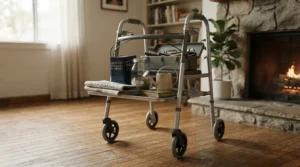
A rollator tray for meals is the single feature that gets people out of the “hover with a plate” routine. The key is a flat, rigid surface at a safe height. The Let’s Go Indoor‘s tray sits at 68cm, and it can serve as a table once you’ve reached your destination.
Here’s the routine that works. Park beside the worktop, apply the brakes, and load the tray while the rollator is locked. Use a plate with a lid or a bowl with a lip, and keep drinks at the centre of the tray, not the edge. Walk slowly, with both hands on the grips, and brake before you set anything down.
A few practical limits apply. Most trays are built for lightweight loads of around 5kg, which is a plate, a mug and a small bowl of soup. A casserole dish isn’t on the menu. If your kitchen routine involves lots of trips, plan two short journeys instead of one overloaded one.
If you’re choosing a rollator tray for meals purely for kitchen duty, the Let’s Go Indoor is the specialist. The Drive Tri-Walker is the budget alternative, with the caveat that its tray limit isn’t published. Seat-top trays like the Drive Nitro‘s are best treated as quick-carry tools.
Rollator Shopping Basket: What It Really Carries
A rollator shopping basket is rated in kilograms, not in vibes. The figures on the models above are modest: 3kg for the Let’s Go Indoor, 5kg for the Drive Steel Rollator, and a notably bigger 12kg for the Let’s Go Out‘s bag. That’s the difference between “a few essentials” and “a proper top-up shop”.
Think of 5kg as five bags of sugar. It sounds generous until you remember a four-pint carton of milk is already over 2kg. For a rollator shopping basket, the sensible rule is to pack heavy items low and central, spread them evenly and keep the load under the stated limit with a margin to spare.
Position matters too. A basket mounted at the front puts weight ahead of you, which can make steering heavier. A bag slung under the seat keeps weight closer to your hips. If you’re regularly buying heavy items, consider supermarket delivery for those and use the basket for bread, fruit and the odd treat.
The NRS Aluminium Rollator and NRS Steel Rollator are bundled with a basket and tray, but the weight limit isn’t clear in the sources I checked. That’s why I’d treat their baskets as light-duty and double-check the manual.
Removable Rollator Tray: Why Detachable Beats Fixed
A removable rollator tray gives you the choice you actually need: tray on for the kitchen, tray off for the car. The Drive Tri-Walker‘s tray, basket and bag all come off. The Drive Steel Rollator folds once you take off the basket and tray and pull the cord under the seat.
There are two practical wins. First, folded width: the tray’s flat surface can block folding if it’s fixed, so a removable one avoids that. Second, weight: every accessory adds a little, so removing the tray makes the frame easier to lift.
Check these before you buy:
- How does it attach (clip, slot, or seat-top)?
- Does it need tools?
- Where will you store it when it’s off?
- Does the frame fold with it on?
A removable rollator tray that sits on the seat, like the Drive Nitro‘s, needs no tools but blocks sitting. One that clips over a basket, like the Let’s Go Indoor‘s, keeps the seat free (where one is fitted) while preserving basket access underneath. The NRS front-fitting set sits between the two. Choose the attachment method to suit how often you swap.
Tray Weight Limits: The Numbers Nobody Reads
Tray weight limits are the most overlooked figure on a rollator listing. It’s easy to confuse three separate numbers: the user weight limit (how much the frame supports), the tray limit (how much the tray holds) and the basket or bag limit.
The verified figures I found are 5kg for the Let’s Go Indoor‘s tray and the Drive Nitro‘s optional tray, 3kg for the Let’s Go Indoor‘s basket, 5kg for the Drive Steel Rollator‘s basket, and 12kg for the Let’s Go Out‘s bag.
For scale, a litre of liquid weighs roughly a kilogram. A full mug of tea plus the mug is around half a kilo, and a plate of dinner adds perhaps another kilo. A 5kg tray limit is generous for meals and mugs. It is not generous for tins, bottles or a laptop.
| Product | Max user | Tray limit | Basket/bag limit | Review evidence | Best For |
|---|---|---|---|---|---|
| Drive Tri-Walker | 125kg | Not stated | Not stated | Limited; check listing | Budget all-in-one |
| Drive Steel Rollator | Check listing | Not stated | Basket 5kg | Limited; check listing | Seat plus basket |
| NRS Aluminium Rollator | 125kg | Not stated | Not stated | Limited; check listing | Light three-wheeler |
| NRS Steel Rollator | 125kg | Not stated | Not stated | Limited; check listing | Lowest price |
| Let’s Go Indoor | 100kg | 5kg | 3kg | Retailer reviews, positive | Meals indoors |
| Let’s Go Out | 130kg | Optional accessory; check | Bag 12kg | Small samples, positive | Outdoor shopping |
| Drive Nitro | 130kg | 5kg (optional tray) | Check spec | Not verified | Tray compatibility |
Looking at the table, the Let’s Go Indoor and the Drive Nitro give you the clearest published tray weight limits. For the budget models, “not stated” doesn’t mean “unlimited”, so ask the seller or read the manual. Never rely on guesswork when the downside is a spilled hot drink or a tipped frame.
Rollator Model Compatibility: Don’t Buy a Tray That Doesn’t Fit
Rollator model compatibility is where most accessory regret begins. Trays and baskets are engineered around specific frame tubes, folding mechanisms and handle positions. A near miss leads to wobble, rattle, or a tray that blocks the fold.
Here are the verified pairings. NRS’s basket-and-tray set is listed as compatible with the NRS 3 Wheel Aluminium Rollator and the NRS 3 Wheel Steel Rollator. Drive’s seat-top tray is listed for the Nitro, Nitro Carbon, Torro, Torro Acero and Diamond DeLuxe. The Let’s Go Out has its own tray, backrest and stick holder sold as accessories.
A quick compatibility checklist:
- Match the exact model name, not just the brand.
- Check whether the accessory is for the three-wheel or four-wheel version.
- Confirm the tray’s weight limit is published.
- Look for UK stock, since some accessory pages are for other markets.
- If it’s a generic universal tray, check the frame tube diameter and fold clearance.
If you’re unsure, ask the seller before ordering and keep the return window in mind.
✨ Don’t Miss These Exclusive Deals!
🔍 Take your rollator setup to the next level with these carefully selected products. Click on any highlighted item to check current pricing and availability. The right tray or basket will help you carry meals, drinks and shopping with real confidence!

Carrying Drinks Safely: A Practical Guide
Carrying drinks safely is a skill, and a few small habits do most of the work. This guide is general information, so an occupational therapist’s advice on your own balance and grip should come first.
Setup (first week):
- Lock the brakes before you load anything.
- Use a lidded mug or travel cup, never an open cup.
- Put a non-slip silicone mat on the tray.
- Fill drinks no more than three-quarters full.
- Keep the drink central, close to your body.
Moving:
- Walk slowly and turn wide.
- Avoid carrying hot drinks over thresholds or uneven floors.
- Pause and brake before you stop.
Maintenance:
- Wipe spills immediately, since wet floors are a slip risk.
- Check the tray surface and rim for cracks monthly.
- Re-tighten fixings and clips if you hear any rattle.
The most common mistakes in the first 30 days are overfilling cups, loading the tray with the brakes off, and carrying hot soup in an open bowl. If you’re regularly carrying hot liquids, a flask with a lid is safer than a mug. A tray with a raised lip, like the one on the Let’s Go Indoor, is better than a flat surface.
Real-World Scenarios: Matching Tray or Basket to Your Life
These are illustrative scenarios, not real customers, built from the specs above.
Scenario 1: Daily meals in a flat. Imagine a retired teacher in a two-bedroom flat who walks only indoors but makes five tea-and-snack trips a day. The Let’s Go Indoor fits: a 5kg tray, a basket underneath and a design for hard floors. Budget is the trade-off, at around £230–£260.
Scenario 2: Three shopping trips a week. Picture someone walking about 0.8 miles each way to the high street. The Let’s Go Out‘s 12kg bag and rear-wheel suspension suit that. If they prefer a seat for rest stops at lower cost, the Drive Steel Rollator is the budget alternative.
Scenario 3: Eight weeks of recovery after surgery. Think of a patient with a car boot to fill and a tight budget. The NRS Aluminium Rollator at about 4.5kg, or the Drive Tri-Walker with everything included, keeps the cost down. A temporary need rarely justifies premium pricing.
If cost is a worry, the council’s occupational therapy guidance notes that Attendance Allowance or Personal Independence Payment can be used towards equipment where appropriate. It’s worth asking your local team what you may be eligible for.
Common Problems and Easy Fixes
Problem 1: The tray rattles. Check the clips and slots, and try a thin non-slip mat. If it still rattles, it may be the wrong tray for your model, which brings us back to rollator model compatibility.
Problem 2: The basket sags. Overloading is the usual cause. Reduce the load to the stated limit, and pack heavy items low and central.
Problem 3: Drinks slosh. Switch to a lidded cup, lower the fill level and slow your turns. Carrying drinks safely is mostly about reducing momentum.
Problem 4: The tray blocks the seat. This is the Drive Nitro tray’s trade-off. Remove it to sit, or choose a model with a basket-mounted tray, like the Let’s Go Indoor.
Problem 5: The frame won’t fold. Remove the tray and basket first. On the Drive Steel Rollator, take them off and then pull the cord under the seat.
If a problem persists, don’t improvise. A loose tray on a loaded rollator is a safety issue, so contact the seller or ask an occupational therapist for advice.
Safety, Regulations and Compliance Guide
In Great Britain, medical devices must be registered with the MHRA and conform to the UK Medical Devices Regulations 2002, as set out in the government’s guidance on registering medical devices. Retailers commonly describe rollators as low-risk Class I devices. In practice, that means you should buy from reputable sellers and look for the manufacturer’s stated limits, marking and instructions.
Three safety points matter most:
- Respect every limit. User weight, tray load and basket load are separate ratings, so check all three.
- Don’t treat the tray as a seat or step. It’s designed for light loads.
- Be careful with second-hand frames. Check brakes, wheels and fixings, and confirm that accessories match the model.
Standards give you a useful signal. The Let’s Go Out‘s manufacturer says it is tested to ISO 11199-2 for a 130kg user, and that’s the kind of detail worth looking for. If you’re unsure which rollator suits your balance, a local authority assessment or an occupational therapist is the safest first step.
Long-Term Cost and Maintenance
Value isn’t just the price tag. A cheap rollator that rattles and gets abandoned costs more than a dearer one used every day.
| Product | Price range | Storage included? | Value verdict | Best For |
|---|---|---|---|---|
| Drive Tri-Walker | £75–£95 | Tray, basket, bag | Excellent bundled value | Budget starter |
| Drive Steel Rollator | £70–£90 | Tray, basket | Very good for a seated four-wheeler | Rest stops |
| NRS Aluminium Rollator | £85–£100 | Basket and tray | Good, light | Frequent lifting |
| NRS Steel Rollator | £75–£90 | Basket and tray | Good if you rarely lift | Lowest cost |
| Let’s Go Indoor | £230–£260 | Tray and basket | Premium, specialist | Daily indoor meals |
| Let’s Go Out | £280–£370 | Bag; tray extra | Premium, outdoor | Shopping |
| Drive Nitro | £190–£220 | Tray extra | Mid-premium | Compatible tray |
If you use a rollator every day for five years, the cost per day is tiny even for the premium models. A £250 rollator used daily works out at roughly 14 pence a day over five years. The practical lesson is to spend more where you use it most, and economise on the occasional-use rollator. Maintenance is simple: clean the tray, check clips monthly, keep wheels free of hair and grit, and test brakes regularly.
FAQ
❓ Can a rollator have a tray and a basket fitted together?
❓ Where can I buy a spare removable rollator tray?
❓ Is a rollator shopping basket big enough for a weekly shop?
❓ Can I get a rollator with a tray through the NHS?
❓ Is it worth paying more for a rollator with a tray?
Conclusion
The rollator tray vs basket question has no universal winner, only a right answer for your routine. If meals and drinks around the house are your daily challenge, the Let’s Go Indoor is the specialist, with clear tray and basket limits, though you need to check its 100kg user limit. If the high street is your battleground, the Let’s Go Out brings a 12kg bag and a sturdier, outdoor-ready build.
On a budget, the Drive Tri-Walker gives you tray, basket and bag in one box. The Drive Steel Rollator adds a seat to the mix. The NRS Aluminium Rollator is the featherweight, and the NRS Steel Rollator is the cheapest way in. If you already like Drive’s frames, the Drive Nitro with its optional tray is the premium alternative.
Whatever you choose, read the tray weight limits, confirm rollator model compatibility, and treat carrying drinks safely as a habit rather than a hope. Prices change, so check current pricing and availability on Amazon UK before you buy.
Recommended for You
- Walking Frame Bags: 7 Best Picks For Safer Carrying (2026)
- Replacement Walking Stick Ferrules: 7 Slip-Proof Picks (2026)
- Ice Tips For Walking Sticks: 7 Proven Picks For Icy UK Paths (2026)
Disclaimer: This article contains affiliate links. As an Amazon Associate, I earn from qualifying purchases. If you purchase products through these links, we may earn a small commission at no additional cost to you.
✨ Found this helpful? Share it with your friends! 💬🤗
